


|
Getting your Trinity Audio player ready...
|
TL;DR:
- Swedish tenant law strongly protects tenants, requiring formal procedures for eviction and overstaying.
- Proper documentation, insurance, and tenant screening are crucial to manage rental risks effectively.
- Ongoing property maintenance, communication, and legal compliance are key for long-term rental success.
Renting out a premium property in Sweden can generate strong, consistent returns, but it carries a set of risks that catch many landlords off guard. Swedish law, specifically Jordabalken 12 kap. (the Tenancy Act), is deliberately constructed to protect tenants, which means that an unprepared landlord can find themselves facing months of unpaid rent, costly property damage, or a tenant who simply refuses to leave with very little immediate recourse. The good news is that systematic preparation, the right documentation, and a clear enforcement process can transform those risks into manageable, predictable outcomes.
Table of Contents
- Understand Swedish rental risks and legal obligations
- Prepare essential documents and insurance before renting
- Screen tenants and structure your agreement for maximum protection
- Know how to enforce rights and resolve problems
- What most landlords miss when protecting rental properties
- How Guestly Homes supports safer premium letting
- Frequently asked questions
Key Takeaways
| Point | Details |
|---|---|
| Legal compliance is essential | Strictly follow Swedish law and use written contracts to avoid costly disputes. |
| Require proof of insurance | Update tenant insurance annually, as standard home insurance rarely covers tenant-inflicted losses. |
| Never use self-help for eviction | Illegal lock-outs can result in penalties; always use the legal process. |
| Actively manage tenant relationships | Regular checks and ongoing communication are vital for minimising risks. |
Understand Swedish rental risks and legal obligations
Sweden’s rental framework is one of the most tenant-protective in Europe. Before you place a single advertisement or hand over a key, you need to understand exactly where the legal weight sits and what that means for your exposure as a property owner.
The foundation of Swedish tenancy law is Jordabalken 12 kap., which grants tenants strong rights of possession, meaning a tenant can often remain in a property even after a fixed-term contract expires unless the landlord has followed precise legal procedures. For premium property owners, this creates a specific and serious risk: a tenant who decides to stay beyond the agreed period can do so legally, and removing them requires formal escalation through the courts and enforcement agencies.
The table below summarises the most significant risks and their typical consequences:
| Risk category | Specific risk | Potential consequence |
|---|---|---|
| Tenancy rights | Tenant overstaying | Months of additional occupancy |
| Property condition | Accidental or deliberate damage | Repair costs of 50,000 SEK or more |
| Financial | Non-payment of rent | Revenue loss plus legal costs |
| Insurance | Coverage gaps | Unrecovered damage claims |
| Legal compliance | Improper eviction attempt | Criminal liability under Brottsbalken |
Key risks you must plan for before renting out include:
- Tenants overstaying fixed-term agreements due to possession protection rights
- Property damage ranging from minor wear to structural issues caused by misuse, smoking, or unauthorised alterations
- Non-payment of rent and the lengthy formal process required to recover arrears
- Noise and nuisance complaints that create liability with neighbours and housing associations
- Insurance exclusions that leave landlords exposed when tenants cause damage
“Self-help eviction methods such as changing locks are illegal under Brottsbalken 8:8 and can expose the landlord to criminal prosecution, regardless of how clear the tenant’s breach may be.”
The eviction process in Sweden follows a strict sequence: the landlord must issue a formal written notice, escalate to Hyresnämnd (the Rent Tribunal) if the tenant disputes the notice, and then engage Kronofogdemyndigheten (the Enforcement Authority) to carry out physical removal. This process can take several months even in straightforward cases. Understanding this timeline is essential before you consider renting out in Sweden, and it underscores why prevention through careful preparation is always preferable to enforcement. The unmanaged rental risks associated with short-term and unstructured letting are well documented and avoidable with the right systems in place.
Prepare essential documents and insurance before renting
With an understanding of the possible risks and regulatory backdrop, focus shifts to what you need in place before the first tenant signs or receives keys. Documentation is not a formality. It is your primary line of defence.
Follow this numbered checklist before any tenancy begins:
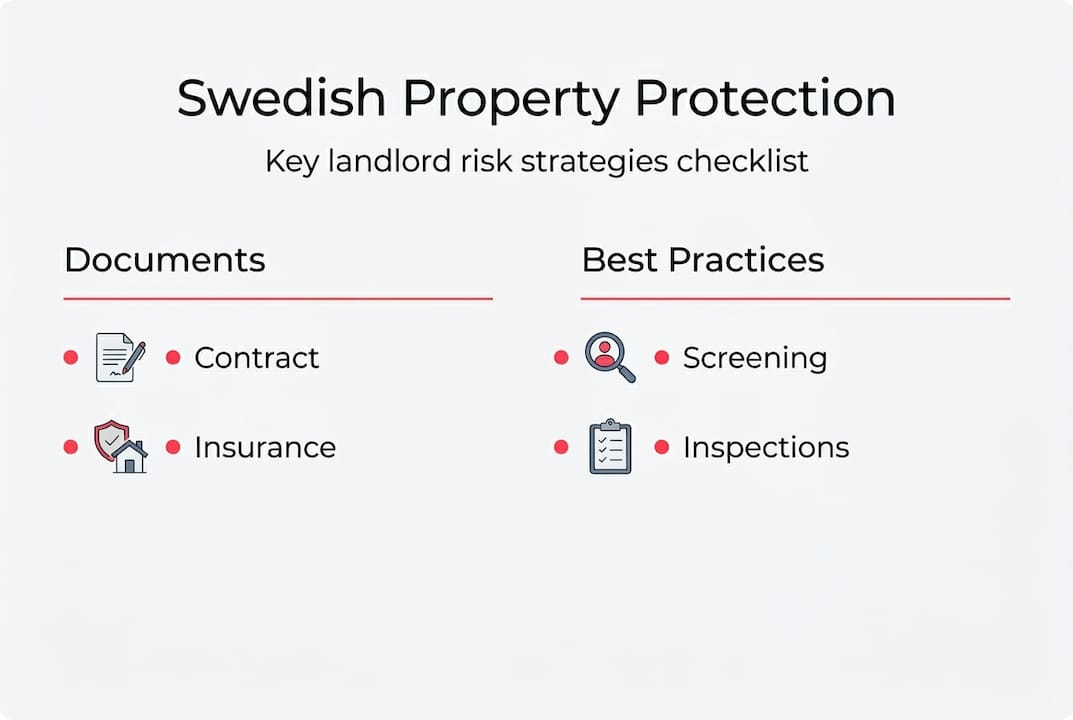
- Draft a written rental agreement compliant with Jordabalken 12 kap., including clauses on maintenance responsibilities, permitted use, noise restrictions, and smoking policy.
- Include a possession protection waiver (avstående från besittningsskydd) for private rentals to prevent tenants from claiming the right to remain after the contract ends.
- Require proof of tenant insurance (hemförsäkring) before handing over keys, and specify in the contract that this must be renewed and evidenced annually.
- Conduct and document a property inspection before the tenancy begins, with photographs and a written inventory signed by both parties.
- Collect a security deposit and document its purpose and conditions for return clearly in the agreement.
- Establish a maintenance log and provide tenants with written instructions for reporting issues promptly.
Insurance deserves particular attention. Many landlords assume their standard home insurance policy covers all tenant-related risks. It does not. Standard home insurance in Sweden frequently excludes theft or intentional damage caused by tenants, leaving the property owner personally exposed. The comparison below illustrates the critical differences:

| Insurance type | Covers accidental tenant damage | Covers tenant theft | Covers liability claims | Annual cost range |
|---|---|---|---|---|
| Standard home insurance | Partially | Rarely | Sometimes | 2,000–5,000 SEK |
| Landlord-specific insurance | Yes | Often | Yes | 4,000–9,000 SEK |
| Tenant’s own hemförsäkring | N/A | N/A | Yes (third-party) | 1,500–3,500 SEK |
Requiring tenants to hold their own hemförsäkring does not replace the need for landlord-specific coverage. An uninsured tenant is personally liable for damages they cause, but collecting that money in practice can be extremely difficult, particularly if the tenant has limited assets. Annual verification of their insurance is therefore not optional; it is a contractual requirement you enforce.
Pro Tip: Ask for a copy of the tenant’s insurance certificate at the start of each renewal period and store it alongside the signed contract. A simple calendar reminder each year prevents this critical check from being overlooked.
Reviewing the rental agreement essentials for premium properties and using a thorough prep checklist for landlords ensures that nothing critical is missed before the tenancy begins.
Screen tenants and structure your agreement for maximum protection
Documents are necessary, but selecting the right tenant and setting strict terms makes all the difference in daily risk exposure. Tenant screening for premium properties requires a structured, consistent approach that goes beyond a quick reference call.
Effective screening for premium rental properties should include:
- Credit and income verification through UC (Upplysningscentralen) or equivalent credit check services
- Employment confirmation via a letter from the employer or signed contract, verifying both stability and income level
- Previous landlord references with specific questions about payment history, property care, and compliance with house rules
- Identity verification to confirm the applicant is who they claim to be
- Written declaration of the intended use of the property, including the number of occupants
For corporate lettings, the process differs slightly. When a company is the contracting party, verify the organisation’s registration and financial standing through Bolagsverket. Corporate tenant agreements require specific clauses that reflect the commercial nature of the arrangement and the potential for rotating occupants.
Once you have selected a tenant, the agreement itself must close every foreseeable loophole. The key clauses to include are:
- A clear prohibition on subletting, short-term re-letting (including Airbnb), or hosting undisclosed occupants
- An explicit smoking ban, covering both indoors and any private outdoor areas such as balconies
- A noise policy with reference to permitted hours and consequences for breach
- A maintenance responsibility schedule distinguishing between tenant duties (e.g., keeping drains clear) and landlord obligations
- The possession protection waiver (avstående från besittningsskydd), which must be signed separately and in advance to be legally valid under Jordabalken
- A clause requiring the tenant to notify the landlord within 24 hours of any damage, leak, or maintenance issue
“Tenant-focused legal sources emphasise the landlord’s statutory duties, while landlord guides consistently stress the importance of waivers and thorough screening to counter the strong default protections tenants hold under Swedish law.”
Pro Tip: The possession protection waiver must be signed before the tenancy begins, not at the same time as the main contract. Courts have invalidated waivers signed simultaneously with the lease, so timing matters. Consult a property lawyer to confirm the process is correctly followed.
Avoiding the common landlord mistakes that Swedish first-time landlords make often comes down to these precise procedural details, which are easy to overlook but costly to ignore.
Know how to enforce rights and resolve problems
Even detailed agreements and careful screening cannot eliminate all risk, so be prepared to act decisively and legally when things go wrong. The moment you suspect a breach, the clock starts. Delayed action almost always makes the situation worse.
Follow this process when a problem arises:
- Document the issue immediately. Photograph damage, save written communications, and log dates and times of incidents or missed payments.
- Issue a formal written notice to the tenant specifying the breach, the remedy required, and the deadline for compliance. Send this by registered post and retain proof of delivery.
- Allow the statutory remedy period to pass. For non-payment of rent, this is typically two weeks from the notice date.
- If the breach continues, apply to Hyresnämnd for a termination order. Prepare all documentation, including the original contract, notices sent, and evidence of the breach.
- Once a termination order is granted, engage Kronofogdemyndigheten to execute the eviction if the tenant does not vacate voluntarily.
“The eviction process is non-negotiable in its sequence. Landlords who attempt shortcuts, such as changing locks, removing belongings, or cutting utilities, commit an offence under Brottsbalken 8:8 and may face prosecution regardless of the tenant’s conduct.”
Throughout this process, every communication must be written and retained. Verbal agreements or informal messages carry little weight in formal proceedings. The quality of your documentation directly determines the speed and success of your enforcement.
Pro Tip: Use a dedicated folder, either physical or digital, for each tenancy. Store the signed contract, inspection report, insurance certificates, payment records, and all correspondence in one place. If a dispute arises, this folder is your case file.
Understanding the full scope of Swedish rental processes and the eviction challenges in Sweden helps landlords set realistic expectations and avoid costly procedural errors.
What most landlords miss when protecting rental properties
Most guides focus heavily on the setup phase: the contract, the insurance, the screening process. That preparation is essential, but it is only half the work. The landlords who experience the fewest serious problems are those who treat property protection as an ongoing practice, not a one-time task.
Contracts do not self-enforce. A possession protection waiver signed three years ago does not protect you if you have never followed up on insurance renewals, conducted a single inspection, or maintained any written communication with the tenant. Swedish courts and Hyresnämnd look at the full picture of the landlord-tenant relationship, and a landlord who has been passive for years is in a weaker position than one who has maintained consistent, documented engagement.
Insurance coverage is another area where complacency is costly. Some specialist policies such as Hedvig Max offer up to 100,000 SEK in tenant damage coverage, but even these have conditions and exclusions that must be reviewed annually. Insurance products change, and a policy that was adequate in 2023 may have different terms in 2026. Annual verification of both your own policy and the tenant’s hemförsäkring is a non-negotiable routine.
Routine property inspections are perhaps the most undervalued tool in a landlord’s risk management approach. A walkthrough every six months, conducted with proper notice and documented with photographs, achieves three things simultaneously: it deters misuse, it catches maintenance issues before they become expensive, and it maintains an active landlord-tenant relationship that signals you are engaged and attentive. Tenants who know their landlord conducts regular inspections are statistically less likely to allow conditions to deteriorate.
Communication matters more than most landlord lessons acknowledge. A tenant who feels comfortable reporting a small leak promptly prevents a large water damage claim. A landlord who responds quickly to maintenance requests builds the kind of cooperative relationship that makes disputes far less likely. The practical reality is that most tenancy problems escalate because of silence, not conflict.
How Guestly Homes supports safer premium letting
Managing a premium rental property in Sweden requires consistent attention to legal compliance, documentation, tenant communication, and property condition. For many owners, that level of ongoing involvement is neither practical nor desirable.
Guestly Homes provides fully managed letting solutions designed specifically for premium Swedish properties. From compliant rental agreements and possession protection waivers to regular property inspections and annual insurance verification, every element of the risk management process is handled professionally and systematically. Owners benefit from flexible rental agreements structured to Swedish legal standards, without the administrative burden of managing them independently. Whether you prefer a revenue share partnership or a fixed-income arbitrage arrangement, Guestly Homes delivers property performance with the rigour that premium assets deserve.
Frequently asked questions
What legal documents do I need to rent my property in Sweden?
At a minimum, you need a written rental agreement compliant with Jordabalken 12 kap., including insurance clauses, maintenance responsibilities, and a separately signed possession protection waiver (avstående från besittningsskydd) for private rentals.
Can I evict a tenant immediately for non-payment?
No. You must follow a formal written notice process and, if required, escalate through Hyresnämnd and Kronofogdemyndigheten. Self-help eviction methods such as changing locks are illegal under Brottsbalken 8:8.
Who pays if a tenant causes damage without insurance?
An uninsured tenant is personally liable for damages they cause, but recovering that money in practice can be very difficult. Requiring annual proof of insurance is the most effective safeguard.
Is property theft by tenants covered by home insurance in Sweden?
Most standard home insurance policies in Sweden exclude theft or intentional damage caused by tenants, making landlord-specific insurance and mandatory tenant hemförsäkring essential components of your coverage strategy.