


Many first-time landlords in Sweden underestimate the complexity of rental income taxation and legal requirements. Rental income from private residences is taxed at 30% on surplus after deductions, and subletting condos requires housing association approval. This guide clarifies essential rental income rules, rental type options, and practical steps for managing your premium property efficiently. You will learn how to optimise tax benefits, compare long-term and short-term strategies, and navigate legal obligations to avoid costly mistakes.
Table of Contents
- Key takeaways
- Understanding tax implications for rental income in Sweden
- Comparing long-term and short-term rental options for premium homes
- Legal requirements and practical steps before renting out your property
- Optimising rental income and compliance for your premium property
- Explore premium properties with Guestly Homes
- Frequently asked questions
Key Takeaways
| Point | Details |
|---|---|
| Tax on surplus | Rental income from private residences is taxed at 30 per cent on the surplus after deductions. |
| Subletting approval required | Housing association approval is required before subletting a condo. |
| Tax relief and declarations | The standard deduction is SEK 40,000 per property, with an additional 20 per cent deduction for houses and condo association fees deductible. |
| Short term risk and VAT | Short term lets may attract higher revenue but may trigger VAT registration and different accounting treatment. |
Understanding tax implications for rental income in Sweden
Rental income from private residences is taxed as capital income at 30% on the surplus after deductions. This rate applies to net rental profit, not gross income. Swedish tax law provides a standard deduction of SEK 40,000 per property annually. Houses qualify for an additional 20% deduction on rental income, while condo owners can deduct association fees.
You must declare on Form K3, and losses on rental cannot offset other income. This restriction means negative rental results remain isolated from your other tax calculations. Short-term rentals may trigger VAT obligations if they become frequent or professional in nature. The distinction between occasional private rental and business activity matters significantly for tax treatment.
Pro Tip: Keep meticulous records of all rental-related expenses throughout the year. Mortgage interest, maintenance costs, property management fees, and insurance premiums are deductible. Track every receipt and invoice to maximise your allowable deductions and reduce taxable surplus.
Key deductions available to Swedish property owners:
- Standard deduction of SEK 40,000 per property
- Additional 20% of rental income for houses
- Condo association fees for apartment owners
- Mortgage interest payments on the property
- Maintenance and repair costs
- Property management and letting agent fees
- Insurance premiums for landlord coverage
| Deduction type | Amount | Applies to |
|---|---|---|
| Standard deduction | SEK 40,000 | All rental properties |
| Additional deduction | 20% of income | Houses only |
| Association fees | Actual cost | Condos only |
| Mortgage interest | Actual cost | All properties |
Understanding these rules helps you calculate realistic net returns. If your gross rental income is SEK 200,000 annually, you can deduct SEK 40,000 standard plus SEK 40,000 (20% for a house), leaving SEK 120,000 taxable at 30%, resulting in SEK 36,000 tax. Your net income becomes SEK 164,000 before other expenses. This calculation demonstrates why avoiding rental tax pitfalls requires careful planning. Short-term rentals complicate matters further if they cross into business territory, potentially requiring VAT registration and different accounting treatment. Always consult a tax adviser before committing to a rental strategy, especially if you plan frequent short-term lets.

Comparing long-term and short-term rental options for premium homes
Long-term rentals provide stable income and easier management. You sign a contract for 12 months or more, receive predictable monthly payments, and face fewer turnovers. Tenant screening happens once, and ongoing maintenance remains minimal. This approach suits owners seeking passive income without daily involvement.
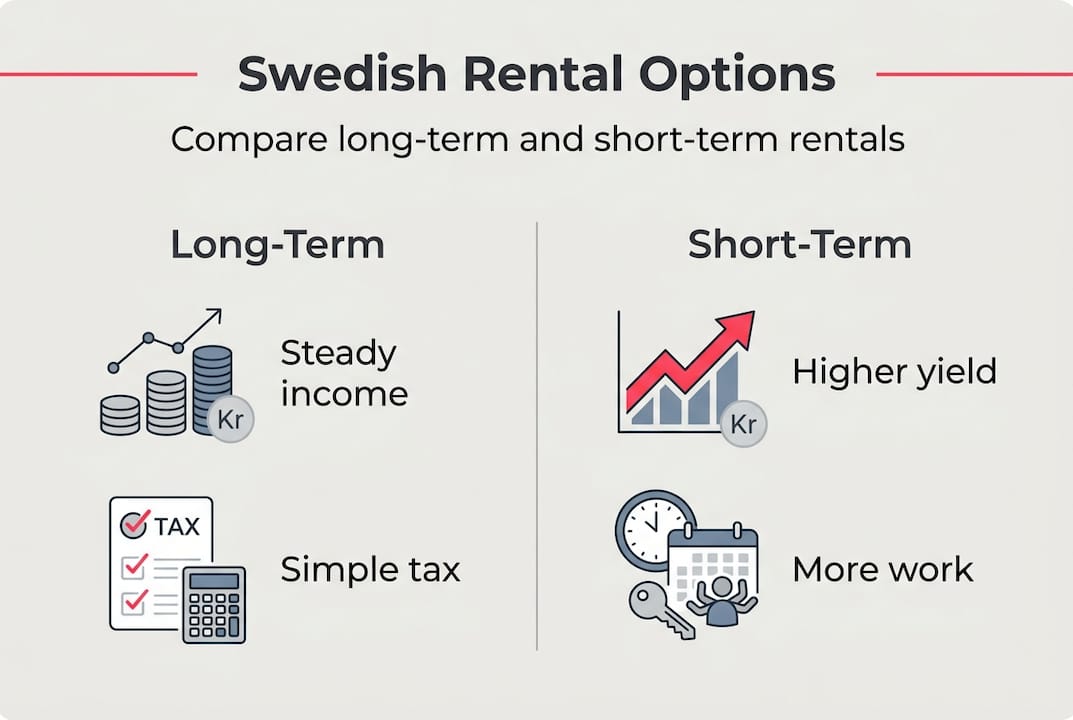
Short-term rentals yield higher revenue but come with volatility and higher costs. Short-term rentals average annual revenue of €25,943 (approximately SEK 290,000) with 58.75% occupancy across Sweden. Stockholm performs better at €30,783 per year. Premium homes suit furnished short-term rentals targeting expats, tourists, and business travellers who pay premium rates for quality.
| Rental type | Average annual income | Occupancy rate | Management effort | Tax complexity |
|---|---|---|---|---|
| Long-term | SEK 180,000-240,000 | 95-100% | Low | Simple |
| Short-term | SEK 290,000-350,000 | 58-75% | High | Complex |
| Mid-term | SEK 220,000-280,000 | 75-85% | Medium | Moderate |
The choice between strategies depends on your goals. Long-term rentals are simpler and predictable, while short-term rentals offer higher potential but volatile occupancy and VAT or business tax risks. Premium properties in central Stockholm or Gothenburg command higher nightly rates, making short-term letting financially attractive despite the workload.
Pro Tip: Consider seasonal patterns when choosing your strategy. Stockholm sees peak tourism from May to September, with occupancy rates climbing above 75%. If you want personal use during summer, opt for long-term rentals with fixed terms ending in spring. This timing maximises income while preserving flexibility.
Key considerations for each rental type:
- Long-term: Lower turnover costs, stable cash flow, minimal marketing
- Short-term: Dynamic pricing opportunities, higher gross yields, frequent cleaning
- Mid-term: Balance of stability and flexibility, appeals to relocating professionals
- Corporate housing: Premium rates, reliable bookings, professional tenants
VAT and business tax risks emerge when short-term rentals become frequent or professional. If you rent your property more than occasionally, Swedish tax authorities may classify it as business income rather than capital income. This reclassification triggers VAT registration requirements and different tax treatment. The threshold remains unclear, but consistent weekly bookings throughout the year likely cross into business territory. Mixing strategies can help: rent long-term for nine months, then switch to short-term during peak season. This approach optimises income while maintaining clarity on tax treatment. Explore premium short-term rental comparison to understand market positioning. Professional management of Swedish rental properties eliminates daily hassles while preserving income potential.
Legal requirements and practical steps before renting out your property
Condo owners must obtain housing association approval before subletting. This requirement applies to bostadsrätt properties, which represent most apartments in Swedish cities. Associations can refuse permission or impose conditions. Legal maximum rent for furnished units is your own cost plus 10-15%. This calculation includes mortgage payments, association fees, and maintenance costs. Exceeding this limit risks legal challenges from tenants.
Use specialised platforms for drafting contracts and conducting tenant checks. Services like Bofrid provide legally compliant rental agreements tailored to Swedish law. First-time landlords should use platforms for contracts and tenant screening, document everything, and secure landlord insurance. Tenant screening verifies income, employment, and rental history. This process reduces risks of non-payment or property damage.
Pro Tip: Conduct a thorough besiktning (property inspection) with photos before tenants move in. Document every room, fixture, and surface condition. Store these records digitally with timestamps. This evidence proves invaluable if disputes arise about damage or wear during the tenancy.
Essential legal and practical steps:
- Obtain housing association consent for condo subletting
- Calculate maximum allowable rent based on your costs
- Draft legally compliant rental contracts
- Screen tenants for income and rental history
- Document property condition with dated photographs
- Purchase comprehensive landlord insurance
- Register with Skatteverket for rental income reporting
- Establish clear communication channels with tenants
Landlord insurance protects against tenant damage, non-payment, and liability claims. Standard home insurance does not cover rental activities. Purchase a policy specifically designed for landlords before accepting your first tenant. Premiums typically cost SEK 2,000-4,000 annually for comprehensive coverage.
Practical first steps before renting:
- Contact your housing association for subletting approval if applicable
- Calculate your maximum allowable rent based on actual costs
- Prepare the property: deep clean, minor repairs, safety checks
- Take comprehensive photographs of every room and surface
- Draft or obtain a legally compliant rental contract
- List the property on appropriate platforms or engage an agent
- Screen potential tenants thoroughly before signing
- Conduct move-in inspection and document condition jointly
- Establish payment methods and communication protocols
- Register rental income with Skatteverket and set aside tax reserves
These steps create a foundation for successful rental management. Managing rental risks in Sweden requires proactive planning rather than reactive problem-solving. Understanding rental pitfalls and insurance protects your investment and peace of mind. Professional property managers handle these tasks systematically, reducing your workload while ensuring compliance. Consider whether self-management or professional services better suit your situation and goals.
Optimising rental income and compliance for your premium property
Mixing furnished long-term and seasonal short-term lets enhances income and tax benefits. Rent your property on a 10-month contract from September to June, then switch to short-term bookings during summer peak season. This strategy captures stable base income while maximising revenue during high-demand periods. The approach keeps you below business activity thresholds while optimising returns.
Standard deductions include SEK 40,000 per property plus 20% of rental income for houses. Calculate your tax position before committing to rental strategies. If you earn SEK 300,000 gross from rentals on a house, you deduct SEK 40,000 standard plus SEK 60,000 (20%), leaving SEK 200,000 taxable at 30%. Your tax bill becomes SEK 60,000, with net income of SEK 240,000 before expenses.
Pro Tip: Track occupancy trends monthly and adjust pricing dynamically. Stockholm averages 58.75% occupancy, but premium properties in Östermalm or Vasastan achieve 70-80% with proper marketing. Use data from comparable properties to set competitive rates that maximise both occupancy and revenue per night.
| City | Gross rental yield | Net rental yield | Average annual income |
|---|---|---|---|
| Stockholm | 3.5% | 2.0% | SEK 245,000 |
| Gothenburg | 4.2% | 2.7% | SEK 210,000 |
| Malmö | 6.0% | 4.5% | SEK 180,000 |
| Uppsala | 4.8% | 3.3% | SEK 165,000 |
Gross rental yields vary from 3.5% in Stockholm to 6% in Malmö, with net yields dropping approximately 1.5 percentage points after costs. These figures reflect long-term rental scenarios. Short-term rentals can achieve higher gross yields but incur greater operating expenses for cleaning, utilities, and management.
Strategies for optimising rental income:
- Furnish properties to premium standards for higher nightly rates
- Target corporate clients and relocated professionals for mid-term stability
- Adjust pricing seasonally based on demand patterns
- Minimise vacancy periods through advance booking strategies
- Maintain property condition to justify premium positioning
- Use professional photography and detailed listings to attract quality tenants
- Implement dynamic pricing tools for short-term rentals
- Bundle services like cleaning and concierge for corporate bookings
Benchmark your property against comparable listings. Up to SEK 3,333 monthly income remains tax-free through standard deductions (SEK 40,000 divided by 12 months). Optimisation becomes possible by mixing rental types strategically. A booking workflow for furnished homes streamlines operations and reduces administrative burden. Understanding extended stays in Sweden opens opportunities for mid-term rentals that balance stability with flexibility.
Track key performance indicators monthly: occupancy rate, average daily rate, revenue per available night, and operating expense ratio. These metrics reveal whether your strategy delivers expected returns. Adjust tactics quarterly based on performance data and market conditions. Premium properties require premium management to justify their positioning and capture maximum value.
Explore premium properties with Guestly Homes
If managing rental properties feels overwhelming, consider professional operators who handle everything. Guestly Homes specialises in premium serviced apartments and villas across Sweden, offering fully managed solutions for property owners. We operate two models: revenue share partnerships and fixed-rent arbitrage agreements. Both deliver predictable income without daily involvement.
Our portfolio includes exceptional properties like this executive premium suite designed for professionals seeking extended stays. For larger groups or families, explore our grand villa with garden that combines space with premium amenities. Corporate clients appreciate our business villa with 5 bedrooms for team accommodation during projects.
We handle guest screening, property maintenance, cleaning, and all operational details. You receive consistent income while we maintain hotel-grade standards. Our approach suits owners who value professional management over self-operation. Explore our properties to understand the quality standards we deliver and how partnership models create value for premium property owners.
Frequently asked questions
What do I need to know before renting out my property?
Understand tax obligations, legal requirements, and time commitments before starting. Rental income is taxed at 30% after deductions, and condo owners need association approval. Calculate realistic net returns after expenses like insurance, maintenance, and potential vacancy periods. Document everything and secure proper landlord insurance from day one.
Do I have to pay tax on rental income in Sweden?
Yes, rental income is taxed at 30% on surplus after allowable deductions. You must declare income on Form K3 annually. Standard deduction is SEK 40,000 per property, with additional deductions for houses and condo fees. Losses on rental cannot offset other income categories. Short-term rentals may trigger VAT if classified as business activity.
Is short-term renting better than long-term for premium homes?
Short-term rentals yield higher revenue but require more management and carry regulatory risks. Stockholm averages SEK 310,000 annually for short-term lets versus SEK 220,000 for long-term. Long-term rentals provide stable income with minimal involvement. Premium homes suit both strategies depending on your goals: choose short-term for maximum income or long-term for simplicity.
What legal permissions do I need to rent out a condo?
You must obtain housing association approval before subletting any bostadsrätt property. Associations can refuse or impose conditions on subletting. Maximum allowable rent is your own costs plus 10-15% if furnished. This includes mortgage, association fees, and maintenance. Exceeding this limit risks legal challenges. Always secure written approval before advertising your property.