


Every Swedish HR lead knows the challenge of securing reliable long-term stays for teams in cities like Piteå, Luleå, Boden, and Nyköping. Local Airbnb property owners navigate complex regulations, seasonal competition, and strict condominium rules, making it vital to understand how professional hosts distinguish themselves in the market. This guide offers clear insights into premium accommodation strategies and features that matter for team stays, highlighting what sets successful Swedish hosts apart in the short-term rental landscape.
Table of Contents
- Airbnb Listings Explained for Swedish Owners
- Income Patterns, Seasonality and Competition
- Guest Risks: Screening, Damage and Complaints
- Managing the Hidden 24/7 Hosting Workload
- Comparing Airbnb to Professional Operators
Key Takeaways
| Point | Details |
|---|---|
| Understanding Regulations | Swedish property owners should familiarise themselves with local regulations and condominium restrictions before listing on Airbnb. |
| Maximising Revenue Potential | Professional hosts use dynamic pricing strategies and technology to effectively respond to seasonal demand fluctuations and market competition. |
| Importance of Property Features | Listings with high-quality photos, clear descriptions, and flexible cancellation policies attract more bookings and enhance performance. |
| Operational Excellence | Successful hosting requires structured processes and technology for effective communication, maintenance coordination, and guest experience management. |
Airbnb Listings Explained for Swedish Owners
Navigating the Swedish short-term rental market requires strategic understanding. Property owners considering Airbnb face a complex landscape of regulations, market dynamics, and performance considerations. Revenue patterns in Swedish regions reveal nuanced opportunities for successful hosting.
Key considerations for Swedish Airbnb listings include:
- Condominium restrictions from housing associations
- Regional variations in occupancy rates
- Seasonal pricing strategies
- Local market competition
- Compliance with municipal short-term rental guidelines
Professional hosts differentiate themselves through specific strategies. They typically offer winter-ready amenities, maintain swift communication channels, and position their nightly rates strategically between 1,000 to 1,500 SEK. Understanding these market dynamics is crucial for potential hosts.
Property Features Matter
Successful listings correlate directly with specific property attributes. Research indicates that the number of bedrooms, bathrooms, available photos, and flexible cancellation policies significantly impact rental performance. Properties with comprehensive, transparent presentations tend to generate more consistent bookings.
Professional Swedish hosts outperform average listings by understanding micro-market dynamics and guest expectations.
The Swedish Airbnb market presents both opportunities and challenges. As of 2026, approximately 95,000 active listings exist, predominantly featuring entire homes in popular leisure regions. Hosts must navigate complex local regulations while maintaining competitive pricing and service quality.
Pro tip: Invest time in understanding your specific local housing association rules before listing your property on Airbnb to avoid potential legal complications.
Income Patterns, Seasonality and Competition
The Swedish short-term rental market exhibits complex income patterns heavily influenced by seasonal variations and competitive dynamics. Host professionalism significantly impacts pricing strategies, revealing nuanced approaches to revenue generation across different market segments.
Key income and competition characteristics include:
- Pronounced seasonal demand fluctuations
- Significant price variations during peak periods
- Different strategies between professional and casual hosts
- Regional variations in occupancy rates
- Complex competitive landscape
Professional Hosting Dynamics
Professional hosts demonstrate sophisticated market positioning by leveraging seasonal demand more effectively than casual operators. Research indicates large-scale hosts can strategically manage pricing and availability, reducing internal competitive pressures and maximising revenue potential.
Successful Airbnb hosts in Sweden understand that seasonality is not a challenge, but an opportunity for strategic pricing.
Seasonal Market Segmentation
Seasonal host behaviour in urban markets reveals distinct patterns between leisure and business travel periods. While leisure seasons show relatively uniform pricing, business travel demonstrates more pronounced competitive strategies, with professional hosts exhibiting more refined market approaches.
Understanding these intricate market dynamics requires continuous monitoring of local trends, occupancy rates, and competitive positioning. Hosts must remain adaptable, using data-driven insights to optimise their rental strategies.
Pro tip: Develop a flexible pricing strategy that accounts for seasonal variations, using dynamic pricing tools to automatically adjust rates based on local demand trends.
Guest Risks: Screening, Damage and Complaints
Property owners on Airbnb face significant challenges related to guest screening, potential property damage, and complaint management. Safety and security measures remain critical for minimising risks in peer-to-peer accommodation platforms.
Key risks for property owners include:
- Inadequate guest background verification
- Potential property damage
- Disputed damage claims
- Neighbourhood disturbances
- Complex complaint resolution processes
Screening and Verification Challenges
Most Airbnb platforms provide limited guest screening mechanisms, leaving property owners vulnerable to potential risks. Effective risk mitigation requires proactive strategies beyond platform-provided verification, including detailed communication, thorough house rules, and comprehensive documentation.
Trust-building mechanisms are essential in managing guest-related risks effectively.
Damage Claim Complexities
European damage claim processes reveal significant challenges for hosts attempting to recover repair costs. Many hosts encounter difficulties with vague evidence, delayed processing, and potential disputes over actual damage extent.

Navigating these risks requires a systematic approach, including detailed property documentation, clear communication of expectations, and robust evidence collection techniques. Professional hosts develop comprehensive strategies to minimise potential conflicts and protect their property investments.
Pro tip: Create a comprehensive property condition checklist with photographic evidence before and after each guest stay to protect yourself against potential disputed damage claims.
Managing the Hidden 24/7 Hosting Workload
Airbnb hosting demands far more than simply listing a property. Remote management requires structured processes and sophisticated operational strategies that extend well beyond traditional rental approaches.
Key workload management challenges include:
- Constant guest communication
- Immediate response requirements
- Complex scheduling logistics
- Maintenance and cleaning coordination
- Emergency management protocols
Operational Intensity
Professional hosts quickly discover that Airbnb management is a full-time commitment. The platform’s expectations create a relentless operational environment where responsiveness, quality, and immediate problem-solving become critical success factors.
Successful hosting is not about property ownership, but continuous operational excellence.
Professionalization of Hosting
Platform hosting increasingly resembles business operations, with large-scale operators developing specialised teams and advanced software to manage complex workloads. This shift transforms individual property management into sophisticated, technology-enabled service delivery.
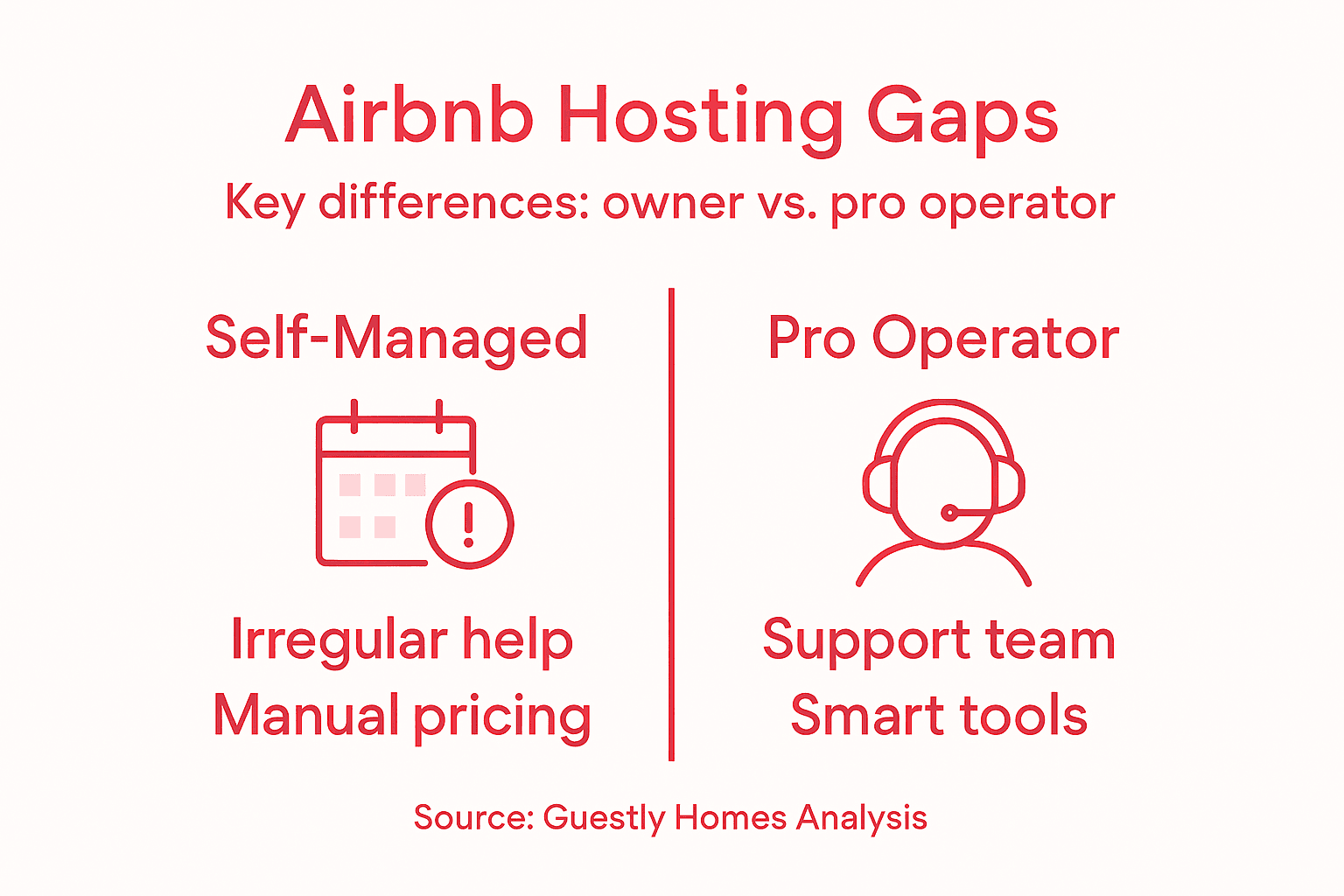
Navigating these challenges requires robust systems, technology integration, and strategic partnerships that can absorb the continuous operational demands of short-term rentals. Professional hosts invest in automation, reliable local support teams, and comprehensive communication infrastructures.
This table summarises critical operational workload differences in Airbnb hosting:
| Task | Professional Approach | Self-Managed Approach |
|---|---|---|
| Guest Communication | Dedicated staff or systems | Owner handles directly |
| Maintenance & Cleaning | Outsourced teams, scheduled | Ad-hoc, owner-arranged |
| Emergency Response | Automated protocols | Manual, reactive |
| Process Documentation | Standard operating procedures | Informal, limited documentation |
Pro tip: Develop a comprehensive standard operating procedure manual and invest in property management software to streamline communication, booking, and maintenance processes.
Comparing Airbnb to Professional Operators
The landscape of short-term rentals has dramatically transformed, with professional hosts increasingly dominating urban markets. This shift represents a fundamental change from individual property owners to sophisticated, commercial rental operations.
Key distinctions between amateur and professional operators include:
- Scale of property management
- Marketing and technological capabilities
- Operational efficiency
- Revenue optimization strategies
- Systematic approach to guest experience
Operational Sophistication
Professional operators leverage economies of scale, developing comprehensive management systems that individual hosts cannot easily replicate. They invest in advanced technologies, standardised processes, and dedicated support teams to streamline operations and maximise rental performance.
Professional hosting is less about individual properties and more about creating systematic, replicable hospitality experiences.
Market Transformation
Airbnb’s platform increasingly supports commercial interests, creating uneven opportunities that favour well-resourced operators. This commercialisation fundamentally alters the short-term rental landscape, pushing smaller, amateur hosts towards increasingly competitive market conditions.
Successful property owners must recognise these shifts, understanding that modern short-term rentals require more than just a available space—they demand professional-grade management, technological integration, and strategic market positioning.
Here’s a concise summary of professional versus amateur Airbnb hosting in Sweden:
| Aspect | Professional Hosts | Amateur Hosts |
|---|---|---|
| Property Management | Multiple properties, structured teams | Single property, self-managed |
| Technology Integration | Uses booking and management software | Relies on basic platform tools |
| Pricing Strategy | Data-driven, adjusts seasonally | Simple, often static pricing |
| Guest Experience | Consistent, standardised service | Varied, informal approach |
| Revenue Performance | Higher, maximises market potential | Lower, susceptible to local shifts |
Pro tip: Consider partnering with professional management services that can provide technological infrastructure, marketing expertise, and operational support to compete effectively in the evolving short-term rental market.
Experience Seamless Property Management Beyond Airbnb Challenges
Many Swedish property owners listing on Airbnb face complexities such as fluctuating seasonal demand, regulatory hurdles, and the intense 24/7 hosting workload. The article highlights crucial pain points including risk management, inconsistent income, and operational intensity that can overwhelm those managing properties independently. If you recognise the struggle to balance guest expectations with administrative burdens and want predictable, high-margin returns without the constant hassle, it is time to explore a smarter approach.
At Guestly Homes, we specialise in transforming premium properties into thriving, fully managed homes designed for extended stays—taking stress off your shoulders while maximising your property’s potential. Our tailored Revenue Share and Arbitrage Models provide property owners with hands-off management, consistent profitability, and trusted 5-star service standards. Through strategic market understanding and professionalised operational excellence, Guestly Homes seamlessly navigates the challenges that often trip up the average Airbnb host.
Discover how effortless hosting can be when you partner with a dedicated operator. Visit Guestly Homes to learn about our Revenue Share Model and Arbitrage Model designed specifically for property owners seeking stability and growth without compromise.
Take control of your short-term rental journey now and move beyond the pitfalls of traditional listings. Explore our solutions at Guestly Homes and unlock a new standard of hassle-free property performance with a trustworthy partner by your side.
Frequently Asked Questions
What are the key considerations for listing a property on Airbnb?
Key considerations include understanding local regulations, addressing condominium restrictions, implementing seasonal pricing strategies, and maintaining competitive rates while ensuring compliance with municipal guidelines.
How can property owners enhance their Airbnb listings for better performance?
Owners can enhance their listings by providing detailed descriptions, high-quality photos, flexible cancellation policies, and additional amenities that appeal to guests, especially for different seasons.
What are the challenges of guest screening on Airbnb?
Challenges include limited background verification within the platform, which can expose hosts to risks such as property damage or complaints. Hosts should implement thorough house rules and direct communication to mitigate these risks.
How can hosts manage the operational workload of Airbnb hosting effectively?
Effective management of hosting workload involves developing structured processes, investing in property management software, and possibly outsourcing cleaning and maintenance tasks to streamline operations.