

TL;DR:
- Long work assignments demand careful planning of team comfort to prevent morale issues and burnout. Assess individual preferences early, ensure high-quality accommodation, and structure daily routines to support well-being and productivity. Regular feedback and proactive logistics management help teams remain cohesive and effective throughout extended durations.
Long work assignments place significant demands on teams. When people are away from home for weeks or months at a time, the question of how to keep teams comfortable during long work assignments becomes an operational priority, not a nice-to-have. Discomfort compounds quickly: poor sleep, inadequate meals, and unclear boundaries between work and rest erode focus, lower morale, and accelerate turnover. This guide offers practical, field-tested strategies for HR professionals, project managers, and team coordinators who need to get this right from day one.
Table of Contents
- Key takeaways
- How to keep teams comfortable during long work assignments: the preparation phase
- Accommodation quality: privacy, shared spaces, and amenities
- Supporting daily comfort: meals, transport, and routines
- Managing long work hours: communication and burnout prevention
- Evaluating comfort success and iterating throughout
- My perspective on what actually changes team outcomes
- How Guestlyhomes supports teams on long assignments
- FAQ
Key takeaways
| Point | Details |
|---|---|
| Assess comfort needs early | Gather individual preferences before the assignment begins to avoid preventable friction. |
| Accommodation quality drives morale | Private spaces, functional kitchens, and laundry access are non-negotiable for extended stays. |
| Structure daily rhythms | Consistent routines with built-in breaks and downtime protect focus and prevent burnout. |
| Monitor hours, not just output | Structured monitoring reduces excessive working hours and supports sustained team productivity. |
| Feedback loops matter | Regular check-ins and iterative adjustments keep comfort strategies aligned with real team needs. |
How to keep teams comfortable during long work assignments: the preparation phase
Most comfort failures on long assignments begin before the work even starts. The team arrives to find accommodation that does not match expectations, logistics that were never confirmed, or no shared understanding of how the weeks ahead will be structured. Fixing those problems after arrival costs time, trust, and energy that teams cannot afford to spend.
The first step is a comfort preference assessment. Before finalising any logistics, ask each team member directly about their priorities. Some people need a private room above everything else. Others care most about reliable internet or proximity to a gym. Understanding individual work styles and comfort preferences means people feel heard before the assignment begins, which sets a productive tone from the outset.
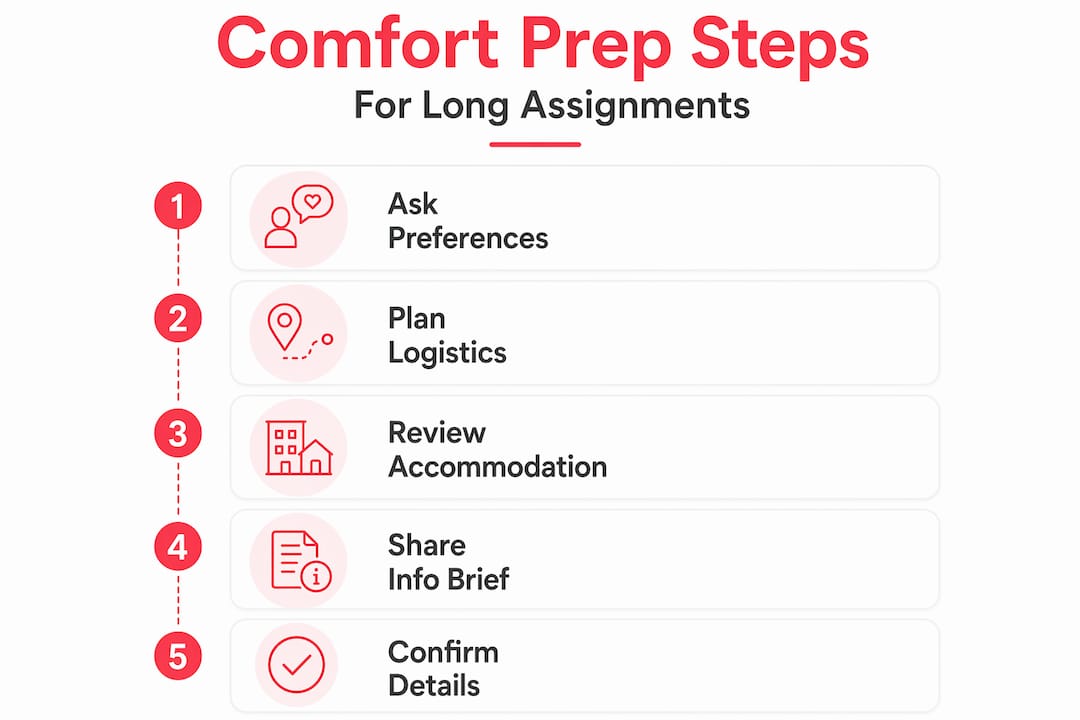
Once you have individual input, establish shared expectations across the group. Define how communication will work, when working hours begin and end, and what the process is for raising concerns. Written norms matter here. Written-first communication cultures reduce the anxiety that comes from ambiguity and ensure no one feels excluded from important decisions.
Cover these four comfort factors before departure:
- Living quarters: Private sleeping space with adequate light, ventilation, and temperature control
- Privacy: Clear boundaries within shared accommodation so people can decompress alone
- Food access: A functional kitchen or reliable meal provision within easy reach
- Transport: Confirmed arrangements that remove daily uncertainty about getting to and from the worksite
Pro Tip: Create a one-page pre-assignment comfort brief for each team member. Include accommodation details, transport arrangements, meal options, and the name of the contact person for any issues. It takes twenty minutes to prepare and eliminates dozens of questions on arrival.
For guidance on booking long-term team accommodation effectively, it is worth reviewing your options early and involving your accommodation provider in the planning conversation.
Accommodation quality: privacy, shared spaces, and amenities
The quality of where your team sleeps and recovers is the single biggest variable in long-assignment wellbeing. Hotels work for three nights. For three weeks or three months, teams need something closer to a home.
The distinction matters practically. A hotel room offers no space to cook, no laundry, and nowhere to sit except a desk or a bed. A well-chosen serviced apartment or villa provides the conditions for genuine rest and recovery. That difference shows up directly in how people perform.
Here is how accommodation quality affects key comfort dimensions:
| Accommodation feature | Impact on team comfort |
|---|---|
| Private bedrooms | Protects sleep quality and psychological recovery |
| Shared kitchen | Reduces meal costs, supports healthier eating, creates informal connection |
| In-unit laundry | Removes a persistent low-level stressor from daily life |
| Communal living area | Provides a space for informal interaction without work pressure |
| Ergonomic workspace | Supports focused work without physical strain |
| Reliable high-speed internet | Removes technical friction that disrupts productivity and causes frustration |
When selecting accommodation, look beyond the headline specification. A five-bedroom property with one bathroom will create daily friction regardless of how well-appointed the rest of the space is. Confirm bathroom-to-person ratios, kitchen equipment, and whether the washing machine can realistically handle a full team’s laundry load across a working week.
Managing shared spaces deserves specific attention. Even in a well-chosen property, communal areas can become a source of tension if expectations are not set clearly. Agree on cleaning responsibilities, quiet hours, and how the kitchen is shared before anyone arrives. Small, practical agreements prevent the kind of low-level friction that, over weeks, quietly undermines team morale.
For the working environment within the property, consider ergonomics seriously. A kitchen chair at a dining table is not a sustainable workspace for eight-hour days. Where possible, arrange for proper desk chairs and adequate desk space, or confirm that the accommodation provider has already accounted for this. For practical guidance on maximising guest comfort in a corporate housing context, the specifics of layout and furnishing make a measurable difference.
Supporting daily comfort: meals, transport, and routines
Operational logistics are where good intentions either hold or collapse. A team that cannot get a decent meal without a forty-minute detour, or that faces an unreliable commute every morning, will absorb that stress into their working day. The cumulative effect is significant.
On nutrition, the goal is reducing decision fatigue while supporting genuine choice. Small, repeated rituals such as a shared breakfast before work or a standing evening meal rotation build belonging without adding pressure. Where a shared kitchen is available, coordinate a basic provisioning arrangement so the fridge is stocked on arrival. Where it is not, identify two or three reliable nearby options and share them with the team before they land.
Transport deserves the same level of pre-planning. The daily commute is a compounding stressor. Unreliable public transport, expensive daily taxis, or a team member left waiting in the cold at 07:00 each morning erodes morale in a way that is disproportionate to its apparent scale. Arrange a consistent transport solution, whether that is a shared vehicle, a travel pass, or a confirmed car hire arrangement, and confirm it is in place before the assignment starts.

Pro Tip: Schedule transport logistics as a formal line item in your assignment planning process, not an afterthought. Confirm the arrangement in writing with the provider at least two weeks before departure.
For daily rhythm, structure matters more than many managers realise. Teams on long assignments lose the natural cadence of home life, and without a deliberate replacement, working hours expand and rest contracts. Build a working day that protects:
- A consistent start and finish time, agreed collectively
- At least two genuine breaks during the working day, away from screens
- Time for physical activity, whether a morning walk, access to a gym, or a group stretch
- An evening that is genuinely free from work communication
For additional guidance on organising smooth extended stays at team scale, operational planning in advance reduces the number of in-assignment corrections required.
Managing long work hours: communication and burnout prevention
Extended assignments and extended working hours are not the same thing. One is a location arrangement. The other is a health risk. The distinction gets blurred when teams are living together, always near one another, and without the natural separation that a commute home provides.
Research is clear on the direction of travel. Every 0.1 increase in structured monitoring of production processes associates with a 7.7% reduction in workers exceeding 50 hours per week. Structure protects people. Ambiguity expands into their personal time.
Use this framework to manage working hours actively:
- Set a daily focus limit. The 6-4-2 formula recommends six hours of deep, interruption-free work per day for sustained output without burnout. Build your schedule around this, not around filling every available hour.
- Implement a written right-to-disconnect policy. Written policies outperform culture-only approaches in preventing off-hours work intrusion. Put it in writing, communicate it clearly, and enforce it.
- Train managers in trust-based communication. 70% of remote team engagement is attributable to managerial behaviour. A manager who sends messages at 22:00 and expects replies is undermining every other comfort measure in place.
- Prepare teams for interpersonal friction. NASA’s operational psychologists treat long-term teamwork under pressure as an expedition skill that requires specific conflict de-escalation training. Bring in that preparation before, not during, the assignment.
- Recognise burnout signals early. Withdrawal from team communication, persistent fatigue, and declining work quality are the earliest visible signs. Address them in a private conversation, not a performance review.
For teams where conflict management and communication are already stretched, specialist coaching in those areas before a long assignment begins pays returns across the entire duration.
Evaluating comfort success and iterating throughout
Comfort strategies need feedback to stay relevant. What worked in week one may not work in week six. Teams change, pressures shift, and accommodation issues that seemed minor can grow into real friction points if left unaddressed.
Build a simple, regular feedback rhythm. The most effective approach combines short weekly pulse surveys with brief individual check-ins, alternating between the two so that people are not experiencing survey fatigue but are never more than a fortnight away from a genuine conversation. Consistent feedback loops and psychological safety drive the results that one-off interventions cannot.
Watch these indicators alongside what people tell you:
- Attendance at optional team activities (a drop signals disengagement before it shows up in work quality)
- Response times to non-urgent communications (lengthening gaps can indicate withdrawal)
- Physical energy levels observed during team meetings
- Kitchen and communal area usage (a team that stops gathering informally is a team under stress)
When feedback surfaces a genuine problem, move on it quickly. Changing accommodation mid-assignment is disruptive, but leaving a team in a property that is not working for them is more disruptive over time. Engaged teams outperform disengaged ones by 21% in profitability. That figure represents the value of getting comfort right, not just the cost of getting it wrong.
Celebrate what is working. Acknowledge effort, mark milestones within the assignment, and make sure individual contributions are recognised. These acts do not require budget. They require attention, which is the one resource managers always have available.
My perspective on what actually changes team outcomes
I’ve spent considerable time working alongside HR teams and project managers who are responsible for keeping people performing in conditions that are genuinely difficult. What I’ve learned is that most comfort failures are not caused by bad intentions. They are caused by treating comfort as a secondary concern, something to sort out once the real logistics are in place.
In my experience, the teams that come out of long assignments intact are almost always the ones whose managers treated the living arrangement as part of the operational brief, not separate from it. The accommodation was chosen as deliberately as the project team itself. The daily schedule was designed with recovery in mind. The communication norms were set before departure, not negotiated under pressure on day three.
What I’ve also found is that diverse teams have meaningfully different comfort thresholds and needs. An introverted engineer and an extroverted project lead will experience the same shared villa in completely different ways. The manager who builds in flexibility, whether that is a private corner, a quiet morning before the team gathers, or the option to eat alone occasionally, is the one whose team arrives at the end of a long assignment still wanting to work together.
The uncomfortable truth I’ve learned is that structure is not the opposite of care. Structure is often the expression of care. Clear hours, written norms, and a proper bed are not management bureaucracy. They are the conditions under which people can do their best work without losing themselves in the process.
— Joakim
How Guestlyhomes supports teams on long assignments
When the assignment runs for weeks or months, the accommodation decision carries real operational weight. Guestlyhomes provides fully managed, high-standard properties across Sweden designed specifically for professional teams on extended stays. Every property is equipped with the practical foundations that long assignments require: private bedrooms, functional kitchens, laundry facilities, reliable connectivity, and communal space that allows people to decompress without pressure.
For teams that need space to work and space to recover, properties such as the 5-bedroom business villa and the 4-bedroom grand villa with garden are built around exactly those requirements. Flexible contracts, a single point of contact, and hotel-grade consistency mean the accommodation works quietly in the background so your team does not have to think about it. Get in touch with Guestlyhomes to discuss what your team needs.
FAQ
What is the most important comfort factor on long work assignments?
Quality accommodation is the single biggest variable. Private sleeping space, a functional kitchen, and in-unit laundry remove the most persistent daily stressors that erode team morale over time.
How do you prevent burnout during extended team assignments?
Set a daily focus limit of around six hours of deep work, implement a written right-to-disconnect policy, and train managers to model the boundaries they expect the team to observe.
How often should managers check in with teams on long assignments?
A combination of short weekly pulse surveys and individual conversations every two weeks strikes the right balance between frequency and survey fatigue, keeping issues visible without overwhelming people.
How does accommodation quality affect team productivity?
Engaged and comfortable teams are 21% more profitable than disengaged ones. Accommodation that supports genuine rest directly influences the focus and output teams can sustain across a long assignment.
What should HR professionals do before a long assignment begins?
Conduct individual comfort preference assessments, establish written communication norms, confirm all transport and meal logistics, and brief each team member with a clear one-page summary of the arrangements in place.