


Over 60 percent of british property owners say they struggle to gauge how much income their rentals could produce each year. Understanding your property’s rental potential goes far beyond guessing at monthly rates. It takes smart analysis and a clear perspective on what makes a space profitable in the competitive world of short lets. Whether you own a flat in the city or a cosy cottage, you will find practical ways to measure true market appeal and boost your long-term returns.
Table of Contents
- Step 1: Define Rental Potential For Your Property
- Step 2: Analyse Location, Demand And Guest Profile
- Step 3: Evaluate Layout, Amenities And Digital Readiness
- Step 4: Examine Local Trends And Long-Stay Opportunities
- Step 5: Apply Data-Driven Assessment With Guestly
Quick Summary
| Essential Insight | Detailed Explanation |
|---|---|
| 1. Calculate key financial metrics | Understand the importance of the capitalisation rate and gross rent multiplier for evaluating your property’s rental potential. |
| 2. Focus on location and demand | Regularly assess local market trends, job opportunities, and amenities to optimise your property’s appeal to target guests. |
| 3. Prioritise layout and amenities | Ensure your property features an intuitive layout and modern amenities that cater specifically to the needs of professional guests. |
| 4. Investigate local rental trends | Keep informed on regional economic developments and demand for long-stay accommodations to enhance investment potential. |
| 5. Utilise data-driven assessments | Leverage advanced analytical techniques to gain deep insights into market dynamics and inform strategic rental decisions. |
Step 1: Define rental potential for your property
Defining rental potential is about understanding how your property could generate income by attracting guests consistently and profitably. This involves assessing multiple factors that transform a simple space into a strategic financial asset.
To evaluate rental potential, start by examining key financial metrics like capitalization rate, which reveals the property’s potential return on investment. This metric helps you understand how much annual income your property might generate relative to its current market value. A robust capitalization rate indicates strong earning potential, suggesting your property could be an attractive option for short term rentals.
Another critical indicator is the gross rent multiplier, which provides a quick snapshot of how quickly your property could recoup its initial investment through rental income. By calculating how many years of gross rent it would take to pay for the property, you gain immediate insight into its financial performance potential.
Beyond numbers, consider the intangible factors that make a property attractive: location proximity to business centres, transportation links, local amenities, and the overall appeal of your property’s design and features. Properties in well connected areas with modern amenities often command higher rental rates and experience lower vacancy periods.
The goal is not just to rent out a space, but to create a compelling living environment that professionals and corporate travellers would be eager to choose. Your property should offer more than just four walls – it should provide a seamless, comfortable experience that makes guests feel productive and at ease.
Step 2: Analyse location, demand and guest profile
Analysing your property’s rental potential requires a strategic approach to understanding location dynamics, market demand, and the specific profile of potential guests who might call your space home.

Start by evaluating market trends and neighbourhood features that impact rental attractiveness. This involves examining critical factors such as job opportunities, population growth, nearby amenities, and current vacancy rates. Population growth and local job market research are particularly crucial indicators of an area’s rental potential.
Understand your target guest profile by considering the professional landscape of your region. Are you near business districts that attract corporate travellers? Are there technology parks, research centres, or industrial zones that might generate consistent demand for extended stay accommodations? Corporate professionals typically seek properties that offer more than just a place to sleep – they want a functional living space that supports their work rhythms.
Your property’s location should offer more than geographical convenience. It needs to provide an ecosystem of amenities that make life seamless for business travellers. Proximity to public transportation, high speed internet connectivity, quiet workspaces, and nearby dining options can transform a standard rental into an attractive proposition for discerning professionals.
Remember that understanding demand is not a one time assessment but an ongoing process. Markets evolve, and so do professional travel patterns. Regularly revisiting your location analysis ensures your property remains competitive and attractive in a dynamic rental landscape.
Step 3: Evaluate layout, amenities and digital readiness
Evaluating your property for rental potential goes beyond simple square footage. It requires a comprehensive assessment of how your space functions, performs, and meets the sophisticated needs of modern professional guests.
Advanced spatial configuration analysis reveals that floor plan layouts dramatically influence a property’s rental value. The way rooms connect, natural light availability, and functional flow can significantly impact a guest’s perception and willingness to book. Professional travellers seek intuitive spaces that seamlessly blend work and relaxation environments.
Assessing the property’s physical condition becomes crucial in determining rental potential. This means critically examining not just current amenities, but potential upgrade opportunities that could elevate your property’s market positioning. Consider elements like high speed internet infrastructure, ergonomic workspaces, modern kitchen appliances, and soundproofing that create an attractive environment for extended stay guests.
Digital readiness is no longer optional for contemporary rental properties. Professionals expect seamless connectivity, smart home features, and technology that supports both work and leisure. This means robust wifi networks, multiple charging stations, smart locks, and integrated entertainment systems that transform your space from a mere accommodation to a comprehensive living solution.
Remember that amenities are about quality, not quantity. A well designed compact space with intelligent features often outperforms larger properties lacking thoughtful infrastructure. Your goal is creating an environment that anticipates and exceeds professional travellers’ expectations.
Step 4: Examine local trends and long-stay opportunities
Examining local trends and long-stay opportunities requires a nuanced approach that goes beyond surface-level market analysis. Your goal is to uncover the underlying dynamics that transform a property from a simple rental into a strategic investment.
Analysing real estate markets reveals complex patterns of growth and potential. Different cities exhibit unique characteristics that can dramatically influence long-term rental prospects. Some urban centres demonstrate robust fundamentals with growing middle classes and consistently strong rental demand, indicating reliable investment potential.
Assessing local rental markets involves more than reviewing current vacancy rates. You need to understand the ecosystem of professional mobility, corporate expansion, and regional economic trends that drive extended stay demand. Look beyond immediate rental yields and consider factors like proximity to business districts, emerging industry sectors, and infrastructure developments.
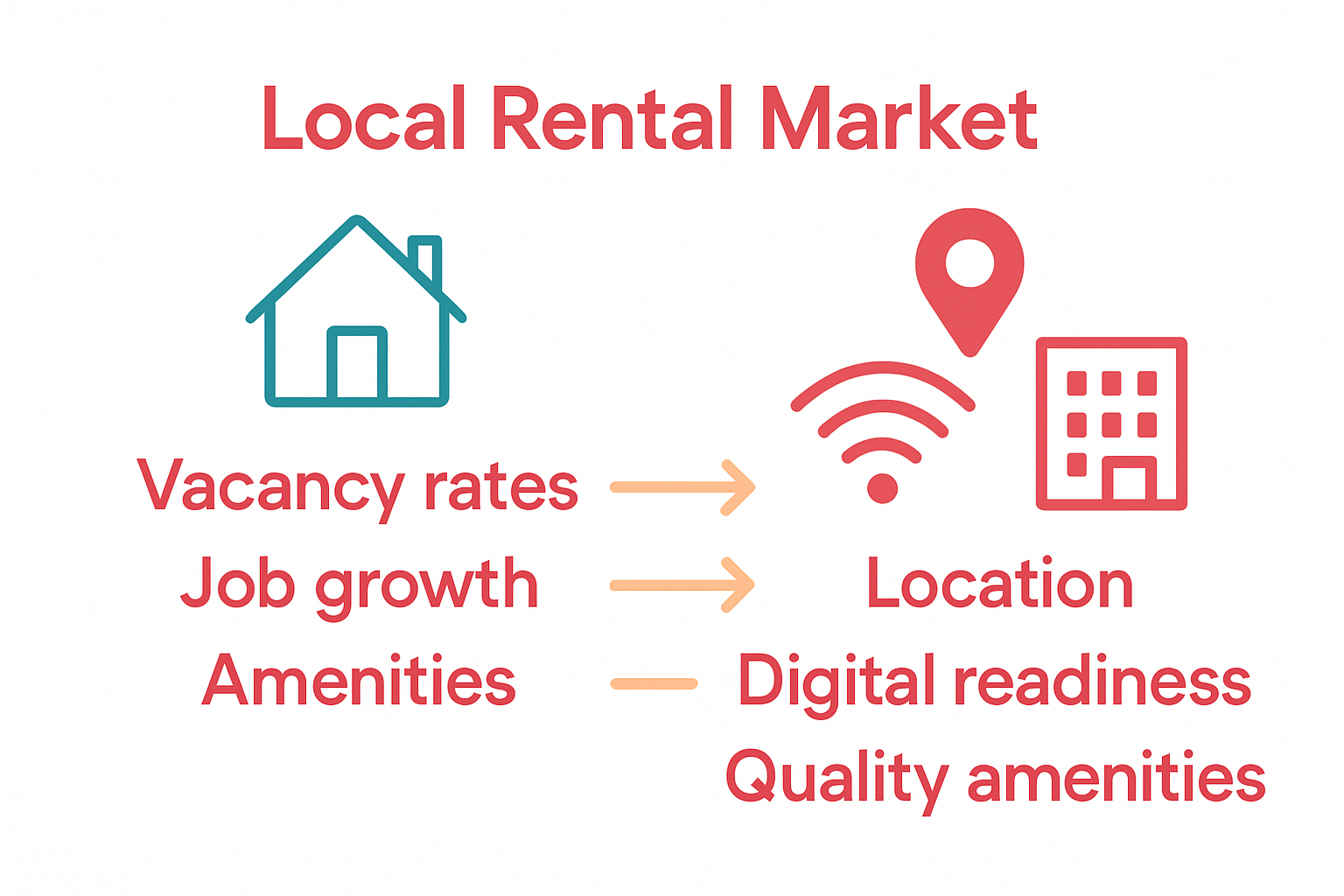
Long-stay opportunities are not just about having a suitable property, but creating an environment that professionals want to inhabit for weeks or months. This means thinking holistically about your offering comfortable workspaces, reliable connectivity, and amenities that support both professional productivity and personal wellbeing.
Successful long-term rental investments require continuous market intelligence. The most profitable properties are those that adapt quickly to changing professional landscapes, anticipating needs before they become obvious market trends.
Step 5: Apply data-driven assessment with Guestly
Data-driven property assessment transforms guesswork into strategic decision-making. By leveraging advanced analytical techniques, you can unlock precise insights about your property’s true rental potential.
Machine learning methods applied to rental price prediction demonstrate how sophisticated data analysis can dramatically enhance our understanding of market dynamics. These advanced techniques go far beyond traditional evaluation approaches, providing nuanced insights that capture complex market interactions and potential future trends.
Graph convolutional network analysis of spatial configurations reveals that property characteristics extend well beyond simple square footage. By examining intricate relationships between layout, amenities, and market demand, data-driven assessments can pinpoint exactly what makes a property attractive to professional tenants.
Guestly’s approach integrates multiple data streams to create a comprehensive property profile. We analyse location specifics, market trends, property features, and potential guest profiles to generate a holistic assessment that goes beyond surface-level metrics. Our methodology considers not just current market conditions but emerging trends that could impact future rental performance.
The goal is not just to collect data, but to translate that information into actionable insights. By understanding the nuanced factors that drive rental success, you can make informed decisions that maximise your property’s earning potential while minimising risk.
Unlock Your Property’s True Rental Potential with Guestly Homes
Understanding rental potential involves more than numbers and layouts. It demands strategic insights into location dynamics, guest profiles, and digital readiness to create a seamless, high-performing living environment for professional travellers. If you aim to transform your property into a premium asset that offers stable income, hassle-free management, and consistently excellent guest experiences, Guestly Homes is your strategic partner.
Explore how our fully managed, 5-star operating model supports property owners like you to capture long-stay opportunities and maximise returns while maintaining brand consistency and minimal involvement. Visit Guestly Homes to discover how our tailored Revenue Share Model or Arbitrage Model aligns with your goals and unlocks your property’s highest potential today.
Frequently Asked Questions
How can I define the rental potential of my property?
To define the rental potential of your property, assess key financial metrics like the capitalisation rate and gross rent multiplier. Calculate these metrics to understand your property’s potential income and how quickly it could recoup its investment.
What factors should I analyse when evaluating my property’s location?
When assessing your property’s location, consider job opportunities, population growth, and local amenities. Evaluate these elements to determine if your area is attractive for professional tenants, enhancing your property’s rental demand.
How can I evaluate the layout and amenities of my property for rental potential?
To evaluate the layout and amenities of your property, assess the spatial configuration and the quality of available facilities. Ensure that the property offers functional workspaces and modern conveniences to appeal to professional guests.
What local trends should I examine to identify long-stay rental opportunities?
When examining local trends, focus on real estate market patterns, job market dynamics, and infrastructure developments. Identify growing industries and corporate expansions to enhance your property’s long-stay rental appeal.
How can I apply data-driven assessment techniques to determine my property’s rental potential?
You can apply data-driven assessment techniques by leveraging analytical methods to evaluate market dynamics and property features. Collect and analyse data on location specifics, market trends, and potential guest profiles to inform your rental strategy.
What is the importance of staying updated on market trends for rental properties?
Staying updated on market trends is crucial for maintaining a competitive edge. Regularly analyse changes in professional travel patterns and local demand dynamics to adapt your rental offerings accordingly.
Recommended
- How to Rent Out My Home: A Practical Owner’s Guide – Guestly Homes
- How to Increase Rental Value for Your Property in 2025 – Guestly Homes
- The Ultimate Guide to New Rental Apartment Hunting (2025) – Guestly Homes
- How to Maximize Rental Income for Your Property – Guestly Homes
- Buy or Rent in the South of France? Make the Smartest Choice.