


Managing a premium short-term rental in Piteå, Luleå, Boden, or Nyköping often feels like balancing constant guest expectations with the reality of complex rules and unpredictable income. Property owners face a maze of operational and regulatory demands that quickly dispel any hopes of simple, passive earnings. Discover how understanding key operational differences and investing in professional management unlocks clarity, control, and profitability in the Swedish short-term rental market.
Table of Contents
- Short- And Mid-Term Rentals Defined Clearly
- Hidden Realities Of Guest Management
- Operational Demands Most Owners Miss
- Pricing Pitfalls And Income Instability
- Why Professional Management Reduces Exposure
Key Takeaways
| Point | Details |
|---|---|
| Rental Types Differentiation | Understand the distinctions between short-term, mid-term, and long-term rentals to navigate regulatory complexities better. |
| Complex Guest Management | Effective guest management necessitates robust systems for screening, behaviour management, and compliance to mitigate risks. |
| Operational Demands | Short-term rental management requires significant ongoing effort in maintenance, scheduling, and financial management. |
| Professional Management Benefits | Engaging professional management can significantly reduce risks and enhance operational efficiency through systematic oversight and technology integration. |
Short- and Mid-Term Rentals Defined Clearly
Short-term and mid-term rentals represent dynamic accommodation solutions that differ significantly from traditional long-term housing arrangements. European regulatory frameworks776016_EN.pdf) distinguish these rental types based on duration, occupancy patterns, and operational characteristics, creating nuanced categories that impact housing markets and property management strategies.
Typically, rental durations are categorised as follows:
- Short-term rentals: Generally defined as stays ranging from a few nights up to 30 consecutive days
- Mid-term rentals: Accommodations spanning 30 to 180 days, bridging the gap between short holiday stays and traditional residential leases
- Long-term rentals: Typically exceeding six months, offering more stable housing arrangements
The legal and operational distinctions between these rental types are critical for property owners to understand. EU research highlights759356_EN.pdf) that professional and non-professional providers face different regulatory requirements, with implications for taxation, insurance, and local housing policies.
Professional operators managing multiple properties face more complex compliance requirements compared to occasional homeowners renting their primary residence.
Property characteristics also vary across these rental categories. Short-term rentals often feature fully furnished spaces with hotel-like amenities, while mid-term rentals provide a more home-like environment suitable for business travellers, project teams, or individuals in transitional life stages.
Here is a comparison of rental types by legal, operational, and occupant features:
| Rental Type | Typical Duration | Regulatory Complexity | Primary Occupants |
|---|---|---|---|
| Short-term | 1–30 days | High | Tourists, business travellers |
| Mid-term | 30–180 days | Moderate | Project workers, relocating professionals |
| Long-term | Over 6 months | Low | Residents, families |
Pro tip: Always verify local regulations and platform-specific rules before listing your property, as rental definitions and legal requirements can vary significantly between municipalities.
Hidden Realities of Guest Management
Guest management in short-term rentals is far more complex than most property owners initially anticipate. Property research reveals significant operational challenges that extend well beyond simply providing a clean, comfortable space for visitors.
The key operational challenges include:
- Guest screening: Verifying identities and assessing potential risks before booking
- Behaviour management: Handling disruptive guests and preventing property damage
- Regulatory compliance: Meeting local safety and reporting requirements
- Communication management: Providing 24/7 responsive support and handling unexpected issues
European regulatory frameworks mandate stringent requirements for short-term rental operators. Operational challenges in guest management759356_EN.pdf) include strict protocols for guest reporting, managing maximum occupancy, and maintaining safety standards.
Professional short-term rental management requires significantly more active engagement than traditional long-term leasing.
Unlike traditional rentals, short-term accommodations demand constant vigilance. Owners must develop robust systems for guest vetting, rapid communication, and immediate problem resolution. This includes implementing advanced booking verification processes, creating detailed house rules, and establishing clear consequences for violations.
Pro tip: Invest in comprehensive guest management software that automates screening, communication, and compliance tracking to reduce operational complexity and potential risks.
Operational Demands Most Owners Miss
Property management research reveals that short-term rental ownership is dramatically more labour-intensive than most property owners initially comprehend. The romanticised vision of passive income quickly dissolves when confronted with the intricate operational realities of professional rental management.
The most demanding operational aspects include:
- Time-intensive maintenance: Constant property upkeep and rapid repair responses
- Complex scheduling: Managing bookings, cleaning cycles, and availability windows
- Technical infrastructure: Implementing booking systems, communication platforms, and payment processing
- Financial management: Tracking expenses, managing tax obligations, and maintaining accurate financial records
European regulatory frameworks759356_EN.pdf) mandate sophisticated operational protocols that transform short-term rentals from a simple income stream into a sophisticated business enterprise. Owners must navigate intricate legal requirements, including safety standards, guest reporting mechanisms, and local licensing regulations.
The gap between expectation and operational reality can quickly overwhelm unprepared property owners.
Successful management requires developing robust systems that transform individual property rental into a professional, systematised operation. This involves creating detailed standard operating procedures, investing in technological infrastructure, and developing a network of reliable service providers who can respond quickly to maintenance and guest-related issues.

Pro tip: Develop a comprehensive operational manual detailing every potential scenario, creating predictability and reducing stress in your short-term rental management.
Pricing Pitfalls and Income Instability
Economic research reveals that short-term rental pricing is far more complex than most property owners anticipate. The dream of consistent, predictable income quickly unravels when confronted with the intricate dynamics of market-driven pricing strategies.
The primary income destabilising factors include:
- Seasonal volatility: Dramatic shifts in demand across different times of year
- Market saturation: Increasing competition reducing individual property attractiveness
- Regulatory constraints: Local restrictions impacting rental availability and pricing
- Unpredictable demand cycles: Rapid changes in traveller preferences and economic conditions
Short-term rental regulations significantly impact income potential, creating substantial revenue uncertainty for property owners. Sophisticated pricing algorithms and real-time market analysis become essential tools for maintaining financial stability.
Successful short-term rental owners treat their properties as dynamic business assets, not passive income streams.
Navigating these complex pricing landscapes requires advanced technological solutions and a deep understanding of market dynamics. Owners must develop flexible pricing strategies that can adapt to rapid market changes, leveraging data-driven insights to optimise revenue and minimise income volatility.
Pro tip: Invest in professional dynamic pricing software that automatically adjusts rates based on real-time market conditions, local events, and seasonal trends.
Why Professional Management Reduces Exposure
Property management research reveals that professional management serves as a critical shield against the numerous risks inherent in short-term rental operations. Individual property owners often lack the sophisticated systems and expertise required to effectively mitigate potential vulnerabilities.
Key risk reduction strategies include:
- Legal compliance: Ensuring adherence to complex local and national regulations
- Guest screening: Implementing rigorous vetting processes to minimise potential property damage
- Operational efficiency: Managing bookings, maintenance, and communication seamlessly
- Financial protection: Developing robust insurance and liability management approaches
European regulatory frameworks759356_EN.pdf) demonstrate that professional management significantly reduces exposure by providing comprehensive oversight across multiple operational dimensions. These services transform potentially chaotic rental experiences into structured, predictable business models.
Professional management converts unpredictable rental activities into systematic, low-risk income streams.
The most sophisticated management approaches leverage advanced technologies and deep market insights to create robust operational frameworks. This includes real-time monitoring, automated compliance checks, rapid response mechanisms, and data-driven decision-making that individual owners cannot typically replicate.
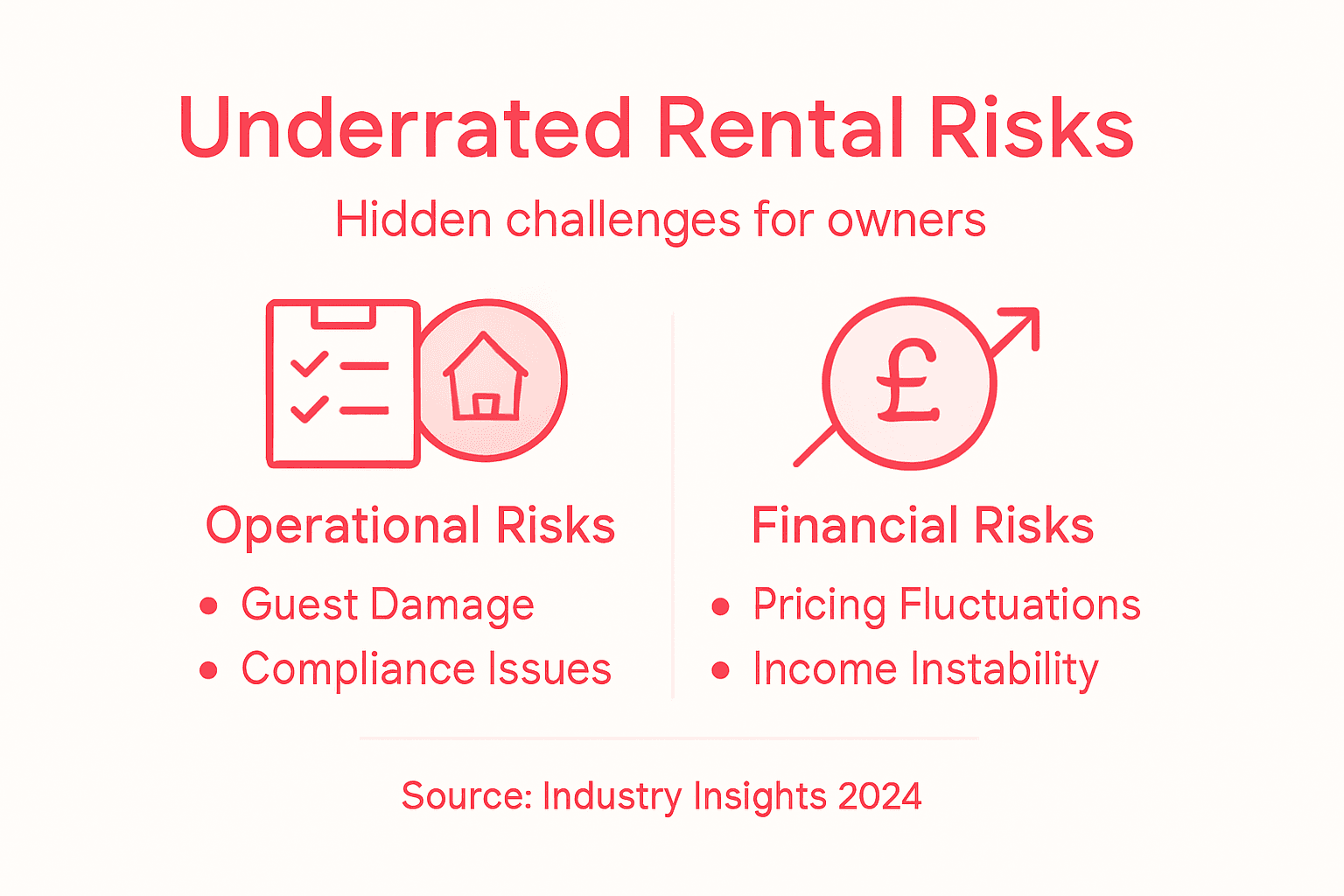
The table below highlights key technologies essential for successful short-term rental management:
| Technology Solution | Purpose | Business Impact |
|---|---|---|
| Guest management software | Automates screening and communication | Reduces errors and saves time |
| Dynamic pricing tools | Adjusts rates to market trends | Maximises revenue potential |
| Maintenance management platforms | Schedules repairs and upkeep | Minimises downtime and complaints |
Pro tip: Select a management partner with demonstrable expertise in local regulations, technology integration, and risk mitigation strategies.
Transform Rental Risks into Reliable Revenue with Guestly Homes
The article highlights the overlooked complexities and risks property owners face with short-term rentals, including regulatory compliance, guest management, operational demands and pricing challenges. These pain points can quickly overwhelm owners seeking hassle-free, stable income. At Guestly Homes, we understand these realities and offer premium, fully managed homes tailored for longer stays from 10 nights to 12 months across Sweden and the Nordics. Our expertise transforms short-term rental headaches into professional, systematised solutions that protect your property and maximise profitability.
Why choose Guestly?
- Comprehensive management that covers guest screening, maintenance, and compliance so you can relax
- Flexible partnership models designed to suit your income goals and involvement preferences
- Dynamic pricing strategies optimised by market data to improve revenue stability
Explore how Guestly Homes delivers frictionless property performance and peace of mind for owners who want predictable returns from their premium spaces. Visit Guestly Homes now to discover our fully managed service and learn why professional operation is the key to turning rental risks into lasting success.
Frequently Asked Questions
What are the main risks associated with short-term rentals?
The primary risks include legal compliance issues, guest screening challenges, operational inefficiencies, and financial unpredictability, which can all impact a property’s profitability.
How can owners effectively manage guest screening in short-term rentals?
Owners should implement rigorous vetting processes, including identity verification and background checks, to minimise potential risks associated with guests, such as property damage or disruptive behaviour.
Why is professional management beneficial for short-term rental owners?
Professional management provides comprehensive oversight, ensuring adherence to regulations, efficient operational processes, and effective guest management, which collectively reduce the risks for owners significantly.
What technology solutions can help improve short-term rental management?
Key technologies include guest management software for automating communication and screening, dynamic pricing tools for optimising revenue based on market conditions, and maintenance management platforms to efficiently handle repairs and upkeep.
Recommended
- Risks and Benefits of Renting Out Property – Guestly Homes
- Houses to Let by Owner: A Complete Guide (2025) – Guestly Homes
- How to Rent Out My Home: A Practical Owner’s Guide – Guestly Homes
- How to Handle Extended Stays: A Calm Guide for Property Owners – Guestly Homes
- Dubai Property Laws Explained: Risks, Rights, and Returns