


Managing a premium rental in Sweden can quickly become overwhelming, especially in markets like Piteå, Luleå, Boden, and Nyköping. Owners face constant demands for maintenance, rent collection, and tenant relations while wanting peace of mind and strong returns. Choosing property management services means turning daily headaches into predictable performance. This guide lays out what qualified management truly covers, how different service models impact your income, and why clarity is the key to maximising your investment.
Table of Contents
- Defining Property Management Services For Owners
- How Service Models Affect Owner Outcomes
- Revenue Models: Sharing Versus Fixed Income
- Reducing Risks And Ensuring Compliance
- Enhancing Property Performance And Guest Experience
Key Takeaways
| Point | Details |
|---|---|
| Importance of Clear Definitions | Clearly defined property management services prevent financial gaps and disputes, ensuring better returns for owners. |
| Choice of Management Model | Selecting the right management model (fixed-fee or revenue-share) directly impacts income predictability and owner involvement. |
| Compliance Management | Effective compliance management protects assets and reduces legal risks, ultimately safeguarding profitability. |
| Guest Experience Impact | High guest satisfaction directly correlates with occupancy rates and profitability; continuous improvement in service is essential. |
Defining Property Management Services for Owners
Property management is not one thing—it’s a coordinated system designed to keep your investment performing whilst you focus on what matters. For owners in Swedish markets like Piteå, Luleå, Boden, and Nyköping, this distinction matters enormously.
At its core, property management services encompass the full operational coordination of residential properties: rent collection, maintenance coordination, tenant relations, and the thousand small decisions that happen between bookings. These services operate on-site or remotely, depending on your preference and property type.
But here’s what separates competent management from ordinary management.
What Effective Property Management Actually Covers
Your management partner handles the work that directly affects your returns:
- Rent collection and financial management – ensuring payments arrive on time, accurately recorded
- Maintenance coordination – scheduling repairs, managing contractors, preventing small issues from becoming expensive ones
- Tenant or guest screening and relations – selecting reliable occupants, handling communications, resolving conflicts
- Property inspections – regular oversight to catch problems early
- Lease or booking administration – contract management, renewal coordination, compliance documentation
- Marketing and occupancy optimisation – keeping your property visible and booked at appropriate rates
Effective property management transforms your role from operator to observer. You set the strategy; the team handles execution.
For premium properties targeting extended stays, management also includes quality assurance. Every stay reflects on your asset. A professional operator ensures consistency in guest experience, property condition, and standard adherence.
Why Definition Matters for Your Returns
Vague management agreements cost money. When you don’t know exactly what services you’re paying for—or what you’re responsible for—gaps appear. Those gaps create costs, vacancy periods, and tenant disputes that erode your margin.
A clear definition protects both sides. You understand what you’re receiving. Your management partner understands exactly what they’re delivering. This clarity directly impacts your financial performance.
In Swedish property markets, where consistency and reliability are expected, this precision becomes even more critical. Guests booking premium extended stays aren’t forgiving of operational failures.
The Relationship Between Services and Returns
Different service models produce different financial outcomes. Full-service management costs more upfront but reduces your active involvement and risk exposure. Understanding what property management companies do helps you evaluate whether the margin split is worth the operational freedom you gain.
The best definition for your property depends on your circumstances: whether you want partnership upside or predictable fixed income, whether you prefer hands-off operation or ongoing involvement, whether your property suits revenue-sharing or arbitrage models.
Pro tip: Before signing any management agreement, request a detailed service matrix listing every responsibility, response time for repairs, occupancy targets, and financial reporting frequency—in writing.
How Service Models Affect Owner Outcomes
Your choice of service model isn’t simply an operational preference—it’s a direct financial lever that shapes your annual returns. Different frameworks create different incentives, risks, and ultimately, profitability for property owners.

The model you select determines how your management partner operates, what they prioritise, and crucially, how aligned their interests are with yours. In Swedish markets, where consistency and predictability matter to extended-stay bookers, this alignment becomes even more critical.
Fixed-Fee (Arbitrage) Models: Predictability Over Upside
With a fixed-fee model, Guestly signs a long-term lease and pays you a guaranteed monthly amount. You receive stable, predictable income regardless of occupancy or booking rates.
The trade-off is straightforward:
- Your advantage: Guaranteed income, zero operational involvement, no occupancy risk
- Your constraint: You forfeit upside when the property performs exceptionally well
- Operator incentive: The management partner profits from every booking above the lease cost
Fixed-fee models suit owners prioritising certainty and peace of mind over potential maximum returns.
This model works particularly well for owners in Piteå or Luleå who value stability over speculation. You know exactly what you’ll earn each month, allowing confident financial planning.
Here is a comparison of Fixed-Fee and Revenue-Share property management models to help you evaluate their implications:
| Model Type | Owner Financial Risk | Income Predictability | Operator Incentive | Owner Involvement Level |
|---|---|---|---|---|
| Fixed-Fee | Minimal (operator absorbs losses) | Very High | Maximise operator’s profit margin | No involvement, fully passive |
| Revenue-Share | Moderate (shared with manager) | Variable, depends on market | Maximise owner/manager shared success | Some reporting, active partnership |
Revenue-Share Models: Aligned Growth
Revenue-share models (typically 60/40 or 70/30 splits) tie your income directly to property performance. When occupancy rises, your income rises. When standards slip, both parties feel the impact.
This creates powerful alignment:
- Shared responsibility: Both owner and operator benefit from excellent management
- Performance incentive: The operator is motivated to maximise occupancy and pricing
- Your upside: Strong market conditions or seasonal demand directly increase your earnings
Service delivery models impact financial incentives and operational focus, meaning your choice directly influences how thoroughly your property is managed.
Revenue-share suits owners comfortable with variability but wanting to participate in success. Your returns reflect market conditions and management quality.
Why Model Choice Matters More Than You Think
Different models attract different operator behaviours. A fixed-fee operator knows their margin is fixed, regardless of effort—though professional operators maintain standards regardless. A revenue-share operator directly benefits from your property outperforming.
Neither is inherently superior. The right model depends on your risk tolerance, capital needs, and involvement preference.
- Choose fixed-fee if you want: certainty, passive income, zero involvement, predictable cash flow
- Choose revenue-share if you want: upside participation, active partnership, aligned incentives, growth potential
Pro tip: When evaluating models, calculate your expected income under three scenarios—realistic, optimistic, and conservative—for each model; the right choice becomes obvious when you see actual numbers, not theoretical percentages.
Revenue Models: Sharing Versus Fixed Income
The revenue model you choose fundamentally shapes your financial relationship with your property manager. It determines how risk is distributed, how income flows, and critically, whether your interests align with the operator’s.
These aren’t minor operational details. They’re structural decisions that affect your long-term profitability and peace of mind.
Understanding Fixed-Income Models
With a fixed-income model, you receive a guaranteed monthly payment regardless of how the property performs. Guestly leases your property for a set term (typically three to five years) and pays you a fixed amount each month.
This approach offers clear advantages:
- Predictable cash flow – You know exactly what you’ll earn, month after month
- Zero operational responsibility – The operator handles occupancy, pricing, maintenance, everything
- Income certainty – Market downturns or seasonal dips don’t affect your payment
- Planning confidence – You can budget and invest with certainty
Fixed-income models trade potential upside for operational peace and financial certainty.
For owners in Nyköping or Boden seeking stable, hands-off income, this model provides exactly that. Your property becomes a reliable income stream, not a source of operational stress.
Understanding Revenue-Share Models
Revenue-share models tie your income directly to property performance. Typically structured as 60/40 or 70/30 splits, your earnings rise and fall with actual bookings and occupancy rates.
This creates a fundamentally different financial relationship:
- Upside participation – Strong performance directly increases your income
- Aligned incentives – The operator benefits when your property thrives
- Market responsiveness – Your earnings reflect actual demand and seasonal strength
- Partnership mindset – Both parties invested in maximising property value
Revenue management pricing strategies vary between fixed and sharing approaches, meaning your chosen model influences how aggressively occupancy is pursued.
The Financial Trade-Off Explained
Fixed income provides security but forgoes upside. Revenue-share offers growth potential but introduces variability. Neither is superior—the right choice depends on your situation.
Consider these factors:
- Your financial stability: Can you absorb income variation, or do you need certainty?
- Market confidence: Do you believe your property will outperform, or is consistency safer?
- Involvement preference: Do you want true partnership, or complete hands-off operation?
- Risk tolerance: Are you comfortable with fluctuation, or do you prioritise predictability?
Owners seeking stable, passive income in quieter Swedish markets often prefer fixed-income models. Those believing their property has strong upside potential and comfortable with variability typically choose revenue-share.
Pro tip: Run a three-year financial projection for both models using conservative, realistic, and optimistic occupancy scenarios; the spreadsheet will reveal which model genuinely suits your goals and risk comfort.
Reducing Risks and Ensuring Compliance
Compliance isn’t bureaucracy. It’s protection. When your property manager handles regulatory adherence properly, your asset stays safe, your liability shrinks, and your returns remain intact.
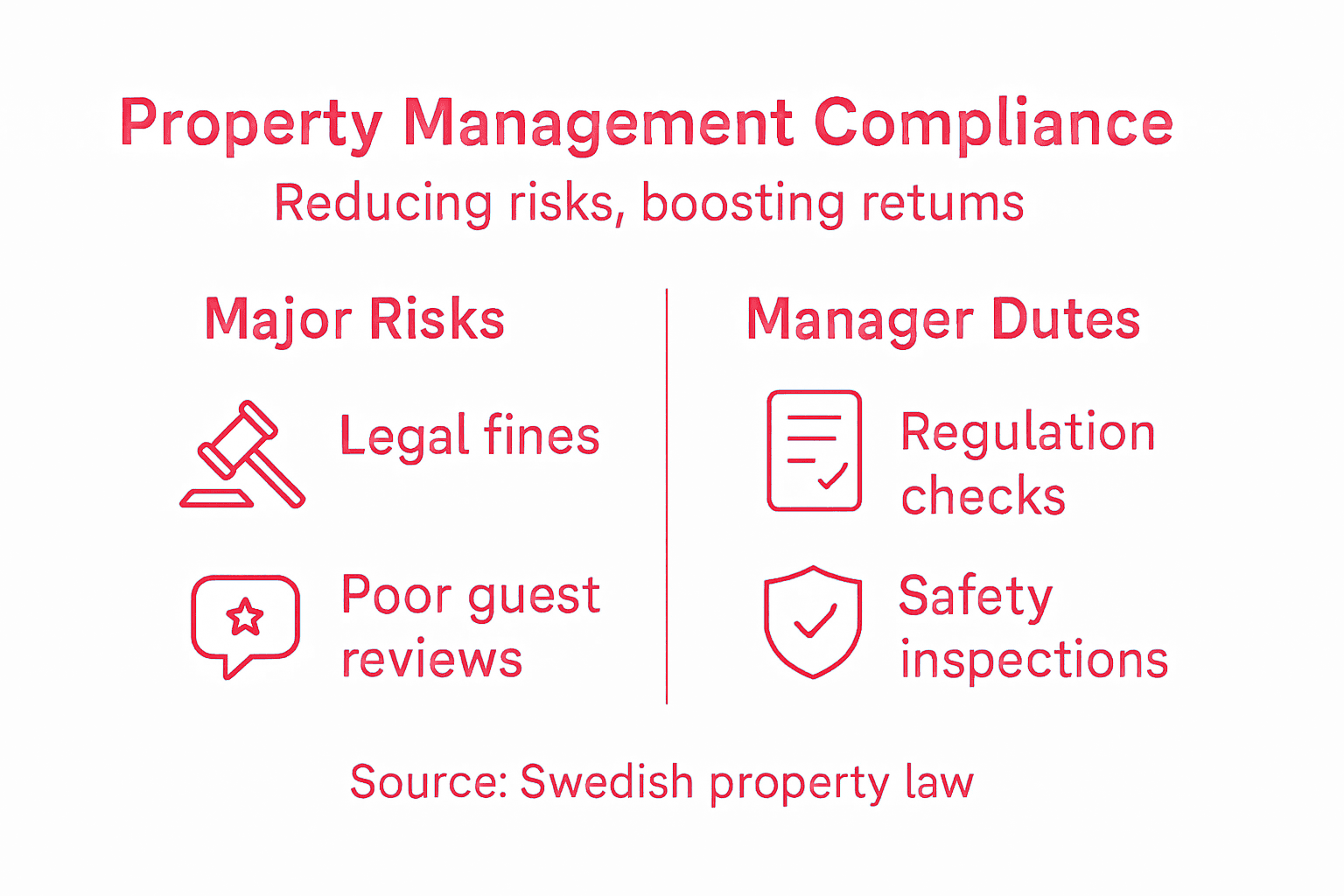
Neglecting compliance creates cascading problems: fines, guest injuries, legal disputes, and damage to your property’s reputation. A competent management partner makes compliance invisible—it simply happens, protecting everyone involved.
Why Compliance Matters for Your Returns
Compliance costs money upfront but saves far more later. Environmental regulations, safety standards, tenant rights, tax obligations—these aren’t optional considerations.
Property management requires adherence to regulations governing property acquisition and operation, reducing legal risks and ensuring your investment remains protected.
When your manager cuts corners on compliance, you pay the price. Guest injuries, environmental violations, or tax disputes can consume years of profit in legal fees and settlements.
Key Compliance Areas Your Manager Should Handle
A professional property manager takes ownership of these critical areas:
- Environmental safety – Lead paint regulations, asbestos management, proper disposal protocols
- Guest safety standards – Fire safety, electrical systems, structural integrity, emergency procedures
- Financial compliance – Accurate record-keeping, tax reporting, income documentation
- Local regulations – Zoning laws, rental restrictions, short-term letting permits where applicable
- Insurance and liability – Proper coverage, incident documentation, claim management
- Guest rights – Fair treatment, privacy protection, dispute resolution processes
Compliance failures are invisible until they become catastrophic. Prevention costs far less than recovery.
For properties in Swedish municipalities, local regulations regarding extended-stay accommodation vary. Your manager must understand these nuances and ensure your property meets every requirement.
Below is a summary of compliance responsibilities and their significance for property owners:
| Compliance Area | Business Importance | Risk Mitigated |
|---|---|---|
| Environmental standards | Protects property value | Fines, reputational harm |
| Guest safety regulations | Minimises legal exposure | Injury claims, legal disputes |
| Financial record-keeping | Supports accurate tax handling | Tax penalties, audit failures |
| Local permitting & zoning | Ensures ongoing legal operation | Forced closure, lost income |
| Insurance cover | Secures financial assets | Uncovered incident costs |
Your Role in Risk Mitigation
You’re not passive here. Request clear documentation of compliance activities. Ask your manager to explain their approach to safety inspections, environmental standards, and regulatory changes.
Environmental and safety regulations protect occupants and mitigate financial penalties, meaning your manager’s attention to detail directly protects your income.
Regular communication about compliance isn’t micromanagement—it’s due diligence. Your manager should welcome questions and provide evidence that compliance activities are occurring.
Don’t assume compliance is happening. Verify it.
Pro tip: Request a quarterly compliance checklist from your manager detailing inspections completed, regulations reviewed, safety updates implemented, and any incidents or concerns—this creates accountability and protects you both.
Enhancing Property Performance and Guest Experience
Guest experience and property performance aren’t separate concerns—they’re inseparable. When guests feel cared for, they stay longer, book again, rate properties higher, and recommend them to colleagues. This directly translates to occupancy, pricing power, and returns.
A professional property manager understands this connection and manages proactively to strengthen it.
The Connection Between Experience and Returns
Your property’s reputation determines its market value. One poor experience shared across review platforms can suppress bookings for months. Conversely, consistently excellent experiences build momentum that sustains occupancy even during slower seasons.
Lodging managers enhance guest experience through oversight of cleanliness, service standards, and facility maintenance, directly influencing guest satisfaction and property profitability.
For premium properties targeting extended-stay guests in Swedish markets, this matters intensely. These aren’t tourists seeking novelty—they’re professionals seeking reliability. They notice every detail and expect consistency.
What Excellent Property Management Delivers
A competent manager focuses on elements that compound guest satisfaction:
- Proactive maintenance – Issues are prevented, not reacted to; guests never encounter problems
- Consistent cleanliness standards – Every arrival meets the same high standard; no variability
- Responsive communication – Questions answered within hours; concerns resolved before escalating
- Thoughtful amenities – Small touches that signal care: quality linens, well-stocked kitchens, reliable WiFi
- Property condition monitoring – Regular inspections catch wear before it becomes visible damage
- Guest feedback integration – Feedback drives continuous improvement, not dismissal
Guest satisfaction and occupancy rates move together. Invest in experience; returns follow.
When satisfaction with amenities and support services improves, retention and perceived value increase significantly, meaning every quality enhancement directly supports your financial performance.
Building Competitive Advantage Through Excellence
In competitive markets, average management produces average results. Excellence creates differentiation that justifies premium pricing and sustains occupancy.
Your manager should be tracking occupancy trends, guest feedback patterns, and competitive positioning. They should communicate openly about what’s working and where improvement is needed.
Don’t accept passivity. Push for strategies to maximise guest comfort and property appeal. Ask specifically about guest feedback, what competitors are offering, and how your property can stay ahead.
The returns gap between mediocre and excellent management often exceeds 20–30% annually. That gap is yours to claim.
Pro tip: Establish a monthly review cadence with your manager covering occupancy percentage, average guest rating, maintenance issues, and competitive market changes; this creates accountability and ensures performance stays visible and optimised.
Maximise Your Property Returns with Expert Management
The article highlights how precise definition and the right service model are essential to protect and grow your investment in the Swedish property market. Owners often face challenges such as unclear management responsibilities, shifting risks between fixed-fee and revenue-share arrangements, and ensuring strict compliance to safeguard returns. Guestly Homes specialises in exactly these areas, offering full-service property management that aligns with your income goals—whether you seek predictable fixed income or a performance-driven partnership.
Why struggle with uncertainty when you can partner with a trusted operator? Our deep expertise ensures your property benefits from clear service agreements, proactive maintenance, and compliance management tailored to local regulations. Experience peace of mind alongside maximised financial performance. At Guestly Homes, we operate as the brand, the operator, and the sole guest interface, delivering seamless management for premium extended-stay properties across Sweden.
- Choose between our flexible Revenue Share Model for upside participation or the stable Arbitrage Model if you prefer guaranteed income.
- Benefit from hands-off ownership with consistent brand standards and transparent reporting.
- Protect your asset and enhance guest experience with our structured, professional approach.
Ready to turn your property into a reliable, high-return investment with expert management? Visit Guestly Homes today to discover how our tailored service models can match your goals. Act now to secure a management partnership that truly boosts your returns.
Frequently Asked Questions
What services are typically included in property management?
Property management services often include rent collection, maintenance coordination, tenant relations, property inspections, lease administration, and marketing to optimise occupancy.
How do property management services affect my rental income?
Effective property management can enhance your rental income by ensuring timely rent collection, maximising occupancy rates, and maintaining property standards, thus attracting higher-quality tenants.
What are the advantages of fixed-fee property management models?
Fixed-fee property management models provide stable, predictable income as owners receive a guaranteed monthly payment, eliminating risks associated with occupancy fluctuations.
Why is compliance important in property management?
Compliance is crucial as it protects your investment from legal risks, ensures adherence to regulations, and helps avoid costly fines and disputes, thus safeguarding your financial returns.