


Every property owner knows the challenge of balancing stable income with changing guest needs. In Sweden, especially in Piteå and Luleå, flexible lease terms for premium serviced apartments are reshaping how owners approach rentals. This structured approach allows you to capture premium rents and adapt to project-driven guests, while also managing increased vacancy risk and income variability. Discover what truly defines flexible leases in Sweden and how these terms can help you achieve reliable returns without constant operational headaches.
Table of Contents
- Defining Flexible Lease Terms In Sweden
- The Swedish Market Context
- Key Characteristics Of Flexible Leases
- Why Flexibility Matters For Your Returns
- Key Lease Structures For Extended Stays
- The Fixed-Term Extended Lease
- The Flexible Extended Lease With Defined Minimums
- The Rolling Month-To-Month Extended Stay
- Choosing The Right Structure For Your Goals
- Legal Rights And Termination Protocols
- Swedish Termination Law Fundamentals
- Notice Periods And Timing
- Valid Termination Grounds
- Building Ironclad Lease Agreements
- Financial Benefits And Risk Management
- The Premium Rent Advantage
- The Income Volatility Risk
- Hybrid Risk Management Strategies
- Calculating True Returns
- Choosing Flexibility Over Fixed Agreements
- When Flexibility Makes Sense
- When Fixed Agreements Provide Better Returns
- The Hybrid Approach: True Operational Excellence
- Alignment Questions For Your Decision
- Making The Transition
Key Takeaways
| Point | Details |
|---|---|
| Importance of Flexibility | Flexible lease terms cater to the needs of extended-stay guests in Sweden, providing adaptable booking options that can align with varying work timelines. |
| Understanding Lease Structures | There are three main lease structures: fixed-term, flexible with minimums, and rolling month-to-month, each offering different balances of predictability and flexibility for both owners and guests. |
| Financial Management Considerations | While flexible leases can attract premium rents, they also introduce income volatility, necessitating careful financial management and risk assessment. |
| Legal Obligations | Swedish lease law emphasises tenant protections, making clear and precise lease agreements essential for safeguarding owner interests. |
Defining Flexible Lease Terms in Sweden
Flexible lease terms in Sweden represent a structured approach to property agreements that balance owner income stability with guest adaptability. Rather than rigid fixed-term contracts, flexible arrangements allow for variable lease lengths, early termination options, and negotiated renewal conditions.
In the Swedish property market, flexible leases have become increasingly important for premium serviced apartments catering to extended-stay guests. These terms acknowledge that guests—particularly project teams and professionals—may need adjustable stay durations based on work timelines or project completion.
What Makes a Lease “Flexible” in Sweden?
Flexible leases differ from standard agreements in several measurable ways:
- Variable lease length: Guests can book periods ranging from 10 nights to 12 months, with the ability to adjust as circumstances change
- Early termination options: Clear exit clauses allow guests to leave before the contracted end date, usually with reasonable notice periods
- Renewal flexibility: Automatic or manual renewal options at agreed rates, rather than rigid annual commitments
- Seasonal adjustments: Pricing or terms that adapt to seasonal demand without requiring new negotiations
Research on Swedish commercial property markets reveals that flexible leases offer adaptability and potential premium rents, though they do introduce income volatility that owners must actively manage.
The Swedish Market Context
Sweden’s approach to leases reflects broader Nordic principles: transparency, fairness, and mutual benefit. Flexible lease agreements in Sweden follow national tenant protection laws whilst allowing property owners reasonable negotiation space.
For properties in Piteå and Luleå—particularly serviced apartments targeting corporate extended stays—flexibility is increasingly expected. Guests want accommodation that adapts to their situation, not the reverse.
Financial viability analysis of shorter lease terms shows that whilst premium rents may be achievable, owners must account for increased vacancy risks and income variability. This tradeoff is central to understanding whether flexible terms suit your property.
Key Characteristics of Flexible Leases
Flexible lease terms typically include:
- Defined minimum stay periods (often 10 nights to 30 days)
- Clear notice requirements for early termination
- Specified rent amounts or pricing structures
- Maintenance and upkeep responsibilities
- Cancellation or modification policies
The structure protects both parties: owners know minimum revenue expectations, whilst guests understand their rights and responsibilities.
Why Flexibility Matters for Your Returns
For property owners, flexibility opens market access. A property locked into rigid annual leases misses higher-margin short-term bookings. Conversely, pure month-to-month arrangements create unpredictability that impacts long-term financial planning.
Flexible terms allow you to capture premium rates during peak seasons whilst maintaining baseline occupancy during quieter periods. The operational certainty—knowing your minimum commitment and exit conditions—transforms variable income into manageable forecasting.
Pro tip: Document your flexibility parameters clearly before listing: specify your minimum acceptable stay length, notice period for changes, and pricing tiers for different lease durations. This clarity attracts serious, aligned guests and reduces negotiation friction.
Key Lease Structures for Extended Stays
Extended stays require lease structures that balance predictability with adaptability. Property owners in Piteå and Luleå need frameworks that protect income whilst accommodating guests whose projects may shift or conclude earlier than anticipated.
Three primary lease structures dominate the extended-stay market. Each serves different owner goals and guest profiles, offering distinct trade-offs between stability and flexibility.
The Fixed-Term Extended Lease
Fixed-term leases lock both parties into agreed durations, typically 3 to 12 months. The guest commits to the full period; the owner receives guaranteed income.
This structure works well when:
- You have reliable tenant vetting and confidence in guest quality
- Your property serves long-term corporate relocations or project assignments
- You prefer income predictability over monthly variability
- Early termination would create genuine operational hardship
The trade-off is clear: you sacrifice access to seasonal rate premiums and higher short-term bookings. A fixed £2,000-per-month lease blocks potential £150-per-night bookings during peak demand.
The Flexible Extended Lease with Defined Minimums
This hybrid model sets a minimum commitment period—typically 30 to 90 days—with the option to extend or conclude after that point. The guest knows their baseline cost; you know your baseline revenue.
Flexible extended leases typically include:
- Clear minimum stay requirements
- Tiered pricing for longer commitments
- Notice periods for early exit (usually 14 to 30 days)
- Renewal discussions initiated before expiry
This structure offers the operational certainty owners need whilst providing guests the adjustment flexibility projects demand.
It’s the goldilocks approach: neither fully rigid nor entirely volatile. Understanding long-term lease options helps clarify whether this suits your property strategy and guest profile.
The Rolling Month-to-Month Extended Stay
This model eliminates predetermined end dates. The lease continues until either party provides notice, typically 30 days. Guests gain maximum flexibility; owners accept maximum variability.
Month-to-month arrangements suit properties targeting:
- Travelling professionals with uncertain timelines
- Teams with projects that expand or compress unpredictably
- Guests valuing freedom over long-term rate discounts
- Owners comfortable with turnover and redecorating costs
This structure demands active management: constant vacancy risk, guest turnover every 30 to 90 days, and ongoing marketing activity.
Here’s a summary comparison of the three main extended-stay lease structures in Sweden:
| Lease Type | Predictability | Flexibility for Guest | Owner Financial Stability |
|---|---|---|---|
| Fixed-Term Extended | High income assurance | Minimal adjustment options | Very stable, less vacancy risk |
| Flexible Extended with Minimum | Moderate certainty | Adjustable duration, renewal possible | Balanced, mitigated vacancy exposure |
| Rolling Month-to-Month | Low certainty | Maximum freedom, easy exit | Requires active management, higher vacancy risk |
Choosing the Right Structure for Your Goals
Your choice depends on three factors: your cash flow needs, your guest profile, and your operational capacity.
If you require predictable monthly income and prefer minimal guest turnover, a fixed-term extended lease serves you well. If you want premium seasonal rates and can manage moderate turnover, the flexible extended lease with defined minimums is ideal. If you’re comfortable with operational complexity and seek maximum market access, month-to-month extended stays work.
None is objectively superior. Each reflects different ownership philosophies and property market positions.
Pro tip: Analyse your historical booking data before choosing: calculate average guest length of stay, identify your highest-margin booking periods, and honestly assess your tolerance for vacancy gaps. This clarity eliminates guesswork and ensures your lease structure supports, not undermines, your financial targets.
Legal Rights and Termination Protocols
Swedish lease law prioritises fairness and stability for both parties. Understanding your legal obligations and your guests’ rights protects your property, your income, and your reputation.
Unlike some jurisdictions, Sweden does not view landlords and tenants as equal negotiating partners. The law assumes tenants—and extended-stay guests—occupy a weaker position. This shapes every termination protocol you must follow.
Swedish Termination Law Fundamentals
Swedish lease termination law emphasises fairness by requiring reasonable notice periods, just-cause justifications, and often granting renewal rights. These protections reflect a legal environment that values stability in housing and long-term agreements.
Key principles include:
- Reasonable notice periods: Typically 1 to 3 months, depending on lease length and type
- Just-cause requirements: Termination without cause may be contested or deemed unfair
- Renewal rights: Guests may have grounds to extend, even if original terms suggested otherwise
- Tenant protection bias: Courts favour the occupant over the property owner
This framework means your lease agreement must be crystal clear. Vague termination language creates legal exposure.
Notice Periods and Timing
Notice periods in Swedish leases follow clear progression. Shorter leases allow shorter notice; longer commitments require longer advance warning.
For extended-stay agreements:
- Under 1 year: Typically 1 to 2 months’ notice
- 1 to 3 years: Typically 2 to 3 months’ notice
- Over 3 years: Typically 3 months’ notice or lease terms specify otherwise
Your lease agreement must state notice periods explicitly. Ambiguity works against owners in Swedish courts.
Written notice must be delivered formally—email, certified post, or hand delivery with proof. Verbal agreements or casual messages do not satisfy legal requirements.
Valid Termination Grounds
Swedish law distinguishes between termination with cause and termination without cause. With cause, you need substantiation; without cause, you typically cannot terminate at all unless your lease explicitly allows it.
Valid termination grounds include:
- Non-payment of rent (usually after formal demand and grace period)
- Significant property damage beyond normal wear
- Breach of lease terms (with written warning and opportunity to remedy)
- Lease expiry at the contracted end date
- Guest-initiated termination within agreed notice periods
Invalid grounds include personality clashes, guest nationality, employment status changes, or simply wanting the property back.
Building Ironclad Lease Agreements
Your protection depends entirely on your written lease. Verbal agreements carry no legal weight in Swedish property disputes.
Every lease must clearly state:
- Exact start and end dates
- Notice periods for both parties
- Grounds for early termination
- Consequences of non-compliance
- Renewal terms or post-expiry expectations
- Deposit handling and security requirements
Consider having a Swedish-qualified legal professional review your lease template. A £300 investment in proper documentation prevents thousands in dispute resolution.
Pro tip: Send all lease-related communication in writing—never verbally. Keep copies of signed agreements, notices, and guest responses. If termination becomes contested, your documentation trail is your only defence in Swedish courts.
Financial Benefits and Risk Management
Flexible lease terms promise higher returns, but they demand sophisticated financial management. The trade-off between premium rents and income stability is real, and understanding it separates successful owners from those surprised by volatility.
Swedish market research confirms this balance: flexibility attracts premium pricing, but it introduces measurable financial risk. Your job is managing that risk intelligently.
The Premium Rent Advantage
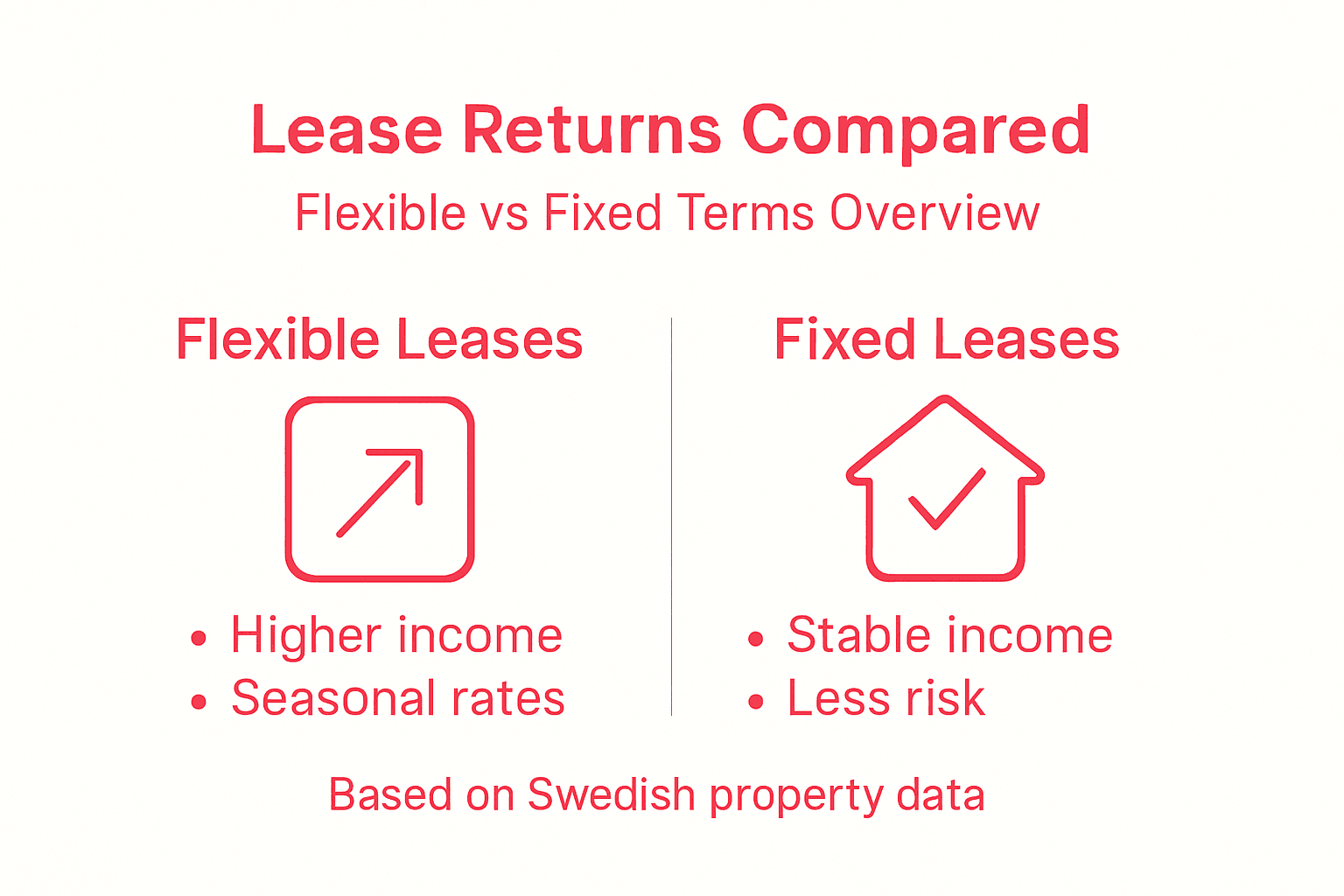
Flexible leases command higher nightly rates than fixed annual agreements. A guest booking 60 days at flexible terms pays more per night than a guest committing to 12 months at fixed rates.
This premium reflects several factors:
- Market responsiveness: You adjust pricing seasonally without renegotiating entire leases
- Scarcity value: Short-term flexibility appeals to a broader guest pool willing to pay more
- Operational agility: You capture peak-season rates that fixed-term agreements exclude
- Reduced long-term discount: Guests pay full rates rather than negotiated annual discounts
In Piteå and Luleå, this translates to measurable income uplift. A property averaging £1,800 monthly on fixed leases might generate £2,100 to £2,400 monthly on flexible arrangements with proper rate management.
The Income Volatility Risk
Higher average rents come with genuine financial uncertainty. Flexible leases increase vacancy rates and income volatility, which elevates financial risk and impacts property valuations. Some months exceed expectations; others fall short.
Specific risks include:
- Turnover gaps: Each guest departure creates potential vacancy days between arrivals
- Seasonal dips: Winter months in northern Sweden attract fewer extended-stay bookings
- Market sensitivity: Economic downturns reduce corporate travel and project assignments
- Valuation impact: Banks and investors apply higher risk premiums to volatile income
This volatility is quantifiable. If your fixed-lease property generates £21,600 annually with zero vacancy, a flexible-lease property might generate £24,000 in strong years but £18,000 in weak years. The average may be higher, but the range is wider.
Hybrid Risk Management Strategies
Optimal returns require balancing flexibility with stability. Consider these practical approaches:
- Portfolio diversification: Mix fixed-term and flexible leases across your properties
- Tiered pricing: Offer discounts for 6–12 month commitments, premiums for month-to-month
- Seasonal anchors: Secure fixed bookings during peak demand, flexible during slower periods
- Reserve management: Build cash reserves to cover 2–3 months of vacancy
- Professional management: Understanding property management costs helps you budget accurately for vacancy risk
Sustainable returns require treating flexibility as a financial tool, not a default strategy. Blend approaches based on market conditions, not ideology.
Calculating True Returns
Measure success beyond gross rental income. Account for all costs:
- Turnover and cleaning between guests
- Maintenance and repairs from increased wear
- Marketing and commission costs for frequent bookings
- Vacancy periods and foregone income
- Professional management fees (if applicable)
A flexible lease generating £2,400 monthly with £800 in associated costs delivers £1,600 net. A fixed lease generating £1,800 monthly with £400 in costs delivers £1,400 net. Context determines which is superior.
Pro tip: Calculate your break-even vacancy rate before committing to flexible terms. If you require 85% occupancy to match fixed-lease net income, confirm your market can support that. If it cannot, fixed terms protect your financial stability better.
Choosing Flexibility Over Fixed Agreements
The decision between flexibility and fixed terms fundamentally shapes your ownership experience. This choice affects income stability, operational demands, and long-term asset value. Neither option is universally correct—but one aligns better with your situation.
Flexibility suits certain owners and properties. Fixed agreements suit others. The distinction matters deeply.
When Flexibility Makes Sense
Flexible leases work best when your property and circumstances align with specific conditions. Consider flexibility if:
- Your property attracts corporate extended stays with unpredictable timelines
- You can absorb 2–3 months of vacancy without financial stress
- You actively manage pricing and marketing (or employ professional management)
- Your local market (Piteå, Luleå) shows consistent demand for short-term premium bookings
- You prefer operational control and dynamic rate adjustments
- Your guest profile values flexibility enough to pay premium rates
Flexibility opens revenue upside. A property with strong seasonal demand and reliable corporate bookings can genuinely earn more through flexible terms than through fixed annual leases.
When Fixed Agreements Provide Better Returns
Fixed leases excel in different circumstances. Choose fixed terms if:
- You need guaranteed monthly income for mortgage payments or living expenses
- Your market shows weaker extended-stay demand during winter months
- You prefer minimal operational involvement and stable cash flow
- You lack capital reserves to cover extended vacancy periods
- Your guest profile values long-term discounts over premium flexibility
- You want to simplify accounting and reduce financial forecasting complexity
Fixed agreements trade upside for certainty. That certainty has real value—especially for owners prioritising stability over maximum returns.
To help you decide, here are typical circumstances where Flexible or Fixed leases excel:
| Lease Approach | Best For | Typical Returns | Operational Demands |
|---|---|---|---|
| Flexible Terms | Properties with corporate guests or seasonal demand | Higher average, but volatile income | Frequent pricing updates, more guest turnover |
| Fixed Agreements | Owners seeking reliable monthly cashflow | Stable, predictable net income | Lower management, fewer marketing efforts |
The Hybrid Approach: True Operational Excellence
Flexible leases provide adaptability and premium rents but require managing higher vacancy risk. The smartest owners don’t choose one approach exclusively. They blend both strategically.
Hybrid strategies include:
- Portfolio splitting: Operate fixed-lease properties for baseline income; flexible-lease properties for upside
- Seasonal anchoring: Offer fixed annual rates in winter; flexible premium rates during peak seasons
- Guest-type segmentation: Fixed terms for relocations; flexible terms for project teams
- Staggered renewal: Ensure some guests renew on fixed terms whilst maintaining booking flexibility
- Rate tiering: Discount fixed 12-month commitments 15–20%; price month-to-month at full market rates
The best owners stop debating flexibility versus fixed and start designing balanced portfolios that deliver reliable returns across market conditions.
Alignment Questions for Your Decision
Before committing, answer these honestly:
- What is your minimum acceptable monthly income?
- Can you survive a 90-day vacancy without financial hardship?
- Do you enjoy active management, or do you prefer hands-off operations?
- What is your honest occupancy rate forecast for the next 24 months?
- Are you building wealth for long-term appreciation, or harvesting current income?
Your answers clarify which approach fits your reality, not your aspirations.
Making the Transition
If you currently operate fixed leases and want to test flexibility, pilot the change strategically. Convert one guest at renewal to flexible terms. Observe the outcome. Measure actual versus forecast income, vacancy duration, and operational burden.
Data beats ideology. Real numbers from your property matter more than generic advice.
Pro tip: Commit to your chosen approach for a minimum of 12 months before evaluating success. Shorter timeframes capture seasonal anomalies rather than true performance. After 12 months, review occupancy, net income, and operational stress honestly—then adjust your strategy with actual evidence, not speculation.
Secure Reliable Returns with Flexible Lease Expertise
Navigating the complexities of flexible lease terms in Sweden requires a partner who understands both your financial goals and market realities. Whether you face challenges balancing premium seasonal rates with income stability or managing tenant turnover and legal obligations, Guestly Homes offers a structured, hands-off solution tailored for property owners seeking long-term profitability through flexible leasing. Our experience with serviced apartments in Piteå, Luleå, and across the Nordics aligns perfectly with the hybrid lease models discussed in this article, empowering you to capitalise on market demand while mitigating vacancies.
Why settle for uncertainty when you can have clarity and growth? Guestly Homes specialises in transforming premium homes into high-margin assets, handling all operational complexity in confidence with two distinct business models that let you choose the risk and reward balance that suits your strategy. Learn how to maximise returns while maintaining peace of mind with our fully managed services and revenue-sharing partnerships.
Explore how our approach brings together flexibility and financial control at Guestly Homes. Discover our Revenue Share Model and Arbitrage Model to find the perfect fit for your property and start turning flexible lease challenges into rewarding opportunities today.
Frequently Asked Questions
What are flexible lease terms?
Flexible lease terms are agreements that allow for variable lease lengths, early termination options, and renewal conditions tailored to the needs of both property owners and guests.
How do flexible leases differ from fixed-term leases?
Flexible leases allow guests to adjust their stay duration and may include early termination clauses, while fixed-term leases lock both parties into a set duration with guaranteed income for the owner.
What are some benefits of choosing flexible lease terms for property owners?
Flexible lease terms can help property owners capture premium rates during peak seasons, attract a broader guest base, and maintain baseline occupancy during quieter periods, enhancing overall revenue potential.
What are the risks associated with flexible leases?
The main risks include income volatility due to higher turnover rates, potential vacancy periods between guests, and the need for active management to ensure consistent occupancy and revenue.