


TL;DR:
- Choosing the correct rental model avoids legal issues, restricted rents, and tenant disputes in Sweden.
- Fixed income offers predictability, while revenue sharing provides upside but involves more risk.
- Professional management is highly recommended to navigate Sweden’s strict tenancy laws and operational complexities.
Picking the wrong rental model for your premium Swedish property is not simply a missed opportunity. It can mean locked-in contracts you cannot exit, revenues capped by law below what the market would otherwise bear, and tenant disputes that erode both profit and peace of mind. Sweden’s robust tenant protections create a framework that rewards informed, strategic decisions and penalises guesswork. This guide cuts through the complexity, comparing fixed income and revenue share arrangements, mapping legal tripwires, and giving you a clear process for selecting the model that best fits your property, your goals, and Swedish law.
Table of Contents
- Understanding the rental landscape in Sweden
- Key comparison: Fixed income vs revenue share rental models
- Legal and operational pitfalls to avoid
- The decision process: Matching your property to the best model
- Why the ‘best’ rental model is sometimes the least obvious one
- How Guestly Homes supports your rental model choice
- Frequently asked questions
Key Takeaways
| Point | Details |
|---|---|
| Legal compliance first | Sweden’s tenant laws override profitability—always check your model fits both property and regulation. |
| Balance risk and reward | Fixed income offers stability, but revenue share can bring volatility and higher potential returns requiring careful analysis. |
| Professional management benefits | Using a specialised operator reduces hassle and ensures your rental strategy is legally sound and effective. |
| Match model to property | Not all models suit every property—choose based on type, location, and your operational capacity. |
Understanding the rental landscape in Sweden
Sweden’s rental market operates under one of Europe’s most tenant-protective legal frameworks. Before you assess which model earns more, you need to understand how the law shapes what is actually possible. The rules differ sharply depending on whether your property is a hyresrätt (rental apartment), a bostadsrätt (cooperative apartment), or a villa, and whether you are the primary or secondary letting party.
First-hand versus second-hand lettings is a critical distinction. A first-hand letting means you hold the original lease or own the property outright. A second-hand letting occurs when a tenant sublets to another party, usually with landlord approval. For premium furnished properties in the corporate segment, most owner-led arrangements are first-hand, which carries the fullest set of legal responsibilities but also the greatest structural control.
Key features of the Swedish rental landscape include:
- Hyreslagen (the Tenancy Act) governs most residential lettings and sets out tenant security of tenure, notice periods, and rent limits
- Privatuthyrningslagen (the Private Letting Act) applies when an individual lets their own home, offering slightly more flexibility but still restricting rent levels
- Utility value (bruksvärde) is the benchmark for rent-setting in the hyresrätt segment, tying allowable rents to comparable properties
- Furnished corporate lettings for stays between roughly 10 nights and 12 months often sit in a legally distinct space, particularly when managed by a professional operator rather than an individual owner
| Property type | Applicable law | Rent-setting method | Tenant protection level |
|---|---|---|---|
| Hyresrätt | Hyreslagen | Bruksvärde | Very high |
| Bostadsrätt (let) | Privatuthyrningslagen | Cost-based reasonable rent | Moderate |
| Villa (owner-let) | Privatuthyrningslagen | Cost-based reasonable rent | Moderate |
| Corporate furnished (operator-managed) | Mixed/contractual | Market-aligned, operator-set | Lower, operationally governed |
“A practical way to choose between rental models is to align the model to property and legal constraints and operational complexity; for Sweden, furnished corporate housing and premium furnished operations are typically delivered via specialised operators that handle end-to-end tenancy while owners delegate operations.”
Understanding these categories matters because they determine which models are open to you. Owners who overlook the costly pitfalls when renting in Sweden often discover the limits of their contract only when a dispute arises. Reading the essential guide for Swedish owners before finalising any arrangement is time well spent.
Key comparison: Fixed income vs revenue share rental models
With Sweden’s legal backbone in mind, you are ready to compare the two main models you will likely encounter as a premium property owner.
Fixed income (arbitrage model): An operator, such as Guestly Homes, signs a long-term lease with you, typically three to five years, and pays a guaranteed monthly rent regardless of occupancy. You receive predictable cash flow, zero operational involvement, and no exposure to vacancy risk. The operator then manages the property, sets pricing, handles guests, and earns the margin between what they pay you and what guests pay them.
Revenue share model: You and the operator split revenues according to an agreed ratio, commonly 60/40 or 70/30 in the owner’s favour. Your income fluctuates with occupancy and market rates, but in strong periods it can significantly exceed what a fixed rent would deliver. The trade-off is that lower-demand periods produce lower returns.
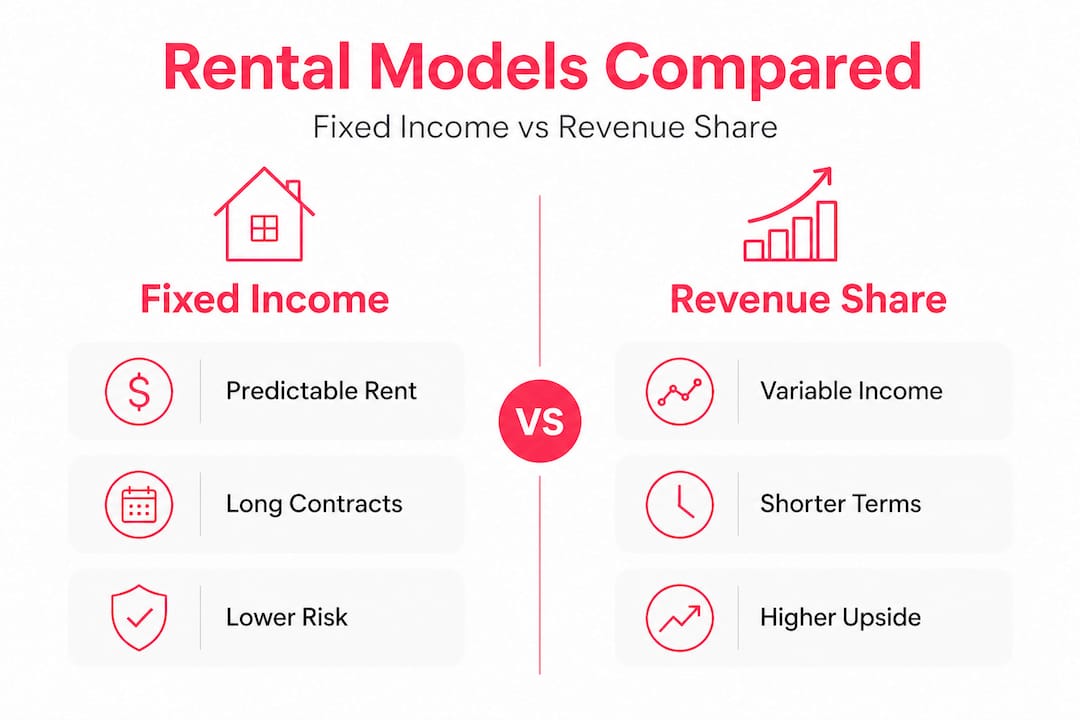
| Feature | Fixed income model | Revenue share model |
|---|---|---|
| Income predictability | High, fixed monthly rent | Variable, market-dependent |
| Upside potential | Capped at agreed rent | Uncapped, linked to performance |
| Vacancy risk to owner | None | Partial, depending on contract |
| Operational involvement | Minimal | Minimal (with operator) |
| Exit flexibility | Bound to lease term | Often more flexible clauses |
| Best suited for | Owners prioritising stability | Owners seeking performance upside |
Sweden’s tenant-protective residential framework means cash-flow volatility and exit risk can be considerably higher than in markets with more landlord-friendly legislation. This reality makes model selection more than a financial calculation. It is a risk management decision. Owners who choose revenue share must ensure the contract clearly defines how revenues are calculated, who bears costs, and what happens in prolonged low-occupancy periods.
Pro Tip: Before committing to either model, request a multi-year cash flow projection from your operator under both optimistic and conservative occupancy assumptions. The gap between those projections tells you how much volatility you are actually signing up for.
Understanding the differences between corporate housing vs Airbnb rental structures is also valuable here, as it clarifies why premium furnished properties often perform better within managed corporate frameworks than on consumer short-stay platforms. The Swedish rental apartment guide offers further context on how market positioning affects model performance.
Legal and operational pitfalls to avoid
Even the most attractive model fails if you miss these legal and operational tripwires. Sweden’s rental law is detailed and strictly enforced, and errors in contract drafting or rent-setting can have lasting consequences.
Here are the most critical pitfalls to address before signing any rental agreement:
-
Rent-setting errors: Setting rent above what the law permits for your property type exposes you to claims from tenants and potential orders to repay excess rent. For a bostadsrätt or privately-owned villa, the allowable rent must reflect cost-based reasonable rent, not simply what you believe the market will bear.
-
Vague contract terms: Contracts that fail to specify the letting period, furniture provision, maintenance responsibilities, and permitted use leave both parties exposed. In Sweden, ambiguities are generally resolved in the tenant’s favour.
-
Deposit limits: Swedish law restricts security deposits to two months’ rent for most arrangements. Charging more is not just unenforceable but can undermine the entire contract’s validity.
-
Ignoring notice period requirements: Swedish tenants have significant notice rights. Failing to include legally correct notice clauses, or misapplying them, can make it nearly impossible to regain your property within your intended timeline.
-
Incorrect property classification: Letting a property under the wrong legal category (for example, treating a bostadsrätt letting as if it were a commercial arrangement) can void protections you rely upon and create unforeseen liabilities.
“Edge case: choosing a revenue-share model for a premium furnished offering can be undermined if your underlying rent-setting rules cap the rent you can actually charge. The contract must remain legally supportable, or the revenue upside you expect may be litigated down.”
Professional management is one of the most reliable ways to avoid these errors. An experienced operator understands which contract structures withstand scrutiny, which rent levels are defensible, and how to document the letting correctly from day one. Reviewing the risks of unmanaged rentals in Sweden makes clear why self-management of premium properties carries disproportionate legal exposure. Equally, understanding flexible rental agreements for premium properties helps you negotiate terms that protect your ability to exit or adapt.
Pro Tip: Always have a Swedish-qualified lawyer review your rental contract before signing, even if you are working with an established operator. Independent review costs a fraction of what a dispute resolution process would.
Avoiding first-time landlord mistakes in Sweden comes down to preparation, correct classification of your property, and working with partners who have demonstrated compliance track records.
The decision process: Matching your property to the best model
Confidently avoiding common errors is vital, but now you need an actionable system for deciding which model fits your premium property. The following steps give you a structured approach to reach that decision.
-
Clarify your financial goals. Are you seeking maximum income, predictable monthly returns, or a long-term capital strategy? Your answer immediately narrows the model options. If stability is paramount, fixed income is almost always preferable. If you are comfortable with some variability in exchange for higher potential returns, revenue share may suit your profile.
-
Audit your property type and legal status. Establish whether your property is a hyresrätt, bostadsrätt, or freehold villa. Each carries different rent-setting rules. Your legal constraints should filter your model options before anything else.
-
Assess your operational appetite. Even with a managed arrangement, owners vary in how hands-off they want to be. Fixed income models typically involve minimal owner interaction. Revenue share models may require more engagement around strategy, pricing, and performance reviews.
-
Evaluate the operator’s track record. In Sweden, the operator’s understanding of Hyreslagen and their ability to manage compliance, pricing, and guest experience simultaneously is what separates good outcomes from costly ones. Specialised operators that handle end-to-end tenancy management are well-placed to navigate this complexity.
-
Model the financial outcomes. Use the table below to map your property’s likely performance under each model before making a final choice.
| Decision factor | Favours fixed income | Favours revenue share |
|---|---|---|
| Financial priority | Predictability | Upside performance |
| Risk tolerance | Low | Moderate to high |
| Market demand in your location | Uncertain or seasonal | Strong and consistent |
| Property management involvement | Fully delegated | Delegated with oversight |
| Exit timeline | Long-term (3-5 years) | Shorter, flexible |
Pro Tip: Check whether your property is genuinely ready for corporate rental in Sweden before committing to a model. Fit-out quality, location, and broadband connectivity significantly affect which model an operator will offer and at what terms.
Understanding medium-term rental in Sweden is also worthwhile, particularly for owners whose properties are well-suited to extended corporate stays. Medium-term furnished rentals for professionals often achieve pricing that neither short-term platforms nor long-term residential leases can match, making them a strategically attractive segment for premium property owners.

Why the ‘best’ rental model is sometimes the least obvious one
There is a tendency among property owners to gravitate towards whichever model appears most profitable on first inspection. Revenue share looks exciting when occupancy projections are strong. Fixed income looks safe when markets feel uncertain. But in practice, the best model for a Swedish premium property is often neither of these two in their pure form.
The most overlooked option is a structured partnership with an operator that incorporates elements of both approaches, or that evolves from one model to another as a property matures in the market. A new-to-market property may benefit enormously from the fixed income approach in the first two years, where operator expertise builds occupancy and reputation without exposing the owner to revenue risk. Once the property is established, renegotiating towards a revenue share split can unlock greater long-term returns.
What looks most profitable on paper can also fail under Swedish legal scrutiny. Owners who project revenue share returns based on unrestrained market pricing often discover that bruksvärde benchmarks or cost-based reasonable rent calculations constrain what can legally be charged. The revenue upside evaporates when contracts are challenged. This is not a theoretical risk. It is a documented reality for owners who move into furnished letting without legal guidance.
Working with professional operators also unlocks models that individual owners cannot access independently. An established operator can structure agreements that qualify as corporate housing rather than residential tenancy, which changes the legal landscape significantly in terms of rent-setting flexibility and exit conditions. Reviewing rental model case studies from the Swedish market quickly illustrates how much this structural distinction matters in practice.
The genuine recommendation here is to prioritise legal resilience over headline income figures. A model that survives scrutiny and runs smoothly for five years will almost always outperform one that promises more but collapses under its first legal challenge.
How Guestly Homes supports your rental model choice
If you want support putting this guidance into action with peace of mind, here is how Guestly Homes can help.
Guestly Homes is a premium, fully managed operator working directly with property owners across Sweden. We protect owners from the most common Swedish rental risks by managing compliance, guest relations, and property performance as a single integrated service.
Whether the fixed income model or revenue share structure is the right fit for your property, Guestly handles the complexities that make self-management risky. Our managed portfolio includes properties such as the Nordic Studio Comfort & Work, the 1 Bedroom Nordic Comfort, and the 1BR Nordic Apartment, each demonstrating how premium furnished properties perform at their best under professional management. Reach out to our team to discuss which model aligns with your property and your goals.
Frequently asked questions
What is the main risk of choosing the wrong rental model in Sweden?
The main risk is that tenant protections and rental caps could limit profits or leave you unable to regain your property when planned, particularly where residential tenancy rights apply.
Can I change rental models mid-contract if the market shifts?
You cannot usually switch models mid-contract without tenant agreement and legal review, as contracts are protected under Swedish tenancy law and changes require formal process.
How are revenues and allowable rents set for furnished properties?
Revenues and rents are set with reference to utility value or reasonable cost, and can be capped by property type and rental arrangement under Swedish law.
Is professional management required for corporate or premium furnished rentals?
It is highly recommended, as specialised operators handle complexities and compliance requirements that are genuinely difficult for individual owners to navigate alone.
Recommended
- Flexible rental agreements for premium properties in Sweden – Guestly Homes
- Before you rent out your property: essential guide for Swedish owners – Guestly Homes
- Top benefits of long-term rental for premium properties in Sweden – Guestly Homes
- Build a profitable rental portfolio in Sweden: 2026 guide – Guestly Homes
- Rental intermediaries: Maximise your income protection – Rental Income Insurance