

TL;DR:
- Handling accommodation emergencies involves quickly securing safe, temporary housing and documenting every step to ensure effective assistance. Recognizing the type of emergency—disaster, unsafe conditions, or travel disruption—determines the appropriate response and official resource. Preparation, including storing essential documents and understanding aid programs like FEMA, is crucial for managing crises efficiently.
Handling accommodation emergencies means swiftly securing safe, temporary housing and accessing the right resources to minimise disruption during travel or business stays. Whether you face disaster displacement, an unsafe hotel room, or a cancelled flight stranding you in an unfamiliar city, the difference between a manageable situation and a crisis often comes down to preparation and knowing exactly which steps to take. This guide covers accommodation crisis management from the ground up, drawing on official programmes such as FEMA, travel insurance protocols, and health and safety standards to give you a clear, composed path forward.
How to handle accommodation emergencies: recognise the type first
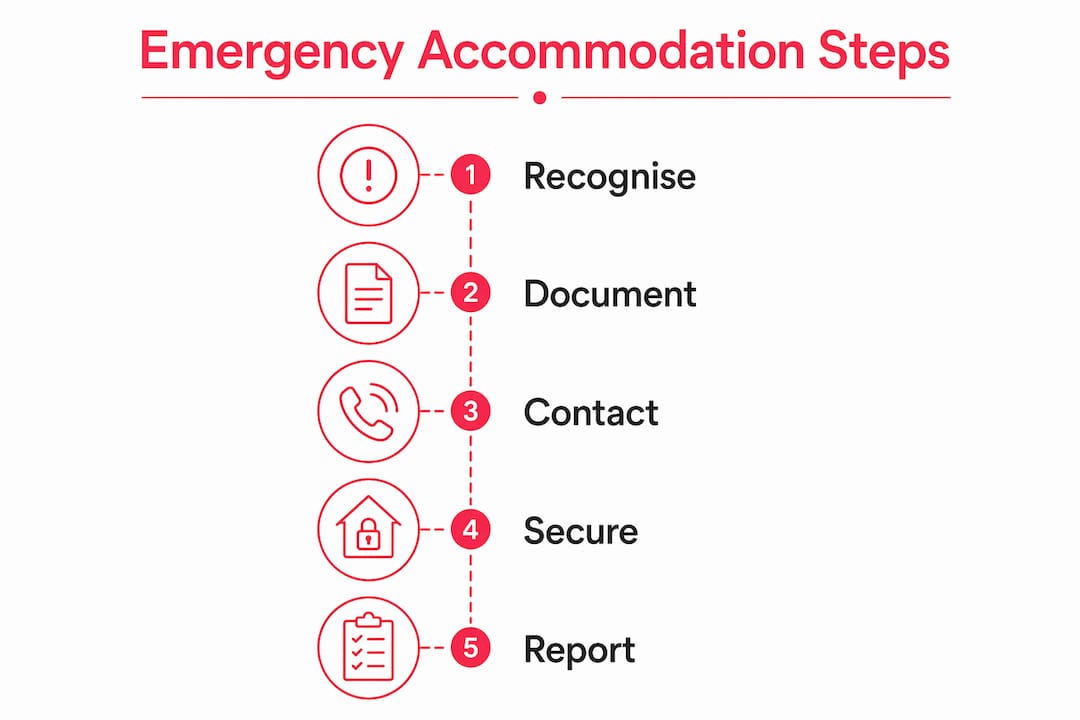
Accommodation emergencies fall into three distinct categories, and identifying yours quickly determines which resources you need. The three types are: disaster displacement (floods, fires, storms), unsafe or unsanitary lodging conditions, and travel disruptions such as flight cancellations that leave you without a confirmed place to stay. Each demands a different response, but all share one requirement: documentation from the very first moment.
Signs you are facing a genuine accommodation emergency:
- Structural damage, flooding, or fire rendering your property uninhabitable
- Visible mould, pest infestations, broken locks, or absent heating in cold climates
- A cancelled or severely delayed flight leaving you stranded overnight with no confirmed lodging
- A booking that does not exist on arrival, commonly called a “phantom booking”
- Evacuation orders issued by local authorities or emergency services
For disaster displacement, FEMA eligibility criteria require proof that your primary residence is in the declared disaster area and that the property is either unsafe or inaccessible. This proof requirement is not a formality. Without it, assistance applications stall. Photograph damage, collect any official notices, and record the date and time of every communication with landlords, hotels, or airlines.
Pro Tip: Create a dedicated folder on your phone labelled “Emergency Docs” before you travel. Store copies of your booking confirmations, insurance policy number, passport photo page, and insurer’s emergency contact number. Retrieving these under stress takes seconds rather than minutes.

For business professionals, the stakes extend beyond personal comfort. A displaced project team or stranded executive affects deliverables, client relationships, and company reputation. Treating accommodation crisis management as a professional risk, not merely a travel inconvenience, changes how seriously you prepare.
How do you secure emergency accommodation after a disaster?
When a natural disaster or major crisis displaces you from your primary residence, the most structured path to emergency housing runs through official assistance programmes. FEMA’s Displacement Assistance covers up to 14 days of lodging costs, including hotel or motel stays and costs associated with staying with family or friends, provided you can prove displacement or unsafe housing conditions. This is bridge funding, not a long-term solution, and understanding that distinction matters for planning.
The step-by-step process for securing FEMA assistance:
- Register immediately. Apply at DisasterAssistance.gov or call the FEMA helpline as soon as the disaster declaration is confirmed for your area. Delays reduce your options.
- Gather proof of occupancy. Utility bills, a lease agreement, or a mortgage statement tied to the damaged address are all acceptable. Collect at least two forms.
- Document household size. Room allocation under FEMA programmes is based on household size, so list every person in your household accurately during registration.
- Prepare for the inspection. FEMA housing inspectors typically arrive within 7 to 10 days of your application. The inspection lasts approximately 45 minutes. You must be present, and the inspector collects data rather than making an eligibility decision on the spot.
- Plan your transition. Displacement Assistance is a one-time payment. After the initial 14 days, you will need to apply for FEMA Rental Assistance or identify private alternatives.
The table below summarises the key FEMA programme details for quick reference.
| Programme | Varaktighet | Covers | Key requirement |
|---|---|---|---|
| Displacement Assistance | Up to 14 days | Hotel, motel, staying with relatives | Proof of displacement and unsafe housing |
| Transitional Sheltering Assistance | Short-term, extended | Participating hotels, room by household size | Proof of displacement and damaged housing |
| Rental Assistance | Longer-term | Private rental costs | Post-inspection eligibility decision |
For those exploring types of temporary housing beyond official programmes, options range from serviced apartments to extended-stay hotels, each with different cost profiles and availability timelines.
Pro Tip: FEMA inspectors focus on data collection, not on-the-spot decisions. Applicants who arrive with organised documentation, including photos, utility bills, and a written account of the damage, move through the process more smoothly than those who rely on verbal explanations alone.
What should you do when a flight cancellation leaves you without lodging?
Travel disruptions represent the most common form of accommodation emergency for frequent travellers and business professionals. When a flight cancellation or severe delay leaves you stranded, the first 60 minutes determine the quality of your outcome. Speed and documentation are the two non-negotiable factors.
Immediate steps to take when stranded:
- Contact your travel insurer within 24 hours. Travel insurance policies with trip interruption cover typically require notification within this window to validate emergency accommodation claims. Missing this deadline can void your reimbursement.
- Request written confirmation from the airline. An email or printed statement confirming the cancellation and its cause is the foundation of any insurance or compensation claim.
- Understand your rights under EU261 or UK261. Passengers on flights departing from or arriving into the UK or EU are entitled to care, including meals and accommodation, when cancellations are within the airline’s control.
- Book alternative lodging promptly using platforms that show real-time availability. Hostelworld, Booking.com, and similar services allow rapid last-minute bookings across budget ranges.
- Keep every receipt. Hotel invoices, taxi fares to alternative accommodation, and meal costs during the delay are all potentially reimbursable under travel insurance with emergency assistance cover.
For corporate travellers, the calculus is slightly different. Your company’s travel policy may specify approved hotels or spending limits. Contact your travel manager or HR coordinator before booking independently, as unapproved expenditure can complicate reimbursement. If your team needs short-term rental alternatives that accommodate multiple people at once, a serviced apartment often proves more cost-effective than booking several separate hotel rooms at short notice.
Pro Tip: Save your insurer’s 24-hour emergency assistance number as a contact in your phone before every trip, not in a document you will need to search for. Timely communication with insurers dramatically increases the likelihood of receiving assistance for emergency accommodation.
How do you report unsafe or unsanitary accommodation conditions?
Unsafe lodging is an accommodation emergency that travellers often underestimate because the threat is less dramatic than a flood or a cancelled flight. Mould, broken locks, absent fire safety equipment, or pest infestations are all grounds for formal complaint and, in serious cases, immediate relocation.
The reporting process follows a clear hierarchy. Start with the property manager or hotel duty manager, presenting your documented evidence. If the response is inadequate, escalate to local authorities. In many cities, dedicated hotlines handle lodging complaints directly. Minneapolis 311, for example, is a public health reporting channel specifically for lodging issues, and similar services exist across most major cities. Photographs with visible timestamps are the most effective form of evidence at every stage of this process.
For fire and power-related emergencies inside hotels, the safety infrastructure matters more than most guests realise. Photoluminescent exit signage and emergency lighting remain effective for 90 minutes after a power loss, giving guests a reliable evacuation window even in complete darkness. This is why verifying your evacuation route on arrival is not overcaution. It is the single most time-efficient safety action you can take when checking into any unfamiliar property.
“Document everything before you report anything. A photograph taken at 11:47 pm carries more weight with a health authority than a verbal account given the following morning. The timestamp is your evidence.”
When dealing with lodging issues that involve health risks, do not wait for the property to resolve the matter internally. Local authority involvement creates an official record, which protects you legally and strengthens any insurance or compensation claim. For business travellers, this record also protects the company if the stay was booked on corporate account.
Key takeaways
Effective accommodation crisis management requires early documentation, knowledge of official assistance programmes, and prompt communication with insurers and authorities.
| Punkt | Detaljer |
|---|---|
| Document from the first moment | Photographs with timestamps are the foundation of every successful claim or complaint. |
| Know your FEMA entitlements | Displacement Assistance covers up to 14 days and is a one-time payment; plan your transition early. |
| Notify your insurer within 24 hours | Travel insurance claims for emergency accommodation are frequently invalidated by delayed notification. |
| Verify safety on arrival | Check evacuation routes when you check in; emergency lighting remains effective for 90 minutes post-power loss. |
| Escalate unsafe conditions formally | Local authority hotlines create an official record that protects you legally and supports reimbursement claims. |
What experience has taught me about staying calm under pressure
I have seen travellers and business professionals make the same mistake repeatedly: they wait to see if the situation resolves itself before taking action. A flooded ground floor, a cancelled flight, a hotel room with a broken lock. The instinct is to hope the problem disappears. It rarely does, and the delay costs time, money, and options.
The most composed people I have observed in accommodation emergencies share one habit. They treat documentation as a reflex, not a task. Before they make a single phone call, they have already photographed the damage, screenshotted the cancellation notice, or noted the name of the person they spoke to at the front desk. This is not anxiety. It is preparation expressed as calm, methodical action.
There is also a nuance in official assistance programmes that most guides skip over. FEMA Displacement Assistance is designed as a bridge, not a resolution. Recipients who treat it as a solution rather than a starting point often find themselves without housing when the 14-day window closes. The professionals who manage this well are the ones who begin researching long-term accommodation options on day one, not day thirteen.
Travel insurance is similarly misunderstood. The policy document matters far less than the emergency assistance phone number printed on your insurance card. That number connects you to a team whose job is to arrange accommodation on your behalf. Most travellers never call it. The ones who do resolve their emergencies faster and with less personal expenditure than those who navigate the process alone.
My honest view is that accommodation emergencies are not primarily logistical problems. They are information problems. The traveller or professional who knows which number to call, which document to produce, and which authority to contact is never truly stranded. Preparation is the only reliable emergency solution.
— Joakim
When you need reliable accommodation without the uncertainty
Accommodation emergencies are stressful precisely because they remove the certainty you planned around. Guestlyhomes exists to restore that certainty. Whether you are a business professional whose project accommodation has fallen through or a team coordinator who needs to rehouse a group at short notice, Guestlyhomes offers fully managed, high-standard properties across Sweden and the Nordics, available for stays from 10 nights upwards.
Every Guestlyhomes property is maintained to a consistent five-star standard, with one point of contact and no operational surprises. For corporate bookers who need precision and speed, the process is direct: submit a housing request and receive a response without the back-and-forth that emergency situations cannot afford. For executives and project teams who need a space that supports performance rather than disrupts it, Guestlyhomes delivers exactly that, quietly and reliably.
FAQ
What is an accommodation emergency?
An accommodation emergency is any situation in which your planned or current lodging becomes unavailable, unsafe, or inaccessible, requiring immediate action to secure alternative housing. Common causes include natural disasters, unsafe conditions, and flight cancellations.
How quickly does FEMA provide emergency housing assistance?
FEMA Displacement Assistance is a one-time payment covering up to 14 days of lodging costs, with housing inspectors typically visiting within 7 to 10 days of application to assess eligibility.
Does travel insurance cover emergency accommodation?
Most travel insurance policies with trip interruption or flight cancellation cover include emergency accommodation, provided you notify your insurer within 24 hours of the disruption and retain all receipts and documentation.
What should I do if my hotel room is unsafe?
Report the issue immediately to the hotel duty manager with photographic evidence, then escalate to a local authority hotline if the response is inadequate. Verify your evacuation route on arrival, as emergency lighting remains effective for 90 minutes after a power failure.
How do I find last-minute emergency accommodation?
Use real-time booking platforms such as Booking.com or Hostelworld for immediate availability, contact your travel insurer’s 24-hour assistance line for managed arrangements, and explore temporary accommodation options including serviced apartments for stays longer than a few nights.