


TL;DR:
- Corporate housing offers fully furnished, professional residences for stays of 30 days or more, providing a more stable and comfortable alternative to hotels. It includes utilities, kitchens, and furnishings, making it ideal for relocating employees, project teams, and executives, especially for stays averaging 84 nights. Selecting the right property type and provider model depends on assignment length, location, and group size, ensuring cost-effective and efficient accommodation.
Corporate housing is defined as fully furnished, professionally managed residential accommodation designed for extended stays of 30 days or longer. The industry term used by the Corporate Housing Providers Association describes it as a distinct lodging category that fills the gap between short hotel stays and traditional long-term leases. For HR leads, project managers, and team coordinators, understanding this category is the first step towards making confident, cost-effective accommodation decisions for employees.
The average corporate housing stay runs approximately 84 nights. That figure alone explains why hotels fall short. A hotel is built for transience. Corporate housing is built for living.
What is corporate housing and how does it work?
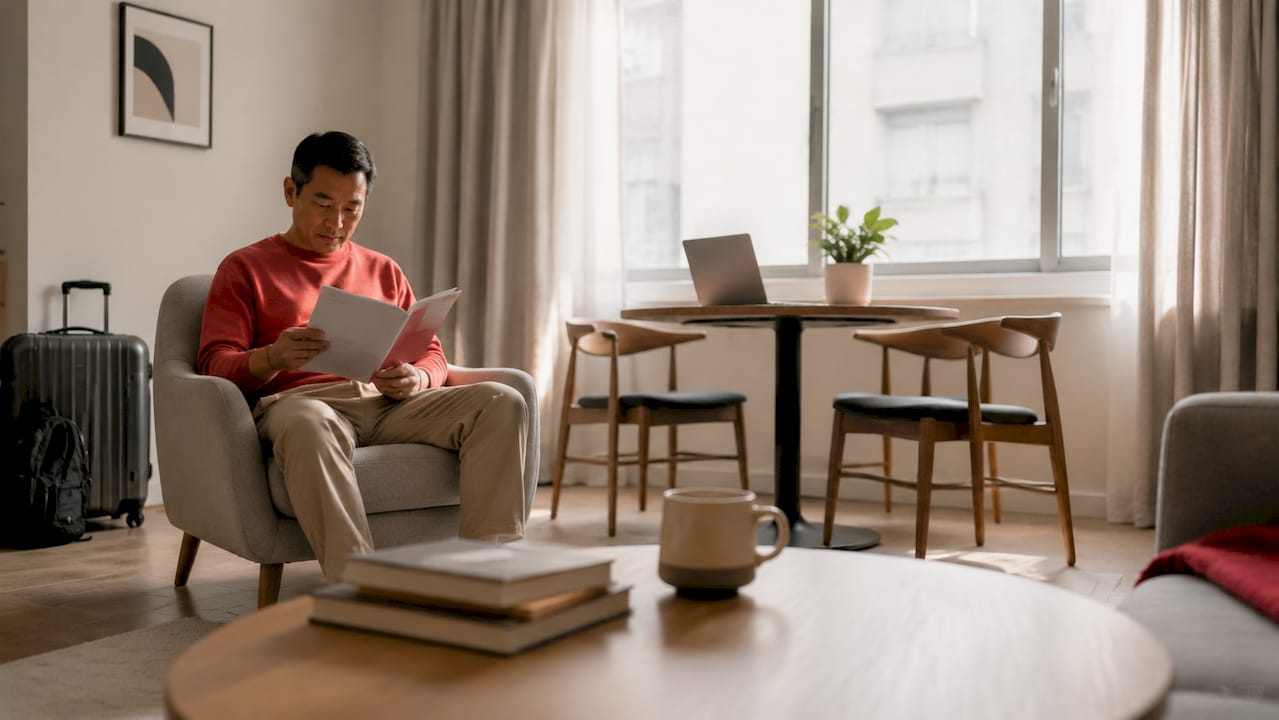
Corporate housing is a fully furnished, professionally managed accommodation solution for professionals on extended assignments. Properties range from serviced apartments and condominiums to single-family homes and villas. The category is also referred to as temporary corporate accommodation or extended-stay housing in industry contexts.
The defining characteristic is the all-inclusive nature of the arrangement. Corporate housing typically includes furniture, housewares, utilities, high-speed internet, workstations, and kitchen facilities. Guests arrive and begin working. There is no assembly required and no utility account to open.
Users of corporate housing span a wide range of professional contexts. Relocating employees, project-based consultants, executives on interim assignments, military personnel, and entire project teams all rely on this accommodation type. The residential setting provides stability that a hotel corridor simply cannot replicate.
What varieties of corporate housing exist?
The corporate housing market offers several distinct property types and provider models. Understanding the differences helps coordinators match the right solution to the right assignment.
Property types available:
- Serviced apartments: The most common format. Self-contained units within a managed building, typically with concierge-level support and consistent standards.
- Single-family homes: Suited to employees relocating with families or requiring more space and privacy over longer assignments.
- Villas: Premium properties offering multiple bedrooms, outdoor space, and high-specification interiors. Particularly suited to senior executives or small teams.
- Team accommodation: Villas or adjacent units configured for groups working on shared projects, enabling collaboration outside working hours.
Provider models also differ significantly. Client-centred providers curate bespoke solutions across multiple locations, making them well-suited to large-scale or geographically diverse deployments. Unit-centred providers manage their own inventory, offering predictability and consistency for fixed-location assignments. The right model depends on how frequently your organisation deploys staff and across how many locations.
Pro Tip: If your team travels to the same city repeatedly, a unit-centred provider gives you consistency. If your assignments span multiple regions, a client-centred provider saves significant coordination time.
| Accommodation type | Best suited for | Key advantage |
|---|---|---|
| Serviced apartment | Individual professionals | Consistent standards, managed support |
| Single-family home | Familjer som flyttar | Space, privacy, neighbourhood feel |
| Villa | Executives or small teams | Premium specification, group capacity |
| Team accommodation | Project groups | Collaboration, shared amenities |
| Extended stay hotel | Short assignments under 30 days | Flexibility, no lease commitment |
Corporate housing supports team stays through villas or multiple adjacent units, enabling groups to maintain proximity and shared routines throughout a project.
Corporate housing vs hotels and private rentals
Corporate housing differs from hotels and private rentals in ways that matter directly to the quality of an employee’s stay and a company’s budget.
| Faktor | Corporate housing | Hotellet | Private rental |
|---|---|---|---|
| Minimum stay | 30+ dagar | 1 night | 6–12 months typically |
| Inredning | Fully furnished, all-inclusive | Room only | Usually unfurnished |
| Kitchen facilities | Fullt utrustat kök | Begränsad eller ingen | Fullt utrustat kök |
| Utilities included | Ja | Ja | Usually separate |
| Integritet | Hög | Låg | Hög |
| Flexibilitet | Moderat | Hög | Låg |
| Cost for 60+ nights | Lower per night | Higher per night | Comparable but less flexible |
Hotels serve transient guests with short stays in mind. Corporate housing provides a stable, residential environment with far more living space and privacy. For a professional spending 84 nights away from home, the difference in daily quality of life is substantial.
Private rentals offer space and privacy but typically require long minimum terms, unfurnished properties, and separate utility contracts. Corporate housing removes all of that friction. The accommodation is ready on arrival, and the provider manages everything operationally.
Key advantages of corporate housing over hotels:
- Significantly more living space per night of cost
- Full kitchen reduces daily food expenditure
- Dedicated workstation supports productivity
- No shared corridors or lobby traffic
- Consistent, home-like environment reduces fatigue on long assignments
For a detailed comparison of serviced apartments and hotels, the differences in cost and comfort become even clearer across stays of 30 days or more.
What are the benefits of corporate housing?
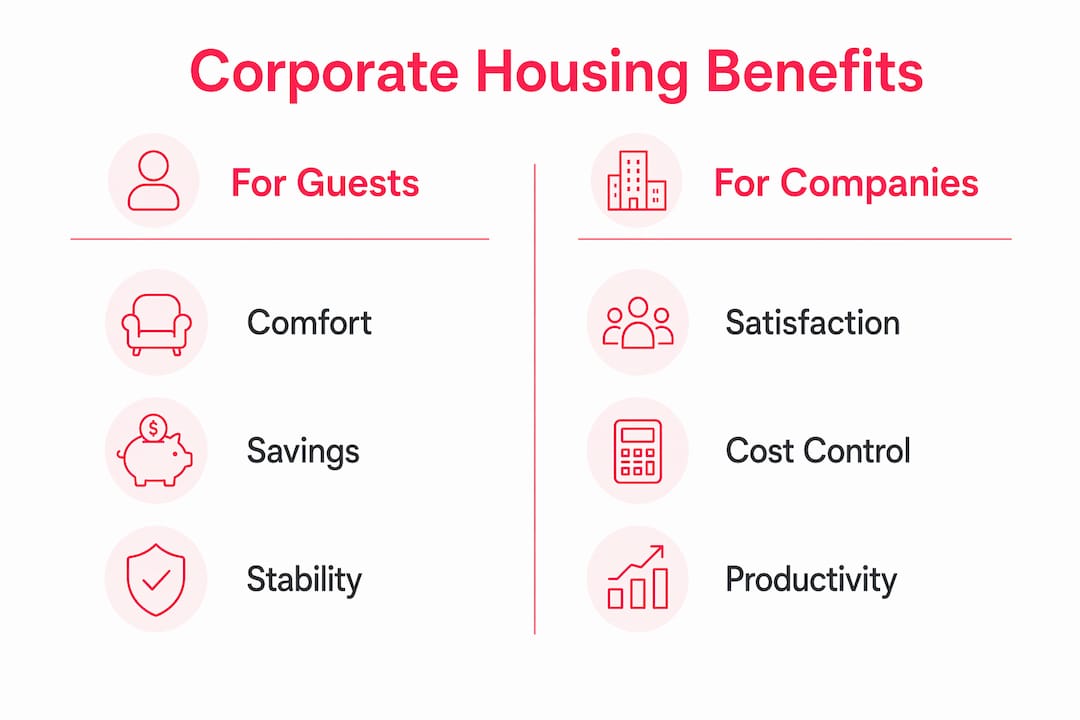
Corporate housing delivers measurable benefits across three groups: the guest, the company, and the property owner. Each group gains something distinct.
Benefits for guests
Guests consistently report that the homely atmosphere, cost savings over long hotel stays, and included amenities ease the experience of living away from home. A full kitchen alone reduces daily food costs considerably. A private living space reduces the mental fatigue that comes with hotel living over weeks or months.
Comfort and stability also affect performance. An employee who sleeps well, cooks their own meals, and has a quiet workspace arrives at the office ready to contribute. Corporate housing supports that directly. For guidance on maximising guest comfort in these settings, the environment and furnishing quality matter as much as location.
Benefits for companies
Corporate housing improves employee satisfaction during relocations and extended projects. Satisfied employees perform better and are more likely to accept future assignments. That has a direct impact on talent retention and operational flexibility.
Cost control is equally significant. Nightly rates for corporate housing over a 60-night stay are consistently lower than equivalent hotel accommodation. Companies also benefit from consolidated billing, professional guest accountability, and bookings arranged directly with providers rather than through casual platforms. This differs fundamentally from vacation rentals and provides greater reliability for corporate clients.
Pro Tip: When budgeting for an extended assignment, calculate the total cost of a hotel stay including meals and laundry. Corporate housing with a full kitchen and in-unit laundry typically costs less over 45 nights or more.
Benefits for property owners
Property owners benefit from lower tenant turnover, consistent income, and professional management when working with corporate housing providers. Providers handle maintenance, guest screening, and lease compliance. The owner receives predictable revenue without managing day-to-day operations. For owners of premium properties, corporate housing is a more stable and professionally managed alternative to short-term holiday letting.
How to choose the right corporate housing
Selecting corporate housing requires a clear process. The wrong choice creates friction for employees and cost overruns for the company. Key selection factors include duration, location, provider model, service level, and lease terms.
-
Define the stay duration. Assignments under 30 days may suit extended-stay hotels. Assignments of 30 days or more benefit from dedicated corporate housing with full residential amenities.
-
Assess location requirements. Proximity to the worksite matters, but so does access to transport, supermarkets, and amenities. A property that saves 40 minutes of daily commuting time has real productivity value.
-
Choose the right provider model. For fixed-location, recurring deployments, a unit-centred provider offers consistency. For multi-city or large-scale programmes, a client-centred provider manages complexity on your behalf.
-
Evaluate inclusions carefully. Confirm that utilities, internet, furnishings, and housewares are included. Hidden costs for parking, laundry, or cleaning can erode budget savings quickly.
-
Review lease terms and exit clauses. Corporate assignments change. A provider with flexible exit terms protects the company if a project ends early or an employee’s plans shift.
-
Plan team bookings in advance. Group accommodation, particularly villas or adjacent units, books quickly in high-demand locations. Secure team accommodation at least four to six weeks ahead of deployment.
-
Verify provider accountability. Corporate housing bookings arranged through professional providers offer greater reliability than casual platforms. Confirm the provider’s management standards, guest screening process, and support availability.
For a practical checklist, Guestlyhomes has published corporate housing selection tips that address common pitfalls for business travel coordinators.
Key takeaways
Corporate housing is the most cost-effective and comfortable solution for professional stays of 30 days or longer, provided the provider model, inclusions, and lease terms are matched carefully to the assignment.
| Punkt | Detaljer |
|---|---|
| Average stay length | Corporate housing stays average 84 nights, making full residential amenities essential. |
| All-inclusive inclusions | Utilities, furnishings, internet, and kitchen facilities are standard in quality corporate housing. |
| Provider model matters | Client-centred providers suit multi-location deployments; unit-centred providers suit fixed locations. |
| Cost advantage | Corporate housing costs less than hotels over stays of 45 nights or more, especially with kitchen use. |
| Team accommodation | Villas and adjacent units support group projects and are best booked four to six weeks in advance. |
What I have observed about corporate housing adoption
The corporate housing industry generated $10 billion in revenue in 2019 in the US alone. That figure reflects a market that had already matured well before the pandemic accelerated remote and project-based working patterns. The growth since then has been consistent, and the reasons are not complicated.
What I find most underestimated by bookers is the productivity argument. Companies spend considerable effort optimising office environments and then place employees in hotel rooms for two months. The disconnect is real. A professional working from a quiet apartment with a proper desk, a full kitchen, and no corridor noise simply performs differently. The accommodation is part of the work environment.
The second thing I see overlooked is provider selection. Not all corporate housing providers operate to the same standard. A property that looks well-presented in photographs but lacks responsive management creates problems that fall back on the HR coordinator. Partnering with a provider who operates with genuine professionalism, clear communication, and consistent standards removes that risk entirely.
For large or remote teams, the villa model deserves more attention than it typically receives. A group of six engineers sharing a well-specified villa costs less per person than six individual hotel rooms, and the shared environment supports the kind of informal collaboration that structured meetings rarely achieve.
The market is growing because the logic is sound. Extended stays need residential solutions. The companies that recognise this early build a genuine operational advantage in how they deploy and retain talent.
— Joakim
Explore premium corporate accommodation with Guestlyhomes
Guestlyhomes operates a portfolio of fully managed, high-specification properties across Sweden, designed specifically for professionals, project teams, and executives on extended assignments.
Whether you need a five-bedroom business villa for a project team, a luxury villa with lake views for an executive stay, or a four-bedroom villa with garden for a longer group deployment, Guestlyhomes provides hotel-grade consistency in a residential setting. Every property is fully furnished, all-inclusive, and managed end-to-end. One contact, complete accountability, and a stay that supports performance from day one.
FAQ
Vad är företagsbostäder?
Corporate housing is fully furnished, professionally managed residential accommodation for stays of 30 days or longer. It includes utilities, furnishings, kitchen facilities, and internet as standard.
How long is a typical corporate housing stay?
The average corporate housing stay is approximately 84 nights. Stays typically range from one to six months depending on the assignment.
How does corporate housing differ from a hotel?
Hotels serve short-term, transient guests with limited living space. Corporate housing provides a residential environment with full kitchen, private living areas, and significantly more space, at a lower nightly cost over extended stays.
What types of properties are available in corporate housing?
Corporate housing options include serviced apartments, single-family homes, villas, and team accommodation. The right type depends on group size, assignment length, and location requirements.
How do I choose the right corporate housing provider?
Assess duration, location, inclusions, lease flexibility, and provider accountability. Client-centred providers suit multi-location programmes; unit-centred providers suit fixed, recurring deployments.