


TL;DR:
- Effective accommodation planning for large project teams requires early requirement definition, choosing suitable housing formats, and allowing sufficient lead times to ensure team cohesion, safety, and well-being.
- Matching accommodation types, such as villas or apartments, to team size and maintaining centralized communication reduces logistics complexity and enhances performance.
Accommodation planning for large project teams is a strategic, multi-stage process that determines where your people sleep, how they travel, and whether the project runs on schedule or unravels under logistical pressure. Done well, it protects team cohesion, controls costs, and removes a significant source of friction from an already complex project. Done poorly, it fragments teams, inflates budgets, and creates the kind of daily frustration that compounds over weeks. This guide covers how to plan accommodation for large project teams from first principles: defining requirements, comparing housing configurations, managing lead times, and keeping people comfortable through extended stays.
How to plan accommodation for large project teams: start with requirements
Before you contact a single supplier or browse a single property, early requirement definition accelerates supplier negotiations and delivery timelines. That means locking down four variables before anything else: peak headcount, project duration, location constraints, and the amenity mix your team genuinely needs.
Peak headcount is not the number of people on the project. It is the maximum number of people who will be on-site simultaneously, accounting for staggered arrivals, rotating shifts, and phased mobilisation. A 40-person project may only ever have 28 people in residence at once. Booking for 40 wastes budget; booking for 25 creates a crisis when the third phase mobilises early.
Duration shapes everything from contract type to cost structure. A six-week stay opens different options than a six-month deployment. Longer stays justify purpose-built or fully managed serviced accommodation, where weekly cleaning, maintenance, and utility management are included. Shorter stays may suit hotel blocks or apart-hotels, though these carry trade-offs in bonding and shared space.
Geographic constraints and site access matter more than most planners anticipate. Consider whether the accommodation must be within a specific radius of the worksite, whether public transport is viable, and whether seasonal weather affects road access. In Nordic contexts, winter conditions can make a property that looks convenient on a map genuinely difficult to reach at 06:30 on a January morning.
Use a structured welfare checklist to define your amenity baseline before approaching suppliers. Welfare standards drawn from frameworks like the Maritime Labour Convention inspection model cover sleeping quarters, sanitary facilities, mess and kitchen areas, laundry, recreation space, and medical provisions. Applying this kind of structured thinking to land-based project accommodation raises the quality of your brief and reduces the risk of discovering gaps after your team has moved in.
- Sleeping arrangements: private rooms or shared, minimum floor area per person, noise separation between sleeping and common areas
- Kitchen and dining: self-catering capacity, number of hobs and refrigerators relative to headcount, dining table space
- Sanitary facilities: ratio of showers and toilets to occupants, hot water reliability
- Recreation and quiet space: areas for decompression, outdoor access where possible
- Connectivity: reliable broadband for remote working, video calls, and project management tools
- Medical and safety: first aid provisions, proximity to healthcare, fire safety compliance
Pro Tip: Build your requirements brief as a scored checklist rather than a wish list. Assign each amenity a priority weighting so that when you compare properties, you are comparing against a consistent standard rather than gut feel.
Which accommodation format suits your team size?
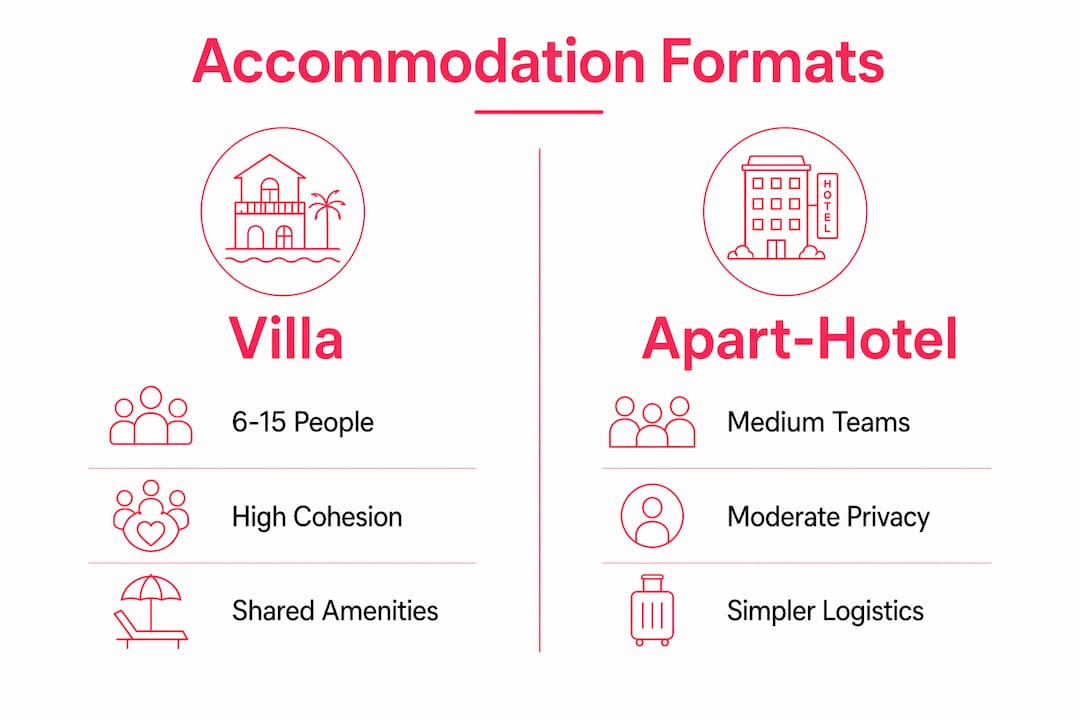
Accommodation type directly impacts team bonding: villas suit groups of 6 to 15 people, apart-hotels work well for teams of 15 to 30, and larger dedicated retreat or residential centres serve teams of 20 or more. Understanding these thresholds helps you match the housing format to your actual group size rather than defaulting to whatever is easiest to book.

The table below compares the three primary configurations for group accommodation strategies across the dimensions that matter most to project managers.
| Format | Best team size | Cohesion impact | Logistical complexity | Admin overhead |
|---|---|---|---|---|
| Large villa or house | 6 to 15 people | High: shared meals, informal bonding | Low: single address, one contract | Matala |
| Apartments in one building | 15 to 30 people | Medium: shared entrance and common areas | Low to medium: one location, multiple units | Medium |
| Multiple scattered properties | 30 or more | Low: fragmented daily experience | High: transport coordination, multiple contacts | Korkea |
| Hotel block booking | Any size | Low to medium: corridor culture, no shared kitchen | Low: single contract | Low to medium |
| Purpose-built retreat centre | 20 or more | High: designed for group living | Medium: often remote, requires transport planning | Medium |
Large villas create the conditions for genuine team cohesion. Shared kitchens, communal living areas, and the simple fact of eating breakfast together build the kind of informal trust that formal team-building exercises rarely achieve. The constraint is scale: a villa that comfortably houses 12 people becomes crowded and noisy at 18, and the logistics of a single kitchen serving 20 people across different shift patterns quickly become unworkable.
Apartments within a single building offer a practical middle ground. Each person or pair has privacy and a degree of autonomy, while shared entrance areas, communal lounges, and proximity create enough overlap for team culture to develop. This format also simplifies administration: one building address, one point of contact for maintenance, and one set of access arrangements for staggered arrivals.
Multiple scattered properties are sometimes unavoidable for very large teams, but they carry real costs. Poor communication and fragmented housing are among the most common logistical risks in large group accommodation, and splitting a team across three or four addresses amplifies both. Transport coordination becomes a daily task, informal communication drops, and the sense of shared purpose that sustains teams through difficult project phases weakens over time. If you must use multiple locations, keep them within walking distance of each other where possible and designate one as the social hub.
Hotel block bookings are logistically straightforward but are the least conducive to team bonding. There is no shared kitchen, no communal living room, and the transactional nature of hotel stays does not encourage the informal interaction that builds team resilience. They work well for short mobilisation phases or for senior individuals who need a higher standard of privacy, but they are a poor default for extended project stays.
Pro Tip: When evaluating rental versus resort-style options for larger groups, consider the trade-offs between flexibility and amenity carefully. Rental properties give you kitchen access and a home-like environment; resort-style venues offer managed services but less control over daily routines.
What lead times should you plan for?
The single most common mistake in managing accommodation for project teams is treating it like a hotel reservation. Overlooking the multi-step supply chain for temporary or purpose-built accommodation, covering design, production, shipping, and assembly, causes costly delays and forces last-minute compromises that affect both cost and quality.
For temporary or modular site accommodation, the procurement timeline follows a predictable sequence:
- Requirements sign-off and design confirmation: 1 to 2 weeks. This is the stage most planners rush. Incomplete briefs at this stage generate change requests later, which extend every subsequent phase.
- Production: 4 to 8 weeks. Modular units, fitted kitchens, and welfare facilities are manufactured to specification. Lead times vary by supplier capacity and order volume.
- Shipping and logistics: 2 to 6 weeks depending on origin, destination, and transport mode. Nordic and remote sites often sit at the longer end of this range.
- On-site assembly and commissioning: 1 to 3 days per unit, plus time for utilities connection, inspection, and sign-off before occupancy.
Staging shipments prevents logistical bottlenecks on site and allows you to begin occupancy in completed units while later phases are still being assembled. For large-scale deployments, progressive installation is not just a convenience. It is a risk management strategy.
For serviced apartments and managed villas, the timeline is shorter but the principle holds. Properties with the right specification, in the right location, and with flexible booking terms for staggered arrivals are not always immediately available. Locking requirements early is the single biggest lever for securing timely, budget-compliant accommodation. Starting the search six to eight weeks before mobilisation is a minimum for teams of 15 or more; twelve weeks is safer for groups above 30.
Practical logistics and wellbeing for extended project stays
The booking is only the beginning. The daily experience of your team, across weeks or months, is shaped by decisions that sit outside the accommodation contract itself. Proximity to worksites, parking availability, and accessible transportation are the practical foundations on which everything else rests.
Effective team accommodation balances privacy for decompression with shared spaces for collaboration, and the design features that support this include flexible partitions, breakout rooms, soundproofing, and zoned lighting. When evaluating properties, look beyond the bedroom count and assess whether the layout actually supports both focused rest and informal interaction. A property with ten bedrooms and a single open-plan living area will generate noise conflicts within a fortnight.
Key practical considerations for extended team stays:
- Transport and parking: Confirm parking capacity against the number of team vehicles. For urban sites, map public transport routes and journey times to the worksite at the hours your team actually travels.
- Kitchen and dining: Self-catering reduces daily costs significantly over a long project and creates natural opportunities for team interaction. Assess whether the kitchen can realistically serve your headcount across different shift patterns.
- Privacy and noise management: Separate sleeping areas from social areas physically where possible. Teams working rotating shifts need genuine acoustic separation between those sleeping and those active.
- Recreation and outdoor access: Access to outdoor space, a gym, or simply a quiet room for reading reduces the psychological compression of long deployments. This is not a luxury consideration. It is a wellbeing one.
- Safety and compliance: Crew accommodation inspections should cover sleeping quarters, sanitary and mess facilities, laundry, recreation, and medical amenities. Apply the same rigour to land-based project housing, particularly for deployments exceeding four weeks.
“The accommodation you choose is not just a place to sleep. It is the environment in which your team recovers, reconnects, and prepares for the next day’s work. That environment either supports performance or quietly erodes it.”
Communication logistics deserve specific attention. Centralising booking communications and maintaining updated arrival rosters facilitates smooth staggered arrivals and reduces the chaos of multiple people contacting multiple suppliers with conflicting information. Designate a single point of contact for accommodation queries, use a shared platform for arrival schedules and room assignments, and build flexible cancellation provisions into your contracts to absorb the roster changes that are inevitable on complex projects.
Pro Tip: Build a contingency buffer of 10 to 15 per cent additional capacity into your accommodation plan from the outset. Projects rarely shrink; they expand. Having pre-agreed overflow options with your supplier is far less disruptive than scrambling for additional beds mid-project.
For practical guidance on keeping teams comfortable across longer assignments, the extended stay comfort guide from Guestlyhomes covers amenity selection and wellbeing considerations in detail.
Key takeaways
Effective accommodation planning for large project teams requires early requirement definition, the right housing format for your team size, realistic lead times, and daily logistics that actively support wellbeing and performance.
| Kohta | Yksityiskohdat |
|---|---|
| Define requirements before supplier contact | Lock headcount, duration, location, and amenity needs first to avoid over-ordering and budget surprises. |
| Match housing format to team size | Villas suit 6 to 15 people; apartments in one building work for 15 to 30; scattered properties increase complexity significantly. |
| Treat accommodation as a logistics deliverable | Plan for 8 to 16 weeks of lead time for temporary or modular accommodation, not a simple reservation. |
| Balance privacy with shared space | Properties need acoustic separation between sleeping and social areas to support both rest and team cohesion. |
| Centralise communication and roster management | One point of contact and a shared arrival platform reduces errors and protects against last-minute disruption. |
What I have learned from planning team accommodation at scale
Joakim’s perspective
The most expensive mistake I see project managers make is treating accommodation as an afterthought. The project plan is detailed to the hour; the accommodation plan is a spreadsheet with three columns. That imbalance creates problems that are entirely avoidable.
What I have found consistently is that the teams who perform best over long deployments are the ones whose accommodation was planned with the same rigour as the project itself. Not because comfort is a luxury, but because fatigue, friction, and fragmentation are project risks. A team that is poorly housed is a team that is already managing a secondary problem before the working day begins.
The fragmented housing model, spreading a team across multiple properties to save money or because nothing larger was available, is the configuration I would avoid above all others. The cost savings rarely survive contact with the transport coordination overhead, the communication gaps, and the slower team cohesion that results. I have seen projects where the accommodation fragmentation was a direct contributor to communication failures on site. The connection is real, even if it is rarely documented.
The other lesson is about timing. The extended stay booking workflow is not something you can compress. Suppliers need time, properties need to be available, and your team needs certainty. Starting early is not caution. It is competence.
Scandinavian welfare standards offer a useful frame here. The structured, inspection-oriented approach to crew accommodation, covering every facility category from sleeping quarters to medical provisions, reflects a philosophy that worker welfare is an operational input, not a soft benefit. That philosophy produces better outcomes. It is worth adopting regardless of where your project sits.
— Joakim
How Guestlyhomes supports project teams on extended stays
Project managers working across Sweden and the Nordics need accommodation that performs without supervision. Guestlyhomes operates fully managed villas and serviced apartments designed specifically for professionals and project teams on extended stays, from 10 nights to 12 months.
Properties like the 5-bedroom business villa are built for mid-sized teams that need shared amenities, dedicated workspace, and communal kitchen access without the logistical overhead of managing multiple contracts. For teams requiring individual studio spaces within a shared framework, the Nordic Studio offers work-ready comfort with hotel-grade consistency. Guestlyhomes handles arrivals, maintenance, and communication through a single interface, so you can focus on the project rather than the housing. Explore the full property range at guestlyhomes.com.
FAQ
What is the first step in accommodation planning for large teams?
Define your peak headcount, project duration, location constraints, and amenity requirements before contacting any supplier. Early requirement definition reduces over-ordering and accelerates supplier negotiations.
How far in advance should you book accommodation for a large project team?
For teams of 15 or more, begin the search at least six to eight weeks before mobilisation. For groups above 30, or where temporary modular accommodation is required, twelve weeks is the safer minimum given production and shipping lead times.
Which accommodation format best supports team cohesion?
Villas and houses best support cohesion for groups of 6 to 15 people through shared kitchens and communal living. Apartments within a single building offer a practical balance of privacy and shared space for teams of 15 to 30.
How do you manage staggered arrivals across a large team?
Centralise all booking communications through a single point of contact, maintain an updated arrival roster on a shared platform, and negotiate flexible check-in arrangements and cancellation provisions with your supplier in advance.
What hidden costs should you watch for in group accommodation?
Total accommodation costs frequently increase due to overlooked cleaning fees, security deposits, service charges, and parking costs. Request a fully itemised cost breakdown from every supplier before signing a contract.