


En resumen:
- Corporate housing in Norrbotten is a growing market driven by major industrial investments that create sustained demand for flexible, fully furnished accommodation. Property owners who partner with managed operators can capitalize on premium pricing, lower vacancy risk, and long-term tenant loyalty during the region’s industrial expansion. The supply shortage amplifies the need for professional, project-aligned housing solutions, making it a lucrative opportunity for forward-thinking investors.
Corporate housing in Norrbotten is defined as professionally managed, furnished accommodation provided to workers, contractors, and project teams on flexible lease terms aligned with industrial project cycles. Why corporate housing demand continues to grow in Norrbotten is no mystery to those watching the region’s industrial transformation: major investments in green steel, mining expansion, and renewable energy infrastructure are pulling thousands of specialists into a region where the permanent housing stock cannot absorb them. The Corporate Housing Providers Association (CHPA) and operators such as Guestlyhomes recognise this shift as structural, not cyclical. For property owners and investors, understanding these forces is the foundation of a sound long-term strategy.
Why do industrial investments drive corporate housing demand in Norrbotten?
Norrbotten’s industrial base is expanding at a pace that has few parallels in modern Swedish history. Projects in green steel production, iron ore mining, and wind energy are drawing engineers, project managers, and specialist contractors from across Europe and beyond. These workers do not arrive for a weekend. They arrive for months, sometimes years, and they need accommodation that functions as a base of operations, not merely a place to sleep.

The scale of this demand is structural. Adaptable housing that scales with project phases is the only practical response to the region’s industrial growth cycle. A single large infrastructure project can require housing for hundreds of contractors simultaneously, with teams rotating in and out as phases progress. Fixed, long-term residential leases cannot accommodate that rhythm.
Corporate housing, known in the industry as serviced accommodation or mid-term furnished rental, fills this gap precisely. It offers lease terms that mirror project durations, fully equipped properties that require no setup time, and management structures that remove administrative burden from both tenant and owner.
- Green steel and mining projects in Norrbotten require multi-year specialist deployments, creating sustained demand rather than short bursts.
- Wind energy construction brings rotating engineering teams with stays typically ranging from 30 to 180 nights per assignment.
- Infrastructure upgrades to roads, rail, and utilities attract civil contractors who need reliable, comfortable accommodation near project sites.
- Corporate relocations of management teams to oversee new facilities generate demand for executive-grade furnished properties.
Pro Tip: If you own a property within commuting distance of an active industrial site in Norrbotten, positioning it as project-aligned accommodation rather than a standard rental can significantly increase both occupancy rates and achievable rent.
What do incoming specialists need that corporate housing provides?
Incoming specialists and contractors have specific requirements that standard residential rentals and hotels cannot reliably meet. Corporate housing provides a home-like environment with privacy, full furnishings, and kitchen facilities that hotel stays simply cannot replicate over extended periods. For a specialist on a 90-night assignment, the difference between a serviced apartment and a hotel room is the difference between performing at full capacity and burning out by week three.
The CHPA notes that the industry has shifted from relocation-led demand to project-driven demand, with operational stability and client experience now the primary differentiators. This matters for property owners because it means tenants are not simply looking for the cheapest available option. They are looking for a property that works without friction, where the broadband is reliable, the kitchen is properly equipped, and the management response is prompt.
The comparison below illustrates why corporate housing consistently outperforms alternatives for project workers in Norrbotten.
| Criterion | Corporate housing | Standard hotel | Traditional rental |
|---|---|---|---|
| Flexibilidad del arrendamiento | Project-aligned, 30–365 nights | Night by night | 12-month minimum typical |
| Kitchen facilities | Full kitchen included | Limitado o ninguno | Full kitchen included |
| Privacy and space | Whole property | Habitación individual | Whole property |
| Cost over 90 nights | Competitive, often lower | Alta | Lower, but inflexible |
| Setup time for tenant | Zero, fully furnished | Zero | High, unfurnished |
| Management support | Operator-managed | Personal del hotel | Self-managed by tenant |
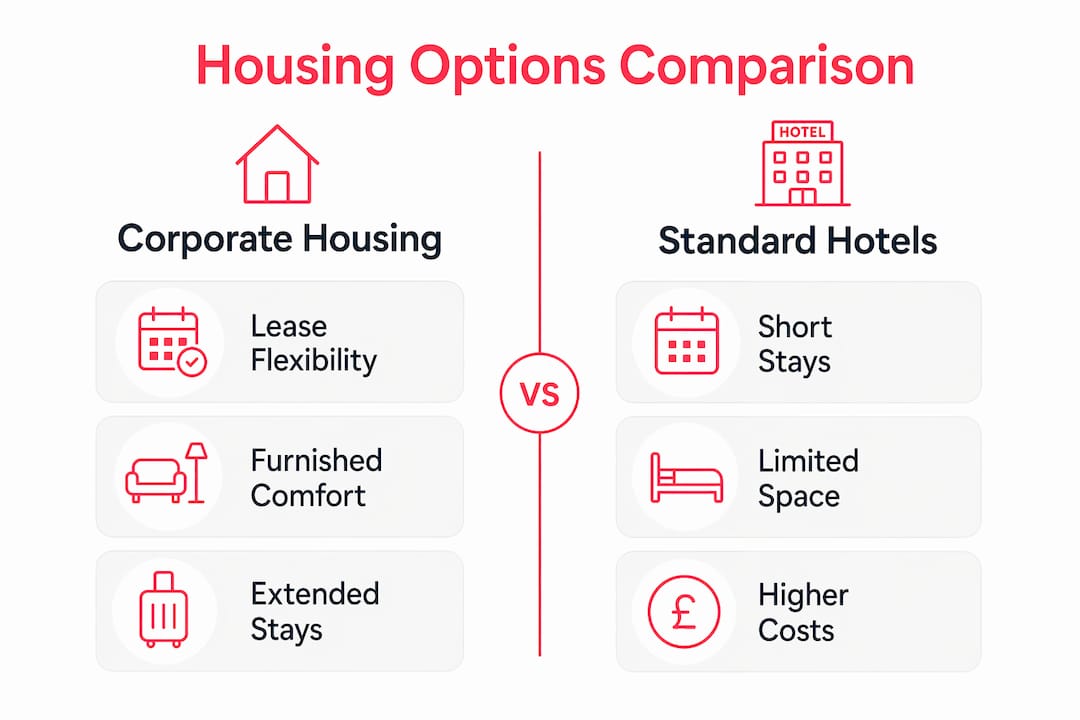
Average corporate housing stays now exceed 70 nights globally, driven by project and specialist workers who require extended, stable accommodation. That figure reflects a fundamental shift in how companies deploy talent. Norrbotten’s industrial projects sit squarely within this trend, with many assignments running well beyond the global average.
For property owners, this means a single corporate tenant can generate the equivalent of several months of traditional rental income in a single booking, with far lower vacancy risk during active project phases.
How do housing shortages amplify demand for corporate accommodation?
The housing shortage in Norrbotten is not a background condition. It is an active constraint on industrial growth. Ola Skogö, a prominent voice in the regional housing debate, has stated clearly that without high-quality housing, attracting and retaining specialist talent becomes structurally difficult, threatening the entire industrial expansion programme.
“Bostadsbristen kan stoppa industriboomen i norr.” The housing shortage can stop the industrial boom in the north. This is not a warning about the distant future. It is a description of conditions already affecting project timelines in 2026.
The shortage operates as a multiplier for corporate housing demand. When the permanent residential market cannot supply adequate accommodation, project teams and their employers turn to the managed corporate housing sector as the only reliable alternative. Early coordination between industrial operators, municipalities, and housing providers is the most effective way to prevent bottlenecks from halting project delivery.
For property owners, this dynamic creates a clear opportunity. A well-managed, furnished property in Norrbotten is not competing with a deep pool of similar options. It is filling a gap that the market has not yet closed. That scarcity supports premium pricing and sustained occupancy in ways that are unusual in most Swedish residential markets.
Pro Tip: Properties that are already furnished and professionally managed require no lead time when a project team needs accommodation urgently. Speed of availability is a genuine competitive advantage in a supply-constrained market.
Sustainable planning matters here too. Scalable housing solutions that balance community needs with workforce accommodation requirements are the ones that earn long-term municipal support and avoid the social friction that can arise when large numbers of workers are housed without adequate planning.
What do corporate housing trends in Norrbotten mean for property owners?
The corporate housing market analysis for Norrbotten points to a clear set of opportunities for property owners who position their assets correctly. Understanding the occupancy patterns, pricing dynamics, and tenant expectations of this market is the starting point for capturing its value.
-
Project cycle occupancy. Demand is not evenly distributed across the year. It peaks when major project phases begin and dips during winter shutdowns or planning periods. Owners who understand this rhythm can price accordingly and avoid the mistake of locking in long-term leases at flat rates during periods of peak demand.
-
Premium pricing during active phases. Mid-term furnished rentals outperform traditional long-term leases in dynamic industrial markets, with flexible lease terms capturing higher pricing during peak project demand cycles. A property priced at a standard residential rate during a major project mobilisation phase is leaving significant income on the table.
-
Tenant quality and property care. Corporate tenants, particularly those placed by employers or managed operators such as Guestlyhomes, tend to treat properties with greater care than the general rental market. Employers have reputational and contractual reasons to maintain good relations with accommodation providers.
-
Long-term asset value. Properties that develop a track record as reliable corporate accommodation in Norrbotten build a form of reputational capital. Repeat bookings from the same industrial clients, or referrals between project managers, reduce vacancy risk over time.
-
Operator partnerships. Working with a managed operator removes the administrative complexity of corporate lettings. Guestlyhomes, for example, handles tenant placement, property maintenance, and billing, allowing owners to benefit from corporate accommodation income without managing the operational detail themselves.
The table below summarises the key income characteristics of corporate housing compared to standard residential letting in a supply-constrained market like Norrbotten.
| Factor | Corporate housing | Standard residential letting |
|---|---|---|
| Achievable nightly rate | Premium, especially during project peaks | Fixed, market-rate |
| Vacancy risk | Low during active project phases | Moderate, tenant-dependent |
| Flexibilidad del arrendamiento | High, project-aligned | Low, typically 12 months |
| Management complexity | Low with operator partnership | Moderate to high |
| Tenant quality assurance | High, employer-backed | Variable |
Providers focusing on operational stability and client experience will outperform in the maturing corporate housing market. For Norrbotten property owners, this means the choice of management partner is as important as the property itself.
Puntos clave
Corporate housing demand in Norrbotten is a structural consequence of industrial expansion, workforce mobility, and a persistent shortage of quality residential supply that will not resolve quickly.
| Punto | Detalles |
|---|---|
| Industrial growth drives demand | Green steel, mining, and energy projects create sustained, project-aligned accommodation needs. |
| Housing shortage amplifies opportunity | Supply constraints support premium pricing and low vacancy for well-managed properties. |
| Corporate tenants prefer furnished stays | Full furnishings, kitchen facilities, and operational support outperform hotels for stays over 70 nights. |
| Flexible leases outperform fixed ones | Project-aligned mid-term leases capture higher rates during peak demand cycles. |
| Operator partnerships reduce complexity | Working with a managed operator delivers income without the administrative burden of self-management. |
Norrbotten’s industrial moment: what I have learned from watching this market
I have spent considerable time analysing property markets where industrial investment and housing supply are fundamentally misaligned. Norrbotten is one of the clearest examples I have encountered. The scale of investment flowing into the region is not speculative. It is committed capital, with project timelines measured in years and workforce requirements that are already straining local accommodation capacity.
What strikes me most is how many property owners in the region are still pricing and positioning their assets as standard residential lettings. The opportunity cost of that approach is substantial. A furnished property managed through a professional operator in a supply-constrained industrial market is a fundamentally different asset from a standard rental. It commands different pricing, attracts different tenants, and carries different risk characteristics.
The risk I see most often is inertia. Owners who wait for the market to come to them, rather than positioning their property to meet project-driven demand, will find that the most active phases of Norrbotten’s industrial expansion pass without their participation. The window is not permanent. As more operators and investors recognise the opportunity, supply will gradually increase and the pricing premium will moderate.
My recommendation is straightforward. If you own a quality property in Norrbotten, explore short-term versus mid-term housing models now, understand the project pipeline in your area, and consider whether a managed operator partnership could activate your asset more effectively than the current approach. The industrial boom in Norrbotten is real. The housing gap is real. The question is whether your property is positioned to benefit from both.
— Joakim
How Guestlyhomes supports property owners in Norrbotten
Guestlyhomes operates fully managed, high-standard properties for extended stays across Sweden, with a growing presence in Norrbotten where industrial demand is strongest. If you own a quality property in the region and want to capture the income potential of project-driven corporate tenants, Guestlyhomes offers two clear partnership models: a revenue share arrangement and a fixed-rent arbitrage model, both designed to deliver consistent returns without operational complexity.
The portfolio already includes properties suited to project teams and executives, such as the modern luxury villa with lake view and the spacious 5BR villa with sauna, both positioned for the corporate tenant profile that Norrbotten’s industrial growth is generating. Explore the listings and speak with the Guestlyhomes team to understand which model fits your property and investment goals.
FAQ
What is corporate housing and how does it differ from standard rentals?
Corporate housing is professionally managed, fully furnished accommodation let on flexible terms of 30 nights or more, designed for project workers, contractors, and relocating professionals. Unlike standard residential rentals, it includes furnishings, utilities, and management support as part of the arrangement.
Why is Norrbotten experiencing such strong corporate housing demand?
Norrbotten’s rapid expansion in green steel, mining, and renewable energy is drawing large numbers of specialist workers who require flexible, quality accommodation that the permanent housing stock cannot supply. This structural shortage makes managed corporate housing the primary solution for project-driven employers.
How do mid-term furnished rentals compare to long-term leases for income?
Mid-term furnished rentals outperform traditional long-term leases in dynamic industrial markets because flexible, project-aligned lease terms capture premium pricing during peak demand cycles. Fixed long-term leases cannot adjust to reflect periods of high industrial activity.
What types of workers typically use corporate housing in Norrbotten?
Engineers, project managers, civil contractors, and executive teams deployed to oversee industrial facilities are the primary users. Corporate bookings for specialist workers now average over 70 nights globally, with Norrbotten assignments frequently exceeding that figure.
How can property owners in Norrbotten access the corporate housing market?
The most direct route is partnering with a managed operator such as Guestlyhomes, which handles tenant placement, property maintenance, and billing. Owners can also review accommodation planning for project teams to understand how industrial clients source and evaluate corporate housing in the region.