

|
Preparando tu reproductor Trinity Audio...
|
En resumen:
- Poor quality team housing can lead to fatigue, stress, conflicts, and project delays.
- Investing in managed, consistent accommodation improves performance, retention, and reduces hidden costs.
- Early planning and proactive management are essential for successful extended team stays in Sweden.
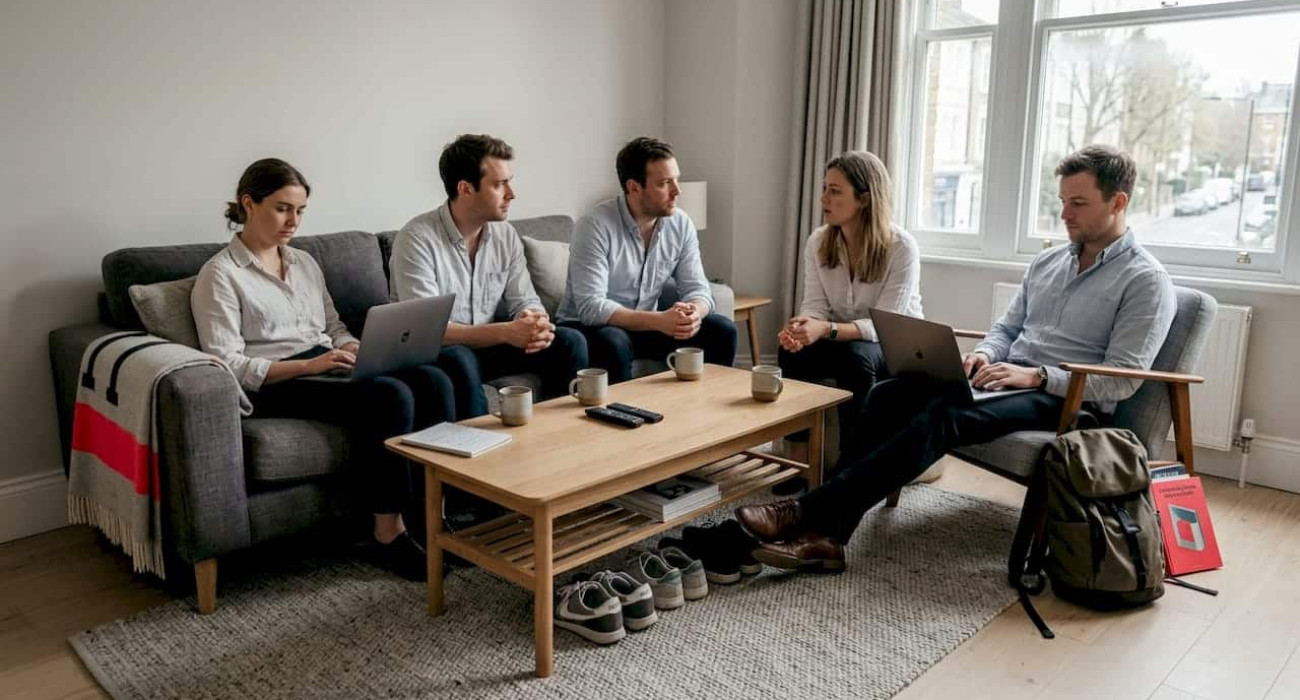
When a project team lands in Sweden for an extended assignment, the accommodation they return to each evening is not a footnote in the budget plan. It is the foundation on which their performance rests. Yet many HR leads and project managers treat housing as a logistical afterthought, booking the cheapest available option and moving on. The consequences of that decision ripple outward in ways that rarely appear on a single invoice: disrupted sleep, rising stress, team friction, and project delays that quietly erode both budgets and reputations before anyone thinks to connect them back to the housing choice.
Índice
- The unseen impact: What really happens when team housing falls short
- Measuring the hidden cost: Financial and operational consequences
- Critical warning signs: How to spot housing issues before they escalate
- Strategic solutions: Best practices for securing successful team stays
- A reality check: Why proactive housing strategy is every manager’s secret weapon
- Explore team accommodation solutions designed for success
- Preguntas frecuentes
Puntos clave
| Punto | Detalles |
|---|---|
| Inadequate housing costs more | Poor team accommodation leads to hidden financial and operational losses beyond basic fees. |
| Early signs signal trouble | Managers can spot housing issues through absenteeism, complaints, and declining performance. |
| Proactive planning saves projects | Securing quality accommodation early avoids disruptions and enhances team productivity. |
| Best practice beats quick fixes | Strategic solutions like managed guest homes deliver the best long-term results for teams. |
The unseen impact: What really happens when team housing falls short
With the stage set, it is time to look beneath the surface at the repercussions of poor housing on work teams. The connection between where people sleep and how they perform is not abstract. It is measurable, immediate, and often irreversible once a pattern takes hold.
Consider a team of six engineers deployed to Gothenburg for a four-month infrastructure project. Their accommodation, chosen quickly to meet a tight deadline, turns out to be a poorly maintained flat with unreliable heating, thin walls, and no dedicated workspace. Within three weeks, two team members report persistent fatigue. Meeting attendance drops. Minor disputes over shared facilities escalate into genuine interpersonal conflict. The project manager spends hours each week fielding complaints and coordinating with the landlord instead of managing deliverables.
This scenario is not unusual. The hidden costs of poor accommodation extend well beyond the nightly rate, touching nearly every dimension of team performance and project health.
“Understanding financial and operational consequences for hotels and resorts when staff housing is inadequate reveals that accommodation failures consistently translate into measurable productivity losses, higher staff turnover, and reputational damage for the organisations responsible for the booking.”
The most common hidden effects include:
- Sleep disruption and fatigue: Noise, poor mattresses, and inadequate temperature control prevent restorative sleep, reducing cognitive performance and decision-making capacity the following day.
- Chronic stress: Unresolved maintenance issues, unreliable internet, and cramped living conditions create a low-level but persistent stress that accumulates over weeks.
- Reduced engagement: Team members who feel their basic needs are not being met disengage from work, contributing less and communicating less effectively.
- Interpersonal conflict: Shared spaces that are poorly designed or maintained become flashpoints for tension, particularly during long assignments when personal space is already limited.
- Reputational risk for the booker: When housing fails, the HR lead or project manager responsible for the booking absorbs the reputational damage internally, sometimes affecting their standing with senior leadership.
These consequences do not announce themselves loudly. They accumulate quietly, making it easy to attribute falling performance to project complexity or team dynamics rather than the accommodation at the root of the problem.
Measuring the hidden cost: Financial and operational consequences
Exploring the hidden impacts makes it only more urgent to understand how these issues convert into tangible costs for the business. Many organisations focus on the headline accommodation fee when evaluating housing options, but this figure represents only a fraction of the true financial exposure.
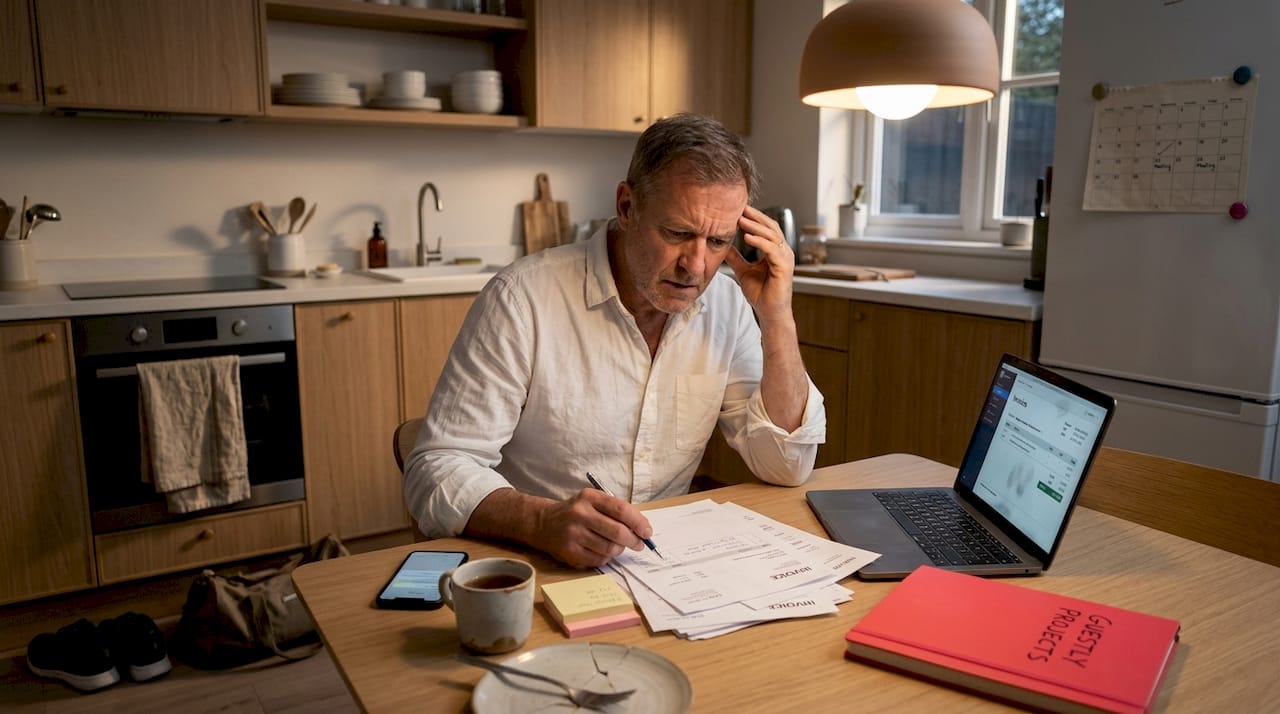
The benefits of quality housing become most apparent when you compare them directly against the penalties of poor alternatives. Research into the financial and operational advantages of providing quality housing for employees in the hospitality sector consistently shows that well-housed teams deliver better outcomes at lower total cost.
| Cost category | Expected cost (quality housing) | Hidden penalty (poor housing) |
|---|---|---|
| Nightly accommodation rate | Higher upfront | Lower upfront but misleading |
| Sick days and absenteeism | Mínimo | 2 to 4 additional days per person per month |
| Project delays | On schedule | 1 to 3 weeks added to timeline |
| Admin and coordination burden | Low, managed by operator | High, falls on HR or project manager |
| Staff turnover or reassignment | Raro | Frequent, with recruitment costs attached |
| Team conflict resolution | Negligible | Significant management time invested |
| Reputational cost to booker | Ninguno | Moderate to high, depending on project stakes |
The numbers in this table are not hypothetical. They reflect patterns observed across extended team deployments where accommodation quality was compromised. When you factor in the cost of reducing executive stay costs through managed solutions, the upfront premium for quality housing frequently pays for itself within the first month of a longer assignment.
Pro Tip: Before finalising any accommodation budget, calculate the fully loaded cost of a housing failure. Include one week of project delay, two sick days per team member, and five hours of additional admin per week. In most cases, this figure exceeds the premium for a managed, high-quality alternative.
Soft costs are particularly easy to overlook. When a project manager spends three hours a week liaising with a difficult landlord, chasing maintenance requests, or mediating complaints between team members about shared facilities, that time has a cost. Multiply it across a twelve-week project and you are looking at thirty-six hours of senior management time redirected away from productive work. That is nearly a full working week lost to accommodation administration.
Critical warning signs: How to spot housing issues before they escalate
Once you can measure the cost, the next step is identifying problems early before they spiral. The good news is that accommodation-related issues tend to follow recognisable patterns, and managers who know what to look for can intervene before the damage becomes significant.
Optimising temporary housing for work trips requires attention not just at the booking stage but throughout the assignment. Best practices for providing better employee accommodations highlight that early intervention is consistently more effective and less costly than reactive problem-solving.
Here are the top warning signs that team housing is undermining performance:
- Increased absenteeism or late arrivals. When team members begin arriving late or calling in sick more frequently, fatigue and stress from poor sleeping conditions are often contributing factors.
- A surge in informal complaints. If team members are venting to colleagues or line managers rather than raising formal issues, it often means they have already lost confidence that complaints will be resolved.
- Visible decline in work quality. Errors, missed deadlines, and reduced output that cannot be explained by project complexity alone may trace back to cognitive fatigue caused by poor rest.
- Withdrawal from team communication. When individuals become quieter in meetings or less responsive to messages, low morale linked to living conditions is frequently a contributing factor.
- Requests for early reassignment. A team member asking to be rotated off a project or relocated is a strong signal that their current situation is unsustainable.
Pro Tip: Schedule a brief, informal check-in with your team at the two-week mark of any extended stay. Ask directly about their accommodation experience. Most people will not volunteer complaints unless invited to, and catching issues at week two is far easier than managing a crisis at week six.
Early intervention strategies should be straightforward. Establish a clear point of contact for accommodation issues before the stay begins. Set expectations with the housing provider about response times for maintenance requests. And make it easy for team members to report problems without feeling that they are being difficult or demanding.
Strategic solutions: Best practices for securing successful team stays
Spotting trouble early is only helpful if you know what to do next. Fortunately, the market for professional team accommodation has matured considerably, and HR leads now have access to options that eliminate most of the risk associated with traditional rental approaches.
When choosing between corporate housing and Airbnb, the quality of staff accommodations has a direct bearing on the overall guest experience and, by extension, team performance. The connection between where people live and how they work is not incidental. It is structural.
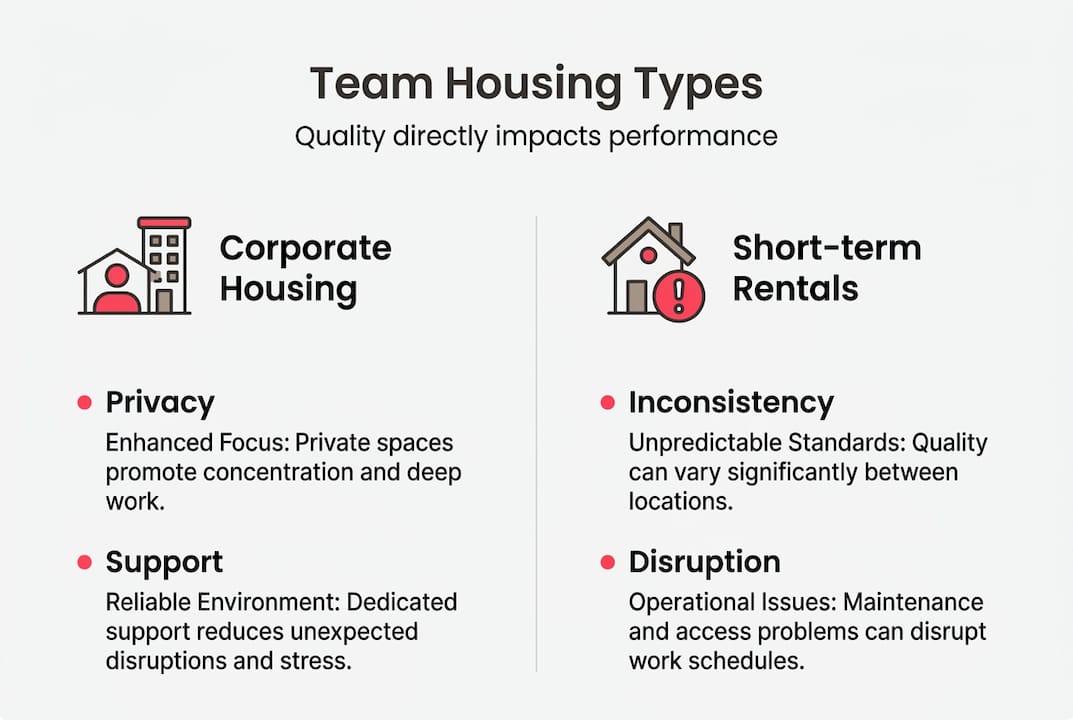
| Housing type | Coherencia | Ayuda | Privacidad | Suitability for teams | Cost predictability |
|---|---|---|---|---|---|
| Managed guest homes | Alta | Dedicated operator | Excelente | Very high | Alta |
| Serviced apartments | Alta | On-site or remote | Bien | Alta | Alta |
| Airbnb | Variable | Platform only | Bien | Moderado | Baja |
| Traditional rental | Baja | Landlord dependent | Bien | Baja | Baja |
| Hoteles | Alta | Full service | Limitado | Low for extended stays | Moderado |
The data is clear. Managed guest homes and serviced apartments consistently outperform less structured alternatives for extended team stays. The corporate housing selection tips that experienced HR leads rely on share a common thread: prioritise consistency, support, and accountability over headline price.
Key elements that define a successful team stay include:
- Reliable, fast internet as a non-negotiable baseline, not a nice-to-have.
- Dedicated workspaces within the accommodation so team members can work from home without compromising their rest environment.
- A single point of contact with the housing operator who can resolve issues quickly and without bureaucratic delay.
- Proximity to the project site to minimise commute fatigue, particularly important during high-intensity project phases.
- Flexible terms that accommodate project timeline shifts without punitive penalties.
Organisations that invest in employee retention through housing report measurably better outcomes on extended projects. When team members feel genuinely cared for, they perform better, stay longer, and speak positively about the organisation to peers and future candidates.
A reality check: Why proactive housing strategy is every manager’s secret weapon
These practical solutions are the foundation, but experience offers a deeper perspective. Most organisations approach team accommodation reactively. They book housing when a project is confirmed, choose based on price and availability, and only engage seriously with the quality of the decision when something goes wrong. This is not negligence. It is a systemic underestimation of how much accommodation shapes performance.
The conventional wisdom in project management focuses relentlessly on deliverables, timelines, and resource allocation. Housing sits outside that framework, treated as a facilities matter rather than a strategic one. But the managers who consistently deliver successful extended deployments think about housing the same way they think about tooling or team composition: as a direct input to output quality.
There is also a human dimension that financial models struggle to capture. A team member who spends four months in a cold, poorly maintained flat in an unfamiliar country is not just uncomfortable. They are isolated, fatigued, and quietly questioning whether the organisation values them. That question, left unanswered, affects retention long after the project ends.
The hidden cost perspectives that experienced operators observe consistently point to the same conclusion: the organisations that treat housing as a strategic investment rather than a budget line item finish projects faster, retain talent more effectively, and build stronger internal reputations for their HR and project management functions.
The managers who get this right are not spending more money. They are spending it more intelligently, earlier in the process, and with a clearer understanding of what is actually at stake.
Explore team accommodation solutions designed for success
For HR leads ready to avoid hidden costs once and for all, the path forward is simple.
Guestly Homes provides fully managed, high-standard team accommodation in Sweden designed specifically for professionals, project teams, and executives on extended assignments. Every home is prepared to hotel-grade standards, supported by a dedicated operator, and backed by a single point of contact who resolves issues before they become problems. From reliable internet and dedicated workspaces to flexible terms and consistent quality across every stay, Guestly removes the operational burden from your desk and places it firmly in the hands of people who specialise in getting it right. When your team performs, your project performs.
Preguntas frecuentes
What are the top early signs that team housing is failing?
Key warning signs include increased absenteeism, persistent complaints, lower work quality, and team conflict, all of which indicate that accommodation issues may be undermining productivity and require immediate attention.
How can poor housing increase company costs beyond accommodation fees?
Hidden costs include staff turnover, recruitment expenses, project delays, and lost productivity, all of which stem from unresolved housing problems that compound over the duration of an extended assignment.
What type of housing is most reliable for extended team projects in Sweden?
Managed guest homes and serviced apartments offer the consistency, privacy, and operational support that minimise disruptions during long-term stays, making them the most reliable choice when comparing housing options for professional teams.
When should HR leads start planning for team accommodation?
HR should begin housing plans as early as possible in the project timeline, ideally at the point of project confirmation, to ensure availability, avoid rushed decisions, and secure the best-fit option for the team’s specific needs and duration.