


En resumen:
- Providing stable, private, and well-managed housing significantly improves employee retention during long project deployments. Features like private kitchens, separate living areas, and quick maintenance reduce burnout, fatigue, and turnover, ultimately lowering costs. Treating accommodation as a strategic project component enhances safety, productivity, and employer reputation.
Accommodation quality is a direct determinant of employee retention during extended work projects. When workers are housed in stable, private, and well-managed spaces, they stay longer, perform better, and cause fewer disruptions to project timelines. The reverse is equally true: poor housing conditions trigger a predictable attrition spike, typically after four to six weeks of deployment. HR professionals and project managers who understand how accommodation influences employee retention during long projects gain a concrete advantage. They can structure housing as a retention tool rather than a compliance afterthought, with measurable effects on project cost, team stability, and employer reputation.
What factors in accommodation most influence employee retention during long assignments?
The specific features of housing matter far more than its proximity to a hotel brand or its nightly rate. Hotel fatigue is a recognised condition among long-term workers: living in impersonal spaces without kitchens or private living areas erodes autonomy and wellbeing within weeks. Workers who cannot cook their own meals, store personal items, or decompress in a private space report significantly higher dissatisfaction and are more likely to request reassignment or resign.
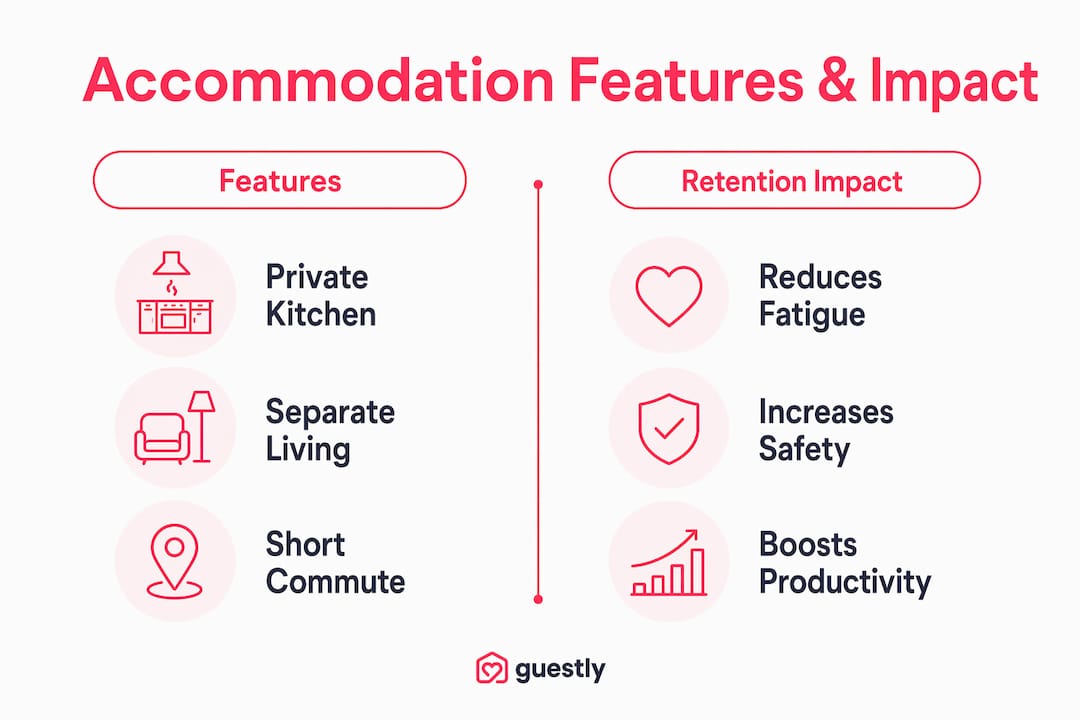
The following accommodation features have the clearest impact on retention during long assignments:
- Private kitchen facilities. Workers who can prepare their own food maintain better nutrition, reduce daily costs, and feel a greater sense of control over their routine.
- Separate living and sleeping areas. Distinct zones for rest and relaxation reduce mental fatigue and support recovery after long shifts.
- Reasonable commute distance. Proximity to the worksite reduces travel stress and supports punctuality, both of which affect morale over time.
- Consistent billing and administration. Stable, predictable invoicing removes a common source of friction between employees, HR teams, and accommodation providers.
- Reliable maintenance and service. Unresolved maintenance issues signal to workers that their comfort is not a priority, which accelerates disengagement.
| Accommodation feature | Retention impact |
|---|---|
| Private kitchen | Reduces hotel fatigue; supports autonomy and nutrition |
| Separate living area | Lowers burnout risk; improves recovery between shifts |
| Short commute | Reduces daily stress; supports punctuality and morale |
| Stable billing | Removes administrative friction for HR and employees |
| Rapid maintenance response | Signals employer care; builds trust and loyalty |
Pro Tip: When evaluating accommodation for a long project, assess it against a six-week liveability standard, not a one-night comfort standard. The features that feel adequate for a short stay often become sources of serious frustration after a month.

How does accommodation quality affect worker fatigue, safety, and productivity?
Poor housing directly degrades physical and mental performance. Stable, residential accommodation with private kitchens and consistent service produces a measurable drop in near-misses and minor incidents compared to rotating hotel stays. That finding is not incidental. Fatigue accumulated from poor sleep, inadequate nutrition, and a lack of personal space compounds over weeks, and its effects show up on site.
The connection between housing quality and safety outcomes follows a clear logic:
- Workers in stable housing sleep more consistently and recover more fully between shifts.
- Better rest reduces reaction time errors and lapses in concentration on site.
- Access to kitchen facilities supports better nutrition, which sustains energy and focus across long shifts.
- A settled living environment lowers background stress, which is a known contributor to poor decision-making in high-consequence settings.
Data links poor housing fatigue with increased safety incidents and lower productivity on long schedules. This means that accommodation is not simply a welfare consideration. It is a project risk variable. HR professionals and project managers who treat housing quality as a safety input, rather than a comfort preference, make better decisions about where to allocate budget.
Stable housing also correlates with higher employee engagement. Workers who feel settled in their living environment are more present, more communicative, and more willing to raise concerns early. That openness is particularly valuable on complex, multi-month projects where small problems can escalate quickly if left unaddressed.
Why does housing stability become a critical retention factor after the first month?
Hotels are designed for short stays. Their layouts, services, and pricing structures assume guests will leave within a few days. Long-term project workers who remain in hotel accommodation beyond the first month begin to experience a cumulative toll that standard hospitality design does not address. Turnover risk sharply increases after six weeks in substandard housing, and effective project budgeting must account for this pattern to avoid costly attrition.
The hidden costs of housing instability extend well beyond the worker who eventually leaves. Consider the management burden:
- Supervisors absorb housing coordination. When accommodation arrangements are unstable or poorly managed, project supervisors spend hours each week resolving billing disputes, chasing maintenance, or finding alternative rooms. That time comes directly from project management capacity.
- Frequent moves raise stress and turnover risk. Workers who are relocated multiple times during a project lose the sense of stability that supports long-term commitment. Each move resets their tolerance threshold.
- Billing inconsistencies create HR overhead. Unpredictable invoicing from multiple providers forces HR teams into reactive administration rather than proactive retention management.
- Attrition triggers replacement costs. Replacing a single worker costs between €8,000 and €12,000. That figure consistently exceeds the incremental monthly cost of upgrading from dormitory-style housing to a private apartment.
| Cost type | Approximate figure |
|---|---|
| Worker replacement cost | €8,000–€12,000 per departure |
| Monthly housing upgrade (dormitory to private apartment) | Approximately €300 per worker |
| Supervisor hours lost weekly to housing coordination | Several hours per week per site |
The arithmetic is straightforward. Preventing two worker departures through better housing justifies substantial additional housing spend. The cost-benefit case for quality accommodation is not marginal. It is decisive when viewed across a full project lifecycle.
Pro Tip: Mark weeks four to six on your project calendar as a retention risk window. Schedule a brief check-in with deployed workers during this period specifically about their living conditions. Early intervention at this point costs almost nothing. Replacing a worker who leaves at week seven costs a great deal.
What practical strategies can HR and project managers use to improve retention through accommodation?
The most effective approach treats accommodation as a planned project input, not an ad hoc procurement task. Managing housing as a cohesive strategy reduces supervisor workload and hidden project costs compared to handling it reactively. The following practices produce consistent results across extended deployments.
- Lock in accommodation for the full project duration before deployment begins. Mid-project housing searches are disruptive and expensive. Securing stable, well-specified accommodation in advance removes uncertainty for both workers and HR teams.
- Prioritise private apartments with kitchen facilities over hotel rooms. The long-term accommodation benefits of residential-style housing are well documented. Workers in apartments with kitchens and separate living areas report higher satisfaction and lower burnout rates.
- Establish a single point of contact for all accommodation administration. Fragmented management across multiple providers creates billing confusion and delays. A single, accountable provider simplifies HR oversight and reduces the management tax on project supervisors.
- Communicate housing details clearly before workers arrive. Workers who know exactly where they will be staying, what amenities are available, and how maintenance requests are handled arrive with lower anxiety and higher confidence in their employer.
- Resolve maintenance issues within 24 hours. Slow responses to maintenance requests are disproportionately damaging to morale. Workers interpret delays as indifference. Fast resolution signals that the employer takes their comfort seriously.
- Evaluate accommodation options by their retention value, not just their nightly rate. Conventional cost-based comparisons miss the full picture. A slightly higher housing cost that prevents one departure pays for itself many times over.
Companies known for well-managed accommodation find it easier and cheaper to staff future projects. Stable housing builds a reputation that travels through professional networks. Workers who had a positive experience recommend the employer to peers, reducing recruitment costs on subsequent projects. The importance of employee accommodation is therefore both immediate and cumulative.
Pro Tip: Include accommodation specifications in your project kick-off documentation alongside safety standards and scheduling requirements. Treating housing as a project deliverable, rather than a support function, signals its importance to the entire project team.
The shift from hotels to corporate housing reflects a broader recognition among project-focused organisations that residential-style accommodation produces better outcomes across retention, safety, and team cohesion. HR professionals who have made this shift consistently report fewer mid-project departures and lower overall accommodation management costs. The impact of accommodation on retention is also recognised in workforce management and hospitality research, where hotel fatigue among long-term workers is identified as a major but avoidable source of burnout.
Puntos clave
Stable, residential accommodation is the single most cost-effective retention tool available to HR professionals and project managers on extended deployments.
| Punto | Detalles |
|---|---|
| Attrition spikes at weeks four to six | Plan a retention check-in at this point to catch housing dissatisfaction early. |
| Replacement costs exceed housing upgrades | Replacing one worker costs €8,000–€12,000; upgrading housing costs roughly €300 per month. |
| Kitchen and privacy features prevent burnout | Private apartments with kitchens reduce hotel fatigue and support long-term commitment. |
| Stable housing reduces safety incidents | Consistent rest and nutrition from good housing lowers fatigue-related errors on site. |
| Accommodation builds employer reputation | Companies with well-managed housing staff future projects faster and at lower recruitment cost. |
Accommodation is the retention lever most project budgets ignore
My view, formed across years of working with project teams and their accommodation arrangements, is that housing is the most consistently underestimated line item in project planning. Budgets are scrutinised for equipment, logistics, and labour. Accommodation is often treated as a residual cost, something to be minimised rather than managed.
That approach is expensive. The workers who leave at week six rarely cite pay as the reason. They cite the shared bathroom, the broken hob that took three weeks to fix, the noise from the corridor, and the sense that nobody was paying attention. Those are solvable problems. They are also cheap to solve relative to the cost of replacing the person who walked out.
The organisations I have seen retain their best project workers consistently are not necessarily the ones paying the highest wages. They are the ones who treat accommodation as a signal of how much they value the people doing the work. That signal is received clearly. Workers notice when their living conditions are managed with care, and they stay longer because of it. The retention savings that follow are real, measurable, and available to any project team willing to treat housing as a strategy rather than an afterthought.
— Joakim Thörn
Guestly Homes: accommodation built for long project teams
Project teams deployed for weeks or months need more than a place to sleep. They need a space that supports performance, rest, and stability across the full duration of the assignment.
Guestly Homes operates fully managed villas and apartments across Sweden, designed specifically for extended professional stays. Every property includes private kitchen facilities, consistent service, and a single point of contact for all administration. HR teams and project managers can book with confidence, knowing that the accommodation will hold to the same standard on day sixty as it did on day one. For teams of varying sizes, the 5BR business villa and the 4BR villa with two showers offer the space and privacy that long-project retention requires. Contact Guestly Homes to discuss accommodation for your next deployment.
FAQ
How does accommodation affect employee retention on long projects?
Accommodation quality directly influences whether workers stay or leave mid-project. Stable, private housing with kitchen facilities reduces burnout, builds loyalty, and lowers the turnover risk that typically peaks after four to six weeks.
When does poor accommodation most commonly cause attrition?
Turnover risk increases sharply after six weeks in substandard housing. Workers who have tolerated poor conditions through the initial adjustment period often reach a decision point at this stage, making early intervention critical.
Is better accommodation worth the additional cost?
Replacing a single worker costs between €8,000 and €12,000. Upgrading from shared to private apartment housing costs approximately €300 more per worker per month. The financial case for quality accommodation is clear when viewed against replacement costs.
What accommodation features matter most for long-term project workers?
Private kitchen facilities, separate living and sleeping areas, a short commute to the worksite, and reliable maintenance response are the features with the greatest impact on worker satisfaction and retention during extended deployments.
How should HR teams manage accommodation to reduce project disruption?
HR teams achieve the best results by securing accommodation for the full project duration before deployment, using a single managed provider, and communicating housing details clearly to workers in advance. Treating accommodation as a planned project input rather than a reactive procurement task reduces both turnover and management overhead.