


TL;DR:
- Companies now view employee accommodation as a key factor in productivity, wellbeing, and retention. Reliable WiFi, private bedrooms, and fully equipped kitchens are now standard expectations for housing staff. Effective accommodation policies prioritize prompt communication, flexibility, and well-designed environments to improve performance and reduce legal risks.
Employee accommodation is defined as any housing or physical arrangement an employer provides or arranges to support an employee’s ability to work effectively. What companies expect from employee accommodation today has shifted considerably. Organisations no longer view staff housing as a basic logistical task. They treat it as a direct input into productivity, wellbeing, and retention. HR professionals and corporate leaders now evaluate accommodation against a clear set of functional standards, and the gap between adequate and excellent has real business consequences.
What amenities do companies prioritise in employee accommodation today?
Reliable, high-speed WiFi is the single most non-negotiable amenity in corporate accommodation. Without it, remote work, video calls, and project coordination fail. A slow or unstable connection does not just frustrate employees. It costs the business time and output on every affected day.
Beyond connectivity, companies consistently prioritise these features when housing staff:
- Private bedrooms. Shared sleeping spaces reduce rest quality and increase interpersonal friction on long assignments. Private rooms are now a baseline expectation, not a premium.
- Fully equipped kitchens. Employees on extended stays need to prepare their own meals. A kitchen reduces daily costs, supports dietary needs, and gives staff a sense of domestic normality that hotels cannot provide.
- Laundry facilities. For stays of two weeks or more, in-unit or on-site laundry is a practical necessity. Its absence forces employees to spend personal time and money on external services.
- Parking and transport links. Employees driving to project sites or client locations need reliable parking. Where driving is not required, proximity to public transport matters equally.
- Quiet, comfortable living spaces. Rest and recovery are not soft concerns. Wellness initiatives are now treated as productivity levers rather than perks. A noisy or poorly furnished flat undermines both.
Pro Tip: When evaluating accommodation for a team deployment, test the WiFi speed before booking. Request a speed test result from the operator. Anything below 50 Mbps symmetric will cause problems for a team of three or more working simultaneously.
The standard amenities package for corporate housing has expanded because companies have learned that cutting corners on comfort produces measurable costs in performance and morale.
How have company policies on employee accommodation evolved?
Corporate accommodation policy has moved from minimal compliance to active wellbeing support. A decade ago, many companies considered any clean, safe lodging sufficient. The standard today is meaningfully higher, shaped by legal frameworks and a clearer understanding of how environment affects performance.
The legal evolution is instructive. Federally regulated employers in Canada must accommodate employees up to the point of undue hardship, engaging promptly and collaboratively with each request. This is not a passive obligation. It requires individual assessment, timely communication, and documentation. The Canadian Human Rights Act sets a standard that many non-regulated employers now voluntarily adopt because it reduces risk and builds trust.
In the United States, the ADA and EEOC framework establishes that effective accommodation must remove functional barriers without imposing undue hardship on the employer. The employer is not required to provide an employee’s preferred option. Effectiveness and feasibility are the governing criteria. This distinction matters for HR teams designing accommodation policies: the goal is barrier removal, not preference matching.
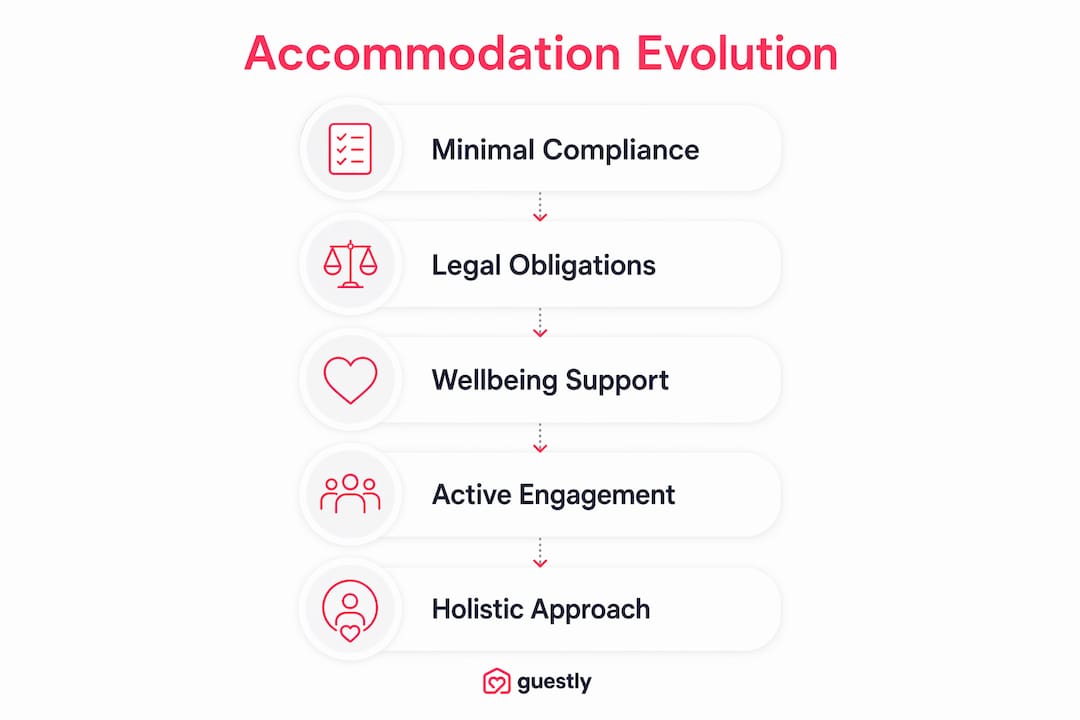
Policy evolution has followed a clear sequence:
- Basic provision. Companies supplied lodging that met minimum safety and hygiene standards. No further consideration was expected.
- Compliance-led adjustment. Legal requirements prompted formal accommodation request processes, documentation standards, and HR training.
- Wellbeing integration. Accommodation became part of broader employee health strategies, with amenities chosen to reduce stress and support recovery.
- Return-to-work planning. Accommodation plans now include gradual reintegration structures and follow-up reviews to adjust for evolving employee needs after absence or relocation.
- Ongoing adjustment. Leading companies treat accommodation as a living arrangement, not a fixed assignment. Regular check-ins and the ability to modify arrangements are built into the process.
The shift from step one to step five reflects a genuine change in how organisations understand the relationship between environment and performance.
Why does accommodation quality affect retention and project performance?
Quality accommodation directly affects whether employees stay with a company and whether projects are delivered on time. The connection is not abstract. An employee housed in a poorly equipped flat during a three-month project assignment carries that discomfort into every working day.
Inclusive accommodation design benefits all employees, improving morale and supporting retention. This finding applies equally to physical housing. When staff feel that their employer has thought carefully about where they live during an assignment, it signals respect. That signal has retention value.
The table below summarises how accommodation quality maps to business outcomes:
| Accommodation factor | Business impact |
|---|---|
| Reliable WiFi | Uninterrupted project work and communication |
| Private bedroom | Improved rest, reduced interpersonal conflict |
| Kitchen and laundry | Lower daily costs, greater autonomy |
| Quiet environment | Reduced stress, lower absenteeism |
| Prompt HR process | Higher trust, lower legal exposure |
“How the accommodation process is managed, including timely and accessible communication, is as important as the accommodation itself for legal protection and employee trust.”
The accommodation process itself carries as much weight as the physical space. Delays, poor communication, and mishandled documentation increase legal risk regardless of whether the accommodation eventually provided is appropriate. HR teams that treat the process as seriously as the outcome protect both the employee and the organisation.
For project teams on extended deployments, corporate housing for retention is a measurable factor. Staff who feel well housed are more likely to complete assignments, recommend the company to peers, and accept future postings.
What do current best practices in corporate accommodation look like?
The clearest examples of best practice come from companies deploying staff for weeks or months at a time, typically on infrastructure projects, consulting engagements, or executive relocations.
Leading organisations now follow a structured approach:
- Needs assessment before booking. HR teams document functional requirements: number of occupants, length of stay, work schedule, transport needs, and any specific requirements related to health or disability. This mirrors the functional-limitation focus recommended by the Canadian Human Rights Commission for workplace adjustments.
- Standard amenities packages. Companies define a minimum specification for staff housing: private bedroom, full kitchen, fast WiFi, laundry access, and a dedicated workspace. Anything below this standard requires sign-off from HR leadership.
- Flexible duration and adjustment. Accommodation arrangements are reviewed at the midpoint of any assignment longer than four weeks. Employees can flag issues without going through a formal complaint process.
- Technology integration. Booking, billing, and communication are managed through a single point of contact. This removes the administrative burden from both the employee and the HR team.
Pro Tip: For assignments of six weeks or more, choose fully managed serviced accommodation over self-arranged rentals. The consistency of service, the single billing contact, and the guaranteed standard save HR teams significant time and reduce the risk of mid-assignment problems.
The comparison below shows how accommodation approaches differ by stay length and organisational priority:
| Stay length | Typical approach | Key priority |
|---|---|---|
| Under 2 weeks | Business hotel or serviced apartment | Location and WiFi |
| 2–8 weeks | Serviced apartment with kitchen | Comfort and cost control |
| 2–12 months | Fully managed corporate housing | Wellbeing, consistency, and support |
Effective accommodation involves offering a practical menu of adjustments that are quickly implementable and measurable, rather than aiming for the most expensive solution. The same principle applies to physical housing. A well-chosen serviced apartment at a fair price outperforms a luxury hotel that lacks a kitchen or a quiet workspace.
For HR professionals comparing options, short-term rental alternatives for teams and corporate housing versus hotels are worth reviewing before committing to a booking approach.
Key takeaways
Companies that treat accommodation as a productivity input, not a logistical afterthought, see measurable gains in retention, project performance, and employee trust.
| Point | Details |
|---|---|
| WiFi is non-negotiable | Reliable, fast connectivity is the baseline requirement for any corporate accommodation today. |
| Process matters as much as space | Prompt, documented HR communication reduces legal risk and builds employee trust. |
| Wellbeing drives retention | Comfortable, well-equipped housing reduces stress and increases the likelihood of staff completing assignments. |
| Flexible menus beat expensive fixes | Practical, adjustable accommodation options outperform costly solutions that do not match functional needs. |
| Stay length shapes the right choice | Accommodation strategy should change based on assignment duration, with fully managed housing preferred for stays beyond two months. |
Accommodation philosophy: what I have learned from watching companies get this wrong
The most common mistake I see is treating accommodation as a procurement task rather than an HR decision. A finance team books the cheapest available flat. The employee arrives to find no desk, no kitchen, and WiFi that drops every hour. Three weeks later, the project is behind schedule and the employee is asking to go home early.
The second mistake is confusing legal compliance with good practice. Meeting the minimum standard under the ADA or the Canadian Human Rights Act does not mean the accommodation is working. Mistakes in the accommodation process, including delays and poor documentation, increase liability even when the eventual outcome is appropriate. Compliance is a floor, not a ceiling.
What I have found actually works is treating accommodation as part of the employee’s performance environment. The same logic that drives investment in good office chairs and reliable laptops applies to the flat where your engineer sleeps and works for three months. The environment shapes the output.
The companies that do this well share one habit: they ask the employee what they need before booking, not after a problem arises. That single shift, from reactive to proactive, changes the entire dynamic. It signals respect. It prevents avoidable problems. And it produces better results on the project.
— Joakim
How Guestlyhomes supports corporate accommodation needs
Guestlyhomes operates fully managed properties across Sweden, designed specifically for professionals and project teams on extended stays. Every property includes fast WiFi, a fully equipped kitchen, private bedrooms, and laundry access as standard.
For HR professionals, the booking process is straightforward. One point of contact. Centralised billing. No follow-up required. Properties such as the 1BR Executive Premium Suite and the Nordic Studio are built around the amenities that companies now expect as standard. Whether you are housing a single executive or a project team, Guestlyhomes delivers consistent quality without the administrative overhead of managing multiple suppliers.
FAQ
What do companies expect from employee accommodation today?
Companies expect reliable WiFi, private bedrooms, kitchen facilities, laundry access, and a quiet workspace as standard. Accommodation is now evaluated as a direct input into employee productivity and wellbeing, not simply as a logistical necessity.

What are employer obligations for employee accommodation?
Under frameworks such as the Canadian Human Rights Act and the US ADA, employers must provide effective accommodation that removes functional barriers, up to the point of undue hardship. The process must be prompt, documented, and collaborative.
How does accommodation quality affect employee retention?
Well-equipped, comfortable housing reduces stress and signals organisational respect, both of which increase the likelihood that employees complete assignments and remain with the company. Poor accommodation is a measurable retention risk on extended deployments.
What is the best accommodation type for long-term staff deployments?
Fully managed serviced accommodation is the preferred option for stays of two months or more. It provides consistent standards, single-point billing, and the domestic amenities that hotels cannot match, making it the most practical choice for HR teams managing extended assignments.
How should HR teams handle accommodation requests?
HR teams should assess requests individually, focus on functional needs rather than diagnostic details, communicate promptly, and document every step. Delays and poor communication increase legal exposure regardless of the quality of the accommodation eventually provided.