


TL;DR:
- Proper accommodation planning enhances team cohesion, morale, and productivity in Sweden projects.
- Budgeting involves assessing costs, choosing all-inclusive serviced apartments, and obtaining multiple provider quotes.
- Structured provider evaluation and seamless logistics ensure hassle-free arrivals and ongoing support for teams.
Poor accommodation planning costs more than money. When a mid-size project team arrives in Sweden without a coherent housing strategy, the consequences ripple outward fast: fragmented locations, inconsistent standards, staggered arrivals with no clear check-in process, and team members spending their first week solving logistics rather than delivering work. The hidden toll on cohesion, morale, and productivity is significant. This guide gives HR leads and project managers a structured, step-by-step process to plan, execute, and verify corporate team housing in Sweden, covering everything from legal requirements and budgeting to provider selection and seamless arrivals.
Innehållsförteckning
- Clarifying your team’s requirements and Swedish legal essentials
- Budgeting and how to avoid surprise costs
- Selecting the right provider: evaluation checklist and comparison
- Execution and seamless arrival: logistics, timing and troubleshooting
- A fresh take: what most guides miss about stress-free team housing
- Make corporate stays easy with high-standard Swedish housing
- Frequently asked questions
Viktiga slutsatser
| Punkt | Detaljer |
|---|---|
| Start early | Booking accommodation 4–12 weeks ahead ensures the best selection and rates for Swedish team stays. |
| Clarify legal and team needs | List every requirement up front and ensure all Swedish legal obligations, like contracts and deposits, are met. |
| Control the budget | Allocate 25-35% of project costs to accommodation including a 15-20% contingency for unplanned expenses. |
| Choose providers carefully | Use a structured checklist and side-by-side comparisons to pick hassle-free, high-standard housing. |
| Plan logistics for success | Coordinate arrivals, prepare for seasonal needs, and set up support channels to keep every team member happy and productive. |
Clarifying your team’s requirements and Swedish legal essentials
Having previewed what can go wrong, the right place to start is a solid foundation: clarifying both practical and legal must-haves before you contact a single provider.
Start by documenting the basics. How many team members need housing? What are their roles, and do any require private rooms for confidentiality or rest? Is the team mixed in terms of gender or seniority, and does that affect room-sharing preferences? How long is the project, and are there staggered start and end dates? Where is the primary work site, and how far can accommodation realistically be from it? These questions seem straightforward, but skipping them leads to mismatched bookings that cost time and goodwill to fix.
Next, define your non-negotiable amenities. For most project teams, the essentials include:
- High-speed WiFi capable of supporting video calls and remote access tools
- A fully equipped kitchen to reduce daily food costs and support dietary needs
- On-site laundry facilities for stays exceeding two weeks
- Dedicated workspace or desk areas for evening work
- Parking, particularly for teams using company vehicles or travelling to multiple sites
For seasonal planning considerations, winter stays in Sweden add specific requirements: robust heating, snow clearance, and proximity to public transport when roads are difficult.
On the legal side, Sweden has clear rules that every booker must understand. Swedish regulations require written contracts, deposits capped at one to two months’ rent, and a minimum 30 days’ notice to terminate an agreement. Choosing reliable serviced apartments with all-inclusive pricing removes much of this complexity, as utilities, insurance, and maintenance are bundled into a single contract.
Documenting your requirements in a simple template before approaching providers saves hours of back-and-forth. Include team size, duration, site address, must-have amenities, and any legal or compliance constraints your organisation requires.
Pro Tip: Build your requirements document as a shared spreadsheet so that HR, finance, and the project manager can all contribute and sign off before outreach begins. This single step eliminates the most common source of booking errors.
Budgeting and how to avoid surprise costs
Once you know your requirements, the next critical move is understanding what it will cost and how to keep costs under control.
Accommodation is rarely the largest project expense, but it is one of the most variable. A useful benchmark: budget 25 to 35% of project costs for accommodation, including a 15 to 20% contingency for utilities and transport. Corporate housing typically costs 2 to 4% of an employee’s annual salary, yet its impact on retention and performance is disproportionately high.
Here is a breakdown of the key budget categories to plan for:
| Budget category | Typical share of accommodation budget |
|---|---|
| Rent or nightly rate | 60 to 70% |
| Utilities (if not included) | 8 to 12% |
| Transport and parking | 6 to 10% |
| Deposits | 5 to 8% |
| Insurance and liability | 3 to 5% |
| Contingency buffer | 15 to 20% |
One of the most impactful decisions you can make is choosing the right accommodation type from the outset. Serviced apartments reduce costs by 20 to 30% compared to hotels for extended team stays, while offering more space, kitchen access, and a consistent standard across the group.
Follow these steps to build a reliable budget:
- Gather quotes from at least three providers before committing to any figures.
- Confirm whether utilities, WiFi, and cleaning are included or billed separately.
- Check for hidden charges: late check-out fees, parking surcharges, or linen replacement costs.
- Add your contingency buffer before presenting the budget for approval.
- Review corporate housing budget factors to ensure no category is overlooked.
When comparing apartment vs hotel costs, the gap widens considerably for stays beyond two weeks. Hotels charge per room per night with no kitchen access, meaning food costs alone can add 15 to 25% to the total. Serviced apartments absorb these costs naturally.

Pro Tip: Always request a fully itemised quote from providers. A low headline rate that excludes utilities, parking, and cleaning can end up costing significantly more than a slightly higher all-inclusive rate.
Selecting the right provider: evaluation checklist and comparison
Budget set, you are ready to choose a provider. This is where many teams go astray, relying on a single recommendation or the first available option rather than a structured, evidence-based approach.
Begin by shortlisting at least three providers. Assess each one on location relative to your work site, what is included in the price, cancellation and extension policies, and how quickly they respond to initial enquiries. Response time at the enquiry stage is a reliable indicator of how they will perform when something goes wrong mid-stay.
Use this numbered checklist when evaluating each provider:
- Verify references from at least two previous corporate clients.
- Request a physical or virtual inspection of the property before booking.
- Confirm service level agreements (SLAs) for maintenance and emergency response.
- Check whether the provider has experience managing group bookings with staggered arrivals.
- Assess flexibility for extensions, early departures, and additional units.
A structured corporate housing comparison across provider types helps clarify the trade-offs:
| Provider type | Best for | Key risk |
|---|---|---|
| Managed serviced apartments | Mid to large teams, extended stays | Higher upfront cost |
| Hotell och restaurang | Short stays, dynamic schedules | Cost and space limitations |
| Airbnb or unmanaged rentals | Small groups, short-term | Inconsistent standards, no SLA |
| Unmanaged long-term rentals | Very long projects | Legal complexity, maintenance gaps |
For mid-size to large teams, managed serviced housing consistently outperforms the alternatives. The corporate housing vs Airbnb comparison is particularly stark: unmanaged options carry real risks around quality consistency, emergency support, and compliance. When one unit in a fragmented booking falls short, the entire team feels it.
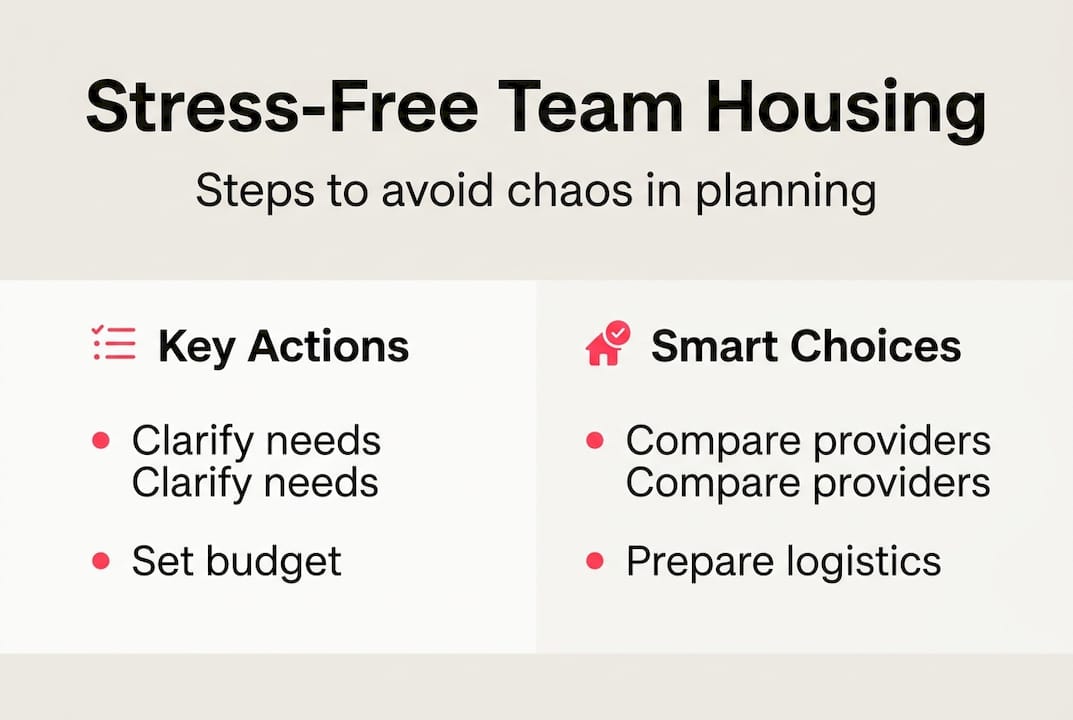
Consolidating the team into fewer locations, ideally a single villa or apartments within the same building, reduces transport friction, strengthens daily cohesion, and simplifies communication. Managed homes cut costs and remove the operational burden from your team entirely.
Execution and seamless arrival: logistics, timing and troubleshooting
After choosing a provider, execution makes all the difference. A well-selected property can still deliver a poor experience if the logistics around arrival and ongoing management are handled carelessly.
Start with timing. Assess team size, duration, and site proximity at least 4 to 6 weeks ahead for standard bookings. For spring and autumn, when demand peaks across Sweden, book 8 to 12 weeks ahead to secure the right properties and negotiate corporate rates.
For teams with staggered arrivals, centralised booking is far superior to letting individuals arrange their own accommodation. It secures volume discounts, ensures consistent standards, and gives you a single point of contact for any issues. Here is a practical arrival checklist:
- Prepare a move-in pack for each team member: WiFi codes, parking instructions, local emergency contacts, and a brief area guide.
- Confirm after-hours check-in procedures with the provider before the first arrival.
- Designate a single internal contact within your team for accommodation queries.
- Share the provider’s direct contact details with all team members on arrival day.
- Conduct a brief walkthrough or video call with the first arrivals to catch any issues immediately.
Troubleshooting is inevitable. The most common mid-stay issues include requests to extend the booking, additional team members joining late, and seasonal challenges. Short-term rental options with flexible terms can cover overflow needs without disrupting the core booking. For winter stays, confirm in advance that heating systems are robust and that snow parking arrangements are in place.
Pro Tip: Build a simple escalation protocol before arrival: who handles maintenance requests, who approves extensions, and what the process is if a unit fails to meet the agreed standard. Having this documented prevents confusion and delays when issues arise under pressure.
Review your accommodation selection tips to ensure your provider can genuinely support the full lifecycle of a team stay, not just the booking stage.
A fresh take: what most guides miss about stress-free team housing
Most planning guides stop at the booking confirmation. That is precisely where the real work begins.
The difference between a smooth team deployment and a month of fire-fighting rarely comes down to the property itself. It comes down to what happens in the first 72 hours after arrival and how well the provider supports the transition. Small details carry outsized weight: a welcome pack with local restaurant recommendations, a single dedicated contact who responds within the hour, or a brief orientation call that answers questions before they become complaints.
Investing as much time in feedback mechanisms as in provider selection is, frankly, unconventional advice. But teams that check in with members at the one-week mark, capture issues early, and have a clear escalation path consistently report higher satisfaction and fewer disruptions. The serviced apartment advantage is not just about square metres and amenities. It is about having a managed system behind the stay that absorbs friction so your team can focus on the project. Fewer locations, consistent standards, and a single accountable operator are what separate genuinely hassle-free housing from accommodation that merely looks good on paper.
Make corporate stays easy with high-standard Swedish housing
If this guide has shown anything, it is that the difference between chaotic and seamless team accommodation comes down to preparation, the right provider, and a system that keeps working after check-in.
Guestly Homes offers a portfolio of fully managed, high-standard properties across Sweden, from executive serviced apartments to spacious team villas, all vetted, compliant, and ready for extended team stays. Whether you need a single unit or housing for a large project team, Guestly provides bespoke quotes, one point of contact, and guaranteed standards from arrival to departure. Reduce your admin, protect your team’s performance, and book with confidence.
Frequently asked questions
How far in advance should I book corporate housing for Swedish teams?
For peak seasons such as spring and autumn, book 8 to 12 weeks ahead to secure availability and negotiate rates. Standard bookings require a minimum of 4 to 6 weeks’ lead time.
Are serviced apartments really better value than hotels for teams?
Serviced apartments reduce costs by 20 to 30% compared to hotels for extended stays, and provide kitchen access, more living space, and consistent standards that support team productivity.
What regulations must I know for Swedish corporate accommodation?
Swedish law requires a written contract, capped deposits of one to two months’ rent, and a minimum 30 days’ notice to end an agreement. All-inclusive serviced apartments simplify compliance considerably.
What’s the best way to compare Swedish corporate housing providers?
Use a spreadsheet to compare at least three providers on location, included services, references, inspection results, and response time. This structured approach prevents costly oversights and makes the final decision straightforward.
Rekommenderas
- 7 Practical Short-Term Rental Alternatives for Teams – Guestly Homes
- Guide till boende för företagsresor för sömlösa teamvistelser - Guestly Homes
- 7 tips för att välja företagsbostad för smidiga affärsresor – Guestly Homes
- How to Arrange Long-Term Stays for Teams with Ease – Guestly Homes
- Commercial relocation explained: move offices efficiently