

TL;DR:
- Norrbotten’s property market experiences strong growth with rental yields up to 8.5%, surpassing Stockholm.
- Industrial projects, tourism, and corporate relocations drive high demand for quality rentals year-round.
- Partnering with professional management maximizes occupancy and net income, making remote investing viable.
Many property owners in Norrbotten assume the far north is simply too remote or too seasonal to generate meaningful rental income. That assumption is costing them money. The region is experiencing strong price growth of 12.6% YoY and rental yields that outperform Stockholm by a significant margin. Whether you own a villa near Luleå or an apartment in Kiruna, this guide walks you through realistic earning estimates, the costs that shape your net income, and why partnering with a professional operator can make the difference between an average return and an excellent one.
Innehållsförteckning
- Understanding the Norrbotten rental market in 2026
- Calculating your potential rental earnings in Norrbotten
- The impact of professional management on your returns
- Factors that influence your final rental income
- Perspective: Why most landlords underestimate Norrbotten’s true rental potential
- Ready to unlock Norrbotten’s rental income? Partner with the experts
- Frequently asked questions
Viktiga slutsatser
| Punkt | Detaljer |
|---|---|
| Norrbotten yields are high | Rental yields in Norrbotten can outperform other Swedish regions, reaching 8.5% in 2026. |
| Management raises net income | Professional management often boosts occupancy, optimises rent, and saves owners time. |
| Tax and costs affect returns | After costs and taxes, net yields are typically 1.5–2% lower than the advertised gross yield. |
| Preparation impacts success | Well-prepared and well-managed homes command higher rents and lower risk of vacancy. |
Understanding the Norrbotten rental market in 2026
Norrbotten is no longer a quiet outlier in Sweden’s property landscape. Industrial expansion, infrastructure investment, and a growing influx of project workers and corporate teams have transformed rental demand across the region. Before estimating your earnings, it helps to understand the market conditions shaping them.
Property values remain accessible compared to southern Sweden. According to Mäklarstatistik, the average price in Norrbotten sits at SEK 23,086 per square metre, with a median sale price of SEK 1,538,000. That lower entry point is precisely what makes yields so attractive here.
For context, rental yields in Upper Norrland including Norrbotten can reach up to 8.5%, compared to 3 to 4% in Stockholm. Nationally, the average new rent in Sweden reached SEK 8,089 per month in 2025, up 5.5% year on year. Norrbotten rents vary by location and property type, but well-positioned homes regularly command competitive rates.
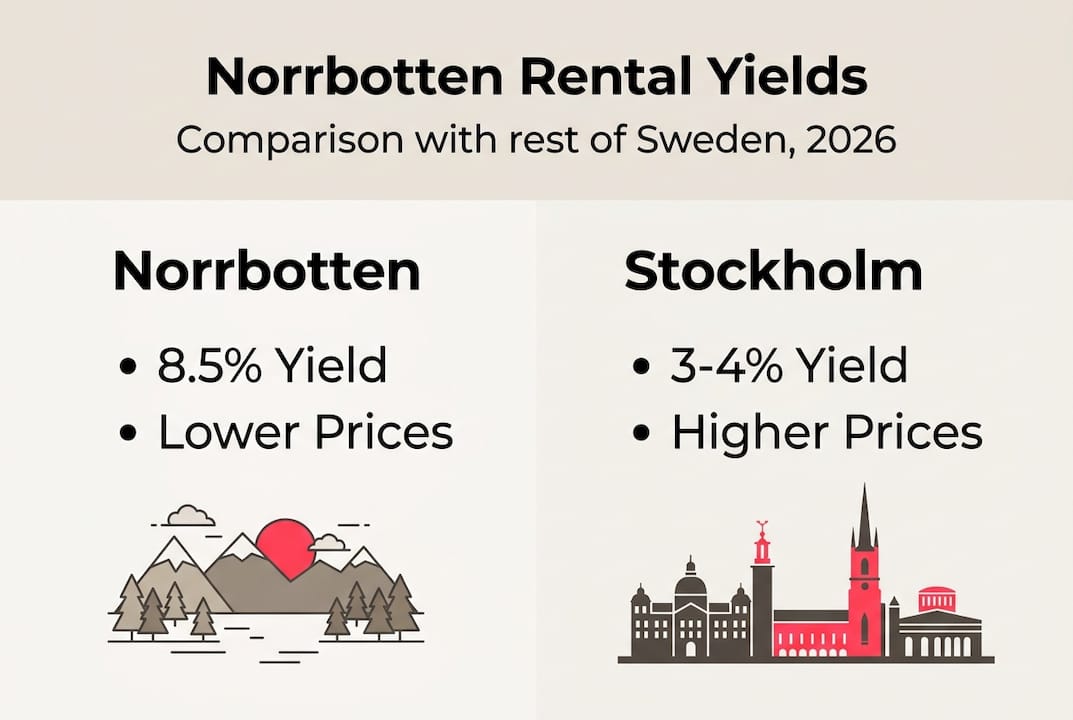
| Metric | Norrbotten | Stockholm |
|---|---|---|
| Gross rental yield | Up to 8.5% | 3 to 4% |
| Median property price | SEK 1,538,000 | SEK 4,500,000+ |
| National avg rent (2025) | SEK 8,089/month | SEK 12,000+/month |
| YoY price growth (mid-2025) | +12.6% | +3 to 5% |
Several factors are driving demand in the region:
- Industrial projects: Major employers such as LKAB, SSAB, and Northvolt-adjacent operations bring large numbers of contractors and project workers who need quality accommodation for weeks or months at a time.
- Tourism and nature: Norrbotten attracts visitors year-round, from aurora hunters in winter to hikers and cyclists in summer.
- Seasonal peaks: Winter tourism and summer outdoor activities create distinct demand cycles that a well-managed property can capitalise on.
- Corporate relocation: Executives and senior professionals moving to the region for project assignments frequently seek furnished, managed homes rather than hotels.
For a broader view of rental apartments across Sweden, the market context is equally relevant when positioning your property competitively.
Calculating your potential rental earnings in Norrbotten
Now that you know the Norrbotten context, let us examine what you could actually earn by renting out your property. The calculation involves gross income, operating costs, and net yield, and each step matters.
Step-by-step income estimate:
- Establish your property value. Use the median of SEK 1,538,000 or your own valuation as the base.
- Apply the gross yield. At 7% gross yield, a SEK 1,538,000 property generates approximately SEK 107,660 per year, or around SEK 8,971 per month.
- Deduct operating costs. Swedish properties typically carry maintenance costs of 3 to 4.5% of property value annually, plus management fees and vacancy allowance.
- Calculate net income. Net yields are usually 1.5 to 2% lower than gross, meaning a 7% gross yield may translate to 5 to 5.5% net.
- Account for tax. Rental income in Sweden is taxed at 30% on net earnings after the SEK 40,000 annual deduction.
| Income scenario | Gross yield | Annual gross income | Estimated net income (after costs) |
|---|---|---|---|
| Conservative | 5% | SEK 76,900 | SEK 53,800 |
| Moderat | 7% | SEK 107,660 | SEK 75,360 |
| Optimistic (managed) | 8.5% | SEK 130,730 | SEK 91,510 |
It is also worth noting that rent increases in Sweden for 2026 average 3.4%, the lowest rise in four years. This means rental income growth will be modest in 2026, making it even more important to maximise occupancy and minimise vacancy rather than relying on rent hikes alone.
Factors that directly affect your final figure include property size, furnishing standard, location within Norrbotten, and how consistently the property is available. A well-furnished four-bedroom villa near an industrial hub will outperform an unfurnished flat in a low-demand area, sometimes by a factor of two or more.
Pro Tip: Use the Guestly Homes income calculator to enter your property’s details and receive a personalised monthly income estimate based on current Norrbotten market data.
For a deeper look at maximising rental yields and preparing your home for rental, both guides offer practical steps to increase your property’s earning potential before you list.
The impact of professional management on your returns
Estimating earnings is only the start. How you operate your rental makes a real difference to both the income you receive and the time you spend managing it.
A professional operator handles the full cycle of rental management: dynamic pricing, guest screening, check-in logistics, maintenance coordination, and ongoing communication. This is not simply a convenience. It directly affects your occupancy rate, which is the single biggest driver of annual income.
“Net yields in northern Sweden consistently reach 6 to 7%, compared to 3 to 4% in Stockholm, largely because professional management optimises pricing and maintenance in markets where local knowledge is scarce.”
Here is what a professional operator typically manages on your behalf:
- Dynamic pricing: Adjusting nightly or monthly rates based on local demand, seasonality, and competitor activity.
- Occupancy management: Targeting corporate clients and project teams for longer, more stable stays rather than relying on short-term bookings alone.
- Guest relations: Handling all communication before, during, and after each stay, reducing your involvement to near zero.
- Maintenance oversight: Coordinating repairs and upkeep promptly, protecting your asset and ensuring guest satisfaction.
- Legal compliance: Keeping the property aligned with Swedish rental regulations, insurance requirements, and safety standards.
While management fees reduce gross yield by 1.5 to 2%, the offsetting gains in occupancy, pricing accuracy, and reduced vacancy often more than compensate. Optimising property operations is a discipline that professional operators practise daily, and the results show in net income figures.
Pro Tip: When choosing a management partner, prioritise operators with direct experience in Norrbotten or northern Sweden. Local knowledge of demand cycles, corporate client networks, and seasonal patterns is not easily replicated by a generic national platform.
For a structured overview, the property management guide covers the full process, and avoiding costly pitfalls is essential reading before you commit to any arrangement.
Factors that influence your final rental income
Even the best-managed property faces risks and challenges. Understanding what can affect your income allows you to plan more effectively and avoid the surprises that catch many landlords off guard.
Key risks to monitor:
- Seasonality and vacancy: Norrbotten’s tourism peaks in winter and summer, but shoulder seasons can see lower demand. A property sitting empty for two months per year can reduce annual income by 15 to 20%.
- Regulated rent caps: Long-term residential rentals in Sweden are subject to rent regulation, which limits how much you can increase rents annually. The 2026 average increase of 3.4% reflects these constraints.
- Tax obligations: Swedish rental income is subject to 30% tax on net income after a SEK 40,000 annual deduction. For a property earning SEK 100,000 net per year, that means approximately SEK 18,000 in tax after the allowance.
- Property condition: Poorly maintained properties attract lower rents and higher vacancy. Keeping your home in excellent condition is not optional; it is a direct income driver.
- Market shifts: Industrial projects can wind down, affecting corporate demand. Diversifying between corporate and leisure guests reduces this risk.
Readiness checklist for Norrbotten landlords:
- Confirm the property meets Swedish habitability and safety standards
- Ensure furnishing quality matches the target guest profile (corporate or leisure)
- Review your insurance policy to confirm it covers rental use
- Register with the Swedish Tax Agency (Skatteverket) for rental income reporting
- Set a clear pricing strategy that accounts for seasonal demand shifts
For a full breakdown of tax and legal obligations, and a direct comparison of short vs long-term rentals for stable income, both resources are worth reviewing before you finalise your approach.
Perspective: Why most landlords underestimate Norrbotten’s true rental potential
The perception of Norrbotten as a remote, low-yield market is outdated. It is a view shaped by old data and a lack of visibility into what is actually happening on the ground. Industrial investment, corporate housing demand, and a shortage of quality managed accommodation have created conditions that favour informed landlords.
What separates high-performing landlords in the region from average ones is not luck. It is the decision to treat their property as a managed asset rather than a passive one. Those who partner with operators who understand landlord yield strategies and local demand cycles consistently outperform those who manage independently.
The other underestimated factor is time. Self-managing a rental in a region with complex seasonality and corporate demand patterns is demanding. Handing that responsibility to a structured partner does not just reduce stress; it typically improves income. The hands-off model is not a compromise. For most owners in Norrbotten, it is the smarter path to stable, predictable returns.
Ready to unlock Norrbotten’s rental income? Partner with the experts
Norrbotten’s rental market offers genuine, data-backed earning potential for property owners who approach it strategically. Yields of up to 8.5%, strong corporate demand, and a shortage of quality managed homes all point in the same direction.
Guestly Homes specialises in fully managed, high-standard properties across Sweden, including Norrbotten. Whether you own a modern business villa or a luxury villa with a lake view, we offer revenue share and long-term lease models designed to maximise your returns with minimal involvement. Visit Guestly Homes to explore your options, or use the income calculator at app.guestlyhomes.se to see a personalised estimate for your property today.
Frequently asked questions
What is the typical rental yield in Norrbotten in 2026?
Rental yields in Norrbotten can reach up to 8.5%, which is significantly higher than the Swedish national average and well above Stockholm’s 3 to 4% range.
What costs reduce my net income from renting out my home?
Management fees, maintenance, vacancy periods, and tax all reduce your net return. Net yields are typically 1.5 to 2% lower than gross yields once these costs are accounted for.
How is rental income taxed in Sweden for 2026?
Swedish rental income is subject to 30% tax on net income after an annual deduction of SEK 40,000, which reduces the taxable base for most private landlords.
Does professional management increase my rental income?
Yes. Professional operators optimise pricing and occupancy through dynamic pricing and corporate client networks, which typically leads to higher net returns than self-managed properties achieve.
What should I know about seasonality and vacancy in Norrbotten?
High seasonality can create vacancy risk during shoulder periods, so a flexible pricing strategy and strong local market knowledge are essential to maintaining consistent annual income.
Rekommenderas
- Before you rent out your property: essential guide for Swedish owners – Guestly Homes
- Rental Yield: Maximising Returns for Swedish Landlords – Guestly Homes
- Prepare your home for rental the right way in Sweden – Guestly Homes
- Hur du maximerar hyresintäkterna för din fastighet – Guestly Homes
- Shutters for rental homes: stylish, durable solutions