


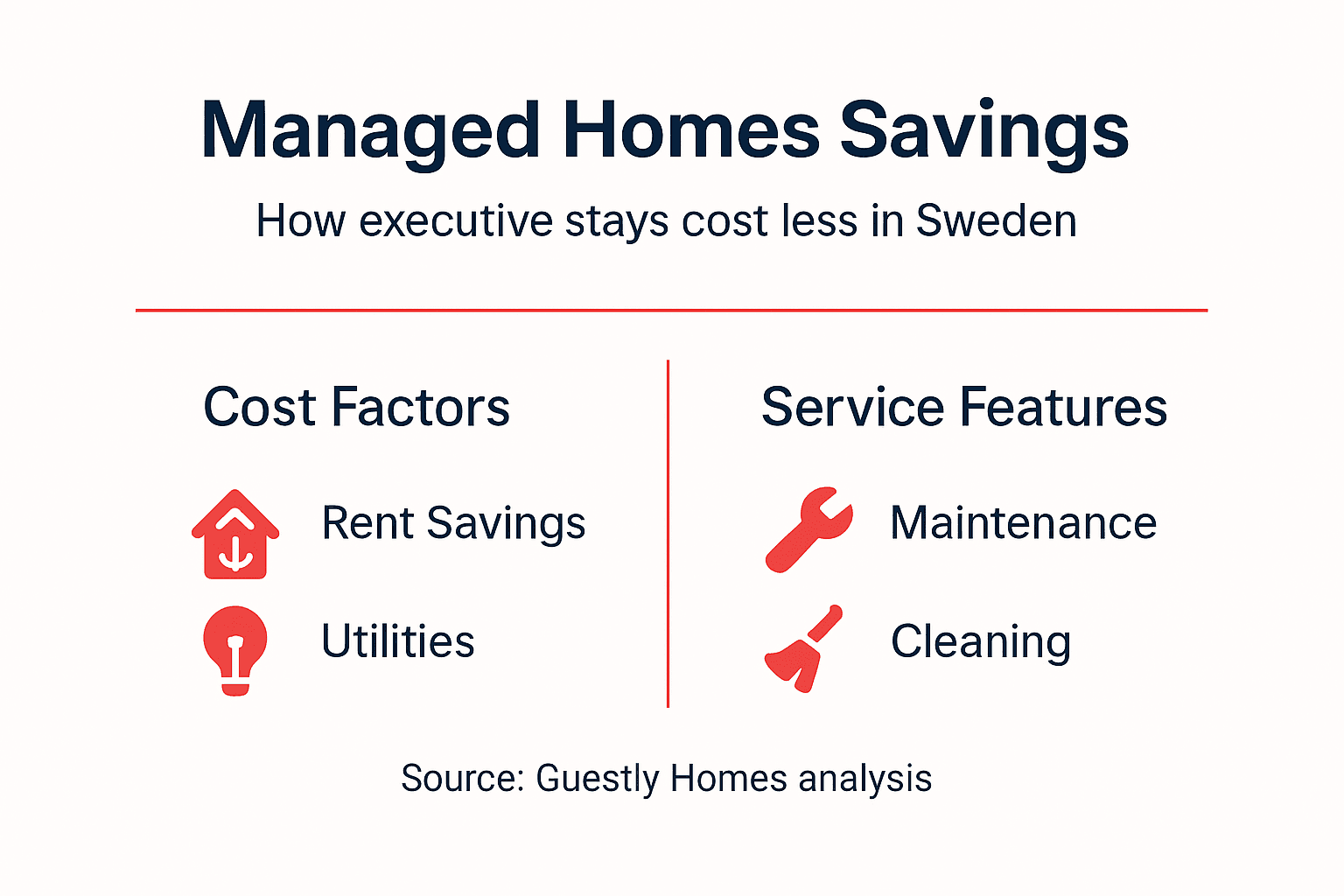
Hotels seem easiest for executive stays. They promise simplicity: one booking, consistent service, done. Yet HR leads and project managers in Sweden know the truth. Hotels drain budgets on extended assignments, executives complain about cramped rooms, and coordinating logistics becomes a second job. Managed homes flip this script, delivering cost savings of 15 to 25%, higher satisfaction, and operational ease that frees your time for strategic work.
Innehållsförteckning
- The Growing Need for Managed Homes in Executive Corporate Housing
- How Managed Homes Enhance Executive Well-Being and Productivity
- The Role of Property Management in Delivering Hassle-Free Stays
- Common Misconceptions About Managed Homes for Executives
- Comparing Managed Homes, Hotels, and Serviced Apartments
- Financial and Operational Models Behind Managed Homes
- Practical Guidance for HR Leads and Project Managers
- Explore Managed Executive Homes with Guestly Homes
- Vanliga frågor och svar
Viktiga slutsatser
| Punkt | Detaljer |
|---|---|
| Kostnadseffektivitet | Managed homes reduce accommodation costs by 15 to 25% compared to hotels for extended stays. |
| Executive Satisfaction | Consistent hotel-grade service and tailored amenities improve well-being and productivity. |
| Streamlined Operations | Single-point property management cuts HR admin time by 50% through simplified booking and communication. |
| Aligned Incentives | Revenue-share financial models ensure quality and occupancy alignment between operators and clients. |
| Proven Results | Well-selected managed homes can cut executive complaints by 70% within six months. |
The Growing Need for Managed Homes in Executive Corporate Housing
Executive assignments in Sweden and the Nordics are growing longer and more frequent. Companies send leaders on three-month projects, six-month expansions, even year-long market entries. Traditional solutions fall short. Hotels lack privacy and space for extended stays. Unmanaged rentals bring unpredictable quality and endless coordination headaches.
HR leads spend hours managing fragmented accommodation logistics. You chase landlords, troubleshoot maintenance issues, field executive complaints about Wi-Fi or cleanliness. This operational drag pulls focus from strategic initiatives like talent development or organizational design. Quality of accommodation directly impacts executive performance and satisfaction. A cramped hotel room or poorly maintained rental undermines productivity and morale.
Managed homes address these gaps. They combine the space and comfort of a rental with hotel-grade service and a single point of contact. You book once, communicate with one provider, and trust consistent standards. Executives get privacy, tailored amenities, and hassle-free living. You reclaim time for work that matters.
Key challenges driving adoption:
- Extended assignment durations require more than hotel functionality
- Fragmented rental markets increase coordination complexity
- Executive expectations for comfort and reliability continue rising
- HR teams lack bandwidth for hands-on accommodation management
How Managed Homes Enhance Executive Well-Being and Productivity
Managed homes provide more space and privacy than hotels. Executives get separate living and sleeping areas, full kitchens, and dedicated workspaces. This layout supports better rest and focus. After a long day leading a project team, your executive can cook a meal, decompress on a sofa, and sleep in a quiet bedroom.

Tailored amenities make a difference. High-speed internet handles video calls and large file transfers. Ergonomic desks and chairs support remote work. Flexible dining options, from fully equipped kitchens to meal delivery partnerships, accommodate personal routines. Executives report up to 40% higher satisfaction with privacy and comfort in managed homes compared to hotels during extended stays over 30 days.
Consistent high standards reduce stress. When an executive knows the home will be clean, maintained, and functional every time, they stop worrying about accommodation. They focus on the assignment. This reliability translates to better performance, fewer complaints to HR, and higher retention on challenging projects.
Pro Tip: Prioritize providers that offer dedicated workspaces, high-speed internet, and flexible dining options. These amenities directly support executive productivity and well-being during extended assignments.
Benefits for executive experience:
- Separate living and work areas improve focus and rest quality
- Full kitchens enable personal routines and dietary preferences
- Consistent standards eliminate accommodation-related stress
- Maximized comfort supports sustained high performance
The Role of Property Management in Delivering Hassle-Free Stays
Professional property management transforms operational complexity into simplicity. Managed homes use a single interface for bookings, communication, and issue resolution. You send one email, make one call, and receive prompt responses. No chasing multiple landlords or vendors.
Hotel-grade cleaning and maintenance standards are enforced consistently. Homes are inspected before arrival, cleaned weekly or bi-weekly, and maintained proactively. Worn furniture gets replaced. HVAC systems receive preventive service. This attention to detail prevents the deterioration common in unmanaged rentals.
Rapid on-call response teams handle issues immediately. If an executive reports a problem, the provider dispatches help within hours, not days. Proactive maintenance catches issues before executives notice them. This reliability allows HR leads to cut accommodation management time by 50%, freeing capacity for strategic priorities.
Choosing the right property management partners is essential. Look for providers with proven track records, clear service level agreements, and dedicated account management. The best operators use property management software to coordinate teams, track maintenance, and communicate transparently.
Operational advantages:
- Single booking and communication interface simplifies coordination
- Hotel-grade standards ensure consistent cleanliness and maintenance
- On-call response teams resolve issues within hours
- Proactive maintenance prevents disruptions before they occur
Common Misconceptions about Managed Homes for Executives
Myth: Managed homes cost more than hotels. Reality: Total costs are typically 15 to 25% lower. Hotels charge premium nightly rates, add fees for parking and Wi-Fi, and lack kitchen facilities, forcing expensive dining out. Managed homes bundle these elements at lower overall cost. Over a 90-day stay, savings compound significantly.
Myth: Managed homes are inflexible. Reality: Flexible contracts and financial models like revenue share allow tailor-made solutions. Need to extend a stay by two weeks? Adjust easily. Want to scale from one executive to a team of five? Providers accommodate. Traditional leases lock you in. Managed homes adapt.
Myth: Service quality is inconsistent. Reality: Many managed homes maintain hotel-grade standards. Executive accommodation options that include professional management reduce stay disruptions by over 70%. Operators stake their reputation on reliability. They inspect properties regularly, enforce standards, and respond quickly to issues.
Debunking these myths:
- Total cost of ownership favors managed homes over hotels for stays beyond 30 days
- Contract flexibility supports changing corporate needs and assignment timelines
- Professional operators enforce hotel-grade standards consistently
- Proven track records demonstrate reliability and executive satisfaction
Comparing Managed Homes, Hotels, and Serviced Apartments
Choosing the right accommodation requires understanding trade-offs. The table below compares managed homes, hotels, and serviced apartments across key factors for extended executive stays.
| Faktor | Managed Homes | Hotell och restaurang | Lägenheter med service |
|---|---|---|---|
| Monthly Cost | Måttlig till hög | Mycket hög | Moderat |
| Utrymme och integritet | Hög | Low to Moderate | Hög |
| Faciliteter i köket | Fullt utrustat kök | Minimal or none | Fullt utrustat kök |
| Service Quality | Hotel-grade, consistent | Hög, standardiserad | Variable, often minimal |
| Operational Complexity | Low, single vendor | Low, single vendor | Moderate to high, fragmented |
| Contract Flexibility | Hög | Hög | Moderat |
Managed homes offer tailored amenities, hotel-grade service, and single-vendor management. Unlike unsupervised serviced apartments, they include proactive maintenance and dedicated support. Hotels provide standardized service but at higher cost and with limited space. For stays beyond 30 days, executive housing options like managed homes deliver better value.
Serviced apartments can work if you’re willing to manage coordination yourself. Many lack consistent cleaning, maintenance, or responsive support. This burden falls on HR or the executive. Serviced accommodation benefits for team stays increase when professional management is included.
Key comparison insights:
- Managed homes balance cost efficiency with hotel-grade service
- Hotels excel at short stays but become expensive for extended assignments
- Unsupervised serviced apartments shift operational burden to clients
- Single-vendor management simplifies logistics and accountability
Financial and Operational Models Behind Managed Homes
Understanding financial models helps you evaluate providers and align expectations. Two primary models dominate the managed home market: revenue share and arbitrage.
Revenue share: Owners and operators share earnings, typically 60/40 up to 70/30 splits. Typical revenue share splits range between 60/40 and 70/30, facilitating alignment of incentives in managed home operations. Operators maximize occupancy and guest satisfaction to boost revenue. Owners benefit from professional management without fixed costs. This model aligns incentives for quality and performance.
Arbitrage model: Operators lease properties at fixed rents, then sublet with full management control. Owners receive predictable income regardless of occupancy. Operators bear vacancy risk but gain operational autonomy. This model works well when owners prioritize income stability over upside potential.
Both models reduce risk and help stabilize pricing for corporate clients. Operators invest in maintenance, cleaning, and guest experience to protect their revenue or margin. Corporate housing financial models like these ensure consistent quality and transparent pricing.
Pro Tip: Evaluate providers’ financial models carefully to match your company’s risk tolerance and budget predictability. Revenue share aligns incentives for quality. Arbitrage offers stable pricing and operator accountability.
| Modell | Owner Income | Operator Risk | Quality Incentive | Client Benefit |
|---|---|---|---|---|
| Revenue Share | Variable, performance-based | Shared with owner | High, direct revenue link | Aligned quality and occupancy |
| Arbitrage | Fixed rent | Full vacancy and operational risk | High, protects margin | Stable pricing and operator accountability |
Understanding property management company expectations helps you negotiate contracts and set clear service levels. Ask providers about their financial model, how it affects service delivery, and what guarantees they offer.
Practical Guidance for HR Leads and Project Managers
Selecting and partnering with managed home providers requires a clear process. Follow these steps to ensure successful outcomes for extended executive stays.
-
Identify executive accommodation needs by duration and preferences. Survey executives about workspace requirements, kitchen preferences, and location priorities. Document typical assignment lengths and team sizes.
-
Evaluate managed home providers on service quality, amenities, and reliability. Request references, inspect sample properties, and review service level agreements. Confirm hotel-grade cleaning and maintenance standards.
-
Compare financial models and contract terms for best fit. Assess revenue share versus arbitrage models. Evaluate flexibility for assignment changes, early termination clauses, and pricing transparency.
-
Negotiate contracts emphasizing responsiveness and issue resolution. Define response times for maintenance requests, escalation procedures, and communication protocols. Establish key performance indicators and review cadences.
-
Run pilot stays to validate quality and process before full rollout. Place one or two executives in managed homes for initial assignments. Gather detailed feedback on comfort, service, and operational ease.
Pro Tip: Actively include executives’ feedback in provider evaluation to ensure satisfaction. Their experience is the ultimate measure of success. Use surveys, interviews, and ongoing check-ins to refine selection criteria.
Choosing managed home providers requires diligence but pays dividends in reduced complaints and streamlined operations. Securing long-term executive accommodation becomes routine when you partner with reliable operators.
Explore Managed Executive Homes with Guestly Homes
Guestly Homes specializes in managed executive homes across Sweden and the Nordics. Our service ensures seamless booking, hotel-grade standards, and tailored amenities that support executive performance. We handle everything: inspections, cleaning, maintenance, and guest communication. You focus on your team. We deliver hassle-free living.
Learn how to select serviced apartments effectively with our expert guides. Partner with trustworthy property management providers to ease your accommodation workload. Explore our portfolio and approach at Guestly Homes. We’re here to make executive stays work quietly and reliably.
Vanliga frågor och svar
What makes managed homes better than hotels for executives?
Managed homes offer more privacy, tailored amenities, and consistent service, improving comfort and productivity during extended stays. Executives get separate living and work areas, full kitchens, and hotel-grade cleaning without hotel premium pricing.
How do managed homes reduce administrative work for HR leads?
They provide a single booking and communication platform and proactive property management, which cuts time spent on logistics by around 50%. You avoid chasing multiple vendors or resolving fragmented coordination issues.
Are managed homes flexible for changing corporate needs?
Yes, many offer flexible contracts including revenue-share or fixed lease models, accommodating varying assignment lengths and executive preferences. You can adjust stays, scale to teams, and adapt as projects evolve.
How can we ensure the quality of managed homes?
Partnering with providers that maintain hotel-grade standards and collect executive feedback ensures consistent quality and satisfaction. Request references, inspect sample properties, and establish clear service level agreements before committing.
Do managed homes offer cost savings over hotels?
Yes, total accommodation costs, including hidden fees and disruptions, can be 15 to 25% lower with managed homes for extended stays. Bundled amenities, kitchen facilities, and transparent pricing eliminate hotel premium markups and unexpected charges.
Rekommenderas
- Corporate Accommodation Sweden – Strategic Value for HR – Guestly Homes
- Bästa bästa företagsboendealternativ Sverige - Expertjämförelse 2025 - Guestly Homes
- Property Management Step by Step for Swedish Homes – Guestly Homes
- 8 Best Corporate Lodging Alternatives Sweden – Expert Comparison 2026 – Guestly Homes