

TL;DR:
- Nordic business travel often faces challenges with unpredictable and costly early check-in due to hotel policies.
- Serviced apartments typically offer more reliable, contract-based early access suited for extended corporate stays.
- Pre-arrival planning and choosing flexible accommodation types are crucial for maintaining team productivity on arrival day.
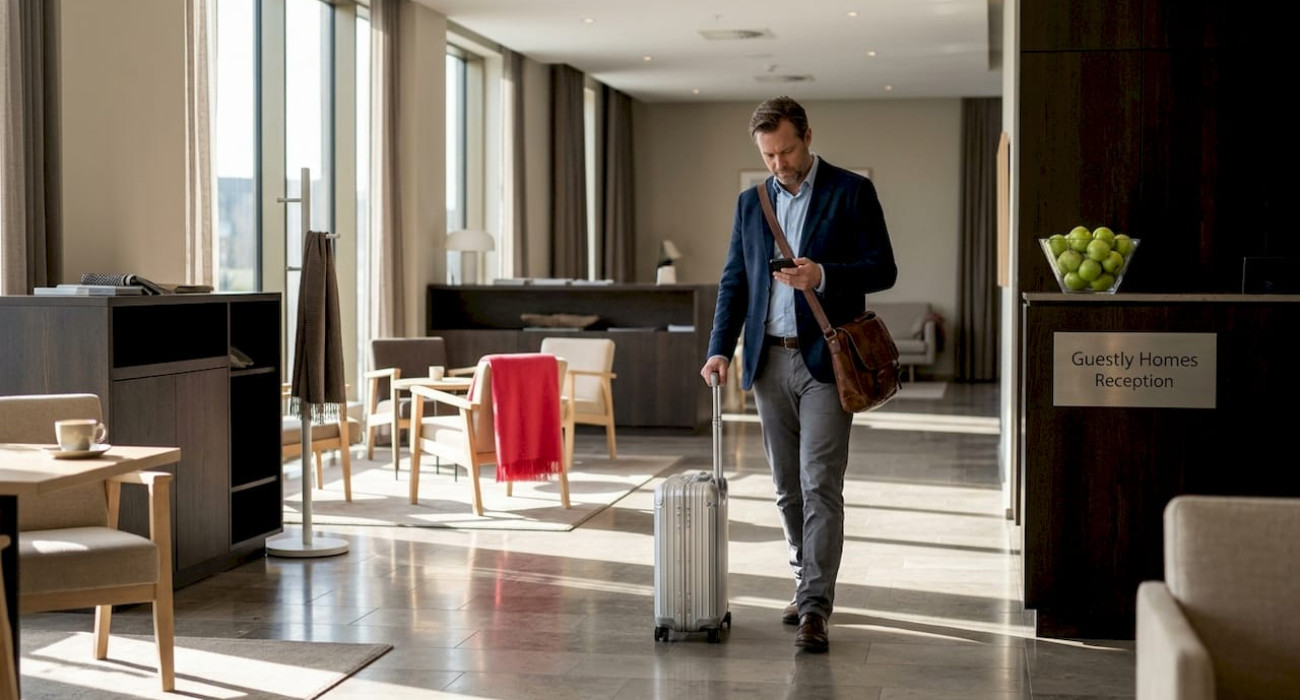
Picture this: a consultant lands at Stockholm Arlanda at 6 AM after a red-eye from Frankfurt, laptop in hand, a full day of client meetings ahead, and nowhere to go but a hotel lobby for six hours. This scenario plays out repeatedly across Nordic business travel, and the cost is real — lost productivity, fatigued employees, and unnecessary stress before a critical project even begins. For HR leads and project managers coordinating extended professional stays across Sweden, Finland, Norway, and Denmark, securing reliable early check-in access is not a luxury. It is a fundamental part of managing team performance on the road.
Innehållsförteckning
- Understanding early check-in challenges in Nordic business stays
- Pre-arrival strategies: maximising the chance of early access
- On-the-day tactics: handling delays, high occupancy, and unavoidable waits
- Hotels vs serviced apartments: choosing the right solution for corporate early access
- What most guides miss: future-proofing business travel with flexible accommodation strategies
- Secure stress-free early check-in with Guestly Homes solutions
- Frequently asked questions
Viktiga slutsatser
| Punkt | Detaljer |
|---|---|
| Early check-in limits | Most Nordic hotels enforce 3 PM check-in, so early access requires planning or extra fees. |
| Pre-arrival planning | Proactively request early check-in, leverage corporate agreements, and confirm arrangements for the smoothest experience. |
| Serviced apartments advantages | Serviced apartments typically offer greater flexibility and digital solutions for business travellers. |
| Backup strategies | Always prepare for edge cases such as high occupancy by arranging bag storage or budgeting for extra nights. |
| Future-proof policies | Adopting digital, transparent, and flexible booking policies will minimise early check-in disruptions for teams. |
Understanding early check-in challenges in Nordic business stays
With the challenge defined, it is useful to break down what actually creates these obstacles and how accommodation types differ in their ability to address them.
Nordic business travel operates within a clearly defined set of hospitality norms. Standard hotel check-in times at major Nordic chains such as Scandic are typically set at 3 PM, with check-out required by 12 PM. Early check-in is subject to availability and frequently incurs additional fees, making it both unpredictable and potentially expensive for corporate travel budgets.
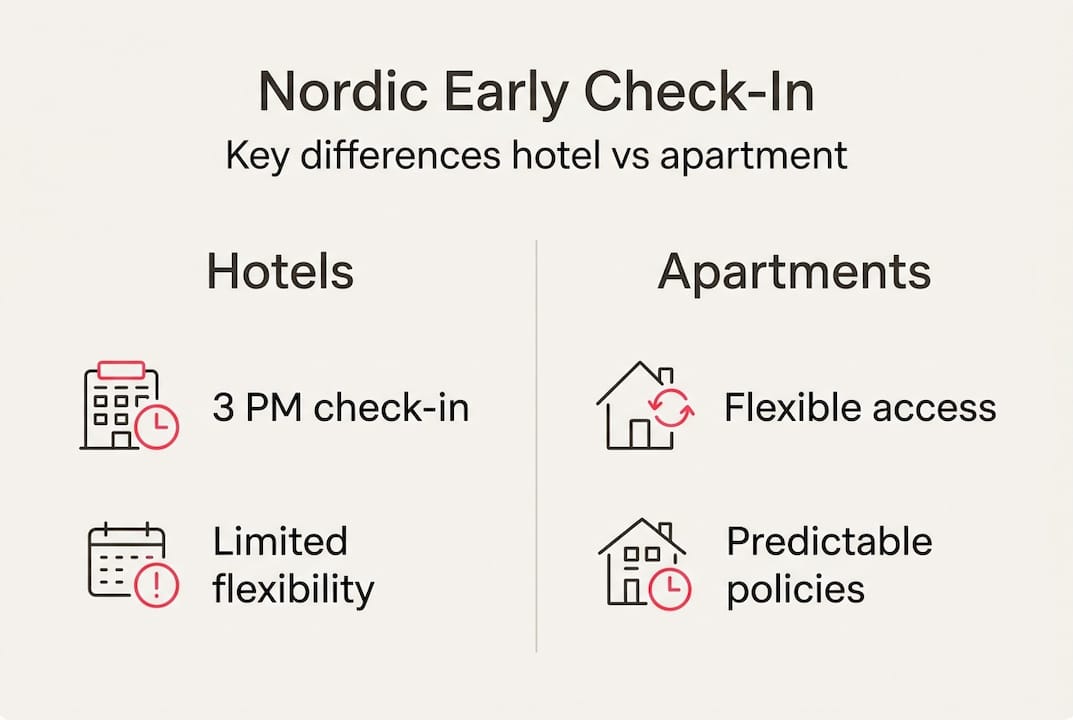
The reasons hotels restrict early check-in are largely operational. Housekeeping teams need time to turn over rooms following morning check-outs, and at full occupancy there is simply no room ready to assign before midday. For a single leisure traveller, a short wait may be manageable. For a project team of six engineers arriving from Helsinki after an early flight, that same wait creates a compounding problem: nowhere to coordinate, nowhere to rest, and no space to prepare for work.
The impact on staff wellbeing and productivity is measurable. Sleep disruption from early travel, combined with hours waiting in a lobby, directly affects cognitive performance on arrival day. HR managers who overlook this factor often find that first-day meetings underperform or that employees report dissatisfaction with the travel experience as a whole.
Here is a quick comparison of how accommodation types typically handle early check-in:
| Funktion | Traditional hotel | Serviced apartment |
|---|---|---|
| Standard check-in time | 3 PM | Often flexible |
| Early check-in availability | Subject to availability | Agreed in advance |
| Digital/self check-in | Varies by chain | Increasingly standard |
| Corporate agreement flexibility | Begränsad | Hög |
| Fee for early access | Vanlig | Ofta ingår |
Serviced apartments, by contrast, are increasingly designed to accommodate corporate requirements. When booking furnished homes through a managed operator, early access is frequently built into the booking agreement rather than treated as an exception. This structural difference matters enormously at scale. The broader hotel vs apartment differences go well beyond room layout: they extend to operational policies, flexibility of access, and the degree to which the accommodation can adapt to professional schedules.
Key considerations for HR leads evaluating accommodation types:
- Policy predictability: Serviced apartments managed under a corporate contract offer written agreements on access times.
- Digital access: Many premium apartment operators use keypad or app-based entry, removing the dependency on front-desk staffing.
- Group logistics: A team of four or more requires coordinated, simultaneous access. Hotels struggle with this; well-managed apartments do not.
- Extended stays: For projects lasting two weeks or longer, the cumulative impact of a rigid check-in policy is far greater than for a single-night stay.
“The best accommodation for a project team is not always the most expensive one — it is the one that works with your schedule, not against it.”
Pre-arrival strategies: maximising the chance of early access
Understanding the challenges, the next stage is to prepare before arrival: here is how to plan ahead and stack the odds in your favour.
For corporate and HR managers, pre-arrival coordination is key. Requesting early check-in via hotel apps or loyalty programmes, offering it as a paid upsell for guaranteed access, or using mobile and self check-in are all proven methods to bypass delays. The difference between a smooth arrival and a wasted morning often comes down to preparation made days in advance.
Here is what effective pre-arrival planning looks like in practice:
- Request early check-in at the time of booking: Do not wait until the day before. Many properties assign available rooms to advance requests when demand is lower. The earlier you submit the request, the better your chances.
- Leverage corporate agreements: Nordic chains such as Scandic Business, Nordic Choice Corporate, and Radisson Meetings have business travel programmes that include preferential access policies. HR leads managing recurring travel should negotiate these terms directly with accommodation providers.
- Use hotel loyalty status: Individual travellers with elite loyalty membership at chains like Marriott Bonvoy or IHG One Rewards receive early check-in as a standard benefit. If your frequent travellers hold this status, ensure bookings are made under their profiles.
- Book through corporate travel platforms: Tools such as Egencia, TravelPerk, or Amadeus GDS allow policy-level requests to be embedded in bookings automatically.
- Pay the premium when it counts: For critical arrivals, such as when an executive needs to be operational from 8 AM, the cost of guaranteeing a room the night before is almost always justified by the value of undisrupted preparation time.
Pro Tip: Always confirm your early check-in request directly with the property by phone the day before arrival. Email requests can be overlooked during busy periods, and a brief call gives you real-time confirmation rather than a generic automated response.
Understanding how accommodation operators approach the check-in procedures and check-in process explained in more detail helps HR leads ask the right questions when evaluating providers.
Here is a comparison of the most common pre-arrival strategies and their reliability:
| Strategi | Kostnad | Reliability | Best for |
|---|---|---|---|
| Request at booking | Ingen | Moderat | Individual travellers |
| Corporate agreement | Negotiated | Hög | Recurring teams |
| Loyalty status | None (earned) | Hög | Frequent travellers |
| Paid early check-in upsell | Low to moderate | Very high | Critical arrivals |
| Book previous night | Room rate | Guaranteed | Executive or VIP arrivals |
| Serviced apartment with agreed access | Ingår | Guaranteed | Project teams |
The pattern is clear: the more formalised and advance-planned the arrangement, the more reliable the outcome. Reactive strategies, such as asking at check-in on the day, carry the lowest success rate and the highest potential for disruption.
On-the-day tactics: handling delays, high occupancy, and unavoidable waits
Even with careful planning, arrival day can bring its own surprises. Here is how to navigate those moments effectively.
High-occupancy days significantly limit early access. When a hotel is running at 95% or above, even confirmed early check-in requests may fall through due to delayed check-outs from the previous night. In these situations, having a clear contingency plan is not optional — it is part of professional travel coordination.
Follow these steps when early check-in falls through on arrival day:
- Confirm the revised room-ready time immediately. Speak to the front desk manager rather than a standard receptionist. Ask for a specific time, not a vague estimate, and request a text or call notification when the room is ready.
- Arrange luggage storage. Every Nordic hotel and most serviced apartment operators offer secure bag storage. Use it immediately so your employee is not carrying bags into meetings or around a city.
- Identify a local workspace option. Many Nordic cities have co-working spaces available on a drop-in basis. Stockholm’s Convendum, Helsinki’s Maria 01, and Copenhagen’s BLOX all offer day-rate access. A quick pre-travel search can arm you with a fallback plan.
- Use hotel lobby facilities wisely. Most hotel lobbies in the Nordics offer complimentary Wi-Fi, seating, and coffee. They are not ideal for extended work, but sufficient for a two-hour wait or a brief preparation call.
- Budget for an extra night in advance for critical relocations. When an entire project team is relocating and first-day performance is essential, booking the night before arrival is a standard contingency that pays for itself.
“In group relocations, the logistics of a delayed check-in multiply with every additional team member. Plan for the exception, not just the rule.”
Pro Tip: For employees arriving on early morning flights, consider optimising temporary housing arrangements that include a briefing note for the traveller: where to store bags, where to find a working space, and when to return to the property. This removes the cognitive burden from a tired traveller and demonstrates genuine organisational care.
Hotels vs serviced apartments: choosing the right solution for corporate early access
With practical, on-the-day tactics covered, it is time to step back and consider your accommodation policy at a higher level.
The fundamental question for HR and procurement managers is not whether to get early check-in, but which accommodation type makes early check-in reliably achievable. Digital pre-check-in and corporate agreements with Nordic chains such as Scandic offer a path forward for hotel-based stays, but serviced apartments offer a structurally more flexible solution for project teams.
| Faktor | Hotellet | Serviced apartment |
|---|---|---|
| Early check-in policy | Reactive, availability-based | Proactive, contract-based |
| Digital access | Chain-specific apps | Often keypad or app-native |
| Policy transparency | Varierar beroende på fastighet | Set at agreement stage |
| Suitability for extended stays | Limited (costs rise) | Optimised for 10+ nights |
| Kitchen and self-sufficiency | Rarely available | Standard |
| Early access cost | Additional fee | Often included in rate |
For HR managers sourcing accommodation for rolling project teams, understanding the service apartment vs hotel distinction at a policy level is critical. When selecting serviced apartments for a team deployment, the checklist should include:
- Written confirmation of access times before signing any agreement.
- Digital or keypad entry to remove dependency on staffed reception hours.
- A dedicated point of contact at the operator for on-arrival support.
- Clarity on what “early check-in” means in practice: is it 10 AM, 8 AM, or fully flexible?
- Track record with corporate clients, ideally from the same sector or project type.
A well-structured serviced apartment agreement reduces the number of variables on arrival day to near zero. That level of predictability is worth significantly more than the marginal cost difference between a hotel room and a managed apartment, particularly when your team’s first morning sets the tone for a two-month project.
What most guides miss: future-proofing business travel with flexible accommodation strategies
When you zoom out and look at company-wide travel planning, a few crucial but overlooked insights emerge, and here is how to future-proof your approach.
Most early check-in guides focus on tactics: call ahead, use an app, pay a fee. These are useful but they address the symptom rather than the cause. The real issue for growing Nordic businesses is that their accommodation strategies have not kept pace with the scale or complexity of their project-based travel.
Relying on hotel goodwill for early check-in is inefficient at scale. When you have three concurrent project teams travelling across Sweden and Finland in the same quarter, individual-level negotiation at each property is a time drain on HR resources and a source of inconsistent employee experience. The answer is structural, not tactical.
Serviced apartments used as a serviced apartment setup under a managed operator model are a genuinely strategic solution for rolling project teams. A pre-agreed corporate rate with a flexible operator removes the early check-in variable entirely. Your team arrives, enters the property, and starts work. That is not a luxury. That is a well-designed system.
Digital check-in technology is also advancing rapidly. Biometric entry, app-controlled smart locks, and remote property management are becoming standard in the premium serviced apartment sector. Within the next few years, the concept of waiting at a reception desk for a key card will feel as outdated as printing a boarding pass. HR managers who build these capabilities into their accommodation policy today will be significantly ahead of the operational curve.
The deeper point is this: early check-in is a symptom of a misaligned travel policy. True value comes from aligning HR, procurement, and travel management around accommodation providers who build flexibility into their operating model from the outset, rather than offering it as an afterthought.
Secure stress-free early check-in with Guestly Homes solutions
Managing corporate accommodation across the Nordics requires a partner who understands that your team’s arrival experience directly affects their performance. At Guestly Homes, we have built our operating model around exactly that understanding.
Our fully managed properties across Sweden and the wider Nordics are designed for professionals who need their accommodation to work without drama. From flexible access arrangements to digital entry and dedicated support, we handle the details so you do not have to. Whether you need an executive premium suite for a senior consultant or a spacious business villa for a project team, our properties offer the policy transparency and operational reliability that HR leads depend on. Contact Guestly Homes to discuss a tailored arrangement for your next deployment.
Frequently asked questions
What is the typical early check-in policy at Nordic hotels?
Most Nordic hotels set a standard check-in time of 3 PM, and early check-in at chains such as Scandic is subject to availability and often carries an additional fee. HR managers should never assume early access without advance confirmation.
What should HR do if early check-in is not available due to high occupancy?
Arrange secure bag storage at the property immediately and identify a nearby co-working space or lobby area for interim use. For high-stakes arrivals, budget for an extra night booked in advance to guarantee room access from the morning.
Is there a difference between hotels and serviced apartments for early check-in?
Serviced apartments typically offer more predictable and flexible early check-in policies than hotels, particularly for extended business projects. Access times can be agreed contractually in advance, removing the uncertainty that comes with hotel availability-based policies.
How can HR guarantee early check-in for a team?
The most reliable methods include using corporate travel agreements, submitting early check-in requests at the point of booking, and booking the preceding night for guaranteed access on critical deployments. Serviced apartments with written access agreements offer the highest level of certainty.
What is the impact of early check-in issues on employee productivity?
Waiting for a room after a long-haul or early morning flight delays recovery, disrupts morning schedules, and reduces cognitive readiness for first-day meetings. For project teams, a poorly managed arrival can undermine the momentum of an entire engagement from the outset.