


TL;DR:
- Choosing a rental strategy depends on your available time, risk appetite, and financial goals.
- Short-term tourist rentals offer high gross income but require extensive management and higher costs.
Rental strategy is defined by the audience you choose to serve, and that choice shapes every financial and operational outcome you will face as a property owner. The three primary rental audiences are tourists (short-term stays under 30 days), local tenants (long-term leases of 12 months or more), and corporate guests (mid-term professional stays typically lasting one to three months). Each model carries a distinct income profile, management burden, and risk level. Choosing between them is not simply a question of which rentals attract tourists or which pays the most on paper. The right answer depends on your capital, time availability, and willingness to manage risk rather than yield alone.
How do stay length and guest behaviour differ across rental strategies?
Stay duration is the clearest dividing line between the three rental audiences, and it drives almost every other difference in how you manage a property.
Tourist rentals run on short cycles, often two to seven nights. High turnover means frequent cleaning, constant guest communication, and dynamic pricing adjustments. Guests arrive with holiday expectations: they want spotless presentation, fast responses, and local recommendations. A single negative review can reduce bookings for weeks. The operational rhythm is relentless.
Local tenants sign leases of 12 months or longer. Turnover is rare. Once a reliable tenant is in place, your day-to-day involvement drops sharply. Long-term tenants provide stable income, fewer regulatory surprises, and a more settled relationship with the surrounding neighbourhood. The trade-off is less flexibility to reprice or repurpose the property.
Corporate guests occupy a middle position. Mid-term rentals feature contracts of 13 or more weeks, which reduces the guest turnover workload significantly compared to tourist lets. Corporate guests are typically professionals on project assignments or executive relocations. They expect workspace, reliable connectivity, ergonomic furnishings, and professional-grade cleaning standards. Their behaviour tends to be predictable and low-drama.
- Tourist stays: Two to seven nights on average. High communication load, frequent cleaning, and seasonal demand swings.
- Local tenant stays: Twelve months or more. Minimal day-to-day management. Stable occupancy and community integration.
- Corporate guest stays: One to three months. Professional usage patterns, moderate turnover, and clear expectations around workspace and connectivity.
Pro Tip: If you are new to property letting, start with a mid-term corporate model. You get the income uplift of short-term letting without the daily operational pressure.
What income patterns and financial trade-offs come with each rental strategy?
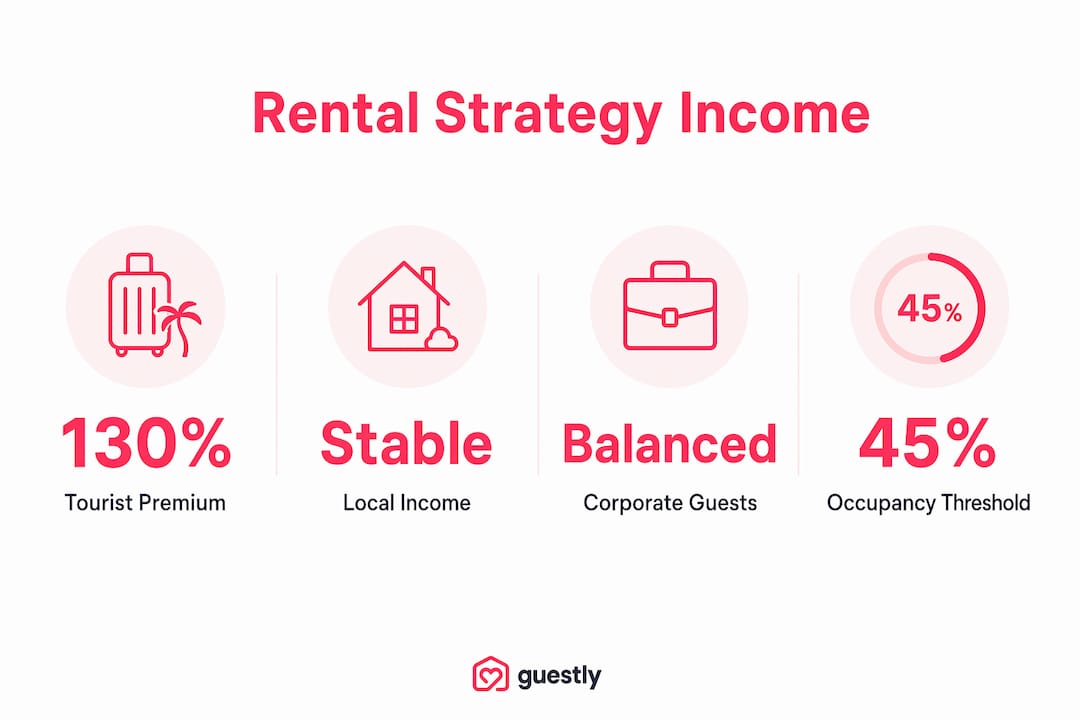
Income potential varies significantly across the three models, and gross figures rarely tell the full story.
Tourist rentals can generate the highest gross rents, particularly in leisure markets. STR net income exceeds LTR by 83–130% in leisure destinations, though the gap narrows to 9–13% in urban areas. That premium comes with real costs: platform fees, frequent cleaning, higher utility bills, and the risk of low occupancy in off-peak months. When occupancy falls below 50% in the off-season, pure STR becomes financially inferior to mid-term letting once cleaning and management costs are factored in.
Local tenant rentals offer the most predictable income. Rent arrives monthly, turnover costs are low, and you face fewer unexpected expenses. The downside is limited upside. Rent increases are constrained by market norms and tenancy law, and you cannot reprice quickly when demand rises.
Corporate guest rentals sit between the two. They generate above-LTR returns with far less active management than tourist lets. Professionally furnishing key items yields a 10–20% rent premium, and smart thermostats reduce utility costs by 10–12%. Those upgrades pay back quickly in a mid-term model where guests stay long enough to notice and value them.
| Metric | Tourist (STR) | Local tenant (LTR) | Corporate guest (MTR) |
|---|---|---|---|
| Gross rent potential | Hoog | Matig | Moderate to high |
| Income stability | Low (seasonal) | Hoog | Hoog |
| Operational costs | Hoog | Laag | Matig |
| Turnover frequency | Wekelijks | Annual | Quarterly |
| Regulatory risk | Hoog | Laag | Low to moderate |
A hybrid rental approach combining tourist lets during peak season with corporate or mid-term lets in the off-season can outperform either model used alone. This works particularly well for properties in seasonal leisure markets where winter demand from tourists collapses but demand from project workers or relocating professionals remains steady.
Pro Tip: Before committing to a pure STR model, calculate your net income at 45% occupancy. If the numbers do not work at that level, a mid-term or hybrid model will protect you better.
What operational demands should property owners plan for?
Operational intensity varies more between these three models than most owners expect before they start.

Tourist lets require dynamic pricing, daily guest messaging, review management, and frequent turnovers. Scaling beyond one unit almost always requires professional management. The time cost is real, and underestimating it is the most common mistake first-time STR owners make. Direct booking methods save owners 10–15% on platform fees, but building a direct booking channel takes time and marketing effort.
Long-term tenancies are operationally simple by comparison. You manage an annual lease, handle maintenance requests, and conduct periodic inspections. The relationship with a reliable tenant can run for years with minimal friction. The risk here is not workload but inflexibility: if the market moves or your circumstances change, exiting a long-term tenancy takes time.
Mid-term corporate lets offer the most efficient balance. Fewer turnovers mean less cleaning coordination and fewer check-in logistics. After initial placement, the property largely runs itself until the next booking cycle. Scaling STR beyond one unit often requires professional management, whereas MTR demands far less frequent intervention, making it more suitable for owners who want performance without constant involvement.
Key operational considerations by model:
- Tourist lets: Daily communication, dynamic pricing tools, cleaning coordination, platform review management, and regulatory compliance checks.
- Local tenancies: Lease administration, periodic inspections, maintenance response, and rent review at renewal.
- Corporate lets: Initial property setup to professional standard, mid-stay welfare checks, and reliable point of contact for the guest or their employer.
- Regulatory exposure: Most STRs face increasing local restrictions on stays under 30 days, while mid-term rentals are typically exempt from those rules.
Pro Tip: Check your local authority’s short-term rental regulations before investing in STR-specific furnishings or marketing. Regulatory changes can alter your income model overnight.
How does tenant type affect property condition and long-term asset value?
The type of guest you host has a direct effect on how your property ages and how your neighbours perceive it.
Tourist turnover creates the highest wear rate. Frequent check-ins and check-outs, varied guest care standards, and the occasional large group booking all accelerate wear on fixtures, flooring, and appliances. Maintenance cycles are shorter. Neighbour relations can suffer if noise or parking becomes a recurring issue, which matters particularly in residential blocks or quiet streets.
Local tenants typically treat a property with more care because it is their home. Long-term occupancy creates a natural incentive to maintain the space. Wear accumulates slowly, and the property benefits from consistent, attentive use. Community integration is stronger, and neighbour relations tend to be stable.
Corporate guests fall between the two. They care about the professional appearance of their temporary home because it reflects on them. Wear is moderate and predictable. They expect the property to be well maintained and will flag issues promptly, which actually helps owners stay on top of maintenance rather than discovering problems after a long tenancy.
Strategies to protect property condition across all three models:
- Conduct a detailed inventory check at every turnover, regardless of tenant type.
- Invest in commercial-grade fixtures in high-wear areas such as kitchens and bathrooms.
- For tourist lets, schedule a deep clean and maintenance review every 60 days.
- For corporate lets, provide a clear point of contact so guests report issues immediately rather than letting them worsen.
- For long-term tenancies, include a mid-tenancy inspection clause in the lease agreement.
Which rental strategy fits your owner profile and investment goals?
The right rental strategy is the one that matches your financial goals, risk tolerance, and available time. There is no single best answer across all owners.
If you want maximum yield and accept high operational involvement and income volatility, tourist lets in a strong leisure market can outperform the alternatives. The income premium in leisure destinations is real, but so is the work. This model suits owners who treat property as an active business rather than a passive asset.
If you want stability and minimal involvement, long-term local tenancies are the most reliable path. Income is predictable, costs are low, and the management burden is light. This model suits owners who prioritise capital preservation and steady cash flow over yield maximisation.
If you want above-average returns without the daily grind of tourist management, mid-term rentals provide the most efficient net-to-work ratio. Corporate guest accommodations attract professionals who pay well, stay reliably, and require less hand-holding than leisure travellers. Guestlyhomes specialises in exactly this model across Sweden and the Nordics.
| Owner profile | Best fit | Why |
|---|---|---|
| Active investor, high involvement | Tourist (STR) | Maximises gross yield in strong leisure markets |
| Passive investor, stability focus | Local tenant (LTR) | Predictable income, low costs, minimal management |
| Balanced investor, moderate involvement | Corporate guest (MTR) | Above-LTR returns with far less daily management |
| Seasonal market owner | Hybrid STR + MTR | Captures peak tourist demand and fills off-season gaps |
Key takeaways
The most effective rental strategy aligns your income goals, risk tolerance, and management capacity before it chases the highest headline yield.
| Punt | Details |
|---|---|
| Stay length drives everything | Tourist, local, and corporate guests differ first by how long they stay, which shapes income, costs, and management load. |
| STR yields are real but conditional | Short-term tourist lets outperform in leisure markets, but only when occupancy stays consistently high. |
| Mid-term lets offer the best balance | Corporate guest rentals generate above-LTR returns with significantly less daily management than tourist lets. |
| Furnishing quality lifts income | Professional furnishings and smart upgrades yield a 10–20% rent premium across all mid and short-term models. |
| Regulatory risk favours MTR | Most local restrictions target stays under 30 days; mid-term corporate lets typically fall outside those rules. |
The model that actually fits your life
The rental strategy debate tends to focus on yield tables and occupancy rates. That is the wrong starting point. The right question is: how much of your time and attention does this property deserve?
I have seen owners chase tourist rental income only to burn out within 18 months. The gross numbers looked excellent. The net numbers, after management fees, cleaning costs, and the hours spent on guest communication, told a different story. The property performed. The owner did not.
Mid-term corporate lets changed that calculation for many of the owners I work with. The income is not always the highest on paper, but the net-to-effort ratio is consistently better. A corporate guest who stays for two months, pays reliably, and treats the property professionally is worth more in practice than a string of weekend tourists who each require a full turnover cycle.
Long-term local tenancies are underrated for owners who genuinely want passive income. The yield is lower, but so is everything else: the stress, the costs, the regulatory exposure. If your goal is to protect an asset and draw a steady return while you focus on other things, a reliable long-term tenant is a sound choice.
The owners who do best are the ones who are honest about their constraints before they choose a model. If you have limited time, do not choose STR. If you want maximum yield and are prepared to treat it as a business, STR in a strong leisure market can deliver. If you want the middle ground, corporate guest accommodations are worth serious consideration. The rental strategy comparison only matters if you apply it to your actual situation.
— Joakim
Properties built for the right rental strategy
Guestlyhomes manages premium properties across Sweden designed specifically for mid-term and extended professional stays. Whether you are an owner evaluating your options or a booker arranging accommodation for a team, the properties are set up to perform from day one.
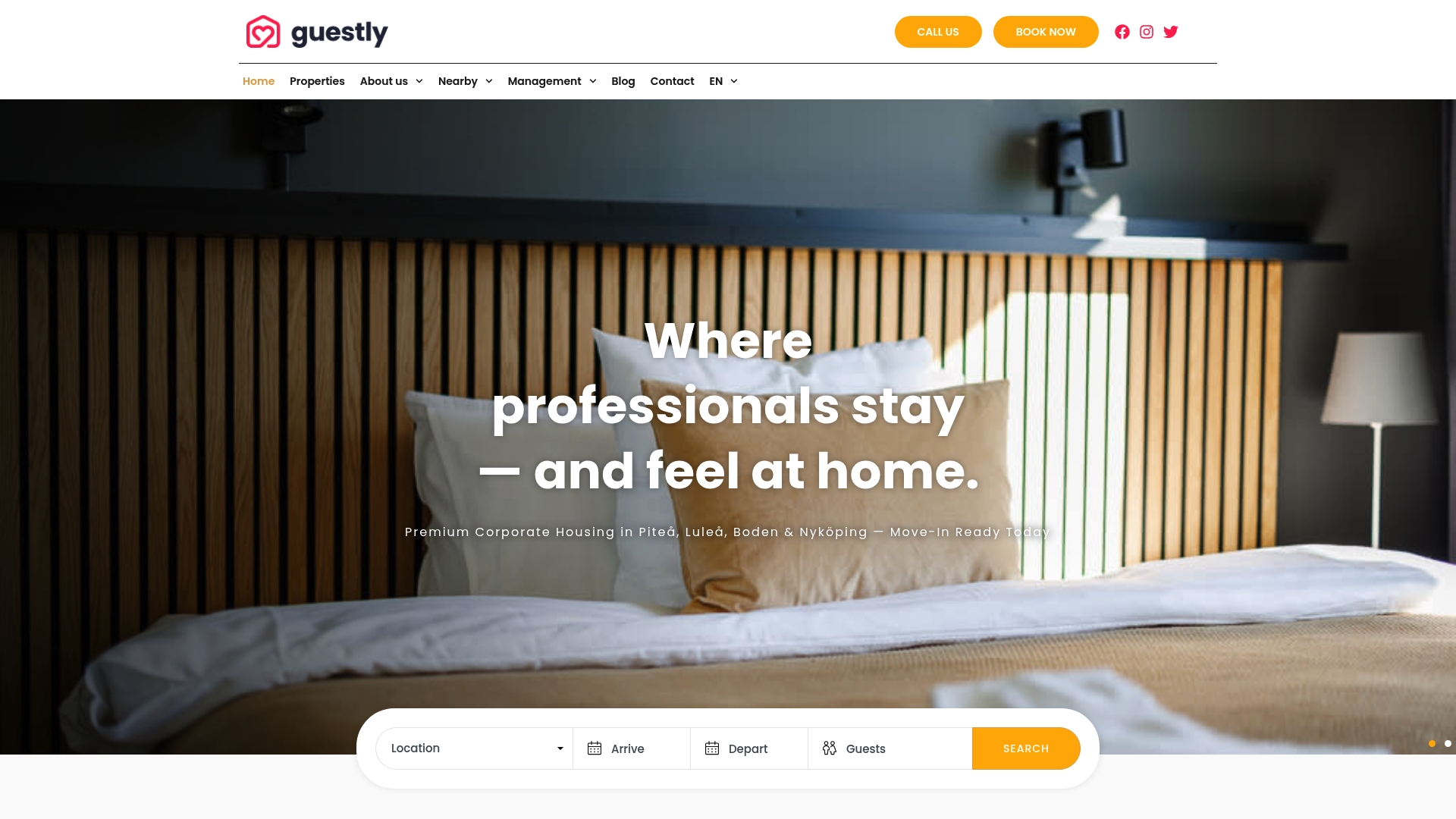
The modern luxury villa with lake view is a strong example of a property calibrated for corporate groups and extended stays: professional-grade furnishings, reliable connectivity, and the kind of space that supports both work and rest. For owners, Guestlyhomes handles management, guest relations, and property standards entirely. For bookers, it means one point of contact and no surprises. Browse the full property portfolio to see what a well-managed rental looks like in practice.
FAQ
What is the most profitable rental strategy for property owners?
Short-term tourist lets generate the highest gross income in strong leisure markets, with net premiums of 83–130% over long-term rentals in those locations. Mid-term corporate lets offer a better net-to-effort ratio for owners who want above-average returns without daily management.
How long do corporate guests typically stay?
Corporate guests typically stay for one to three months. Mid-term rental contracts of 13 or more weeks are standard, which significantly reduces turnover frequency compared to tourist lets.
Are short-term rentals facing more regulation?
Most short-term rentals now face increasing local restrictions on stays under 30 days. Mid-term rentals are typically exempt from these rules, making them a lower-risk choice in heavily regulated markets.
What furnishings make the biggest difference to rental income?
Professional furnishings in key areas yield a 10–20% rent premium across mid and short-term models. Smart thermostats reduce utility costs by 10–12% and improve guest satisfaction, particularly for corporate guests on extended stays.
Which rental model suits a hands-off property owner?
Long-term local tenancies suit owners who want minimal involvement and predictable income. Mid-term corporate lets are a strong alternative for owners who want higher returns with moderate management demands.
Aanbevolen
- Corporate Housing vs Airbnb: Which Model Fits Your Property? – 4 Options 2026 – Guestly Homes
- What corporate guests actually notice in a rental property – Guestly Homes
- What makes a property attractive to corporate guests – Guestly Homes
- Tourists, locals or corporate guests: Best rental for income – Guestly Homes