


TL;DR:
- Short-term accommodation typically lasts up to 30 days and emphasizes flexibility, while extended stay options cover periods from one month or more with added residential comfort. Extended stay properties offer predictable costs, bundled utilities, professional support, and amenities like kitchens, making them more suitable for long-term stays and team accommodations. Choosing the right option depends on assignment duration, administrative capacity, workspace needs, and service reliability, rather than price alone.
The difference between short term vs. extended stay accommodation is defined by duration, contractual structure, and the level of residential comfort each arrangement provides. Short-term stays typically run from one night to around 30 days, prioritising flexibility and minimal commitment. Extended stay accommodations, which include serviced apartments, aparthotels, and long-term lodging programmes, cover periods from one month to twelve months or more, emphasising stability, space, and a home-like environment. For travelling professionals and corporate teams, choosing between these two categories is one of the most consequential logistical decisions of any work assignment.
What defines short term vs. extended stay accommodation?
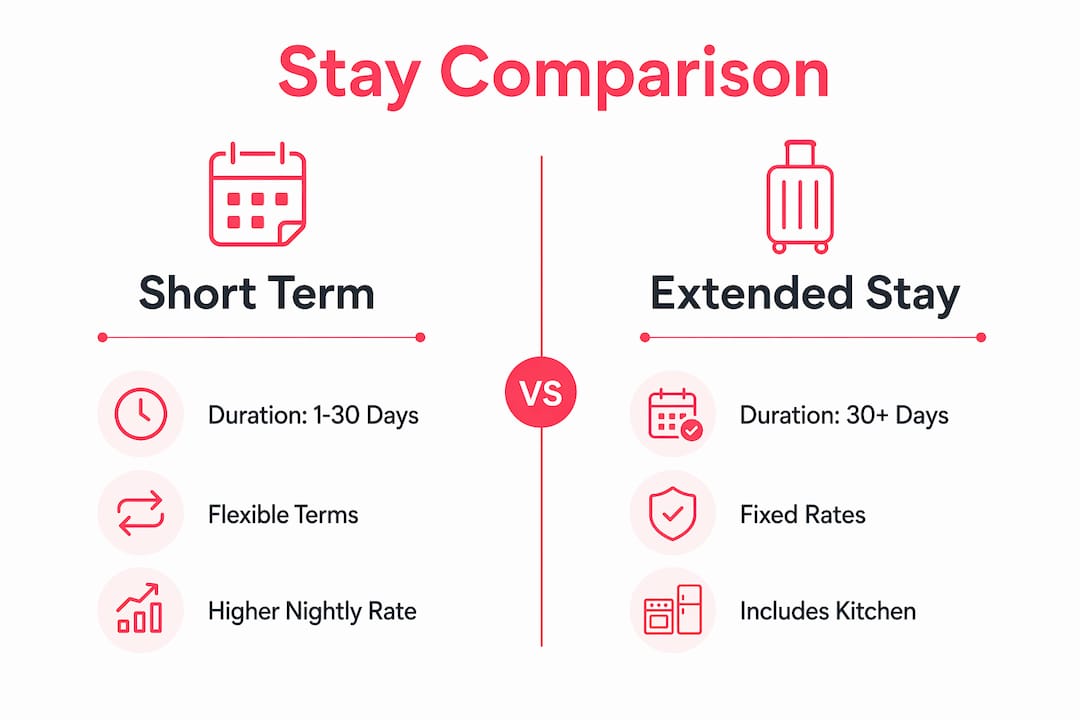
The clearest distinction between short-term and extended stay lies in contractual duration and the services built around it. Short-term arrangements operate on nightly or weekly terms, with no lease paperwork and maximum flexibility. Extended stay accommodations begin at roughly 30 nights and are structured around residential living, with dedicated kitchens, laundry access, and predictable pricing.
The industry uses several recognised formats across both categories. Understanding which format fits your assignment is the first step to avoiding unnecessary cost or disruption.
| Type accommodatie | Duur | Belangrijkste kenmerken |
|---|---|---|
| Short-term rental (e.g. Airbnb) | 1–30 nights | Variable host standards, more living space, personalisation |
| Extended stay hotel | 7 nights to several months | 24-hour reception, bundled utilities, consistent service |
| Serviced apartment | 30 nights to 12 months | Full kitchen, laundry, residential feel, professional management |
| Aparthotel | 1 night to several months | Hotel services with apartment layout, flexible terms |
Extended stay hotels offer 24-hour reception and bundled utilities, while short-term rentals provide more space and a residential environment but with more variable service standards. That variability matters enormously when you are managing a team across multiple locations and cannot afford unpredictable outcomes.
Key characteristics that separate the two categories include:
- Contract terms: Short-term stays carry no lease obligation. Extended stay properties may require a minimum of 30 nights, while residential leases often mandate 3, 6, 9, or 12-month terms.
- Utilities and services: Extended stay hotels typically include all utilities, while short-term rentals may require guests to set up and pay for utilities separately.
- Housekeeping: Extended stay properties offer scheduled housekeeping. Short-term rentals often provide a single clean at check-in and check-out only.
- Front desk support: Extended stay hotels and serviced apartments provide on-call professional support. Short-term rental hosts vary widely in responsiveness.
How do costs and pricing models compare?
Pricing is where the short term vs. extended stay decision becomes genuinely complex. The nightly rate for a short-term rental may appear lower, but the total cost of a 45-night stay often tells a different story once utilities, cleaning fees, and dining expenses are factored in.

Extended stay pricing operates on fixed, predictable rates. The longer the stay, the lower the effective nightly cost, and most extended stay properties bundle utilities, Wi-Fi, and sometimes breakfast into a single invoice. That predictability simplifies budget management for HR teams and project managers significantly.
| Stay Length | Short-Term Rental Cost Profile | Extended Stay Cost Profile |
|---|---|---|
| Under 10 nights | Competitive nightly rate, cleaning fee added | Higher nightly rate, all-inclusive |
| 10–30 nights | Costs rise; utilities often separate | Rates begin to reduce; utilities bundled |
| 30+ nights | Significant utility and dining overhead | Fixed rate, kitchen access reduces dining costs |
The serviced apartment sector is projected to reach $434 billion by 2030, driven by demand for residential-style living with kitchen and laundry access that reduces travel expenses. Access to a kitchen alone can cut daily food costs substantially over a stay exceeding one month. That is a meaningful saving for a team of four engineers on a 60-night project assignment.
Extended stay hotels and serviced apartment operators also offer loyalty benefits and negotiated corporate rates for repeat bookings. These discounts compound over time and are rarely available through short-term rental platforms, which rely on dynamic, host-set pricing.
Pro Tip: Before committing to any accommodation for a stay of 30 nights or more, request a full cost breakdown including utilities, cleaning, and any mandatory fees. Compare this against the all-in rate from a serviced apartment or extended stay hotel to find the true cost difference.
What should travelling professionals consider when choosing?
Choosing between temporary lodging options is rarely a simple price comparison. The right decision depends on four practical factors: assignment duration, administrative tolerance, workspace requirements, and service reliability.
-
Assignment duration. Assignments under ten nights favour extended stay hotels due to ease of check-in and the absence of lease paperwork. For assignments exceeding 30 nights, Long-Term Lodging (LTL) programmes provide fully furnished apartments with dedicated workspace and amenities not typically available in transient hotels.
-
Administrative tolerance. Short-term rentals require more coordination: communicating with individual hosts, managing check-in logistics, and resolving issues without a professional front desk. For a solo traveller with time to manage this, it can work well. For a project manager coordinating accommodation for a team of six, the administrative overhead is a genuine risk.
-
Workspace availability. Remote and hybrid work has made reliable internet and a proper desk non-negotiable. Extended stay properties and serviced apartments are built with this in mind. Short-term rentals vary considerably, and a poorly equipped workspace can affect output on a critical project.
-
Service reliability. Unmet expectations are highest with short-term residential rentals due to variable host standards. Extended stay properties offer consistent, professional service. For corporate teams, service predictability is not a luxury. It is a baseline requirement.
Pro Tip: When booking for a team, always confirm workspace specifications in writing before arrival. Ask specifically about desk space per person, internet speeds, and whether a printer or meeting area is available on-site.
Choosing based on project duration and administrative tolerance is more practical than price alone. This is the insight most travellers overlook when comparing options.
How does accommodation type affect daily work life?
The physical environment of your accommodation shapes your daily routine more than most professionals anticipate before they arrive. Space, privacy, and access to basic facilities all affect concentration, rest, and overall performance during a work assignment.
Short-term rentals often provide more living space and a homier environment, which is beneficial for longer stays or for professionals travelling with family. However, they may lack consistent housekeeping and front desk support, which creates friction over time. Running out of clean towels on a Tuesday evening when your host is unresponsive is a minor inconvenience that compounds across a six-week stay.
Consider the following factors when assessing how accommodation will affect your working life:
- Kitchen access: Cooking your own meals reduces costs and supports healthier eating habits. Serviced apartments and extended stay hotels with kitchenettes make this possible. Standard hotel rooms do not.
- Laundry facilities: In-unit or on-site laundry is a practical necessity for stays beyond two weeks. Relying on external laundromats adds time and cost to an already demanding schedule.
- Proximity to work sites: Location relative to your project site affects commute time, fatigue, and the ability to return to the accommodation during the day if needed.
- Community environment: Extended stay properties often house other professionals in similar situations. This creates a quiet, focused atmosphere that short-term rental neighbourhoods do not always provide.
- Privacy: Serviced apartments and villas offer genuine separation between living and working spaces. A single hotel room, even a well-appointed one, can feel restrictive after three weeks.
For executive accommodation options that address all of these factors, the serviced apartment and managed villa categories consistently outperform both standard hotels and short-term rentals on longer assignments.
Key takeaways
The most effective approach to choosing between short-term and extended stay accommodation is to match the arrangement to your assignment length, administrative capacity, and workspace requirements before comparing prices.
| Punt | Details |
|---|---|
| Duration drives the decision | Stays under 10 nights suit extended stay hotels; stays over 30 nights suit serviced apartments or LTL programmes. |
| All-in cost beats nightly rate | Bundled utilities and kitchen access in extended stays reduce total spend significantly over 30-plus nights. |
| Service consistency matters for teams | Extended stay properties offer predictable standards; short-term rentals carry higher risk of unmet expectations. |
| Contract flexibility protects you | Extended stay hotels allow easier early termination than fixed residential leases when assignments change. |
| Workspace is non-negotiable | Confirm desk space, internet speeds, and facilities in writing before booking for any work assignment. |
What most professionals get wrong about accommodation choice
I have seen the same mistake made repeatedly by experienced project managers and HR leads alike. They open a spreadsheet, compare nightly rates, and book the cheapest option that fits the dates. Three weeks into a six-week assignment, they are fielding complaints about slow Wi-Fi, no laundry, and a host who takes 48 hours to respond to a maintenance request.
The real decision framework is not about price. It is about what the accommodation costs you in time, energy, and operational friction over the full duration of the stay. A serviced apartment that costs 15% more per night but includes utilities, a dedicated workspace, weekly housekeeping, and a professional support line is almost always the better investment for a working professional. The savings in administrative time alone justify the difference.
Contract flexibility is the factor I would urge every booker to examine first. Extended stay hotels allow easier early termination if an assignment ends unexpectedly, unlike fixed-term residential leases. On uncertain projects, this protection is worth more than any nightly rate discount. I have seen teams locked into residential leases for properties they vacated after three weeks because the project scope changed. The financial and administrative cost of that mistake far exceeded any savings made at the point of booking.
My honest recommendation is to run a full cost-benefit analysis using real use-case scenarios before committing. Factor in utilities, food costs, commute time, and the administrative hours your team will spend managing the accommodation. When you do that honestly, the right serviced apartment almost always wins on stays beyond three weeks.
— Joakim
How Guestlyhomes supports professional and team stays
Guestlyhomes operates a portfolio of fully managed, high-standard homes across Sweden, designed specifically for professionals, project teams, and executives who need accommodation that performs without supervision.
Every property in the Guestlyhomes portfolio is managed to a consistent 5-star standard, with utilities included, professional support on call, and spaces designed for both focused work and genuine rest. Whether your team needs a modern villa with lake views for a multi-week project or a spacious five-bedroom villa with sauna for a larger group, Guestlyhomes offers flexible booking from 10 nights to 12 months. One contact, one standard, no surprises.
FAQ
What is the main difference between short-term and extended stay?
Short-term accommodation covers stays from one night to roughly 30 days, with flexible terms and no lease obligation. Extended stay accommodation begins at around 30 nights and is structured around residential comfort, bundled utilities, and professional management.
Is extended stay accommodation more cost-effective for long assignments?
For stays exceeding 30 nights, extended stay properties are generally more cost-effective. Kitchen access reduces dining costs, utilities are bundled, and negotiated corporate rates lower the effective nightly price compared to short-term rental platforms.
What are the risks of using short-term rentals for work travel?
The primary risk is service inconsistency. Short-term rentals rely on individual host standards, which vary widely. Teams face higher exposure to unmet expectations around cleanliness, workspace quality, and maintenance responsiveness.
Can extended stay contracts be terminated early?
Extended stay hotels typically allow easier early termination than fixed residential leases. This contract flexibility protects professionals and teams when assignment durations change unexpectedly, avoiding the financial penalties associated with breaking a standard tenancy agreement.
What accommodation type suits a team of professionals on a 60-night assignment?
A serviced apartment or managed villa is the most suitable option. These properties provide dedicated workspaces, kitchen and laundry facilities, consistent professional support, and the living space needed to maintain performance and wellbeing over a two-month stay.