


TL;DR:
- Property performance optimization in 2025 relies on data-driven decisions to improve occupancy, reduce operational costs, and extend asset life. Implementing planned maintenance, AI-driven leasing, and early tenant retention strategies significantly boosts net operating income and minimizes expenses. Continuous expense monitoring and condition-based asset replacement are essential for sustainable property management and long-term value.
Property performance optimisation is defined as the systematic process of increasing net operating income (NOI) by reducing operational costs, improving occupancy, and extending asset life through data-driven decisions. For property owners and managers in 2025, this is not a theoretical exercise. Rising insurance premiums, tighter margins, and shifting tenant expectations make structured performance management a financial necessity, not a preference. The good news is that the methods are well established, the data is clear, and the results are measurable.
What does optimising property performance in 2025 actually require?
The industry term for this discipline is asset performance management, and it sits at the intersection of maintenance planning, financial monitoring, and tenant experience. Optimising property performance in 2025 means acting on each of those three areas simultaneously, not in isolation.
Stabilised multifamily properties target NOI margins of 55–65%, but rising insurance costs of 27.7% and marketing costs of 12.3% year-on-year are compressing those margins. That compression is not temporary. Owners who treat it as a one-off adjustment will find themselves behind within two years.
The starting point is a clear baseline. Before any strategy takes effect, you need to know your current cost per square foot, your planned versus reactive maintenance ratio, and your average vacancy duration. Without those three numbers, every decision is a guess.
How does planned maintenance reduce operational costs?
Planned maintenance is the single most controllable cost lever available to property owners. Properties with a 75% planned maintenance ratio spend £1.48 per square foot on maintenance, compared to £1.85 per square foot for those below 50%. That difference compounds across a portfolio.
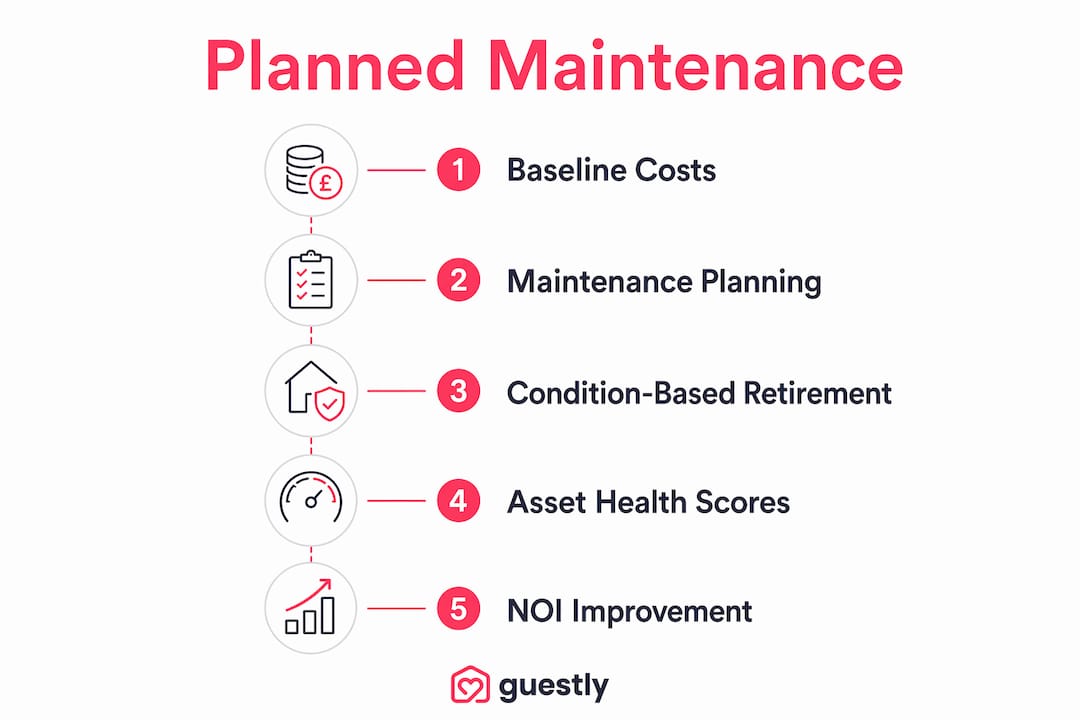
The risk of reactive, “firefighting” maintenance is NOI erosion. Every unplanned repair costs more in labour, parts, and lost rent than a scheduled intervention would have. The goal is to shift the ratio deliberately, not wait for it to improve on its own.
| Maintenance approach | Cost per sq ft | NOI impact |
|---|---|---|
| Below 50% planned ratio | £1.85 | Negative: higher reactive spend |
| 75%+ planned ratio | £1.48 | Positive: 18–25% cost reduction |
A further refinement is Condition-Based Retirement (CBR). Rather than replacing assets on a fixed schedule, CBR replaces them when condition data indicates failure risk. 82% of asset failures are condition-dependent, which means fixed-schedule replacements waste roughly 30% of CapEx budgets. CBR redirects that capital to genuine needs.
Asset health scores formalise this process. Each major system, HVAC, plumbing, electrical, receives a score based on age, service history, and condition data. Maintenance spend is then prioritised by score rather than by whoever raises a complaint first.
Pro Tip: Build your property maintenance checklist around asset health scores, not calendar dates. This alone can reduce unnecessary CapEx by 30%.
How does AI improve leasing velocity and tenant retention?
AI in property management is an operating decision, not a technology experiment. Operators using embedded AI systems report saving 12.5 hours weekly on communications, reporting, and training. That time saving translates directly into faster responses and fewer errors.

The leasing impact is concrete. AI-driven lead nurturing fills vacant units 5.2 days faster than manual processes. Renewal rates increase by 20% when AI flags renewal windows early and prompts timely outreach. Together, these improvements drive NOI gains of approximately 2.8% per property.
The four operational areas where AI delivers the clearest returns are:
- Lead nurturing. Automated follow-up sequences respond to enquiries within minutes, not hours. Speed of response is the primary driver of conversion in competitive rental markets.
- Renewal management. AI flags leases expiring 90 days out and triggers renewal conversations before tenants begin searching elsewhere. Early engagement is the most cost-effective retention tool available.
- Maintenance-to-leasing handoff. Automating alerts from maintenance completion directly to leasing teams eliminates communication lag. A unit that is ready but not listed costs money every day it sits unlisted.
- Reporting and forecasting. Unified platforms aggregate occupancy, maintenance, and financial data in one view, removing the manual effort of cross-referencing spreadsheets.
Pro Tip: The maintenance-to-leasing handoff is where most operators lose days of rent. Automate that alert and you protect income without adding headcount.
How do you manage rising expenses without cutting service quality?
Expense management in 2025 is a discipline, not a cost-cutting exercise. The distinction matters because cutting the wrong costs, maintenance response times, tenant communication, or cleaning standards, increases vacancy and turnover, which costs far more than the saving.
The cost categories demanding attention right now are insurance, marketing, administration, and repairs. Insurance costs rose 27.7% year-on-year, and administrative costs increased 9.6%. These are not discretionary. They require structural responses, not line-item reductions.
| Expense category | Year-on-year increase | Management approach |
|---|---|---|
| Verzekering | 27.7% | Portfolio-level renegotiation, risk profiling |
| Marketing | 12.3% | Channel efficiency review, retention focus |
| Administration | 9.6% | Automation of routine tasks |
| Repairs and maintenance | 8.8% | Shift to planned maintenance ratio |
Monthly variance monitoring is the first-order priority. Operating intelligence tools reveal which properties drive expense overruns, enabling focused interventions before full-year budgets are affected. Waiting for an annual review means the damage is already done.
The counterintuitive principle here is that investing in service quality, fast maintenance response, clear communication, and well-maintained common areas, justifies premium rents. Tenants who receive reliable service do not leave. Tenants who do not leave save you £3,872 per avoided move-out, plus two to four weeks of vacancy. Understanding real estate market trends also helps owners anticipate insurance and cost cycles before they hit.
What are the most effective strategies to reduce tenant turnover?
Reducing tenant turnover is the highest-return activity in property management. Each avoided move-out saves approximately £3,872 and eliminates two to four weeks of vacancy loss. No marketing campaign, pricing adjustment, or amenity upgrade comes close to that return on effort.
The practical steps are straightforward:
- Start renewal conversations 60–90 days before lease expiry. Tenants who are already looking at alternatives are harder to retain. Early outreach signals that you value the relationship.
- Offer moderate rent increases of 4–6%. Renewing leases with 4–6% increases sustains occupancy far better than 8–10% jumps, which push tenants to search the market. The maths favour retention over maximising headline rent.
- Maintain uptime above 96%. Maintenance uptime above 96% reduces move-out notices by 18%. Tenants leave when things break and stay broken. Resolving critical failures within 48 hours also decreases secondary damage costs significantly.
- Respond to maintenance requests within 24 hours. Speed of response is the primary driver of tenant satisfaction in the Nordic rental market. Tenants prioritise reliable maintenance over luxury amenities. A well-maintained property commands premium pricing; a slow-responding one does not.
- Integrate tenant communication management. Clear, consistent communication about maintenance schedules, building updates, and renewal options reduces uncertainty. Uncertainty is what drives tenants to look elsewhere.
Pro Tip: Track your first-time fix rate for maintenance vendors. Vendors with fix rates below 70% double your labour costs and add £800 per unit turnover. Standardise on vendors achieving 85% or above.
Stacking these strategies produces compounding results. Occupancy-optimised pricing combined with strong maintenance uptime and early renewal outreach yields greater annual net income than chasing the highest possible rent with higher vacancy risk. The maths consistently favour the patient, systematic approach.
Key takeaways
Optimising property performance in 2025 requires a planned maintenance ratio above 75%, AI-driven leasing operations, monthly expense monitoring, and a tenant retention strategy built on early renewals and fast maintenance response.
| Punt | Details |
|---|---|
| Target 75% planned maintenance | Properties at this ratio spend 20% less per square foot than reactive operators. |
| Use CBR for asset replacement | Condition-Based Retirement eliminates 30% of unnecessary CapEx spending. |
| Automate leasing and renewals | AI reduces vacancy duration by 5.2 days and increases renewal rates by 20%. |
| Monitor expenses monthly | Variance tracking prevents full-year NOI damage from insurance and admin cost spikes. |
| Retain tenants over maximising rent | Each avoided move-out saves £3,872 and two to four weeks of vacancy loss. |
Why the data alone will not save your property
I have worked with property owners who had excellent data and still underperformed. The reports were accurate. The dashboards were clean. But the decisions were slow, and the vendors were not held to account.
The shift that actually moves the needle is treating data as a trigger for action, not a record of what happened. A monthly variance report is only useful if someone acts on it within the week. An asset health score only matters if it changes your maintenance schedule. The BCG research on commercial real estate makes this point directly: the industry’s conservative mindset is the primary barrier to realising value that is already present in the portfolio.
What I find most telling is the maintenance uptime finding. Tenants do not leave because of rent increases alone. They leave because a boiler broke in january and took ten days to fix. That is a vendor management failure, not a market problem. Standardising on vendors with first-time fix rates above 85% is one of the most underrated decisions an owner can make.
The compounding effect of stacked decisions is also worth stating plainly. Combining data-backed pricing with energy efficiency and strong maintenance uptime does not just add returns. It multiplies them. Each improvement reduces the risk of the others failing. That is the logic behind the 75% planned maintenance target, the early renewal outreach, and the AI-driven leasing handoff. None of them is transformative alone. Together, they build a property that performs quietly and consistently, which is exactly what long-term value looks like.
— Joakim
How Guestlyhomes supports property performance for owners
Guestlyhomes works with property owners across Sweden and the Nordics who want their assets to perform without the operational burden. The model is built around planned maintenance scheduling, consistent service standards, and clear financial reporting, so owners see results without managing the detail themselves.
Whether you prefer a revenue share arrangement or a fixed-income lease model, Guestlyhomes takes responsibility for the full operational picture. That includes maintaining properties without losing bookings, managing guest communications, and keeping maintenance uptime at the level that protects both asset value and income. If you own a premium property and want it managed to a consistent standard, explore what Guestlyhomes offers and see which model fits your situation.
FAQ
What is the ideal planned maintenance ratio for property owners?
The target is 75% or above. Properties at this level spend significantly less per square foot than those relying on reactive repairs, and they see measurable NOI improvements.
How much does tenant turnover actually cost?
Each move-out costs approximately £3,872 in direct expenses, plus two to four weeks of vacancy loss. Early lease renewals with moderate rent increases are the most cost-effective way to avoid this.
Does AI in property management deliver real financial returns?
AI-driven operations reduce unit turn times by 1.2 days, fill vacancies 5.2 days faster, and increase renewal rates by 20%, producing NOI improvements of approximately 2.8% per property.
What expense categories are rising fastest in 2025?
Insurance costs increased 27.7% year-on-year, followed by marketing at 12.3% and administration at 9.6%. Monthly variance monitoring is the most effective tool for managing these increases before they affect annual NOI.
What is Condition-Based Retirement and why does it matter?
Condition-Based Retirement replaces assets based on measured condition rather than age or a fixed schedule. It eliminates roughly 30% of unnecessary CapEx spending, since 82% of asset failures are condition-dependent rather than age-dependent.