


TL;DR:
- Corporate housing offers a 40% to 75% gross rental premium over unfurnished market rates, driven by location, furnishings, and amenities. Success depends on operational discipline, strategic listing, and realistic occupancy assumptions of 80% to 88%, with net profits influenced heavily by management and operating costs. Proper management and location near demand centers create durable income streams, making this a suitable investment horizon of three to five years.
Corporate housing is defined as a fully furnished property let on a mid-term basis, typically between 30 and 180 days, to professionals, project teams, or relocating executives at a meaningful premium above standard market rents. How much your property could earn as corporate housing depends on a set of measurable factors: location relative to corporate demand centres, furnishing quality, property size, included amenities, and the operational standards you maintain. Corporate housing rents typically command a 40% to 75% premium above unfurnished market rates, and in high-demand markets this multiple can exceed 100%. That premium is real, but it is conditional. It requires the right property, the right positioning, and the right management to sustain it over time.
What factors determine your corporate housing rental earnings?
Location is the single most powerful driver of corporate housing profitability. Properties situated near business districts, technology campuses, healthcare institutions, or major infrastructure projects attract consistent demand from employers and relocation agencies. A well-located two-bedroom apartment in a corporate hub will outperform a larger property in a low-demand suburb, regardless of furnishing quality. Proximity to public transport, airports, and amenity-rich town centres further strengthens the rental case.

Property size and bedroom count directly influence the total rent achievable. A three-bedroom unit commands a higher gross rent than a studio, but it also attracts a different tenant profile: project teams, families on relocation assignments, or senior executives requiring workspace within the home. A 3-bedroom corporate rental in Roseville achieved monthly rents between $4,500 and $6,500 at 1.4x to 1.8x the unfurnished rate, demonstrating how bedroom count and all-inclusive pricing combine to lift gross income meaningfully.
Furnishing quality and included amenities are not optional extras in corporate housing. They are the product. Corporate tenants expect hotel-grade consistency: quality beds, functional workspaces, reliable high-speed internet, and fully equipped kitchens. Properties that meet this standard can sustain the premium. Those that do not will compete on price alone and lose the income advantage. You can explore how furnishing standards influence pricing in detail, but the core principle is straightforward: the specification of the property must match the expectations of the tenant.
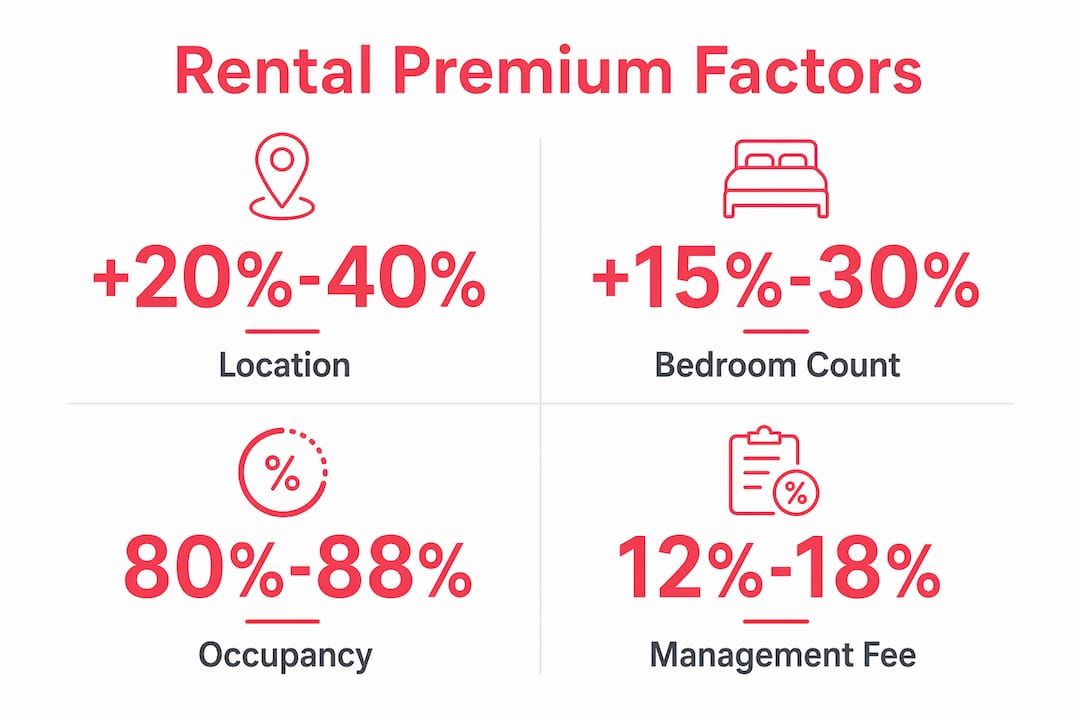
The table below illustrates how individual property factors typically influence the rental premium achievable in corporate housing:
| Factor | Typical impact on rental premium |
|---|---|
| Central or corporate-hub location | +20% to +40% above suburban equivalent |
| Each additional bedroom (beyond studio) | +15% to +25% per bedroom in gross rent |
| High-quality furnishing and workspace | Sustains full 40%–75% premium over unfurnished |
| Utilities and internet included | Adds perceived value; costs offset by higher rent |
| Dedicated parking | +5% to +10% in markets with limited supply |
| Year-round availability | Maximises occupancy and reduces income gaps |
Availability throughout the year matters more than many owners anticipate. A property that is withdrawn from the market for personal use during peak corporate demand periods loses disproportionate income, because corporate bookings are often planned weeks or months in advance. Consistent availability allows you to build a booking pipeline and maintain the occupancy rates that underpin annual income projections.
How does corporate housing income compare with traditional rentals and Airbnb?
Corporate housing occupies a distinct position between traditional long-term leasing and nightly short-term rentals. Understanding where it sits helps you assess whether the model suits your property and your appetite for involvement. The comparison below sets out the key differences across the three models:
| Model | Gross rent premium | Occupancy expectation | Management effort | Vacancy risk |
|---|---|---|---|---|
| Traditional long-term rental | Baseline (0%) | 95%–99% | Laag | Very low |
| Corporate housing (mid-term) | +40% to +75% | 80%–90% | Medium | Low to moderate |
| Short-term nightly (Airbnb) | Variable; can exceed corporate | 60%–80% | Hoog | Moderate to high |
Traditional long-term leasing offers the highest occupancy and the lowest management burden, but it also delivers the lowest gross rent. You trade income potential for simplicity and stability. Nightly rentals can generate impressive gross monthly figures in peak seasons, but they carry significant operational complexity, regulatory exposure in many markets, and higher vacancy risk during off-peak periods.
Corporate housing offers a sweet spot by combining higher rents than traditional leases with fewer operational challenges than short-term rentals. The mid-term model reduces the frequency of guest changeovers, lowers cleaning and restocking costs, and attracts a tenant profile that is less likely to cause damage or default on payment. Net cash flow premiums often run 20% to 50% over long-term rentals after accounting for all operating costs, which is a meaningful advantage for investors who model returns carefully.
Pro Tip: When comparing models, calculate net income rather than gross rent. A corporate housing property generating 60% above unfurnished rent but carrying 18% management fees, utility costs, and periodic furnishing replacement will deliver a different net return than the headline figure suggests. Model all three scenarios with fully loaded costs before deciding.
For a thorough side-by-side analysis of the two most common alternatives, the corporate housing vs Airbnb comparison from Guestlyhomes covers revenue, risk, and operational trade-offs across four distinct property configurations.
Why longer stays and professional management improve profitability
The financial case for corporate housing rests not only on the gross rent premium but on the structural advantages that mid-term tenancies create. Corporate tenants typically sign leases for 30 to 180 days, which reduces the frequency of turnovers compared with nightly rentals. Fewer turnovers mean lower cleaning costs, less wear on furnishings, and fewer vacant nights between bookings.
The quality of the tenant also matters to the income calculation. Professional corporate tenants cause less damage and pay rent reliably, often with leases backed or directly settled by their employers. This reduces the credit risk that landlords face with individual short-term guests and removes the payment uncertainty that can disrupt cash flow projections.
Professional property management amplifies these advantages further. The key operational benefits include:
- Consistent presentation standards that meet corporate tenant expectations on every arrival, protecting the premium and generating strong reviews.
- Proactive maintenance scheduling that prevents small issues from becoming costly repairs and preserves the asset’s condition over time.
- Corporate distribution channels such as Furnished Finder or dedicated relocation agencies, which reach the right tenant profile rather than general tourists.
- Compliance management covering lease documentation, utility accounts, and any local regulatory requirements for furnished rentals.
Effective corporate housing management reduces vacancy variance that can erode the annual income premium despite higher gross rents. A property that achieves 75% occupancy instead of 88% loses a significant portion of the premium advantage, which is why operational discipline is not a secondary consideration. It is central to the income model.
Pro Tip: List your property on specialised platforms such as Furnished Finder or Corporate Housing by Owner rather than relying solely on general consumer platforms. Corporate clients and relocation managers search on dedicated channels, and distribution strategy is one of the most underestimated levers in maximising occupancy.
Common misconceptions about occupancy and pricing in corporate housing
Many property owners overestimate their net income when they first evaluate corporate housing. The following misconceptions are the most frequent causes of unrealistic projections.
-
Occupancy will match a long-term tenancy. Corporate housing occupancies realistically range from 80% to 90%, not the 95% to 99% typical of a traditional lease. One detailed case study assumed 88% occupancy to estimate a viable payback period on furnishing investment. Modelling at 85% is a prudent starting assumption for most markets.
-
Furnishing the property is sufficient to command the premium. The premium depends on delivering the full corporate housing experience: utilities included, reliable internet, quality furnishings, professional cleaning between stays, and responsive management. A furnished property with poor reviews or unreliable services will not sustain the rate premium regardless of its specification.
-
Pricing above local corporate budgets will be absorbed by demand. GSA per diem rates for fiscal year 2026 set lodging caps at approximately $110 per night for standard US markets, and corporate travel policies in most organisations impose similar ceilings. Pricing above what corporate clients can claim on expenses reduces your addressable market significantly.
-
Management fees are the only operating cost to consider. Management fees for furnished rentals typically run between 12% and 18%, but utilities, cleaning, and furnishing depreciation add several hundred pounds per month in additional costs. Net income calculations that omit these items will overstate returns materially.
-
Guest reviews do not affect income in corporate housing. Corporate bookers and relocation managers check reviews before committing to a property. A pattern of negative feedback about cleanliness, internet reliability, or responsiveness will reduce bookings and force price reductions to maintain occupancy. Reviews are a direct input to achievable rate.
Key takeaways
Corporate housing earns a 40% to 75% gross rent premium over unfurnished market rates, but net returns depend on occupancy, operating costs, and management quality working together.
| Punt | Details |
|---|---|
| Gross rent premium | Corporate housing commands 40%–75% above unfurnished rates; high-demand markets can exceed 100%. |
| Net cash flow advantage | After costs, net premiums typically run 20%–50% above long-term rental income. |
| Realistic occupancy target | Model at 80%–88% occupancy; do not assume long-term tenancy levels. |
| Operating costs matter | Management fees, utilities, cleaning, and furnishing depreciation must all be included in net income projections. |
| Management quality is income-critical | Operational standards, distribution channels, and guest reviews directly determine the achievable rate premium. |
What I have learned about evaluating corporate housing income potential
The income case for corporate housing is genuine, but it is frequently misread. Owners see the gross premium and assume the net return follows automatically. It does not. The premium is a reward for operational discipline, not simply for owning a furnished property.
What I have observed consistently is that the properties generating the strongest returns share two characteristics: they are located where corporate demand is structural rather than seasonal, and they are managed with the same rigour as a professional hospitality operation. Location near healthcare institutions, engineering projects, or established business districts in markets like Mälardalen creates rising corporate housing demand that supports stable occupancy through economic cycles.
The furnishing investment is also frequently underestimated. Quality furnishings have a payback window of two to four years depending on occupancy and pricing, which means the early years of a corporate housing conversion carry higher capital costs. Owners who model this correctly and hold the asset through the payback period tend to find the returns compelling. Those who exit early or reduce standards to cut costs find the premium evaporates quickly.
My honest view is that corporate housing suits investors who think in three to five year horizons, not those seeking immediate yield maximisation. The model rewards patience, consistency, and a willingness to invest in the operational infrastructure that corporate tenants expect. When those conditions are met, the income premium is durable and the tenant quality is genuinely superior to most alternatives.
— Joakim
How Guestlyhomes helps property owners maximise corporate rental income
Guestlyhomes operates fully managed, premium properties across Sweden for extended professional stays, and works with property owners through two models: a revenue share arrangement and a fixed-rent arbitrage structure. Both models are designed to remove the operational burden from the owner while maintaining the standards that sustain the corporate housing premium.
For owners with larger properties suited to executive groups or project teams, the 5-bedroom business villa on the Guestlyhomes portfolio illustrates the standard of property and presentation that corporate clients expect. Guestlyhomes manages furnishing, guest relations, distribution, and compliance, so the income arrives without the operational complexity. If you are evaluating whether your property is suited to the corporate rental market, speaking with the Guestlyhomes team is a practical first step.
FAQ
What is the average premium for corporate housing over standard rentals?
Corporate housing rents typically run 40% to 75% above unfurnished market rates, with high-demand urban markets sometimes exceeding a 100% premium. The achievable premium depends on location, furnishing quality, and included amenities.
What occupancy rate should I assume when modelling corporate housing income?
A realistic occupancy assumption for most corporate housing markets is 80% to 88%. One published case study used 88% occupancy as its baseline for calculating furnishing payback periods.
How do management fees affect corporate housing net income?
Management fees for furnished corporate rentals typically range from 12% to 18% of gross rent. Combined with utility costs, cleaning, and furnishing depreciation, total operating costs can reduce the gross premium by a third or more, making net income modelling with fully loaded costs a necessity.
How long do corporate tenants typically stay?
Corporate tenants generally sign leases for 30 to 180 days. This mid-term tenancy structure reduces turnover frequency, lowers operational costs, and creates a more predictable revenue stream than nightly short-term rentals.
Does pricing above corporate per diem limits reduce bookings?
Yes. Corporate travel policies impose reimbursement ceilings, and pricing above those limits reduces the pool of eligible tenants. Aligning your pricing with corporate per diem benchmarks and local market rates is a prerequisite for maintaining strong occupancy.
Aanbevolen
- Corporate Housing vs Airbnb: Which Model Fits Your Property? – 4 Options 2026 – Guestly Homes
- Corporate Housing vs Airbnb: What’s the Real Difference for Your Stay? – Top 7 Solutions 2026 – Guestly Homes
- Corporate Guests vs High-turnover Tourist Stays 2026 – Guestly Homes
- Houd werknemers tevreden met geweldige bedrijfshuisvesting | Guestly