

TL;DR:
- Corporate guests prioritize reliable Wi-Fi, functional workspaces, and location-based commute times over luxury amenities. They value privacy, in-unit laundry, and flexible booking terms as essential for long-term stays. Owners should focus on daily-use features and precise information to attract and retain corporate clients effectively.
A property attractive to corporate guests is defined by its capacity to support professional performance and comfortable daily living across weeks or months, not merely overnight convenience. For travel coordinators and HR professionals managing extended assignments, the industry term for this category is corporate accommodation, and it covers everything from serviced apartments to fully managed villas. The features that drive bookings in this segment are specific: reliable high-speed Wi-Fi, a dedicated workspace, a fully equipped kitchen, in-unit laundry, and a location that reduces commuting friction. Luxury extras matter far less than most property owners assume. This guide breaks down exactly what corporate guests look for, how their preferences differ from leisure travellers, and how travel coordinators can use this knowledge to make better accommodation decisions.
Which amenities do corporate guests prioritise for long-term stays?
Corporate guest preferences centre on functionality first. Reliable Wi-Fi and quiet workspaces are the top two booking criteria for business travellers, and a property that cannot deliver both will lose the booking regardless of how attractive it looks in photographs. This is not a preference. It is a threshold requirement.
Beyond connectivity, the following features consistently drive corporate bookings and guest satisfaction:
- Fully equipped kitchen. Guests on assignments lasting two weeks or more spend significantly less when they can prepare their own meals. A kitchen with a hob, oven, microwave, dishwasher, and adequate storage removes one of the most persistent daily stresses of extended travel.
- In-unit laundry. A washer and dryer inside the property is rated higher than a shared laundry facility by the majority of long-stay guests. It preserves privacy and saves time, both of which matter to professionals managing tight schedules.
- Dedicated ergonomic workspace. A desk pushed into a corner does not qualify. Executive suites with ergonomic furniture and acoustic isolation demonstrably improve cognitive clarity and productivity. A proper chair, adequate desk surface, good lighting, and proximity to a power source are the minimum specification.
- Parking availability. In commuter-heavy locations across Sweden and the wider Nordics, parking is a decisive factor. A guest who rents a car for a project assignment will not book a property without guaranteed parking, regardless of other strengths.
- Privacy and acoustic separation. Thin walls, shared entrances, and noise from neighbouring units are among the most cited complaints in corporate guest reviews. Properties with acoustic isolation and private access consistently receive higher ratings from business travellers.
- Flexible and refundable booking terms. Fully refundable rates cost 10 to 15 per cent more but protect against costly last-minute cancellations, making them cost-effective for corporate travel programmes with shifting schedules.
Pro Tip: When assessing a property for a long-term corporate booking, request the actual internet speed test results rather than accepting “high-speed Wi-Fi” as a description. A minimum of 50 Mbps download and 20 Mbps upload is the practical threshold for video conferencing and cloud-based work.
How do corporate guests evaluate properties differently from leisure tourists?
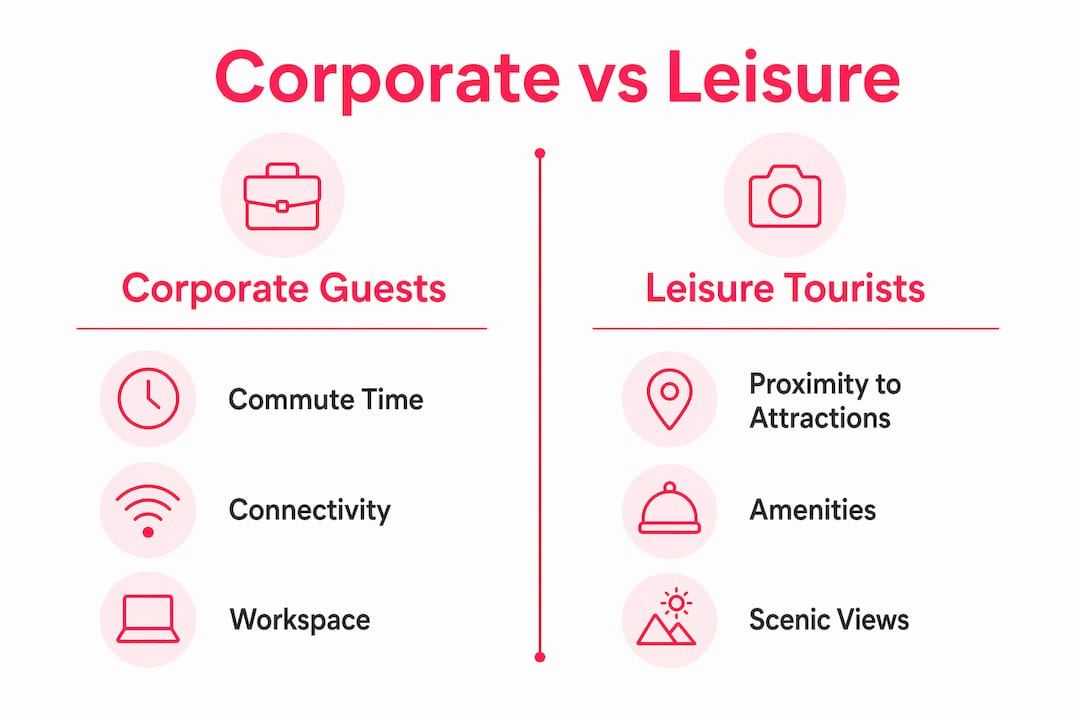
The evaluation criteria used by corporate travellers and leisure tourists diverge significantly, and understanding this distinction is one of the most useful tools available to travel coordinators. You can read a detailed breakdown of these differences in Guestlyhomes’ analysis of corporate versus tourist stays, but the core contrast is this: tourists optimise for experience, while corporate guests optimise for performance.

| Evaluation factor | Corporate guest | Leisure tourist |
|---|---|---|
| Location priority | Commute time during peak hours | Proximity to attractions and city centre |
| Amenity focus | Workspace, kitchen, laundry, Wi-Fi | Pool, spa, scenic views, décor |
| Booking behaviour | Flexible rates, modifiable reservations | Fixed dates, best available price |
| Stay duration | 10 nights to several months | 2 to 7 nights |
| Loyalty programmes | 82% say loyalty programmes influence choice | Rarely a primary factor |
| Review priorities | Reliability, cleanliness, quiet, connectivity | Atmosphere, aesthetics, staff warmth |
The location point deserves particular attention. Corporate travellers assess commute time during expected peak hours rather than straight-line distance. A property two miles from a client site may take 40 minutes to reach at 8 am, while a property five miles away on a different route may take only 15 minutes. Travel coordinators who rely on map distance alone routinely underestimate this variable.
Loyalty programmes also carry disproportionate weight in corporate decisions. When 82 per cent of business travellers report that loyalty status influences their accommodation choice, operators who offer consistent rewards and exclusive rates gain a measurable advantage in repeat bookings.
Pro Tip: Before confirming a booking, run the commute from the property to the primary work location using a navigation app set to the expected departure time on a working day. The result will often differ substantially from the distance shown on a map.
What misconceptions do property owners have about corporate guests?
The most common mistake property owners make when targeting corporate guests is investing in the wrong amenities. Spas, decorative furnishings, and premium entertainment systems attract attention in marketing materials but have limited influence on corporate booking decisions. Daily accessible services such as food and beverage options increase tenant satisfaction far more quickly than sporadic-use amenities like gyms or pools. The implication is clear: owners should prioritise what guests use every day over what photographs well.
Several specific misconceptions recur across the corporate accommodation sector:
- Daily housekeeping is expected. Most corporate guests on extended stays prefer privacy and autonomy over daily room service. Intrusive housekeeping schedules are a consistent source of negative reviews from business travellers who value uninterrupted routines.
- Prestige location outweighs accessibility. A prestigious postcode does not compensate for poor transport links or limited parking. Corporate guests evaluate accessibility to their specific work location, not the general reputation of a neighbourhood.
- Technology is a secondary concern. Self-service check-in, digital key access, and reliable property management communication are now baseline expectations for corporate guests, not premium additions. Properties that require in-person key handovers or have slow response times on maintenance requests lose repeat bookings.
- Marketing to corporate guests requires the same language as leisure guests. Travel coordinators and HR professionals respond to specifics: confirmed Wi-Fi speeds, workspace dimensions, parking details, and cancellation terms. Vague descriptions of “modern interiors” and “stunning views” do not answer the questions these professionals are actually asking.
Understanding what corporate guests actually notice in a property, as Guestlyhomes covers in its guide to corporate guest priorities, often reveals a significant gap between what owners invest in and what guests actually value.
How can travel coordinators select properties that support corporate performance?
Selecting the right accommodation for a corporate assignment is a professional decision with direct consequences for employee productivity, wellbeing, and retention. The following process gives travel coordinators and HR professionals a reliable framework for making that decision well.
-
Map commute times at peak hours. Use a navigation application set to the expected departure time on a standard working day. Do this for both the morning commute to the primary work location and the return journey. Physical proximity alone misrepresents accessibility and leads to avoidable frustration for guests.
-
Prioritise fully refundable or modifiable booking terms. Long-term travellers avoid properties with high change fees regardless of property quality, because schedule shifts are common on extended assignments. Securing a flexible rate protects the organisation from financial penalties and gives the guest confidence.
-
Verify amenity specifics rather than accepting descriptions. Confirm the actual Wi-Fi speed, the workspace configuration, whether laundry is in-unit or shared, and whether parking is guaranteed or subject to availability. These details determine daily quality of life for a guest staying 30 or 60 nights.
-
Assess consistency of quality standards. A property managed by an operator with documented quality standards across its portfolio reduces the risk of inconsistent experiences. For HR professionals placing multiple employees across different assignments, this consistency is operationally significant.
-
Leverage loyalty programmes and exclusive rates. 57% of business travellers value local restaurant suggestions from their accommodation provider, and 58 per cent expect exclusive deals tailored to their stay. Operators who offer these benefits create measurable added value that justifies repeat bookings and simplifies the coordinator’s role.
-
Consider properties that provide local business context. Guests arriving in an unfamiliar city benefit from curated information about nearby dining, transport, and services relevant to professionals. This reduces the cognitive load of settling in and allows guests to focus on their work from day one.
For a practical checklist covering these criteria, Guestlyhomes has published a set of corporate housing selection tips that travel coordinators can apply directly to their booking process.
Key takeaways
A property attractive to corporate guests succeeds by delivering reliable connectivity, functional workspaces, flexible booking terms, and location accuracy, not by investing in luxury amenities that business travellers rarely use.
| Point | Détails |
|---|---|
| Connectivity and workspace are non-negotiable | Confirmed Wi-Fi speeds and ergonomic workspaces are threshold requirements, not optional extras. |
| Location means commute time, not distance | Assess peak-hour travel time to the work location rather than relying on map proximity. |
| Flexible booking terms drive decisions | Refundable and modifiable rates reduce financial risk and increase appeal for corporate programmes. |
| Daily-use amenities outperform luxury features | Kitchens, in-unit laundry, and parking have more impact on satisfaction than spas or pools. |
| Loyalty programmes influence 82% of corporate choices | Operators offering consistent rewards and exclusive rates gain a measurable advantage in repeat bookings. |
What I have observed about corporate stays and the gap owners rarely close
I have spent considerable time working with properties positioned for corporate guests, and the pattern I see most often is this: owners invest in what is visible and neglect what is felt. A beautifully staged living room photographs well. A desk with a proper chair, a tested internet connection, and blackout curtains in the bedroom do not. But the guest who stays for six weeks will remember the chair and the curtains long after they have forgotten the décor.
The 2026 shift in corporate travel is worth naming directly. Executives and project professionals increasingly treat their accommodation as a base of operations, a place engineered for focus and recovery, not a hotel room they happen to sleep in. This means the bar for functional design has risen. A property that was considered well-equipped three years ago may now feel inadequate to a senior consultant arriving for a two-month assignment.
The misconception I find most costly is the belief that privacy is a preference rather than a requirement. Corporate guests are often managing sensitive work, maintaining professional routines, and recovering from high-pressure days. Intrusions, whether from noise, unexpected housekeeping, or poor acoustic separation, do not merely inconvenience them. They disrupt the conditions that make the stay viable. Owners who understand this invest in acoustic quality, private access, and clear communication protocols. Those who do not tend to see shorter stays, lower ratings, and fewer repeat bookings.
My honest observation is that the gap between a good corporate property and a great one is rarely about budget. It is about understanding the workflow of the person staying there and designing around it with precision and care.
— Joakim
How Guestlyhomes supports corporate guests with properties built for performance
Guestlyhomes operates a portfolio of fully managed properties across Sweden designed specifically for professionals, project teams, and executives on extended assignments. Every property in the portfolio is verified for the features that corporate guests actually require: confirmed high-speed Wi-Fi, ergonomic workspaces, fully equipped kitchens, in-unit laundry, and private parking where applicable.
Booking terms are structured for corporate travel programmes, with flexible and modifiable rates that protect against schedule changes. Guestlyhomes’ dedicated support team handles all coordination directly, removing the administrative burden from HR professionals and travel coordinators. Whether you are placing a single executive or a project team, the 1BR executive premium suite and the 5BR business villa are designed to deliver consistent, hotel-grade performance across every stay. Contact Guestlyhomes to discuss corporate rates and availability.
FAQ
What are the most important features for corporate accommodation?
Reliable high-speed Wi-Fi, a dedicated ergonomic workspace, a fully equipped kitchen, in-unit laundry, and flexible booking terms are the features corporate guests consistently rate as most important. Privacy and acoustic separation are also decisive factors for long-stay bookings.
Why does location matter differently for corporate guests?
Corporate guests evaluate location by commute time during peak hours, not by distance. A property two miles from a work site may take 40 minutes to reach at rush hour, making a more distant property with a faster route the better choice.
Do corporate guests want daily housekeeping?
Most corporate guests on extended stays prefer privacy and autonomy over daily housekeeping. Intrusive cleaning schedules are a common source of negative reviews from business travellers who value uninterrupted routines and personal space.
How do loyalty programmes affect corporate booking decisions?
82% of business travellers report that loyalty programmes influence their accommodation choice. Operators offering consistent rewards, exclusive rates, and status recognition gain a significant advantage in securing repeat corporate bookings.
Are luxury amenities worth investing in for corporate guests?
Luxury amenities such as spas and pools have limited impact on corporate booking decisions compared to functional basics. Daily-use features like kitchens, parking, and reliable connectivity deliver far greater returns on satisfaction and occupancy for properties targeting business travellers.
Recommandé
- What corporate guests actually notice in a rental property – Guestly Homes
- Understanding Corporate Accommodations for Business Travel – Guestly Homes
- Corporate Guests vs High-turnover Tourist Stays 2026 – Guestly Homes
- Comment optimiser le confort des clients dans les logements d'entreprise – Guestly Homes