


TL;DR:
- Five-star reviews act as trust signals that reduce uncertainty by reflecting consistency and clear communication. Guests base their reviews on expectations, and managing the gap between promises and experiences is crucial for positive feedback. Slightly lower ratings within a strong profile can boost perceived authenticity and credibility.
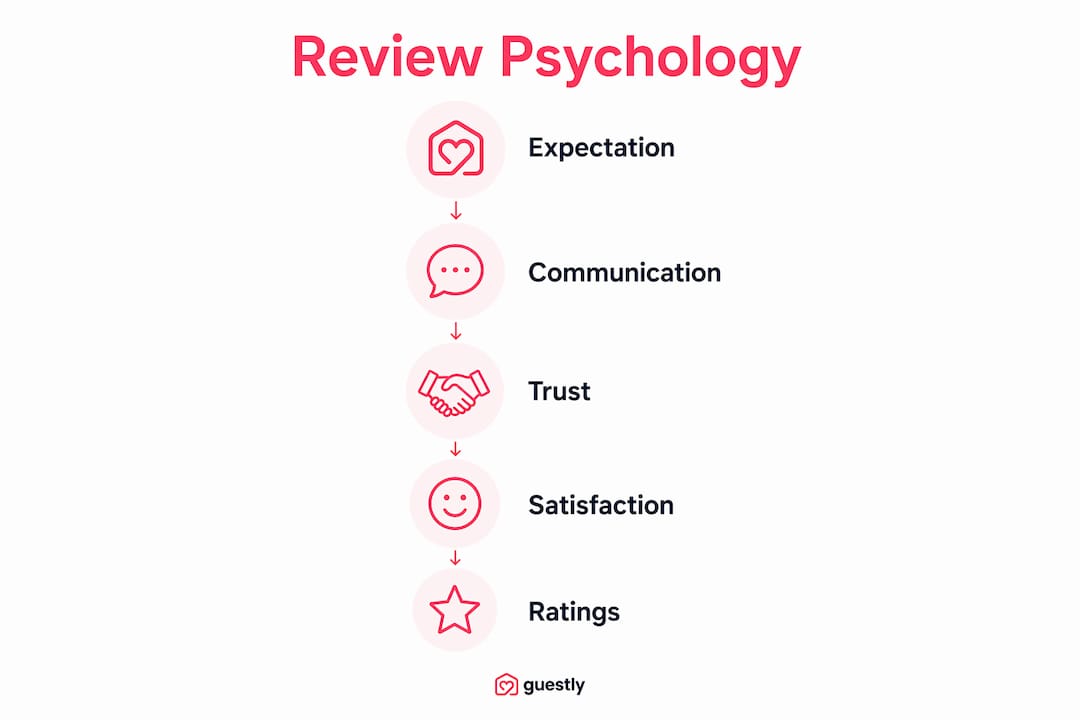
Five-star reviews are defined as trust signals that consumers use as mental shortcuts to reduce uncertainty and assess service quality before committing to a purchase. The psychology behind five-star reviews is not about luxury or surprise. It is about consistently meeting expectations, communicating clearly, and leaving guests with a strong final impression. 98% of consumers identify online reviews as a primary trust signal, and 85% confirm that high ratings reduce decision uncertainty. That figure reveals something important: guests are not just reading reviews for information. They are using them to feel safe.
How does expectation shape a five-star review?
Satisfaction is the product of a gap. When reality meets or slightly exceeds expectation, guests feel satisfied. When reality falls short, they feel let down, regardless of how impressive the property looks in photographs. This is the foundational mechanism behind expectation management in service industries: inflated marketing raises the bar so high that even a genuinely good experience can disappoint.
For private property owners, this gap is particularly difficult to control. A guest who books based on aspirational listing photography arrives with elevated expectations. If the Wi-Fi is slow, the welcome instructions are unclear, or the kitchen is missing basic equipment, the gap widens. One poor experience carries disproportionate weight. Negative reviews deter potential guests twice as effectively as positive reviews attract them.
The foundations of a five-star experience are not glamorous. They are:
- Reliability. The property is exactly as described. Nothing is broken. Everything works.
- Cleanliness. Standards are consistent across every stay, not just the first one.
- Communication. Guests receive clear, timely information before and during their stay.
- Accurate listings. Photographs and descriptions reflect reality without embellishment.
- Responsive problem-solving. When something goes wrong, it is resolved quickly and without friction.
Maintaining these standards across multiple stays is where private owners most often struggle. A single lapse in cleanliness or a delayed response to a maintenance issue can undo weeks of positive momentum.
Pro Tip: Review your listing description against the actual guest experience at least once per quarter. The gap between what you promise and what you deliver is where negative reviews are born.
What psychological principles drive review behaviour?
Several well-established psychological mechanisms shape both why guests leave reviews and how potential guests interpret them.
-
Social proof. Consumers use the behaviour of others to guide their own decisions, particularly under uncertainty. A property with 200 reviews and a 4.6-star average signals safety. A property with 3 reviews and a perfect 5.0 signals risk. Younger consumers rely 15% more on review volume than older demographics, which means the number of reviews matters as much as the score itself.
-
The halo effect. A five-star rating acts as a mental shortcut for quality, helping guests offload research effort. The problem is that this shortcut inflates expectations. Guests who book a five-star property arrive expecting a flawless experience. Any deviation, however minor, feels like a breach of contract.
-
The peak-end rule. Guests do not remember a stay as an average of all moments. They remember emotional high points and endings. A warm welcome, a thoughtful detail mid-stay, and a smooth check-out process carry far more weight in memory than the cumulative quality of everything in between. This is why check-out communication and final impressions are disproportionately powerful.
-
Expectation inflation. Perfect marketing creates a trap. When a property is presented as exceptional in every dimension, guests arrive primed for perfection. The expectation-reality delta then works against the host, not for them.
“Guests do not review the property they stayed in. They review the gap between what they expected and what they found. Manage the expectation, and you manage the review.”
Understanding these principles changes how businesses approach service design. The goal is not to create extraordinary moments at every turn. The goal is to control the gap, protect the ending, and make the experience feel exactly as promised.
Does communication affect review scores?
Clear, proactive communication is one of the most reliable predictors of positive reviews. Guests who receive timely pre-arrival information, clear check-in instructions, and a responsive point of contact during their stay report higher satisfaction, even when minor issues arise. The reason is psychological: communication signals care. It tells the guest that someone is paying attention.

Effective guest communication reduces anxiety before arrival and builds trust during the stay. A guest who knows exactly what to expect, where to park, how to operate the heating system, and who to contact if something goes wrong, is a guest who feels in control. That sense of control translates directly into positive reviews.
Problem resolution is equally significant. When an issue arises and it is resolved swiftly and without drama, guests often rate the experience more highly than if no issue had occurred at all. This is sometimes called the service recovery paradox. A well-handled problem demonstrates competence and genuine care in a way that a trouble-free stay cannot.
Small, thoughtful details also contribute to emotional peaks aligned with the peak-end rule. These do not need to be expensive:
- A handwritten welcome note.
- Local recommendations left on the kitchen counter.
- A bottle of water in the fridge on arrival.
- Clear, friendly check-out instructions sent the evening before departure.
Pro Tip: Send a brief, friendly message to guests on their final evening. Thank them for their stay and confirm check-out details. This single touchpoint directly influences the ‘end’ memory that shapes their review.
Why do perfect ratings reduce trust?
Consumers are more sceptical of a perfect 5.0 average than most businesses realise. Research shows that 4.2 to 4.5 star averages are perceived as more authentic and credible than a flawless score. A perfect rating triggers a “too good to be true” response in many consumers, particularly those who have encountered manipulated reviews before.
This has a direct implication for how businesses should think about their review profile. A small number of lower ratings, provided the overall average remains strong, can actually increase conversion by signalling authenticity.
| Review profile | Consumer perception |
|---|---|
| Perfect 5.0 with few reviews | Suspicious; may indicate manipulation or insufficient data |
| 4.8 average with high volume | Trusted; signals consistent quality at scale |
| 4.2–4.5 average with mixed feedback | Highly credible; perceived as genuine and balanced |
| Below 4.0 average | Raises serious concern; deters most potential guests |
High variation in review scores can increase preference by reducing the “too good to be true” bias. This does not mean businesses should welcome poor service. It means that a handful of honest, lower-rated reviews within a strong overall profile is a feature, not a flaw. Negative reviews also provide guests with the opportunity to see how a business responds, which is itself a powerful trust signal.
The credence quality gap in service industries compounds this issue. Guests rate visible, friendly behaviour more highly than technical quality that only becomes apparent over time. This means a property can receive strong early reviews based on surface impressions, then face harsher feedback once guests notice deeper issues. Businesses that focus only on visible touchpoints risk a gradual erosion of their rating as repeat guests and longer-stay guests form more complete assessments.
How can owners maintain consistently high ratings?
Sustaining a strong review profile requires a systematic approach rather than periodic effort. The following practices reflect the psychological principles discussed throughout this article:
- Prioritise reliability over luxury. Guests forgive the absence of premium features far more readily than they forgive broken promises. A modest property that delivers exactly what it advertises outperforms an impressive one that disappoints.
- Write accurate listing descriptions. Every claim in a listing sets an expectation. Review descriptions regularly and remove anything that overstates the experience.
- Design positive moments at the beginning and end of stays. The peak-end rule means these two points carry the most weight. Invest effort in arrival experience and departure communication.
- Respond to every review, including negative ones. A measured, professional response to a critical review demonstrates accountability and reassures future guests.
- Monitor ratings consistently. Track scores over time and treat any downward trend as an early signal of a service gap, not a statistical anomaly.
- Understand what guests actually notice. Corporate guests and long-stay professionals pay close attention to practical property details that casual visitors may overlook.
The impact of ratings on behaviour is cumulative. Each review shapes the expectations of the next guest. A well-managed review profile is not a marketing asset. It is an operational feedback system that, when read carefully, tells a business exactly where its service standards are holding and where they are not.
Key takeaways
Five-star reviews are earned through consistent, expectation-aligned service, not through luxury or surprise, and the psychological mechanisms behind them are predictable and manageable.
| Point | Détails |
|---|---|
| Expectation management is foundational | The gap between what is promised and what is delivered determines satisfaction more than absolute quality. |
| Peak-end rule shapes memory | Guests remember emotional high points and final interactions most vividly, so invest in arrivals and departures. |
| Perfect ratings can reduce trust | A 4.2–4.5 star average is perceived as more credible than a flawless 5.0, which can trigger scepticism. |
| Communication drives positive reviews | Proactive, clear communication before and during a stay reduces anxiety and signals genuine care. |
| Negative reviews signal authenticity | A small number of lower ratings within a strong overall profile increases perceived credibility and conversion. |
The expectation trap is the real challenge
The most common mistake I see in service management is the belief that a higher-quality product automatically produces higher ratings. It does not. What produces higher ratings is a tighter alignment between what you promise and what you deliver, every single time.
The businesses that struggle most with review consistency are often the ones that have invested heavily in marketing their properties as exceptional. They create an expectation that is genuinely difficult to meet at scale. Then, when a guest arrives and finds something slightly below that elevated standard, the disappointment is acute, even if the property is objectively excellent.
What I have found works is a quieter approach. Describe the property honestly. Communicate early and clearly. Fix problems without being asked twice. And pay close attention to the moments guests remember most: arrival and departure. These are not complicated interventions. They are disciplined ones.
The other thing worth noting is the credence quality problem. Guests often rate warmth and friendliness above technical competence, because friendliness is immediately visible and competence is not. This creates a risk for businesses that focus on surface presentation at the expense of the less visible operational details. Over time, those invisible gaps surface in reviews. The guests who stay longest notice them first.
Emotional intelligence matters here. Anticipating what a guest needs before they ask for it, recognising when something feels slightly off, and responding to feedback without defensiveness: these are the habits that separate properties with sustained high ratings from those that peak and then plateau.
— Joakim Thörn
Guestly Homes and the standard behind the rating
Guestly Homes was built around the understanding that consistent service quality, not occasional excellence, is what earns and sustains strong guest reviews. Every property in the Guestly Homes portfolio is managed to a defined standard: accurate listings, clear communication, reliable maintenance, and a guest experience that delivers precisely what it promises.

For guests seeking extended stays in Sweden, the Business Villa and Grand Villa with Garden represent properties managed with the operational discipline this article describes. For property owners who want their asset managed to a standard that protects and builds its review profile, a housing request is the first step toward a partnership built on quiet, consistent performance.
FAQ
What is the psychology behind five-star reviews?
Five-star reviews are driven by psychological mechanisms including social proof, the halo effect, and the peak-end rule. Guests use high ratings as mental shortcuts to reduce uncertainty and assess trustworthiness before booking.
Why do guests leave five-star reviews?
Guests leave five-star reviews when the reality of their experience meets or slightly exceeds their prior expectations. Reliability, clear communication, and a strong final impression are the most consistent drivers.
Is a perfect 5.0 rating more trustworthy than a 4.5?
No. Consumers perceive a 4.2–4.5 star average as more credible than a perfect 5.0, which can trigger scepticism about manipulation or insufficient review volume.
How do negative reviews affect consumer behaviour?
One credible negative review deters potential guests twice as effectively as a positive review attracts them. However, a small number of lower ratings within a strong overall profile can increase authenticity and improve conversion.
What is the peak-end rule in guest experience?
The peak-end rule is a psychological principle showing that guests remember emotional high points and final interactions most strongly. This means arrival experience and check-out communication carry disproportionate weight in shaping the review a guest leaves.