

|
Préparer votre lecteur Trinity Audio...
|
TL;DR:
- Choosing home-like accommodation for business teams in Sweden enhances sleep quality, routines, and cohesion, leading to better performance. Well-designed spaces with private bedrooms, natural light, and kitchens reduce stress, absenteeism, and costs, outperforming standard hotels over extended stays. Strategic investment in wellness-focused housing supports productivity, morale, and long-term organizational success.
When a team arrives in Sweden for a week-long project or a three-month assignment, most booking decisions still come down to nightly rates and proximity to the office. That logic misses something critical. The built environment measurably influences sleep quality, sick days, and cognitive functioning, which means the space your team sleeps and recovers in is directly tied to what they produce during working hours. Choosing accommodation is not an administrative task. It is a performance decision.
Table des matières
- Why environment matters for business travel
- Key benefits of home-like accommodation for teams
- Comparing home-like stays with standard hotel solutions
- How to choose and secure the right accommodation in Sweden
- Why business travel success in 2026 demands more than four walls and a bed
- Explore premium team accommodation solutions in Sweden
- Frequently asked questions
Principaux enseignements
| Point | Détails |
|---|---|
| Real productivity boost | Home-like environments measurably increase team performance and reduce sick days during work travel. |
| Improved staff well-being | Wellness-focused accommodation supports better sleep, morale, and overall health for travelling teams. |
| Superior retention & value | Thoughtful, comfortable stays encourage long-term talent retention and lower hidden costs. |
| Strategic booking choices | Selecting the right features and setup delivers ongoing success, not just one-off cost savings. |
Why environment matters for business travel
The link between physical environment and employee well-being is no longer a soft conversation. It is backed by measurable outcomes that HR professionals and project managers can no longer afford to ignore. When your team travels to Sweden for an assignment, the space they return to each evening shapes how they show up the following morning.
“The built environment influences sleep quality, sick days, and cognitive functioning — all of which translate directly into team output during any period of business travel.”
Research consistently shows that wellness features in the built environment link to improved sleep, fewer sick days, and higher cognitive functioning. For teams on assignment, this is not a marginal gain. It is the difference between a project delivered on time and one that drags over budget because key people are fatigued, distracted, or absent.
When you read about understanding corporate accommodations and the growing body of evidence behind wellness-driven design, several factors stand out consistently:
- Natural light and ventilation reduce fatigue and improve mood regulation
- Private sleeping areas protect sleep quality and support recovery after long workdays
- Access to a proper kitchen enables healthier eating habits, reducing the inflammatory effects of daily restaurant meals
- Living space beyond the bedroom allows for decompression, which lowers cortisol levels and supports sharper decision-making the next day
- Quiet, low-stimulation environments reduce cognitive load after hours, protecting mental bandwidth for the following day
Many managers consult a solid team lodging guide before booking, but even the best guides are only useful if the underlying principle is understood: accommodation is not just shelter. It is the recovery system that powers your team’s performance. When that system is poor, output suffers regardless of how well the project is planned. Understanding the full range of accommodation types for tech teams and field-based project groups reveals that home-like formats consistently outperform standard hotel rooms when it comes to sustained productivity.
Key benefits of home-like accommodation for teams
With the science clear, it is worth breaking down the real advantages that home-like spaces provide, particularly for teams on extended Swedish assignments. These are not abstract benefits. They are practical outcomes that show up in project timelines, team morale, and health-related absences.
Improved sleep and sharper focus. Sleep is the single most important recovery mechanism for cognitive performance. A home-like setting with proper blackout curtains, a quality mattress, and a separate sleeping area rather than a desk three metres from the bed makes measurable difference. Teams that sleep well consistently outperform those who do not, and wellness-focused environments correlate directly to lower absenteeism, reduced presenteeism, and better cognitive function.
The ability to maintain daily routines. One of the most underrated stressors during business travel is the loss of routine. When a team member cannot cook their own breakfast, exercise, or have a quiet morning without noise from adjacent hotel rooms, their stress baseline rises steadily. Home-like accommodation supports the continuation of healthy routines, which research links to lower reported stress levels and better sustained performance over multi-week assignments.
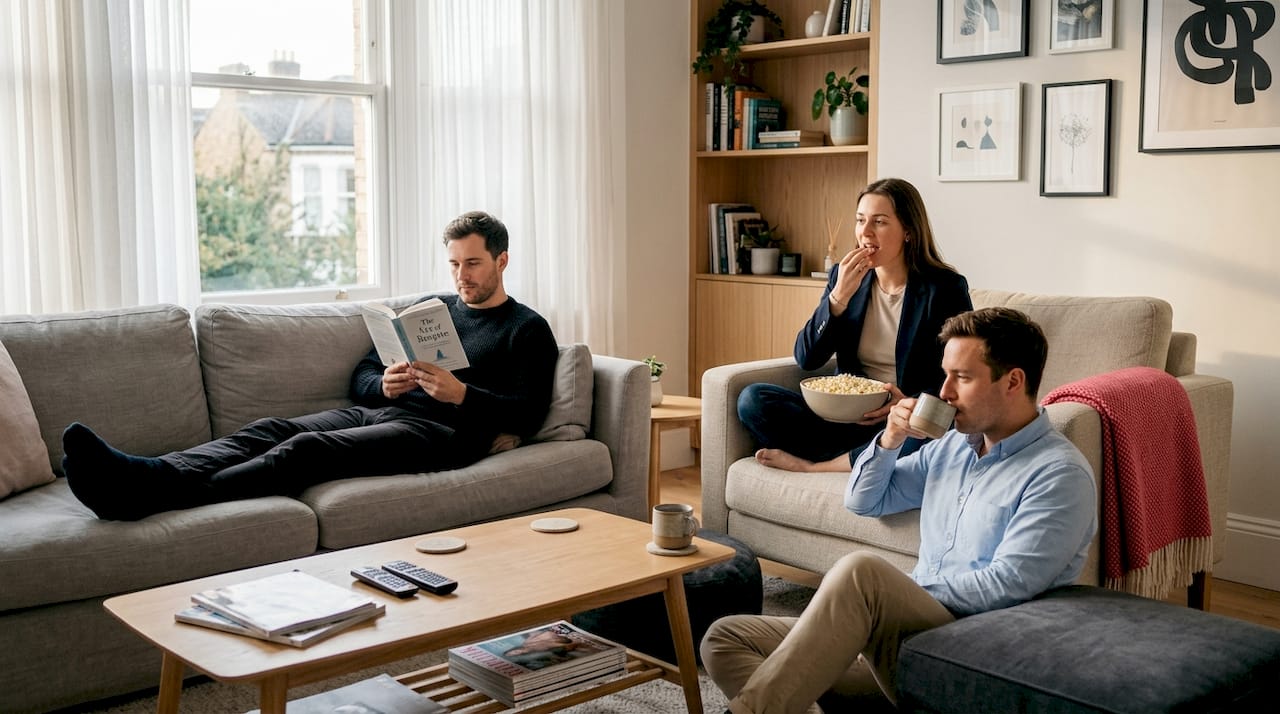
Team cohesion and morale. Shared villas and apartments create informal spaces where teams naturally decompress together. A shared kitchen, a sitting room, or an outdoor terrace gives colleagues a neutral space to connect beyond the meeting room. This kind of organic social interaction builds trust and strengthens working relationships in ways that a row of hotel rooms never can. Strong team cohesion is one of the most reliable predictors of project success.
Privacy and psychological safety. Even in a shared property, well-designed home-like accommodation offers each team member their own space. Private bedrooms, separate bathrooms, and personal storage create a sense of ownership and safety. Teams that feel settled and secure in their accommodation show measurably better focus during working hours.
Financial efficiency through maximising travel benefits. Access to a full kitchen dramatically reduces daily food expenditure. A team of five preparing breakfasts and occasional dinners at home rather than eating out for every meal can save thousands of Swedish kronor over a two-month assignment. These savings often offset any premium over a basic hotel room, while delivering significantly better outcomes.
The serviced accommodation benefits available through premium operators go further still, offering hotel-grade cleanliness and linen services combined with the space and flexibility of a private home. And when it comes to the small details that matter most, reading about maximising guest comfort reveals that lighting quality, furniture ergonomics, and temperature control are consistently among the top factors influencing guest satisfaction and daily performance.
Pro Tip: When evaluating properties for team stays, check for task lighting in work areas, not just ambient lighting. Poor task lighting is one of the most commonly overlooked contributors to afternoon fatigue and headaches during extended work periods.
Comparing home-like stays with standard hotel solutions
Still wondering whether home-like accommodation really outperforms traditional hotels? Here is a direct comparison for team bookings that makes the decision considerably clearer.
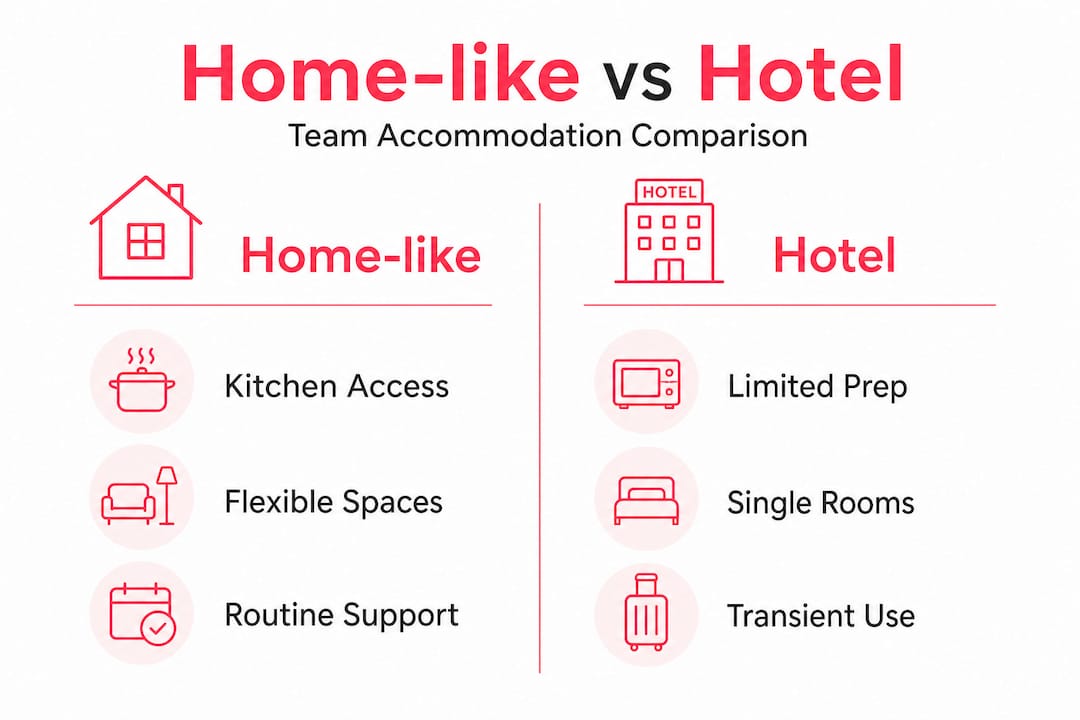
Commercial real estate optimised for wellness consistently improves productivity and performance across professional settings, and accommodation is no exception. The table below illustrates the core differences between home-like accommodation and standard hotel solutions for corporate teams.
| Fonctionnalité | Home-like accommodation | Standard hotel |
|---|---|---|
| Kitchen access | Full kitchen for meal preparation | Limited (minibar or room service only) |
| Living space | Separate living, dining, and sleeping areas | Single room or suite |
| Vie privée | Private bedrooms and bathrooms per team member | Shared corridors, thin walls, noise |
| Flexibilité | Flexible check-in, longer stays, house rules | Rigid check-in, standardised policies |
| Team collaboration | Shared common areas for informal meetings | Lobby or booked meeting rooms only |
| Wellness features | Natural light, outdoor space, ergonomic design | Variable; often prioritises aesthetics |
| Cost efficiency | Kitchen reduces food spend; often better value per night for groups | Daily restaurant spend adds up quickly |
| Psychological comfort | Sense of ownership and home-like familiarity | Transient, institutional feel |
| Sleep quality | Purpose-designed sleeping environment | Variable; noise, adjacent rooms, HVAC |
The contrast is significant. Hotels are designed for transient, single-night stays. Their infrastructure is built around efficiency at scale, not the sustained well-being of a project team in week six of an eight-week assignment. The further you read into why function matters in accommodation design, the clearer the gap becomes.
For senior staff or executives within the team, exploring executive options for extended stays reveals an additional tier of home-like properties in Sweden that combine high-specification amenities with the space and calm required for sustained leadership performance.
Pro Tip: Request floor plans or detailed room layouts before booking any accommodation for a team. A property that advertises five bedrooms may have those bedrooms grouped in ways that compromise privacy or noise separation. Layout matters enormously for group stays.
How to choose and secure the right accommodation in Sweden
Once convinced of the benefits, booking the right accommodation in Sweden is the next critical task. Sweden offers an excellent market for quality home-like corporate accommodation, but navigating the options efficiently requires a structured approach.
Wellness real estate supports team productivity and reduces absenteeism, but those gains only materialise when the right property is selected. Follow these steps to ensure a confident, well-informed booking decision.
-
Define your team’s functional requirements. Start with the basics: number of team members, length of stay, proximity to the project site or client office, and any specific needs such as wheelchair access, pet-friendly policies, or on-site parking. Build a non-negotiable requirements list before looking at any properties.
-
Assess wellness and comfort features. Look beyond the bedroom count. Evaluate natural light exposure, ventilation, outdoor space, mattress and linen quality, and bathroom-to-guest ratio. A property with five bedrooms and two bathrooms will create morning friction for a team of five within the first week.
-
Verify connectivity and work infrastructure. Fast, reliable Wi-Fi is essential. Ask for confirmed upload and download speeds, not just “high-speed internet.” Confirm whether there is a dedicated workspace or a dining table large enough to serve as a working area.
-
Vet the operator, not just the property. A beautifully photographed property managed by an unreliable operator creates the exact disruptions you are trying to avoid. Look for managed operators with consistent service standards, clear communication channels, and documented cleaning and maintenance protocols.
-
Compare total cost, not just nightly rate. Factor in food savings from kitchen access, transport costs related to location, and any productivity costs associated with poor accommodation. Reading through business trip planning best practices consistently reinforces that total cost analysis almost always favours home-like options for stays beyond one week.
-
Confirm booking terms and flexibility. Project timelines change. Ensure your accommodation agreement allows for date adjustments, team size changes, or early departure without punitive penalties.
For teams making these decisions regularly, both corporate housing selection tips and guidance on securing long-term accommodation offer structured frameworks that reduce booking time and minimise the risk of costly errors.
| Feature to prioritise | Why it matters for Swedish team stays |
|---|---|
| Lumière naturelle | Sweden’s seasonal variation makes light access critical for mood and energy |
| Space per person | Adequate personal space reduces interpersonal friction during long assignments |
| Quality kitchen | Enables healthy eating; significantly reduces daily food costs |
| Reliable Wi-Fi | Essential for remote collaboration with colleagues outside Sweden |
| Outdoor access | Supports physical activity and mental recovery, especially during summer months |
| Quiet neighbourhood | Protects sleep quality; particularly relevant in urban Swedish locations |
| Conditions de location flexibles | Accommodates project timeline shifts without financial penalty |
Why business travel success in 2026 demands more than four walls and a bed
With all this evidence in mind, it is worth addressing the bigger shift redefining what good accommodation really means for corporate teams in 2026.
For too long, accommodation has been treated as a line item to compress rather than a variable to optimise. The logic of “cheapest suitable option” is deeply embedded in many corporate travel policies, and it is quietly costing organisations far more than they realise. The true cost of poor accommodation is not visible on a travel expense report. It shows up in missed deadlines, elevated sick days, early talent departures, and the general erosion of morale that comes from asking people to perform under unnecessarily difficult conditions.
The forward-thinking organisations in 2026 are those that have reframed accommodation as a strategic input to project performance. They understand that a well-rested consultant delivers more in four hours than an exhausted one delivers in ten. They know that home-like, wellness-focused accommodation directly benefits team morale and overall work output, and they budget accordingly.
There is also a retention argument that deserves serious attention. Employees who are sent on extended assignments and housed well return with a markedly different view of their employer than those who spent eight weeks in a cramped hotel room. The connection between quality corporate housing and corporate housing and retention is well established. Good accommodation signals that the organisation values the person, not just the project output. That signal matters, particularly for high-performing individuals who have choices.
Tracking business travel efficiency trends confirms that the shift toward wellness-oriented, experience-conscious accommodation is not a niche preference. It is becoming the standard expectation among experienced corporate travellers and the HR teams who support them. The organisations still defaulting to standardised hotel blocks are falling behind, and many do not yet know it.
The bottom line is this: accommodation is not overhead. It is infrastructure. Treat it accordingly.
Explore premium team accommodation solutions in Sweden
To put these benefits into action, Guestly Homes offers a curated selection of fully managed, premium properties across Sweden, designed specifically for the needs of professional teams and project groups.
Every property in the Guestly Homes portfolio is operated to five-star standards, with hotel-grade consistency and the space and comfort of a private home. HR professionals and project managers can book with confidence, knowing that every detail from linen quality to Wi-Fi speed has been managed in advance. Whether your team needs a modern luxury villa with lake view, a spacious 5BR villa with sauna for a larger group, or a well-appointed business villa with 1.5 baths for a focused project team, Guestly Homes delivers the right environment without the administrative friction. One point of contact. No surprises. Just a stay that works.
Frequently asked questions
How does home-like accommodation improve employee performance?
Home-like accommodation supports better sleep, maintains daily routines, and reduces stress, all of which link directly to higher cognitive function, fewer sick days, and stronger work output during assignments.
What features make an accommodation ‘home-like’ for team bookings?
Essential features include separate living and sleeping areas, good natural light, private bathrooms, a quality kitchen with full cooking facilities, ergonomic work areas, and consistently fast Wi-Fi.
Is home-like accommodation better suited for long-term assignments?
Yes, extended assignments benefit most, as the ability to maintain routines, cook at home, and enjoy private space supports sustained well-being and reduces the cumulative stress that degrades performance over time.
How does team housing in Sweden differ from other countries?
Sweden’s strong cultural emphasis on wellness, space, and sustainability means that accommodation standards often feature superior natural light, generous room proportions, and access to outdoor areas, giving teams a tangible quality advantage compared with many other markets.
What is the impact on cost when choosing home-like accommodation over hotels?
While nightly rates may appear comparable or slightly higher, reduced absenteeism and productivity gains combined with lower daily food expenditure through kitchen access typically yield greater overall value for assignments lasting more than one week.