


TL;DR:
- Cheap accommodation often causes productivity losses, higher costs, and team wellbeing issues.
- Investing in quality housing improves productivity, reduces turnover, and enhances team morale.
- Viewing accommodation as performance infrastructure leads to better project outcomes and long-term savings.
Booking the cheapest available accommodation for your project team can feel like responsible budget management. In reality, it often sets off a chain of avoidable costs that quietly erode project margins, team morale, and individual wellbeing. Poor-quality housing causes productivity losses through downtime, disruptions, inadequate facilities, and long commutes, all of which accumulate well beyond the initial saving on the nightly rate. For HR leads and project managers overseeing teams in Sweden, understanding the true cost of accommodation is not just a financial exercise. It is a performance strategy.
Índice
- Why cheap is rarely economical for teams
- Hidden costs: What budget accommodation really means for teams
- Comparing accommodation options: Beyond the headline price
- Choosing quality: Productivity, wellbeing, and long-term savings
- A new mindset for HR: Accommodation as a performance investment
- Ready for high-quality, performance-driven accommodation?
- Frequently asked questions
Puntos clave
| Punto | Detalles |
|---|---|
| Cheap is rarely cheaper | Low-cost accommodation can add hidden expenses and productivity loss, outstripping any savings. |
| Prioritise wellbeing and performance | High-quality housing boosts team productivity, morale, and health, saving money long term. |
| Budget with contingencies | Allocate 25-35% of project costs for accommodation and plan for the unexpected. |
| Evaluate all accommodation options | Weigh flexibility, legal safety, comfort, and all-in pricing—not just the headline rate. |
Why cheap is rarely economical for teams
The appeal of low-cost accommodation is straightforward: lower nightly rates mean lower spend. But this logic only holds if you measure accommodation in isolation, which is rarely how project costs actually behave. When you factor in the downstream effects on your team, the picture shifts considerably.
Industry guidance recommends that organisations budget 25 to 35% of total project costs for accommodation, with a 15 to 20% contingency built in for hidden expenses. Poor accommodation choices can increase total lodging spend by a further 10 to 15%, not because the nightly rate rises, but because problems compound. Teams get relocated. Complaints require management time. Productivity dips. Each of these outcomes carries a real financial cost that never appears on the original booking invoice.
The health dimension is equally significant. Research published in BMC Public Health found that poor housing is linked to lower health-related quality of life, particularly across physical and mental health dimensions, with existing disabilities or morbidities amplifying the effects. For a team working long hours on a demanding project, substandard accommodation is not just uncomfortable. It actively degrades the physical and psychological resources your team needs to perform.
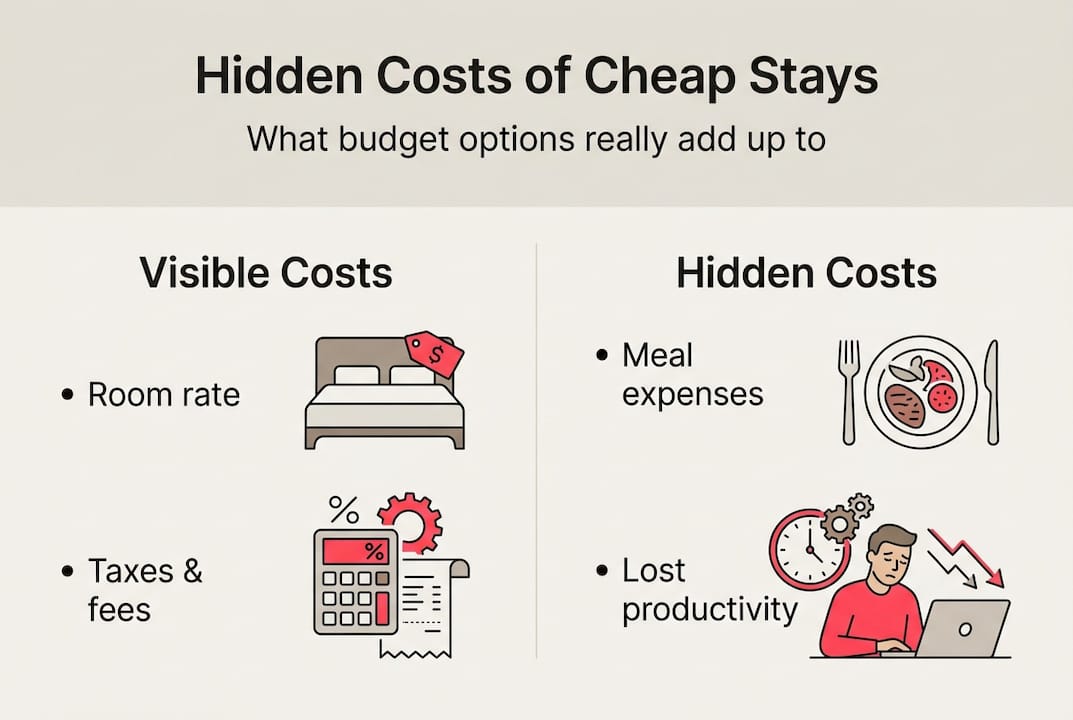
The hidden costs HR leads most commonly miss include:
- Extended commutes adding fatigue before the working day even begins
- Morale drops from cramped, poorly maintained, or noisy environments
- Disruptions and relocations when accommodation fails to meet basic standards mid-project
- Reduced focus and output caused by poor sleep quality and inadequate rest spaces
- Reputational risk for the booker when teams raise formal complaints
“The real cost of accommodation is never just the nightly rate. It is the sum of every disruption, every lost hour, and every team member who disengages because their living conditions are working against them.”
As explored in our analysis of why cheaper stays cost more, the cost equation for team accommodation is fundamentally different from leisure travel. Project teams need consistency, comfort, and space to recover. When those elements are missing, the project pays the price.
Hidden costs: What budget accommodation really means for teams
Budget accommodation tends to share a common set of limitations: small kitchens or none at all, limited shared space, inconsistent cleanliness, and locations chosen for price rather than proximity to project sites. Each of these limitations generates a cost that does not appear on the booking confirmation.
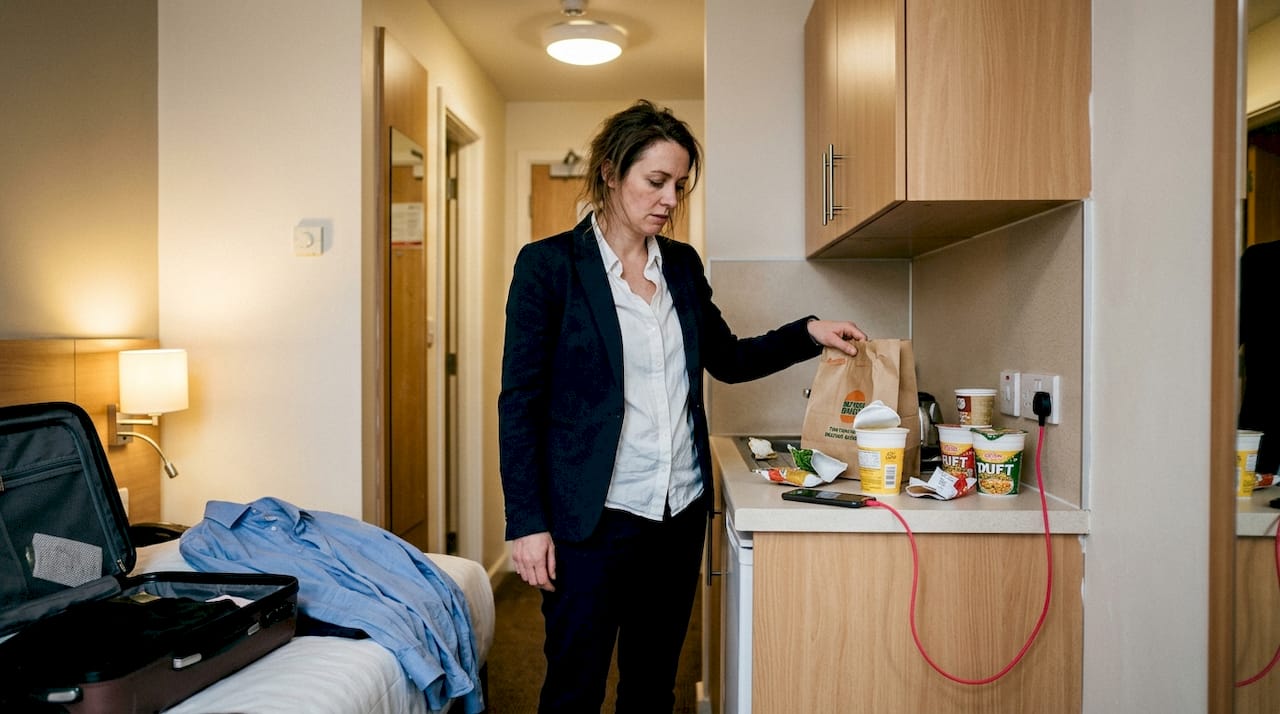
Poor-quality housing forces teams into patterns that erode both budget and performance. Without functioning kitchen facilities, team members eat out for every meal, adding significant daily expense across a multi-week stay. Without adequate rest space, sleep quality suffers. Without proximity to work sites, commute times extend, and fatigue accumulates before the working day begins.
The most significant hidden costs in real-world team stays include:
- Meals and restaurants: A team of six eating out twice daily over a six-week project adds thousands in unplanned food spend
- Lost productivity: Disruptions, relocations, and poor sleep translate directly into slower output and more errors
- Mental health strain: Prolonged stays in cramped or poorly maintained spaces increase stress and reduce emotional resilience
- Turnover risk: Staff who experience poor accommodation on extended projects are more likely to decline future assignments or leave the organisation
- Management overhead: Handling complaints, arranging replacements, and managing dissatisfied team members consumes HR time that should be directed elsewhere
Pro Tip: Before finalising any team accommodation booking, build a simple cost model that includes estimated meals-out spend, commute time per person per day, and a risk line for potential relocation. This single step often reveals that the “cheaper” option is not cheaper at all.
Exploring rental alternatives for teams that offer full kitchen facilities, reliable Wi-Fi, and on-site amenities can eliminate several of these hidden cost categories before they arise. The key is to evaluate accommodation against the full cost of a stay, not just the headline nightly figure.
Comparing accommodation options: Beyond the headline price
When booking for a project team in Sweden, four main accommodation types are typically considered: hotels, serviced apartments, short-term rentals such as Airbnb, and structured corporate housing. Each carries a different cost profile, risk level, and suitability for extended stays.
Serviced apartments reduce costs by 20 to 30% compared to hotels for stays exceeding one month, with all-inclusive pricing that avoids the hidden fees common in other models. Hotels offer flexibility for short or unpredictable stays but become expensive quickly over longer periods. Ad-hoc platforms like Airbnb introduce unpredictability and potential legal risks, while structured corporate housing vs Airbnb comparisons consistently favour managed options for reliability and compliance.
| Accommodation type | Cost for extended stays | Predictability | Kitchen facilities | Wellbeing suitability |
|---|---|---|---|---|
| Hotel | Alta | Alta | Raramente | Moderado |
| Serviced apartment | Media a baja | Alta | Sí | Alta |
| Airbnb / short-term rental | Variable | Baja | Normalmente | Variable |
| Corporate housing | Medio | Alta | Sí | Alta |
To shortlist the right option for your team, follow these steps:
- Define the stay duration. Stays beyond four weeks strongly favour serviced apartments or corporate housing on cost grounds alone.
- Map proximity to the project site. Commute time per person per day is a direct productivity and wellbeing variable.
- Assess kitchen and amenity requirements. Teams on extended stays need full kitchen access to manage food costs and maintain healthy routines.
- Evaluate the provider’s consistency. A single point of contact, clear service standards, and a managed property reduce the risk of mid-project disruptions.
- Compare total cost, not nightly rate. Include meals, transport, management time, and contingency in your comparison.
Reviewing serviced apartment providers against these criteria gives a far more accurate picture of value than comparing nightly prices alone.
Choosing quality: Productivity, wellbeing, and long-term savings
The evidence for investing in quality accommodation is not anecdotal. High-quality accommodation boosts team productivity by up to 20% and supports mental wellbeing through better sleep, access to kitchens, functional workspaces, and proximity to project sites. These are not marginal gains. On a project running for two or three months, a 20% productivity improvement represents a material difference in delivery speed and quality.
The wellbeing benefits are equally concrete. Teams in well-furnished, spacious accommodation with access to cooking facilities maintain healthier routines. They sleep better, eat better, and arrive at work with more energy and focus. Over the course of a long project, these daily differences compound into measurable outcomes: fewer sick days, lower error rates, and stronger team cohesion.
Key benefits of prioritising quality accommodation include:
- Improved sleep quality from quieter, better-maintained environments
- Reduced stress through adequate personal space and comfortable shared areas
- Lower food costs when kitchen facilities allow teams to self-cater
- Greater staff satisfaction, reducing the risk of assignment refusals on future projects
- Budget predictability through all-inclusive or clearly structured pricing
Pro Tip: When evaluating properties, ask specifically about workspace provision, broadband reliability, and laundry access. These three factors have an outsized impact on team satisfaction during extended stays and are frequently overlooked in standard accommodation searches.
The financial logic is clear. Turnover costs between 50 and 200% of an employee’s salary if poor accommodation contributes to a resignation. Investing in quality housing at the outset is significantly less expensive than replacing a skilled team member mid-project. Exploring serviced apartment examples designed specifically for business stays illustrates how much the right environment can change the experience for your team.
A new mindset for HR: Accommodation as a performance investment
There is a persistent habit in project budgeting to treat accommodation as a cost to be minimised rather than a resource to be optimised. This mindset made more sense when projects were short and teams were local. It does not hold up when teams are travelling across Sweden for weeks or months at a time.
The data is unambiguous. Empirical benchmarks show that serviced apartments deliver 20 to 30% savings over hotels, quality housing produces a 20% productivity gain, 60% of professionals prefer serviced apartments for work stays, and turnover costs reach 50 to 200% of salary when poor accommodation drives resignations. These are not soft metrics. They are hard financial outcomes that sit directly within the scope of HR and project management responsibility.
Shifting the framing from “accommodation budget” to “performance infrastructure” changes the decisions that follow. It means evaluating housing against project outcomes, not just nightly rates. It means recognising that a team member who sleeps well, eats well, and lives in a calm, functional space is a more effective contributor than one who is fatigued, stressed, and distracted by inadequate living conditions. Choosing reliable serviced apartments is not a premium indulgence. It is a sound operational decision.
Ready for high-quality, performance-driven accommodation?
If the evidence in this article has shifted how you think about team accommodation, the next step is straightforward. Guestly Homes offers fully managed, high-standard properties across Sweden, designed specifically for professionals and project teams on extended stays.
Every Guestly property includes full kitchen facilities, reliable connectivity, and the kind of consistent, hotel-grade standards that eliminate the hidden costs outlined above. Whether you need a modern luxury villa for a senior team or an executive premium suite for a lead consultant, Guestly delivers accommodation that supports performance from day one. Explore all team accommodation options and find the right fit for your next project in Sweden.
Frequently asked questions
What are the most common hidden costs with cheap team accommodation?
Hidden costs include increased meals-out spending, lost productivity from disruptions and poor sleep, extra transportation from remote locations, and the risk of staff turnover driven by poor living conditions.
How much more productive are teams in quality accommodation?
Teams in high-quality accommodation can be up to 20% more productive compared to those housed in cheap or poorly equipped properties, with gains driven by better sleep, workspace access, and reduced daily stress.
What percentage of project costs should be budgeted for team accommodation in Sweden?
Industry guidance recommends budgeting 25 to 35% of total project costs for accommodation, with an additional 15 to 20% contingency buffer to cover unforeseen expenses and potential disruptions.
How do serviced apartments compare to hotels for extended team stays?
Serviced apartments are typically 20 to 30% cheaper than hotels for stays longer than one month and include all-inclusive pricing that removes the hidden fees commonly associated with hotel billing.
Recomendado
- How to Secure Long-Term Accommodation for Business Stays – Guestly Homes
- 7 Key Serviced Accommodation Benefits for Team Stays – Guestly Homes
- Master accommodation planning for project teams in Sweden – Guestly Homes
- Extended stays: cost, comfort and compliance for Swedish teams – Guestly Homes
- Top advantages of group camping: 5 benefits to know