
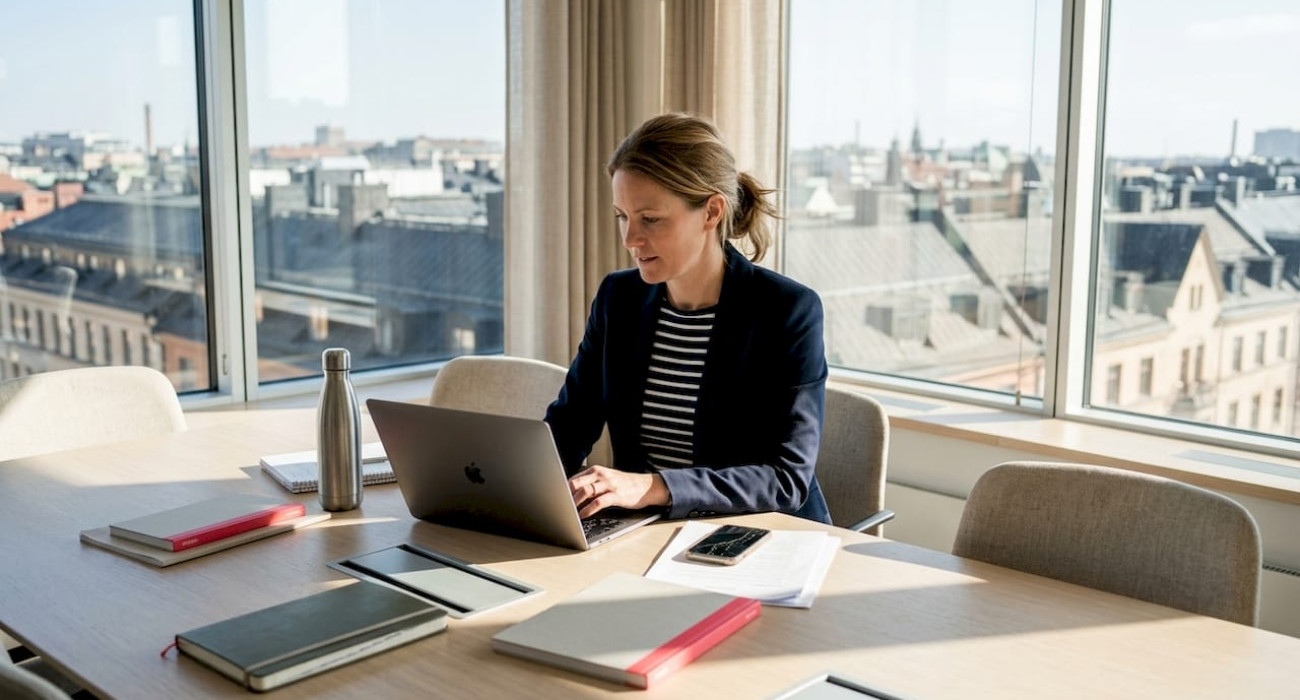

Arranging employee accommodation in Sweden often means choosing between expensive hotels and inflexible long-term leases. Many HR professionals assume medium-term rentals are simply extended hotel stays, missing the distinct advantages these accommodations offer. Medium-term rentals are typically defined as stays ranging from one to six months, providing a distinct alternative to short and long-term rentals. This guide clarifies what medium-term rentals truly are, how they compare to other accommodation types, and why they represent the optimal solution for corporate stays ranging from project assignments to employee relocations across Sweden.
Inhaltsübersicht
- Key takeaways
- Defining medium-term rentals and their suitability for employee stays
- Comparing medium-term rentals with short-term stays, long-term leases, and corporate housing
- Practical considerations for managing medium-term rentals in Sweden
- Benefits of medium-term rentals for businesses and employees in Sweden
- Discover tailored medium-term rental solutions with Guestly Homes
- Frequently asked questions
Wichtigste Erkenntnisse
| Punkt | Einzelheiten |
|---|---|
| Definition and duration | Medium term rentals cover stays from one to six months and provide fully furnished spaces with complete amenities suited to temporary professional needs. |
| Cost savings versus hotels | A hotel room averaging 1,500 SEK per night totals about 135,000 SEK over three months, while medium term rentals typically cost 25,000 to 35,000 SEK per month, reducing total expenditure to roughly 75,000 to 105,000 SEK. |
| Ideal for corporate stays | Ideal for relocations, training or project assignments in Sweden, offering comfortable homes with workspaces and flexibility aligned to project timelines. |
| Difference from other options | Medium term rentals differ from hotels, long term leases and traditional corporate housing in service levels and standards, offering more flexible terms and greater space for collaboration. |
Defining medium-term rentals and their suitability for employee stays
Medium-term rentals occupy a specific niche in the accommodation market. These properties typically accommodate guests for one to six months, offering fully furnished spaces with complete amenities. Unlike hotels that charge premium nightly rates or traditional leases requiring year-long commitments, medium-term rentals provide flexible solutions tailored to temporary professional needs.
These accommodations come equipped with everything employees require for comfortable living. Full kitchens allow self-catering, separate living areas provide workspace and relaxation zones, and bedroom configurations suit individual or family stays. Lease terms adapt to project timelines rather than forcing artificial duration commitments.
For HR professionals coordinating employee accommodation in Sweden, medium-term rentals solve several challenges simultaneously:
- Employees on three-month training programmes gain home-like comfort without hotel monotony
- Project teams working on four-month assignments access collaborative living spaces with individual privacy
- Relocated staff awaiting permanent housing avoid rushed decisions whilst settling into Swedish life
- Consultants rotating between Swedish cities maintain consistent quality standards across locations
- International hires experience Swedish culture authentically before committing to permanent relocation
Cost savings become substantial over extended periods. A hotel room averaging 1,500 SEK per night totals 135,000 SEK over three months. A comparable medium-term rental might cost 25,000 to 35,000 SEK monthly, reducing total expenditure to 75,000 to 105,000 SEK whilst providing significantly more space and amenities.
The psychological benefits matter equally. Employees living in proper homes rather than hotel rooms report better work performance, reduced stress, and improved job satisfaction. Having a kitchen means healthier eating habits. Separate living spaces enable work-life boundaries. Residential neighbourhoods foster genuine cultural immersion.
Pro Tip: When evaluating medium-term rentals for employee stays, prioritise properties within 30 minutes of the workplace and near grocery shops, public transport, and recreational facilities to maximise employee wellbeing and productivity.
Comparing medium-term rentals with short-term stays, long-term leases, and corporate housing
Understanding how medium-term rentals differ from other accommodation types helps HR professionals make informed decisions. Each category serves distinct purposes with varying cost structures, amenities, and flexibility levels.
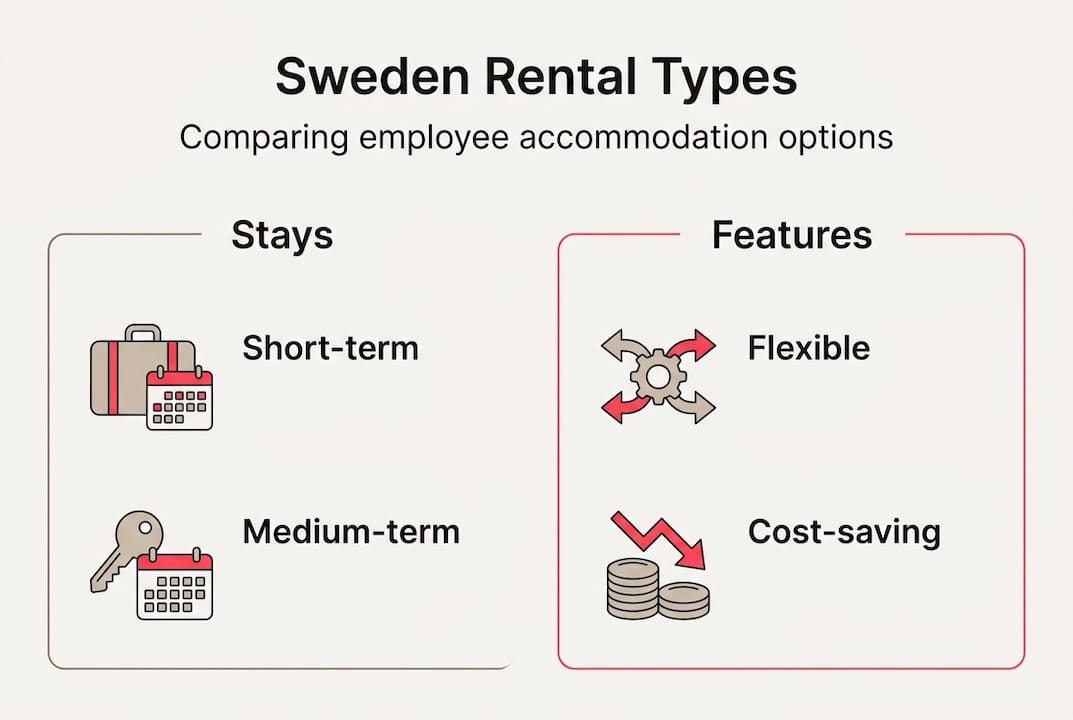
Short-term stays typically last from one night to several weeks. Hotels and Airbnb properties dominate this market, offering daily housekeeping, reception services, and minimal commitment. However, costs accumulate rapidly. A business hotel charging 1,200 SEK nightly becomes prohibitively expensive beyond two weeks. Short-term rentals lack the homely atmosphere employees need for productive extended stays.
Long-term leases span six months to multiple years. Traditional rental contracts in Sweden often require 12-month commitments with three-month notice periods. Properties usually come unfurnished, demanding substantial upfront investment in furniture and household items. Whilst monthly costs decrease, the inflexibility creates problems when project timelines change or employees need to relocate unexpectedly.
Corporate housing vs Airbnb comparison reveals how medium-term rentals bridge the gap between short-term hotels and long-term leases with a balance of cost, flexibility, and comfort. Traditional corporate housing offers furnished apartments with flexible terms but often charges premium rates and requires minimum stay commitments that may not align with actual project needs.
| Faktor | Kurzfristige Aufenthalte | Medium-term rentals | Long-term leases | Corporate housing |
|---|---|---|---|---|
| Dauer | 1 night to 4 weeks | 1 to 6 months | 6+ Monate | 1 to 12 months |
| Einrichtung | Vollständig möbliert | Vollständig möbliert | Usually unfurnished | Vollständig möbliert |
| Monthly cost | Very high | Mäßig | Niedrig | Moderate to high |
| Flexibilität | Maximum | Hoch | Niedrig | Mäßig |
| Annehmlichkeiten | Hotel services | Home amenities | Basic utilities | Enhanced amenities |
| Lease commitment | Keine | Minimal | Substantial | Mäßig |
| Suitability for employees | Brief visits | Project assignments | Permanent relocation | Executive placements |
Medium-term rentals deliver optimal value for the majority of corporate accommodation needs. They cost 40 to 60 percent less than equivalent hotel stays whilst providing triple the living space. Unlike long-term leases, they accommodate changing project scopes without penalty clauses or forfeited deposits.
The amenity package rivals or exceeds corporate housing at lower price points. Employees access full kitchens, in-unit laundry, dedicated workspaces, and comfortable living areas. Properties located in residential neighbourhoods provide authentic Swedish living experiences rather than the corporate hotel atmosphere.
Pro Tip: Calculate the break-even point between hotels and medium-term rentals for your typical assignment lengths; most organisations find medium-term rentals become cost-effective after three weeks and deliver maximum value between two and five months.
Practical considerations for managing medium-term rentals in Sweden
Successful medium-term rental arrangements require attention to legal compliance, property quality, and operational processes. HR professionals must navigate Swedish rental regulations whilst ensuring employee satisfaction and organisational efficiency.
Follow this systematic approach when arranging medium-term accommodation:
- Verify the property owner holds proper rental permissions and tax registrations required under Swedish law for furnished lettings
- Review contracts carefully, confirming lease duration, monthly rent, included utilities, deposit requirements, and termination clauses align with your needs
- Inspect properties personally or through trusted representatives, checking furnishing quality, appliance functionality, safety features, and neighbourhood suitability
- Establish clear communication protocols with landlords or property managers, defining response times for maintenance requests and emergency procedures
- Arrange comprehensive insurance coverage protecting both the employee and organisation against property damage or liability claims
- Create detailed onboarding materials for employees, including property guides, local area information, emergency contacts, and cultural orientation resources
- Implement feedback mechanisms allowing employees to report issues promptly and share experiences that inform future accommodation decisions
- Maintain organised records of all contracts, payments, communications, and incident reports for audit compliance and process improvement
Swedish rental law distinguishes between permanent housing and temporary accommodation. Medium-term furnished rentals typically fall under different regulations than standard residential leases. Ensure contracts specify the temporary nature of the arrangement and comply with local municipality requirements for short and medium-term lettings.
Tax implications deserve careful consideration. Rental income may be subject to VAT depending on the services included. Corporate payments for employee accommodation might have specific reporting requirements. Consult Swedish tax advisors to ensure full compliance and optimise your accommodation budget.
Property management tips demonstrate that effective property management strategies tailored for medium-term rentals improve tenant satisfaction and operational efficiency. Professional property management companies handle routine maintenance, coordinate repairs, manage tenant communications, and ensure regulatory compliance, freeing HR teams to focus on core responsibilities.
When vetting properties and landlords, prioritise these quality indicators:
- Professional property listings with comprehensive photographs, detailed descriptions, and transparent pricing
- Responsive communication during initial enquiries, answering questions promptly and thoroughly
- Clear contracts written in both Swedish and English, outlining all terms without hidden clauses
- Established track records with verifiable references from previous corporate clients
- Proactive maintenance approaches with defined response times for urgent and routine issues
- Modern safety features including smoke detectors, secure locks, and emergency lighting
Employee support extends beyond simply booking accommodation. Create welcome packages with essential information about the property, neighbourhood services, public transport options, and Swedish cultural norms. Schedule check-in calls after the first week to address any concerns. Provide clear escalation paths for maintenance or safety issues.
Pro Tip: Build relationships with two or three trusted property management companies in your key Swedish locations; this ensures consistent quality standards, streamlines booking processes, and provides backup options when specific properties are unavailable.
Benefits of medium-term rentals for businesses and employees in Sweden
Medium-term rentals create measurable value for organisations and their employees. The financial advantages combine with quality-of-life improvements that enhance productivity, satisfaction, and retention.
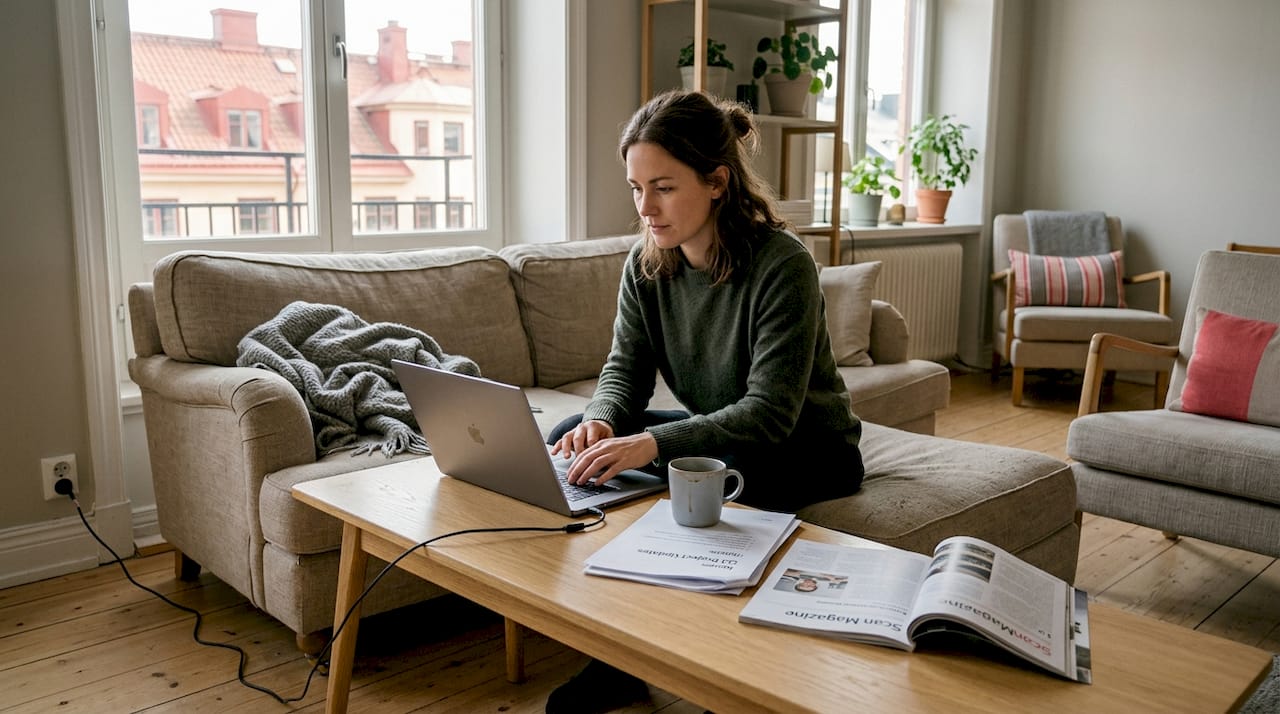
Cost efficiency represents the most immediate benefit. Organisations reduce accommodation expenses by 35 to 55 percent compared to extended hotel stays. A four-month assignment costing 180,000 SEK in hotel accommodation drops to 100,000 to 120,000 SEK with medium-term rentals. These savings multiply across multiple employees and assignments, significantly impacting annual budgets.
Employee wellbeing improves dramatically in home-like environments. Executive accommodation options show that medium-term rentals deliver a combination of cost savings, flexibility, and home-like comfort that enhances employee productivity and satisfaction during extended assignments. Separate bedrooms, living areas, and workspaces allow proper rest and focus. Full kitchens enable healthy eating and dietary control. In-unit laundry facilities provide convenience and privacy.
The psychological impact of having a proper home during temporary assignments cannot be overstated:
- Employees maintain normal routines rather than adapting to hotel constraints
- Family members can visit comfortably, reducing isolation and homesickness
- Personal belongings can be unpacked and arranged, creating genuine living spaces
- Residential neighbourhoods offer authentic cultural experiences and community connections
- Privacy and autonomy foster independence and confidence in unfamiliar environments
Flexibility proves invaluable in dynamic business environments. Project timelines shift, assignments extend or contract, and employee needs evolve. Medium-term rentals accommodate these changes through adaptable lease terms. Extend a three-month stay to five months without relocating. Reduce a six-month assignment to four months without substantial penalties. Add or remove employees from shared accommodations as team compositions change.
Talent attraction and retention benefit from quality accommodation programmes. Top candidates evaluate the entire employment package, including relocation support. Organisations offering comfortable, well-managed accommodation during transition periods demonstrate employee care and professional competence. Current employees accept international assignments more readily when accommodation concerns are eliminated.
Productivity gains emerge from reduced stress and improved living conditions. Employees spending evenings in cramped hotel rooms experience fatigue and diminished focus. Those returning to spacious apartments with proper amenities recharge effectively, maintaining performance throughout extended assignments.
“Luxury hospitality is defined by personalised service, exceptional attention to detail, and creating memorable experiences that exceed guest expectations through sophisticated amenities and thoughtful design.”
Many medium-term rental providers apply these luxury hospitality principles, delivering hotel-grade service within residential settings. This combination provides employees with the best aspects of both accommodation types.
Discover tailored medium-term rental solutions with Guestly Homes
Navigating Sweden’s medium-term rental market requires local expertise and reliable partnerships. Guestly Homes specialises in premium serviced apartments and villas designed specifically for extended corporate stays ranging from 10 nights to 12 months across Sweden and the Nordic region.
Our fully managed properties deliver hotel-grade consistency within home-like environments, eliminating the operational burden from your HR team. We handle property vetting, contract management, maintenance coordination, and tenant support, ensuring your employees experience hassle-free living throughout their assignments. Visit Guestly Homes to explore our portfolio of high-standard accommodations and discover how our tailored solutions simplify corporate housing across Sweden whilst maintaining the quality and reliability your organisation demands.
Frequently asked questions
What duration qualifies as a medium-term rental?
Medium-term rentals typically span one to six months, positioning them between short-term stays of days or weeks and long-term leases of six months or longer. This duration suits project assignments, training programmes, temporary relocations, and transitional housing needs perfectly.
Are medium-term rentals always fully furnished?
Yes, medium-term rentals come fully furnished with complete amenities including kitchen equipment, bedroom furniture, living room furnishings, and household essentials. This distinguishes them from traditional long-term leases which are usually unfurnished, requiring substantial upfront investment from tenants.
How do medium-term rental costs compare to hotels?
Medium-term rentals cost 40 to 60 percent less than equivalent hotel stays over the same period. A three-month hotel stay averaging 1,500 SEK nightly totals 135,000 SEK, whilst a comparable medium-term rental costs 75,000 to 105,000 SEK with significantly more space and amenities.
What legal considerations apply to medium-term rentals in Sweden?
Medium-term furnished rentals fall under different Swedish regulations than standard residential leases. Contracts must specify the temporary nature, property owners need proper rental permissions and tax registrations, and rental income may be subject to VAT depending on included services. Always verify compliance with local municipality requirements.
Can medium-term rental agreements be extended or terminated early?
Most medium-term rental contracts include flexible terms allowing extensions or early termination with reasonable notice periods, typically 30 days. This flexibility accommodates changing project timelines and employee needs far better than rigid long-term leases or expensive hotel cancellation policies.
Who typically uses medium-term rentals in Sweden?
Medium-term rentals primarily serve professionals on temporary assignments including project teams, consultants, relocated employees, trainees, and executives. They also accommodate individuals between permanent housing arrangements or exploring Swedish cities before committing to long-term relocation decisions.