


Many professionals relocating to Sweden expect rapid decisions and blunt directness, but Swedish workplaces operate differently. Consensus and polite communication dominate here. Understanding flat hierarchies and social rituals like fika is essential for smooth integration. This guide covers consensus culture, communication norms, punctuality, work-life balance, and practical challenges newcomers face in Swedish professional settings.
Inhaltsübersicht
- Introduction To Swedish Social Norms And Workplace Culture
- Consensus Culture In The Workplace
- Flat Hierarchies And Equality
- Communication Style And Social Etiquette
- Punctuality And Respect For Time
- Work-Life Balance Norms
- Challenges For Newcomers And Practical Integration Tips
- Explore Seamless Corporate Housing Solutions For Your Sweden Move
- Häufig gestellte Fragen
Wichtigste Erkenntnisse
| Punkt | Einzelheiten |
|---|---|
| Consensus decision-making | Inclusive processes involve team input but slow down timelines compared to hierarchical models. |
| Flat hierarchies | Over 80% of Swedish companies minimize status differences, fostering equality and open idea sharing. |
| Direct yet polite communication | Task-focused clarity balanced with gentle disagreement avoids confrontation. |
| Punctuality is critical | Being more than 5 minutes late signals disrespect in professional and social contexts. |
| Work-life balance priority | Standard 40-hour weeks with minimal overtime protect personal and family time. |
Introduction to Swedish Social Norms and Workplace Culture
Swedish workplaces emphasize collaboration through consensus culture in Sweden rather than top-down commands. Swedish workplaces prioritize consensus culture with group decisions rather than top-down commands. Flat hierarchies encourage participation from every staff level, creating an egalitarian environment where junior employees speak up as freely as managers.
Work-life balance is a strong societal value here. You will notice colleagues leave exactly at closing time without guilt. Communication is direct but framed politely to maintain harmony. Understanding these norms helps newcomers acclimate effectively and avoid misunderstandings.
Key cultural pillars include:
- Collaboration over competition in decision-making processes
- Minimal status symbols and informal manager-employee relationships
- Respect for personal time and strict boundaries around work hours
- Politeness balanced with honest, task-focused feedback
- Social rituals like fika that build workplace relationships
Professionals seeking corporate accommodation in Sweden benefit from understanding these workplace dynamics early. Swedish culture values equality, punctuality, and quiet competence. Adapting to these norms accelerates your professional integration and social acceptance.
Consensus Culture in the Workplace
Consensus means decisions are collaborative, involving discussion and agreement from most team members. Decisions require group buy-in, which can slow processes but increases acceptance. Managers act as facilitators rather than commanders, guiding discussions instead of issuing orders.
Decision timelines are longer than you might expect. What takes one meeting in hierarchical cultures may require three meetings here. The goal is higher awareness and buy-in across the team. Newcomers should prepare for more meetings involving group input, even on smaller matters.
This approach has clear advantages:
- Everyone understands decisions because they participated in shaping them
- Implementation happens smoothly with fewer surprises or resistance
- Team members feel valued and heard, boosting morale
- Managers gain diverse perspectives before committing to action
You may initially find this slow. Patience pays off. Once a decision is made through Swedish consensus decision-making, execution is swift because objections were addressed upfront.
Pro Tip: Active listening in consensus meetings improves your integration and influence. Contribute thoughtfully rather than dominating discussion. Ask clarifying questions and acknowledge colleague input. This builds respect faster than pushing your agenda aggressively.
Professionals who navigate consensus decision-making successfully learn to view silence as reflection, not disengagement. Silent pauses during meetings signal colleagues are thinking, not disagreeing.
Flat Hierarchies and Equality
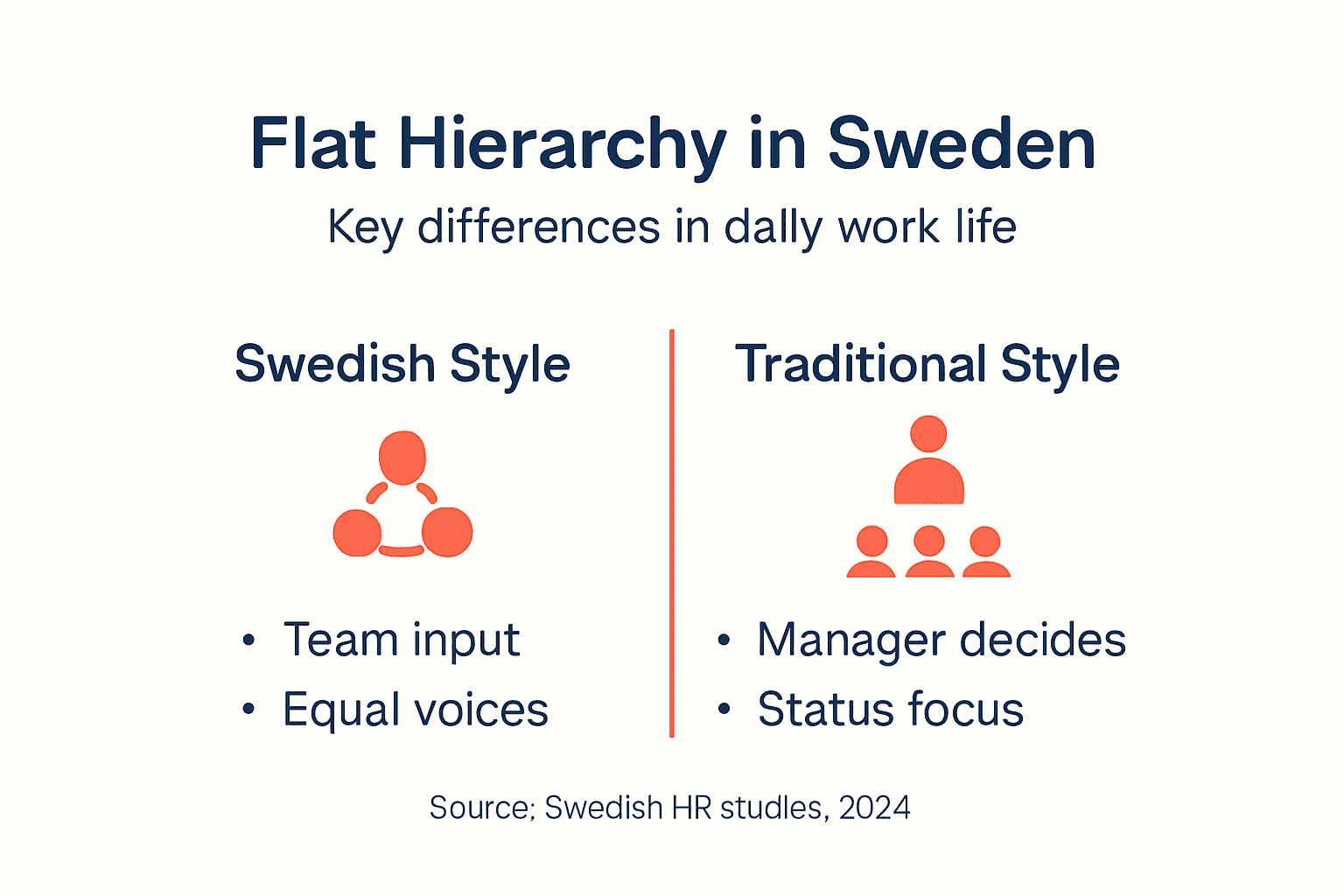
Swedish workplaces prioritize equality, minimizing status differences between ranks. Over 80% of Swedish companies feature flat hierarchies where leaders facilitate rather than command. Managers and employees often use first names and avoid status symbols like reserved parking or corner offices.
Contribution is expected from all ranks, fostering collaborative innovation. Junior staff regularly challenge senior decisions respectfully. This egalitarian culture supports open idea exchange and reduces office politics. You earn respect through competence, not title.
| Aspekt | Swedish Flat Hierarchy | Typical Hierarchical Workplace |
|---|---|---|
| Manager role | Facilitator and coach | Decision maker and commander |
| Kommunikation | First names, open doors | Titles, formal channels |
| Decision input | All levels contribute | Top-down directives |
| Status symbols | Minimal or absent | Offices, parking, perks |
| Idea validation | Merit-based discussion | Authority-based approval |
This structure affects daily interactions. Your manager may ask your opinion before deciding. You are expected to offer input, even as a newcomer. Silence is interpreted as having nothing to add, not as deference.
Flat hierarchies in Swedish workplaces mean you can email the CEO directly without routing through layers. This accessibility feels liberating but requires responsibility. Use it wisely, respecting people’s time.
Key behaviors in flat hierarchies and equality environments:
- Address everyone by first name, including senior leaders
- Contribute ideas regardless of your tenure or position
- Avoid pulling rank or emphasizing your title in discussions
- Expect your manager to ask for your input regularly
- Respect that your ideas will be evaluated on merit, not seniority
Communication Style and Social Etiquette
Swedish communication is task-focused and polite, avoiding emotional expressiveness. Swedes communicate clearly on tasks but soften disagreements to maintain harmony. Disagreements are expressed gently to avoid confrontation. You might hear “I’m not sure that will work” instead of “That’s wrong.”

Fika, a coffee break ritual, is integral to workplace relationship-building. Fika is a daily ritual fostering informal social bonds and relationship-building. Participating in fika improves social integration and trust. These breaks happen mid-morning and mid-afternoon, lasting 15 to 20 minutes.
During fika, conversation remains light. Avoid heavy work topics or personal probing. Colleagues bond over casual chat about weather, weekend plans, or shared interests. This informal time builds the trust that makes formal collaboration smoother.
Communication norms to remember:
- Use polite, measured language even when disagreeing
- Respect silent pauses as thoughtful reflection, not awkwardness
- Avoid loud or animated gestures that draw attention
- Frame criticism constructively and privately when possible
- Participate in social etiquette and communication in Sweden rituals like fika to build rapport
Pro Tip: When you hear hesitant language like “maybe” or “perhaps,” treat it seriously. Swedes use these words carefully, signaling genuine uncertainty or disagreement. They are not casual filler. Respect silent pauses in meetings. Silence often means colleagues are processing information or building consensus internally.
The Swedish communication style balances honesty with kindness. You will rarely face harsh, direct criticism in public. Feedback comes privately and gently. This protects relationships while maintaining high standards.
Punctuality and Respect for Time
Punctuality is a strong sign of respect in Sweden. Being more than 5 minutes late is considered disrespectful in professional settings. Meetings start and end exactly on time. Lateness over 5 minutes is often viewed as rude or unprofessional.
Plan travel and schedules carefully to avoid delays. Swedish public transport is reliable, but you should still build in buffer time. Arriving 5 minutes early is standard practice. Being punctual builds your reputation and trust in professional and social contexts.
Time management expectations:
- Meetings begin precisely at the scheduled time, even if someone is missing
- Agendas are followed strictly, keeping discussions focused
- Meetings end on time so people can attend their next commitment
- Being late signals you do not value others’ time or the meeting itself
- Apologies are expected for any lateness, even if only a few minutes
If you are delayed, send a message immediately. Explain when you will arrive. This courtesy shows respect for punctuality and meeting etiquette. Your colleagues will appreciate the transparency.
Punctuality expectations in Sweden extend beyond work. Social gatherings, dinners, and even casual meetups follow the same rules. Showing up late to a dinner party is a significant faux pas. Swedes plan their evenings around precise schedules.
Respect for time also means respecting boundaries. Do not call colleagues after work hours unless urgent. Swedes protect their personal time fiercely. Emailing late is acceptable, but do not expect immediate replies.
Work-Life Balance Norms
The standard workweek is 40 hours, and overtime is uncommon and discouraged. The typical Swedish workweek is 40 hours, with less than 5% regularly working overtime. Personal and family time is strongly protected culturally. Employees are expected to disconnect after work hours.
This balance supports health and productivity. Swedes believe well-rested employees perform better. Taking vacation days is encouraged, not frowned upon. Most Swedes take four to five weeks of vacation annually, often during summer.
Key work-life norms:
- Leaving work on time is normal and expected, not a sign of poor commitment
- Managers rarely contact employees after hours unless absolutely necessary
- Parents leave early for childcare pickup without judgment
- Vacation planning starts early, and colleagues respect your time off
- Working late regularly may signal poor time management, not dedication
Respecting these norms avoids social and professional friction. If you consistently work late, colleagues may view you as inefficient rather than hardworking. Swedish culture values getting work done within set hours, not logging extra time.
Work-life balance and working hours in Sweden reflect broader societal values. Family time, hobbies, and rest are priorities. You will notice shops and restaurants close earlier than in many countries. Most restaurants stop serving by 9 or 10 p.m. Plan accordingly.
Early dinners are common, often between 5 and 7 p.m. If invited to a colleague’s home, expect dinner around 6 p.m. Arriving late disrupts carefully planned schedules.
Challenges for Newcomers and Practical Integration Tips
Newcomers often misinterpret silent pauses as disengagement rather than consensus-building. Up to 40% of foreign professionals initially find Swedish indirect communication and silent pauses difficult to interpret. Indirect feedback requires attention to tone and subtle cues. What sounds like a suggestion may actually be a firm expectation.
Participating in social rituals like fika accelerates social acceptance. Declining fika repeatedly sends a signal you are not interested in building relationships. Even if you do not drink coffee, join for tea or water. The ritual matters more than the beverage.
Practical integration strategies:
- Observe peer behaviors closely during your first weeks to learn unspoken norms.
- Ask clarifying questions when feedback feels vague or indirect.
- Join fika breaks daily to build informal connections with colleagues.
- Practice patience in meetings, allowing silence and avoiding interruptions.
- Learn basic Swedish phrases to show respect and effort, even if English is spoken.
- Respect quiet hours in residential areas, typically after 10 p.m. on weekdays.
- Master shared laundry room etiquette: book time slots, clean after use, remove laundry promptly.
- Follow waste sorting rules carefully, separating paper, plastic, metal, and organic waste.
Swedish apartment buildings often have shared laundry rooms called tvättstuga. You must book time slots in advance, follow your schedule strictly, and clean machines after use. Leaving laundry in machines past your time is inconsiderate. Neighbors take this seriously.
Waste sorting, or källsortering, is mandatory and detailed. Most buildings provide separate bins for different materials. Recycling culture is strong. Failing to sort waste correctly may draw neighbor complaints.
Indoor norms include removing shoes at entrances and maintaining quiet during evening hours. Smoking is banned inside buildings, on balconies, and at bus stops. Sweden has zero tolerance for drink-driving, with strict legal limits and severe penalties.
Social norms like queuing culture are strict. Swedes form orderly lines and wait their turn patiently. Cutting in line is a serious breach of etiquette. Punctuality applies to social settings as well. Arriving late to dinners or gatherings is disrespectful.
Professionals seeking integration tips for newcomers should focus on observing, asking questions, and showing consistent respect for local habits. Understanding newcomer challenges in Sweden helps you prepare mentally for cultural adjustment.
Explore Seamless Corporate Housing Solutions for Your Sweden Move
Adjusting to Swedish norms is smoother when your living situation supports your needs. Guestly Homes offers expert corporate housing options in Sweden tailored for relocating professionals. Our fully managed homes provide hotel-grade consistency with a home-like feel, supporting your work-life balance from day one.
Whether you need short-term flexibility or extended stays up to 12 months, our property management services handle everything. You focus on integration. We handle the rest. Explore our corporate accommodation benefits to see how we support professionals and HR teams across Sweden.
Häufig gestellte Fragen
What is the role of fika in Swedish workplaces?
Fika is a daily coffee break ritual that fosters informal social bonds and relationship-building. Participating regularly helps you integrate socially and build trust with colleagues. It typically happens mid-morning and mid-afternoon, lasting 15 to 20 minutes.
How can newcomers effectively adapt to consensus decision-making?
Practice active listening and contribute thoughtfully without dominating discussions. View silent pauses as reflection time, not disagreement. Ask clarifying questions and acknowledge colleague input to build respect. Patience and observation help you understand the rhythm of Swedish decision-making.
What should I do if I feel meetings are too slow due to consensus culture?
Recognize that thorough discussion upfront leads to faster implementation later. Resist the urge to push for quick decisions. Focus on understanding diverse perspectives and building buy-in. Over time, you will appreciate the smoother execution that results from inclusive processes.
How strict is Sweden about punctuality in social settings?
Very strict. Being more than 5 minutes late is considered disrespectful, even for casual gatherings. Swedes plan their schedules precisely, so lateness disrupts their evening. Always arrive on time or notify your host immediately if delayed. Punctuality signals respect and reliability.
What are best ways to balance work and personal life in Sweden?
Leave work on time without guilt, as Swedes value efficiency within set hours. Disconnect after hours and protect your personal time. Take your full vacation allowance and respect others’ time off. Participate in hobbies and family activities regularly. Swedish culture supports this balance as essential for health and productivity.
Empfohlen
- Corporate Accommodation Sweden – Strategic Value for HR – Guestly Homes
- Why Book Corporate Housing in Sweden – Key Business Impacts – Guestly Homes
- Die besten Unterkünfte für Unternehmen in Schweden - Expertenvergleich 2025 - Guestly Homes
- Ultimate Guide to Corporate Housing Sweden for Professionals – Guestly Homes