


Most property owners underestimate how much property management fees shape their returns, with over 80% of European landlords citing fee clarity as their biggest concern. Whether your premium apartment in Piteå or smart flat in Luleå attracts british executives, knowing exactly what these fees include can mean the difference between predictable income and unwelcome surprises. This guide reveals how transparent fee models enhance trust, help you avoid risk, and protect your rental investment for the long term.
Inhaltsübersicht
- Property Management Fees Explained Clearly
- Comparing Common Pricing Structures
- What Fees Typically Include and Exclude
- How Model Choice Affects Risk and Return
- The Real Value: Cost Versus Transparency
Property Management Fees Explained Clearly
| Punkt | Einzelheiten |
|---|---|
| Understanding Fee Structures | Property management fees typically range from 8% to 12% of rental income and encompass various service models. |
| Inclusions and Exclusions | Owners should clarify included services to avoid unexpected costs and negotiate effectively. |
| Evaluating Management Options | Assess potential managers based on their ability to maximise property performance, not just fees. |
| Importance of Transparency | Seek detailed fee breakdowns and performance metrics to foster a stronger owner-manager relationship. |
Property Management Fees Explained Clearly
Property management fees represent the critical financial framework determining how rental properties generate income and maintain value. Understanding these charges goes far beyond simple percentage calculations – they reflect sophisticated professional services that protect property owners’ investments.
Typically, property management fees range between 8% to 12% of monthly rental revenue, though structures vary significantly. Management fee models are complex financial arrangements involving multiple potential compensation strategies. Three primary fee structures dominate the market:
- Percentage-Based Fees: Most common model where managers receive a percentage of monthly rental income
- Fixed Monthly Fees: Flat rate independent of property performance
- Hybrid Models: Combination of base fee plus performance incentives
Professional property management involves comprehensive services extending well beyond basic rent collection. Detailed fee structures reflect the extensive operational support provided, including tenant screening, maintenance coordination, financial reporting, and regulatory compliance. These services protect property owners from potential risks and ensure consistent, predictable income streams.

Pro Tip – Fee Assessment: Always request a comprehensive fee breakdown that specifies exactly what services are included and what might incur additional charges. Understanding the full scope of management services helps property owners make informed financial decisions and avoid unexpected expenses.
Key factors influencing management fees include property type, location, rental market complexity, and required maintenance intensity. Owners should evaluate potential managers not just on headline pricing, but on their demonstrated ability to maximise property performance and minimise long-term operational risks.
The table below summarises how key factors influence property management fees across different types of rental properties:
| Faktor | Residential Properties | Commercial Properties | Impact on Fees |
|---|---|---|---|
| Property Size | Usually smaller, less costly | Often larger, higher costs | Larger properties incur higher fees |
| Standort | Suburban, lower rates | City centre, premium rates | Prime locations attract premium fees |
| Market Complexity | Stable, fewer variables | Dynamic, more variables | Complex markets drive up fee structures |
| Maintenance Intensity | Routine, limited repairs | Frequent, substantial repairs | Intensive maintenance increases overall costs |
Comparing Common Pricing Structures
Property management pricing structures represent complex financial models designed to align property owner interests with professional management services. Fee structures in non-listed real estate funds reveal nuanced compensation approaches that balance risk, performance, and operational complexity.
The primary pricing models can be categorised into several distinct approaches:
- Percentage-Based Management Fees: Calculated as a percentage of monthly rental income (typically 8-12%)
- Fixed Monthly Fees: Predetermined flat rate regardless of property performance
- Performance-Linked Fees: Compensation tied directly to achieving specific financial targets
- Hybrid Models: Combination of base fee plus performance incentives
Comprehensive fee analysis reveals significant variations across European property markets, with compensation structures reflecting local market dynamics, property types, and investment strategies. Professional managers often design fee models that balance predictable income for themselves with consistent returns for property owners.
These pricing structures typically incorporate multiple components beyond basic management, including tenant screening, maintenance coordination, financial reporting, and regulatory compliance. More sophisticated models might include graduated fee scales that adjust based on occupancy rates, property value appreciation, or complex performance metrics.
Pro Tip – Fee Negotiation: Request a detailed, itemised fee breakdown that explicitly lists all included and potential additional services. Understanding the comprehensive scope of management charges helps property owners make informed financial decisions and avoid unexpected expenses.
Ultimately, property owners should evaluate management fees not just by headline pricing, but by assessing the potential long-term value creation, risk mitigation, and operational efficiency a professional management team can deliver.
Here’s a quick reference comparing the business impact of different fee models for property owners:
| Gebührenmodell | Predictability | Motivation Alignment | Long-Term Value Potential |
|---|---|---|---|
| Prozentualer Anteil | Moderate, variable costs | High manager motivation | May incentivise short-term gains |
| Fixed Monthly | High, stable costs | Lower performance alignment | Consistent but less growth-focused |
| Hybride | Balanced, partly variable | Shared incentives | Supports sustainable asset growth |
| Performance-Linked | Low, unpredictable costs | Maximises manager drive | Can lead to volatility |
What Fees Typically Include and Exclude
Property management fee structures represent intricate agreements that define the precise boundaries of professional service delivery. Comprehensive operating expense guidelines help property owners understand the nuanced landscape of included and excluded services, ensuring transparent financial expectations.
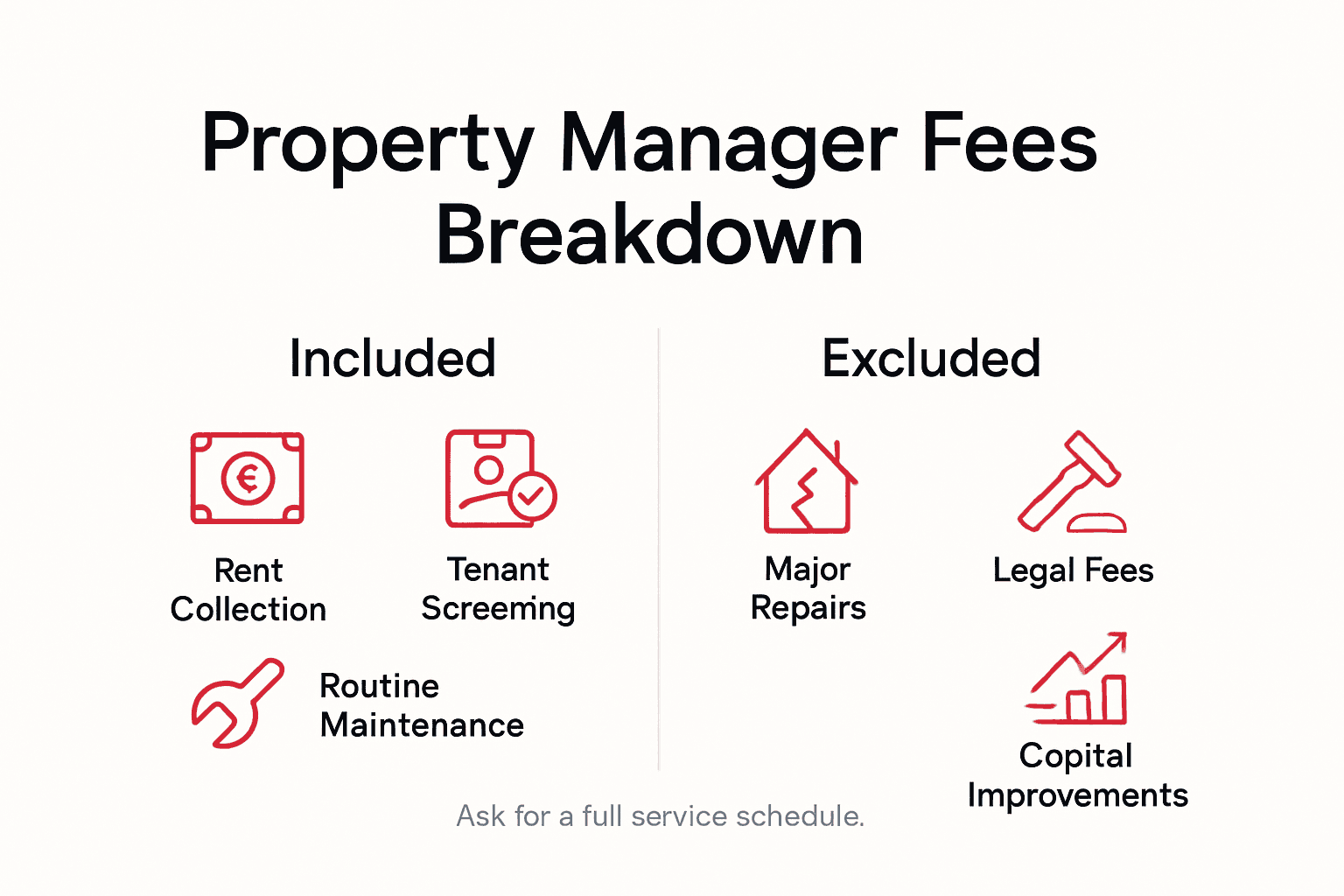
Typical Included Services encompass a wide range of critical property management functions:
- Tenant screening and selection processes
- Einziehung von Mieten und Finanzberichterstattung
- Routine maintenance coordination
- Property inspections
- Basic legal compliance monitoring
- Utility management
- Insurance coordination
- Regular financial performance reporting
Operating expense analyses reveal critical distinctions between standard management responsibilities and owner-specific financial obligations, highlighting the importance of understanding contractual boundaries.
Conversely, Excluded Services typically require additional negotiation or separate financial arrangements:
- Major capital improvements
- Significant structural repairs
- Extensive renovation projects
- Legal dispute representations
- Debt service management
- Specialised tax planning
- Emergency reconstruction efforts
Understanding these service inclusions and exclusions allows property owners to anticipate potential additional costs and negotiate comprehensive management agreements that align with their specific investment strategies.
Pro Tip – Service Boundary Clarification: Request a detailed, written service schedule that explicitly outlines what is and is not included in the management fee. This written documentation prevents future misunderstandings and establishes clear expectations between property owners and management professionals.
Ultimately, successful property management depends on transparent communication, precise service definitions, and a mutual understanding of operational responsibilities and financial boundaries.
How Model Choice Affects Risk and Return
Property management fee models are sophisticated financial instruments that fundamentally shape investment risk, operational performance, and long-term asset value. Strategic fee structures can significantly influence fund leverage and operational risk profiles, creating complex incentive mechanisms that extend far beyond simple compensation calculations.
The primary Risk and Return Models include:
-
Percentage-Based Performance Model
- Higher potential returns
- Increased manager motivation
- Greater potential volatility
-
Fixed Fee Model
- Predictable costs
- Lower risk tolerance
- Reduced operational flexibility
-
Hybrid Performance Model
- Balanced risk allocation
- Shared performance incentives
- Moderate operational adaptability
Each model introduces unique dynamics that fundamentally alter the risk-return relationship between property owners and management professionals. Performance-linked models typically create more aggressive investment strategies, whereas fixed-fee approaches prioritise stability and consistent, measured returns.
The nuanced interplay between fee structure and investment behaviour means that owners must carefully evaluate how compensation models align with their specific risk appetite, investment horizons, and portfolio objectives. Some models inadvertently incentivise short-term gains at the expense of long-term property value, while others create more sustainable, balanced approaches to asset management.
Pro Tip – Risk Assessment: Conduct a comprehensive risk-return analysis that examines not just the headline fee percentage, but the underlying incentive structures and potential long-term implications of different management compensation models.
Ultimately, the most effective property management approach balances financial performance, risk mitigation, and alignment of interests between property owners and management professionals.
The Real Value: Cost Versus Transparency
Property management pricing transcends simple monetary calculations, representing a complex ecosystem of trust, performance, and strategic alignment. Advanced regulatory platforms demonstrate how transparency fundamentally transforms client relationships, challenging traditional opaque pricing models.
Key Transparency Indicators property owners should evaluate include:
- Detailed fee breakdowns
- Clear performance metrics
- Documented service inclusions
- Itemised expense reporting
- Regular financial performance updates
- Predictable cost structures
- Explicit performance benchmarks
European market research consistently highlights the critical importance of comprehensive fee disclosures, revealing that transparent pricing models build significantly more robust owner-manager partnerships. Sophisticated property owners increasingly recognise that lowest cost does not equate to highest value.
The most effective management relationships emerge when financial structures align incentives, create predictable outcomes, and provide granular visibility into operational performance. This approach transforms property management from a transactional service into a strategic partnership focused on long-term asset optimisation.
Pro Tip – Transparency Verification: Request a comprehensive fee disclosure document that explicitly details all potential charges, performance metrics, and service boundaries before entering any management agreement.
Successful property management depends not on finding the cheapest option, but on establishing a transparent, mutually beneficial relationship that prioritises consistent performance and clear communication.
Unlock Hassle-Free Success with Transparent Property Management Fees
Understanding what property managers charge and why it matters is crucial for property owners seeking stability and growth. The article highlights how fee structures impact risk, return, and service quality. If you want to move beyond complex fee models and enjoy a trusted partnership that aligns with your goals, Guestly Homes offers a premium solution. We specialise in fully managed, high-standard homes where fee transparency and predictable returns mean less worry and more income.

Explore how our Revenue Share Model and Arbitrage Model provide tailored flexibility and financial clarity. Whether you prioritise performance-driven partnership or fixed predictable income, Guestly Homes is your strategic partner for frictionless property performance. Discover more about creating value without unexpected expenses by visiting Guestly Homes today and start a conversation that transforms your property management experience.
Häufig gestellte Fragen
What are the typical property management fees?
Property management fees generally range between 8% to 12% of the monthly rental revenue. However, the specific percentage can vary based on several factors, including property type and location.
What services are typically included in property management fees?
Included services often consist of tenant screening, rent collection, financial reporting, routine maintenance coordination, property inspections, and basic legal compliance monitoring.
What additional costs might property owners incur beyond management fees?
Property owners may face additional costs for services not typically included in management fees, such as major capital improvements, significant structural repairs, extensive renovation projects, and legal dispute representations.
How can property owners negotiate management fees effectively?
Property owners should request a detailed, itemised fee breakdown that clearly specifies included and excluded services. This understanding helps in negotiating comprehensive management agreements that align with their financial strategies.
Empfohlen
- Understanding What Are Property Management Fees – Guestly Homes
- Real Estate vs Property Management: What Owners Need to Know – Guestly Homes
- Property Management Cost: Complete Guide for 2025 – Guestly Homes
- Was ist eine Immobilienverwaltungsgesellschaft? Vollständiger Leitfaden - Guestly Homes
- Why Hire Movers for Apartments: Complete Guide