

TL;DR:
- Extended stays offer cost savings, comfort, and legal compliance compared to hotels.
- Proper managed accommodations improve team productivity and well-being during long assignments.
- Choosing professional providers reduces legal, administrative, and operational risks in Sweden.
When HR leads and project managers book accommodation for business teams in Sweden, the instinct is often to reach for familiar options: a cluster of hotel rooms, a short-term booking platform, or whatever is available near the project site. That instinct is understandable, but it is also expensive. For teams working in regions such as Piteå, Luleå, Boden, and Nyköping, where projects can run for months and the climate demands reliable shelter, the accommodation decision carries real operational weight. This article breaks down why extended stays are not a luxury upgrade but a practical necessity, and what HR leads need to know about cost, comfort, and compliance before signing anything.
Inhaltsübersicht
- Understanding the extended stay advantage
- Cost, administration, and financial clarity compared to hotels
- Productivity and well-being: why comfort drives team success
- Legal compliance and risk minimisation in Swedish extended stays
- Our perspective: what most teams get wrong about extended stays in Sweden
- Find the right extended stay for your Swedish team
- Frequently asked questions
Wichtigste Erkenntnisse
| Punkt | Einzelheiten |
|---|---|
| Major cost savings | Extended stays cut team accommodation costs by 15-30 percent over hotels for longer projects. |
| Greater team productivity | Comfortable, purpose-built housing boosts morale and efficiency by up to 20 percent. |
| Compliance made easy | Serviced providers ensure your contracts and reporting meet Swedish and EU regulations. |
| Lower admin hassle | Single-contact providers reduce paperwork and coordination by as much as 50 percent. |
| Hidden risks avoided | Unmanaged rentals can increase total costs and create legal headaches if not properly vetted. |
Understanding the extended stay advantage
An extended stay generally refers to accommodation booked for 14 nights or more, though many providers, including managed operators, offer terms stretching from 10 nights to 12 months. The format sits between a hotel and a long-term lease, offering the flexibility of short-notice booking with the stability of a home. For business teams, that middle ground is precisely where value accumulates.
Sweden’s project-driven industries, including construction, energy, infrastructure, and engineering, routinely deploy teams to regional hubs for weeks or months at a time. Cities like Luleå and Boden are central to Sweden’s green industrial expansion, while Nyköping serves as a logistics and defence corridor. In these locations, hotel supply is limited, pricing is volatile, and the idea of keeping a team of six engineers in separate rooms across two hotels for three months is both costly and operationally chaotic.
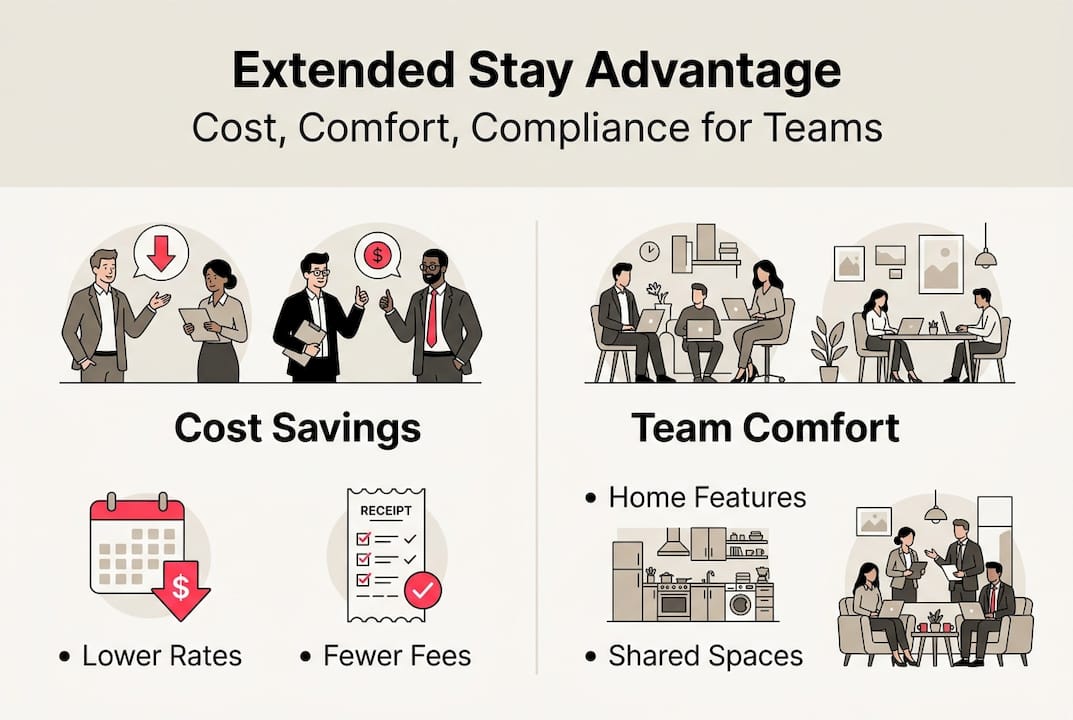
The financial case is straightforward. Extended stay accommodation reduces costs by 15 to 30 per cent compared to hotels for stays over 30 days, largely because all-inclusive rates bundle utilities, internet, and often weekly housekeeping into a single predictable figure. There are no surprise minibar charges, no per-night parking fees, and no meal allowances spiralling out of control because the nearest restaurant is the only option.
For HR teams managing budgets across multiple projects, that predictability is not a minor convenience. It is a planning tool. You can forecast accommodation costs with confidence, report them cleanly, and avoid the end-of-project reconciliation nightmare that hotel receipts tend to produce. To understand the full scope of what this model involves, a medium-term rental guide provides useful context for HR professionals new to the format.
Key reasons HR teams choose extended stays:
- Budget reliability: Fixed, all-inclusive rates make forecasting straightforward
- Comfort and continuity: Teams stay together in one property, maintaining cohesion
- Compliance readiness: Managed providers offer proper contracts and documentation
- Reduced administration: One invoice, one point of contact, one provider
- Scalability: Options range from single apartments to multi-bedroom villas for larger teams
Cost, administration, and financial clarity compared to hotels
Once the distinct nature of extended stays is clear, it is important to see how these translate in day-to-day numbers versus traditional options.
| Merkmal | Serviced apartment | Hotel | Private rental |
|---|---|---|---|
| Nightly rate (30+ days) | Lower, all-inclusive | Higher, variable | Variable, often unclear |
| Utilities included | Ja | Yes (limited) | Selten |
| Kitchen facilities | Vollständige Küche | None or kitchenette | Variiert |
| Contract clarity | Formal, managed | Standard T&Cs | Often informal |
| Admin burden | Low (single invoice) | Medium (multiple receipts) | High (owner negotiation) |
| Legal compliance | Assured by operator | Standard | Risk dependent on owner |
| Team collaboration space | Usually included | Selten | Variiert |
As the table shows, serviced apartments outperform hotels for team stays by enabling collaboration via shared spaces and offering individual privacy, two features that hotels structurally cannot deliver at scale.
Unmanaged private rentals present a different set of problems. The headline rate may appear attractive, but unmanaged rental risks include unclear utility responsibilities, no formal recourse if conditions deteriorate, and the administrative burden of managing a private landlord relationship alongside a live project.
Pro Tip: Always request a fully itemised cost breakdown from any provider before committing. The total cost of a stay includes utilities, internet, cleaning, parking, and any call-out fees. A provider who cannot produce this clearly is one who will surprise you later.
Steps for cost validation and administrative due diligence:
- Request an all-inclusive rate that explicitly lists what is covered
- Confirm billing frequency and invoice format for your finance team
- Verify that the contract is in English or Swedish with a certified translation if needed
- Check cancellation and extension terms before signing, not after
- Confirm a single point of contact for all maintenance and administrative queries
Productivity and well-being: why comfort drives team success
Controlling costs is essential, but the right accommodation can have an even greater impact on team morale and project outcomes.
There is a direct relationship between where people sleep and how well they work. Serviced apartments boost employee productivity and well-being through home-like environments, dedicated workspaces, and privacy, with studies pointing to productivity gains of up to 20 per cent compared to hotel-based stays.
“Private, flexible, and comfortable space delivers measurable gains in focus and lower fatigue for professionals on extended assignments.”
For teams working in northern Sweden, where winter temperatures can drop well below freezing and daylight hours are limited for months at a time, the quality of the living environment is not a soft benefit. It is a performance variable. A team that returns from a site visit to a warm, well-equipped home with a proper kitchen, a living area to decompress in, and reliable broadband is a team that recovers faster and performs more consistently.

For serviced apartment examples that illustrate what this looks like in practice, the contrast with standard hotel rooms is immediately apparent.
Features that make a measurable difference for extended-stay teams:
- Full kitchen access: Reduces meal costs and supports dietary needs
- Separate living and sleeping areas: Enables genuine rest and recovery
- Dedicated workspace: Supports remote calls and focused work outside site hours
- Reliable, high-speed internet: Non-negotiable for project-critical communication
- 24/7 support: Essential in remote or extreme-climate locations
- Proximity to project sites: Reduces commute fatigue over long assignments
For HR leads building a corporate travel lodging guide for their organisation, these features should form the baseline checklist, not an aspirational wish list.
Legal compliance and risk minimisation in Swedish extended stays
With teams’ well-being and finances protected, one last non-negotiable remains: robust legal compliance.
Sweden has clear tenancy regulations, and extended business stays sit within a framework that requires proper contracts, defined deposit terms, and documented notice periods. For companies receiving EU project funding or public grants, accommodation expenses must meet specific documentation standards or risk being excluded from reimbursement claims. That is a risk most project managers only discover after the fact.
| Compliance area | Anforderung | Risk if ignored |
|---|---|---|
| Written contract | Mandatory for stays over 14 days | No legal recourse if disputes arise |
| Deposit terms | Must align with Swedish tenancy law | Unlawful deductions, financial loss |
| Kündigungsfrist | Typically 1 to 3 months depending on term | Unexpected relocation costs |
| EU grant documentation | Itemised invoices, provider details | Reimbursement rejection |
| Data and reporting | GDPR-compliant guest records | Regulatory penalties |
Swedish legal compliance is critical: clear contracts, tenancy law adherence, and EU grant documentation are all areas where managed providers offer a structural advantage over private arrangements.
Pro Tip: Ask any provider directly whether their contracts comply with Swedish tenancy law and whether they can supply documentation in the format required for EU grant reporting. A confident, immediate answer is a good sign. Hesitation is not.
The risks of proceeding without professional management are well documented. To avoid costly property pitfalls and understand the risks of booking without professionals, it is worth reviewing what Swedish property regulations require before any contract is signed. For those managing owner-side arrangements, essential guidance for Swedish owners also sheds light on what responsible operators are expected to provide.
Our perspective: what most teams get wrong about extended stays in Sweden
The most common mistake HR leads make is treating accommodation as a line item to minimise rather than a variable to optimise. They compare nightly rates, choose the lowest number, and move on. The downstream costs of that decision, relocation expenses when a private rental falls through, lost productivity from poor living conditions, failed grant reimbursements due to inadequate documentation, rarely appear on the same spreadsheet.
Northern Sweden adds another layer that many teams from Stockholm or abroad simply do not account for: seasonality. Accommodation that works in September becomes a different proposition in January, when temperatures drop sharply, roads change, and the psychological weight of limited daylight is real. Providers who understand local context plan for this. Providers who do not will leave your team managing it themselves.
The false economy of DIY solutions is persistent. A private rental that saves 10 per cent on paper can cost three times that in admin hours, legal exposure, and staff dissatisfaction. The best results consistently come from trusting operators who know both the paperwork and the practical realities of the regions they serve.
Find the right extended stay for your Swedish team
If the advantages outlined in this article are what your team needs, and the common pitfalls are what you want to avoid, the next step is straightforward: work with a provider who has already solved these problems.
Guestly Homes operates fully managed, high-standard properties across Sweden, including in Piteå, Luleå, Boden, and Nyköping, specifically designed for professional teams on extended assignments. From a one-bedroom corporate comfort option for a solo executive to a five-bedroom business villa for a full project team, every property comes with compliant contracts, transparent billing, and a single point of contact. No chasing. No surprises. Just a stay that works.
Frequently asked questions
How much can a company save with extended stays compared to hotels for team accommodation?
Companies can save 15 to 30 per cent on total accommodation costs for stays over 30 days, primarily through reduced nightly rates, included utilities, and lower dining expenses.
What legal compliance steps are mandatory for extended team stays in Sweden?
You must have clear written contracts, follow Swedish tenancy law on deposits and notice periods, and provide itemised documentation if expenses are being claimed against EU grants.
Do extended stay apartments really improve productivity for business teams?
Yes. Serviced apartments boost productivity through dedicated workspaces, privacy, and home-like comfort, with research indicating gains of up to 20 per cent compared to hotel-based arrangements.
What are the main risks of unmanaged stays or private rental platforms?
Common risks include hidden fees, informal contracts with no legal recourse, last-minute relocations, and failed reimbursement claims when documentation does not meet grant or finance requirements.
Empfohlen
- Long-Term Lodging: Smart Solutions for Team Stays – Guestly Homes
- 7 Smart Accommodation Options in Sweden for Team Stays – Guestly Homes
- Guide to Extended Stays Sweden: Hassle-Free Booking Steps – Guestly Homes
- Lease length options for extended stays in Sweden 2026 – Guestly Homes
- Arten von Firmenreiseangeboten – Mehr Wert für Teams Reiseexperten.de