


Pe scurt:
- Housing quality directly influences workforce well-being, safety, and productivity on construction projects. Stable, well-managed accommodations support consistent routines, improve health, and reduce delays caused by fatigue and illness. Recognizing housing as a core risk factor and managing it strategically enhances project success and workforce retention.
Housing quality is a direct determinant of project success, shaping workforce readiness, safety, and morale from the first day on site. For project managers and HR leads placing teams across Sweden, accommodation is not an administrative detail. It is a performance variable. Poor housing degrades sleep, disrupts routines, and compounds into absenteeism, turnover, and schedule slippage. The research is clear: housing affects job performance primarily through its effect on employee well-being, not just physical comfort. Understanding this connection is the first step to managing it.
Why housing quality impacts project success: the productivity case
Lost productivity from poor accommodation is measurable and significant. When workers cannot recover properly overnight, their first hour on site is compromised. That delay compounds fast. A 30-minute daily loss per worker across a 20-person crew on a 12-week project equals 600 lost hours and roughly £45,000 in wasted labour cost. That figure does not include rework, supervision time, or the knock-on effects of fatigue later in the shift.
The mechanism is straightforward. Noisy, overcrowded, or poorly maintained housing disrupts sleep. Disrupted sleep reduces cognitive function, reaction time, and decision-making quality. A worker who has not recovered properly is slower to start, more prone to error, and less able to sustain focus across a full shift.
Stable, consistent housing routines maintain cognitive readiness in a way that rotating hotel rooms or shared dormitories cannot. Same room, same commute, same morning routine. These predictable patterns preserve mental bandwidth for the work itself. Rotating accommodation resets sleep rhythms and forces workers to re-adapt repeatedly, which erodes performance over time.
The practical implication for project managers is direct. Accommodation decisions made at the planning stage determine the productivity baseline for the entire project duration.
- Assess recovery quality, not just bed count. Noise levels, room separation, and blackout facilities matter as much as square footage.
- Prioritise proximity to site. Long or unpredictable commutes add fatigue before the shift begins.
- Maintain consistency. Avoid mid-project room changes or property switches that disrupt established routines.
- Provide cooking facilities. Access to proper kitchens supports nutrition and reduces reliance on fast food, which affects energy levels.
- Use a single contact point. Centralised housing management removes administrative friction and resolves issues before they affect shift readiness.
Pro Tip: Treat accommodation as recovery infrastructure. The question is not “does it have beds?” but “does it support an eight-hour recovery cycle that prepares workers for a full shift?”
How does housing quality affect health outcomes and team morale?
Poor housing is a documented driver of health inequality. Damp, overcrowding, and poor ventilation are linked to respiratory disease, cardiovascular conditions, mental illness, and premature ageing. For project teams on extended assignments in Sweden, these risks are not theoretical. They are operational.

A 2025 intervention study found that accommodation upgrades produced statistically significant improvements in quality of life, mental health, and physical functioning, particularly over winter. In Sweden, where winter conditions are severe and daylight hours are limited, the quality of indoor living space has a direct bearing on how workers feel and function across a multi-month project.
The indoor environment matters beyond temperature. Inadequate ventilation, crowding, humidity, and poor lighting increase the risk of acute respiratory infections. A single illness spreading through a shared accommodation block can remove several workers from site simultaneously, compressing timelines and increasing pressure on those who remain.
The morale dimension is equally concrete. Workers who feel their employer has provided decent housing report higher job satisfaction and stronger team cohesion. The reverse is also true. Accommodation dissatisfaction is a visible signal that the organisation does not value the people it has deployed. That perception affects retention, effort, and the social environment within the team.
Key health and morale risks from substandard housing:
- Respiratory infections spreading through poorly ventilated shared spaces
- Mental health deterioration linked to overcrowding and lack of privacy
- Fatigue-related mood decline affecting team communication and cooperation
- Increased sick days reducing crew availability and creating scheduling pressure
- Reduced retention as workers seek better conditions elsewhere mid-project
Stat callout: A 2025 quality-of-life study confirmed that housing improvements boost well-being with measurable gains in mental and physical health scores. The implication is direct: upgrading accommodation is a health intervention with project-level consequences.
Is poor housing a safety risk on construction projects?
Poor housing is a safety risk. The connection is not always visible in incident reports, but it is consistent. Fatigue from inadequate recovery increases the likelihood of near-misses, lapses in concentration, and minor incidents on site. Switching from rotating hotel stays to stable housing measurably reduced minor incidents and improved attention at work, without any changes to the safety programme itself. The accommodation change was the variable.
The more acute risk is physical safety within the accommodation itself. A 2026 case in the United Kingdom demonstrated what happens when housing safety standards are ignored. Fire exits were sealed and alarms disabled in a building used for worker accommodation, resulting in a £48,000 fine and near-fatal consequences. The legal and human cost of that failure was entirely preventable.
“Legal compliance must verify more than surface finishes. Fire detection, alarms, and means of escape are critical and often overlooked, with severe legal consequences if ignored.”
For HR leads and project managers selecting accommodation in Sweden, the checklist must go beyond comfort and price.
- Confirm working smoke detectors and carbon monoxide alarms in every unit
- Verify that fire exits are unobstructed and clearly marked
- Check that evacuation procedures are documented and communicated to all occupants
- Review the property’s compliance with Swedish building and housing regulations
- Confirm that emergency contact procedures are in place and accessible
Pro Tip: When inspecting or approving accommodation, walk the fire exit route yourself. A blocked corridor or a locked emergency door is a legal liability and a lethal risk. Do not rely on a landlord’s assurance alone.
Legal cases on housing safety show that ignored due diligence carries both criminal and civil consequences. For project managers, the risk sits squarely within the duty of care owed to deployed workers.
What are the hidden costs of poor housing on project budgets?
Poor accommodation creates costs that never appear as a line item labelled “housing failure.” They surface instead as turnover, retraining, complaint resolution, schedule delays, and reduced output. Housing-induced fatigue and dissatisfaction reduce retention and increase operational friction across the project lifecycle.
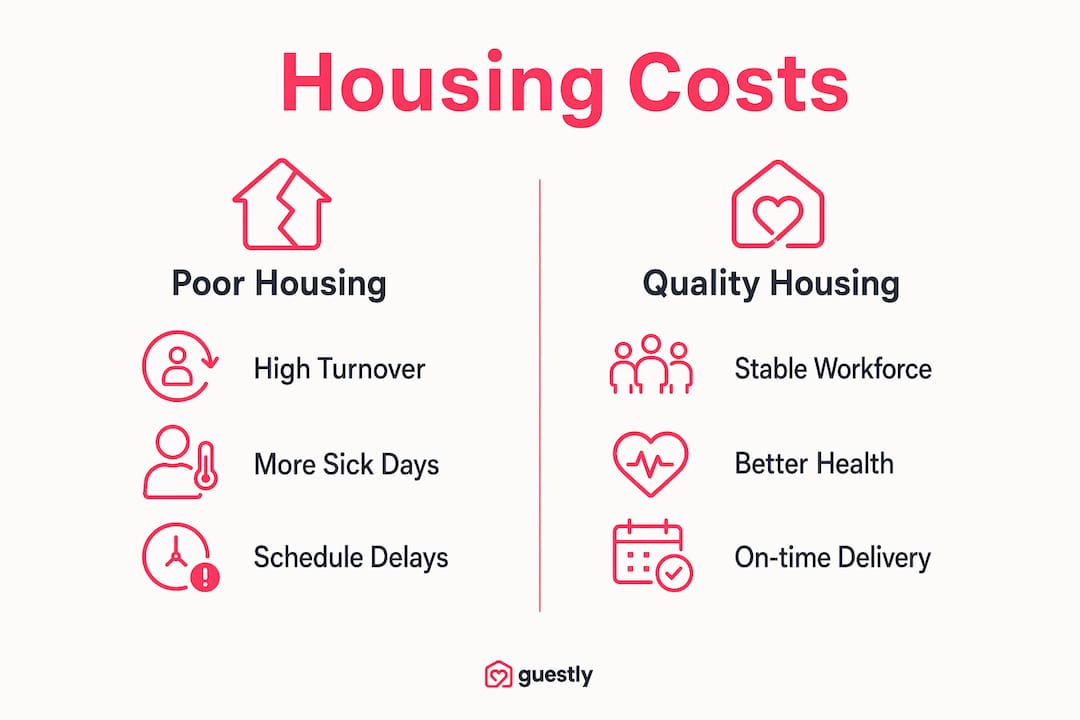
Mid-project turnover is the most damaging hidden cost. When a skilled worker leaves because the accommodation is unacceptable, the project absorbs recruitment time, mobilisation costs, and the productivity gap during handover. Supervision burden increases. Team cohesion drops. The remaining workers notice, and their own satisfaction declines.
Accommodation disruptions also interrupt the routines that support consistent performance. A room change, a property switch, or a noisy environment mid-project resets sleep patterns and forces workers to re-adapt. That adaptation period is unproductive time that no project plan accounts for.
| Cost category | Poor housing | Stable, well-managed housing |
|---|---|---|
| Worker turnover | High. Mid-project exits increase recruitment and retraining costs. | Low. Consistent conditions support retention across the project. |
| Sick days and absenteeism | Elevated. Health risks from poor ventilation and overcrowding. | Reduced. Clean, well-ventilated spaces lower infection risk. |
| Productivity per shift | Degraded. Fatigue and disrupted routines reduce first-hour output. | Consistent. Recovery-focused accommodation maintains daily readiness. |
| Supervision burden | Increased. Complaints and welfare issues consume management time. | Minimal. Stable housing requires less intervention from project leads. |
| Schedule risk | Higher. Cumulative losses from absenteeism and turnover compress timelines. | Lower. Workforce continuity supports on-schedule delivery. |
The pattern is consistent across project types. Housing issues appear in post-mortems as scheduling problems, safety incidents, or turnover spikes rather than as explicit accommodation failures. That misattribution is why the cost is hidden. Project managers who do not look for the root cause will keep solving the symptom.
For HR leads, the practical step is to include accommodation quality in the project risk register alongside logistics, tooling, and subcontractor reliability. It belongs there.
Key takeaways
Housing quality directly determines workforce readiness, safety outcomes, and retention across every phase of a project, making it a core operational decision rather than a support function.
| Punct | Detalii |
|---|---|
| Productivity loss is quantifiable | Thirty minutes of lost readiness per worker per day compounds into thousands of hours across a full project. |
| Health risks are operational risks | Poor ventilation and overcrowding drive infections and absenteeism that compress project timelines. |
| Safety compliance is non-negotiable | Fire exits, alarms, and evacuation plans must be verified before workers occupy any accommodation. |
| Hidden costs erode budgets silently | Turnover, retraining, and supervision burden from poor housing rarely appear as accommodation costs in post-mortems. |
| Well-being mediates performance | Research confirms that housing improves job performance through subjective well-being, not physical features alone. |
Accommodation is a risk register item, not a budget line
I have reviewed enough project post-mortems to recognise the pattern. The schedule slipped. The crew turnover was higher than forecast. There were three safety near-misses in week six. And somewhere in the notes, almost as an afterthought, someone mentions that the accommodation was not great.
That afterthought is the root cause.
Project managers are trained to manage risk in logistics, procurement, and subcontractor performance. Accommodation rarely appears on the risk register with the same rigour. It should. The impact of housing quality on workforce continuity is as direct as any supply chain dependency. When the housing fails, the crew fails to recover. When the crew fails to recover, the project absorbs the cost.
The counterintuitive insight is this: you do not need luxury accommodation to get the performance benefit. You need consistency, cleanliness, safety, and proximity. A well-managed property with reliable facilities and a single point of contact outperforms a nominally higher-spec option with poor management every time. The management layer is what converts physical space into recovery infrastructure.
HR leads in Sweden face an additional variable. Winter conditions here are not mild. Extended darkness, cold, and limited outdoor recovery time make the indoor environment more important than it would be on a summer project in a temperate climate. A property that feels adequate in july becomes a welfare risk in january. That seasonal dimension belongs in the accommodation planning process from the outset.
The organisations that treat accommodation planning for project teams as a strategic decision consistently report better retention, fewer safety incidents, and more predictable delivery. That is not a coincidence. It is cause and effect.
— Joakim
How Guestlyhomes supports project teams in Sweden
Project managers and HR leads working across Sweden need accommodation that performs without requiring supervision. Guestlyhomes operates a portfolio of fully managed villas and serviced properties built for exactly that purpose.
Properties like the 5-bedroom business villa and the 4-bedroom villa with two showers are designed for project teams that need space, privacy, and consistent facilities across extended stays. Fully furnished, professionally managed, and available for stays from 10 nights to 12 months. One contact. No maintenance calls. No mid-project surprises. Guestlyhomes handles the property so your team can focus on the work. For teams that need a quieter recovery environment, the lake view villa offers premium comfort with the kind of calm that supports genuine rest.
FAQ
How does housing quality affect worker productivity?
Poor housing disrupts sleep and recovery, reducing cognitive readiness at the start of each shift. Research shows that 30 minutes of lost productivity per worker per day across a 20-person crew on a 12-week project equals 600 lost hours.
What health risks does substandard accommodation create for project teams?
Inadequate ventilation, overcrowding, and damp conditions are linked to respiratory infections, cardiovascular disease, and mental health decline. These conditions increase absenteeism and reduce workforce availability on site.
Is accommodation a safety compliance issue for project managers?
Yes. Fire safety failures in worker housing carry legal liability and lethal risk. Project managers must verify working alarms, unobstructed fire exits, and documented evacuation procedures before workers occupy any property.
What are the hidden costs of poor housing on a project?
Poor accommodation drives mid-project turnover, increased supervision burden, sick days, and schedule delays. These costs appear in post-mortems as performance or scheduling problems rather than as accommodation failures.
Why does housing quality matter more in Sweden than in other locations?
Sweden’s winter conditions, including extended darkness and cold temperatures, make the indoor environment a primary recovery space for months at a time. Accommodation that is adequate in summer becomes a welfare and performance risk across a Swedish winter project.