


TL;DR:
- Securing compliant team accommodation in Sweden requires careful preparation, documentation, and understanding of tax rules.
- Proper planning, provider evaluation, and ongoing management help organisations avoid costly legal and tax issues.
Securing the right accommodation for a project team in Sweden sounds straightforward until the invoices arrive, the tax queries start, and three team members are sleeping forty-five minutes from the work site. For HR leads and project managers, the gap between a quick booking and a genuinely compliant, cost-effective arrangement can be surprisingly wide. Swedish tax rules introduce specific eligibility thresholds, benefit-in-kind calculations, and documentation requirements that most standard booking processes simply do not account for. This guide walks you through every stage, from prerequisites and provider selection to compliance checks and on-site management, so your team lands prepared and your organisation stays protected.
Tabla de conținut
- What you need before booking team accommodation
- Step-by-step process for planning effective team accommodation
- Compliance considerations: tax, benefits, and documentation
- Verifying and managing your team’s stay
- A fresh take: why teams stumble on accommodation and what really works
- Accommodation solutions for seamless team stays
- Frequently asked questions
Principalele concluzii
| Punct | Detalii |
|---|---|
| Prepare documentation early | Save contracts, travel logs, and receipts to ensure compliance and avoid tax risks. |
| Follow Swedish eligibility rules | Compliant team accommodation needs to meet distance and overnight requirements for tax exemptions. |
| Choose the right provider | Compare serviced apartments, hotels, and corporate lets to match your team’s needs and compliance rules. |
| Assign a central coordinator | Having an accommodation lead streamlines management, feedback, and issue resolution for your team. |
| Keep audit trails | Document every stage of the booking and stay to protect your organisation from tax errors. |
What you need before booking team accommodation
Preparation is where most team accommodation plans either succeed or unravel. Before you open a single booking platform or contact a property provider, you need a clear picture of your requirements, your compliance obligations, and the documentation you will need to produce if challenged.
Core eligibility and compliance thresholds
Swedish tax rules draw a firm line on what qualifies as work-related accommodation. The workplace must be at least 50 km from an employee’s residence for dual residence tax rules to apply. This is not a guideline; it is a hard threshold. If your project site falls inside that radius for any team member, their accommodation costs may be treated differently, and failing to check this upfront can create unexpected tax liabilities later.
Beyond distance, overnight stays at the work location must be a genuine necessity. Commuting daily, even over long distances, does not automatically trigger the same tax treatment as genuine dual residence arrangements. Reviewing each team member’s home address against the work site before booking is a basic but frequently skipped step.
To organise your team-specific needs, consider the full range of team stay accommodation options available in Sweden and map each one against your eligibility criteria before committing.
Documentation you must prepare
Having the right paperwork in place before, not after, your booking protects both the organisation and the individual team members. The key documents to gather include:
- Signed rental or service agreements covering the full duration of the stay
- Expense breakdowns showing accommodation costs separately from any other allowances
- Travel schedules confirming the team’s presence at the work site on relevant dates
- Employee home addresses verified against the work site location
- Project assignment letters linking each individual to the specific assignment
For complex multi-person projects, assessing your project team travel needs in advance ensures you select the right property type and gather the correct documentation from the outset.
| Documentation item | Scop | When to gather |
|---|---|---|
| Rental or service contract | Establishes tenancy terms and costs | Before booking |
| Expense breakdown | Supports tax exemption claims | Before first invoice |
| Travel schedule | Confirms genuine overnight need | At project start |
| Home address verification | Confirms 50 km eligibility | Before booking |
| Assignment letter | Links individual to project | At project start |
Pro Tip: Create a shared drive folder labelled by project and populate it with all required documents before you make a single booking. Chasing paperwork retrospectively under a compliance review is far more disruptive than gathering it upfront.
Step-by-step process for planning effective team accommodation
With your requirements and documentation in place, follow this step-by-step approach for smooth, compliant team accommodation.
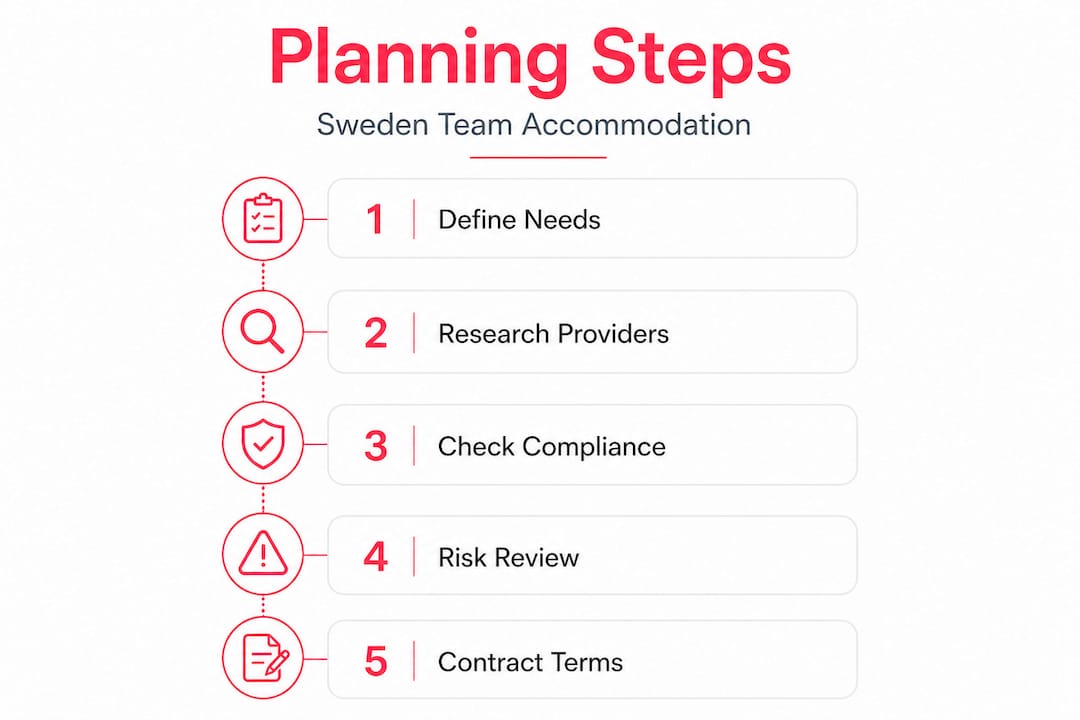
1. Define team needs and scope the assignment
Start with a clear brief. How many people need accommodation? For how long? Are there special requirements such as accessibility needs, secure parking, or proximity to a specific facility? Note the project start and end dates firmly, because open-ended arrangements create compliance ambiguity.
2. Research provider types and their suitability
Not all accommodation providers are equally suited to corporate team assignments. Hotels offer convenience but rarely suit stays beyond two or three weeks. Corporate lets can work well but vary enormously in quality and management standards. Serviced apartments consistently outperform both for extended team stays, offering separate living and working spaces, kitchen facilities, and consistent service standards.
You can compare housing types in detail to match your specific brief before approaching any provider.
| Accommodation type | Best for | Key strengths | Potential weaknesses |
|---|---|---|---|
| Serviced apartments | Stays of 2 weeks or more | Fully equipped, consistent standards, home-like | Higher upfront cost per unit |
| hoteluri | Short stays under 2 weeks | Easy booking, breakfast included | Limited space, no kitchen, costly long-term |
| Corporate lets | Medium to long stays | More space, residential feel | Variable quality, less managed |
| Employer-owned property | Large long-term projects | Cost control | Benefit-in-kind taxation risk |
3. Evaluate providers against compliance criteria
When shortlisting providers, ask directly whether they can supply compliant rental documentation, itemised invoices, and confirmation of tenancy terms. Serviced apartment solutions designed for corporate stays typically provide this as standard. Providers who hesitate to supply proper paperwork are a red flag.
4. Run pre-booking risk checks
Before confirming any booking, verify that the arrangement aligns with Swedish protocols. Employers can structure tax treatment for accommodation as long as documentation and eligibility rules are met, which means the responsibility for structure sits firmly with the organisation, not the employee.
5. Review contracts and cancellation terms
Never confirm a booking without reading the cancellation and refund policy carefully. Project timelines shift. A rigid, non-refundable contract signed for a twelve-week project can become a costly commitment if the timeline shortens.
Pro Tip: Always request a sample contract before committing. Compare the cancellation clauses, the notice period required for changes, and whether partial refunds apply. A provider who refuses to share contract terms in advance is rarely one you want managing your team’s stay.
Compliance considerations: tax, benefits, and documentation
Effective planning hinges on getting the compliance and documentation right, and this area trips up even experienced HR teams.
Benefit-in-kind and employer-owned property
When an employer owns the accommodation provided to employees, a taxable benefit arises. The accommodation valued by local per-square-metre rates is assessed using figures set according to property location and year, meaning the tax value is not simply the cost to the employer. This calculation can produce unexpected results, particularly in higher-value Swedish cities.
For teams placed in employer-owned properties, the benefit must be declared and reported through payroll. Failing to do so creates retroactive liability.
Key rule: If the accommodation is employer-owned, valued benefit-in-kind taxation applies. If it is third-party managed and paid directly by the employer as a work necessity, different treatment may apply, provided documentation is in order.
Dual residence deduction: conditions and limits
For employees who maintain a primary residence at least 50 km away and must stay overnight at the work location, the dual residence deduction can significantly reduce the individual’s taxable income. The conditions are specific, however:
- The employee must genuinely maintain their primary home
- Overnight stays must be required by the nature of the work
- The deduction period is capped, varying by personal circumstances
- All supporting receipts, contracts, and trip logs must be retained
Understanding how this affects your team’s individual tax positions has a direct impact on accommodation’s HR value as a benefit, because poorly structured arrangements can erode the financial advantage entirely.
Common pitfalls to avoid
Many organisations fall into these avoidable mistakes:
- Under-documenting expenses: Paying for accommodation without retaining itemised receipts breaks the audit trail
- Mismatching arrangement type: Using an arrangement labelled as a corporate let but managed informally, without proper contracts, creates compliance gaps
- Ignoring the 50 km threshold: Booking accommodation for employees who live closer to the site than the threshold requires, without noting this and applying the correct tax treatment
- Conflating travel allowances with accommodation costs: These are separate line items under Swedish rules and must not be grouped in expense reports
Reviewing lodging alternatives with a compliance lens can help you identify which arrangement type best matches your team’s specific circumstances.
Verifying and managing your team’s stay
After booking and compliance checks, robust management ensures your team’s comfort and legal compliance throughout the stay.
Check-in checklist
Arriving at an accommodation that is not fit for purpose wastes time and generates immediate friction. Before or on the day of check-in, verify the following:
- All booked spaces are available, clean, and as described in the contract
- Internet connectivity is adequate for remote work needs
- Kitchen facilities are fully stocked and functional
- Emergency contact details for local property support are provided
- Parking, key access, and any building-specific procedures are clearly communicated
Ongoing management during the stay
Proactive management is far less costly than reactive problem-solving. Set up a weekly check-in routine with a designated team member to flag any issues early. A clear issue resolution process, with defined escalation paths, prevents minor inconveniences from becoming major disruptions.
Actual accommodation expenses and travel must be documented for tax exemption purposes, which means encouraging team members to retain all receipts from the first day, not just at the end of the project. A shared digital folder for ongoing expense capture is far more reliable than a last-minute collection effort.
The corporate housing benefits of using a fully managed provider become especially clear during the stay itself. Managed providers handle maintenance, cleaning, and support independently, meaning your team can focus on the project rather than the property.
Building a compliant expense trail
Maintaining compliance throughout the stay requires more than a signed contract at the start. Keep a running log that includes:
- Monthly rental receipts or invoices from the property provider
- Records of any additional costs such as utilities or parking
- Travel logs confirming project-related travel to and from the work site
- Any correspondence with the provider relating to changes in the arrangement
Team accommodation solutions that include built-in administrative support simplify this significantly, because compliant documentation is provided as a matter of course rather than as a special request.
Pro Tip: Allocate one team member as accommodation lead for the duration of the project. This person owns the communication with the provider, maintains the shared document folder, and acts as the single point of contact for any issues. Central oversight prevents gaps and reduces the administrative load on HR.
A fresh take: why teams stumble on accommodation and what really works
After covering all the practical steps, it is worth pausing for a candid look at what makes or breaks team accommodation in Sweden.
The most common failure is not a lack of effort. It is a mismatch between the way organisations think about accommodation and the way Swedish tax rules actually work. HR teams often treat accommodation as a logistics question, booking the nearest available property quickly and moving on. But in Sweden, the arrangement type, the property ownership structure, and the individual employee’s home location all interact to determine the tax outcome. A booking that looks efficient on the surface can carry hidden compliance costs that only become visible months later.
Standard corporate booking processes frequently fall short here. Many procurement frameworks are built around hotel stays, not extended serviced accommodation. When those frameworks are applied to multi-week project assignments, they miss the compliance dimensions entirely.
The arrangement must match the tax logic and documentation when pursuing dual residence or workplace-provided benefits. This means the contract, the expense categorisation, and the actual use of the property all need to tell the same story. Inconsistencies invite challenge.
What actually works? Expectation alignment before the project starts. A digital audit trail from the first inquiry through to check-out. A single point of contact who owns the process end-to-end. And a property provider who understands the corporate context and supplies documentation proactively.
Teams that invest in serviced homes built for Swedish business travel consistently report fewer administrative issues, because the provider’s operational standards are already aligned with corporate needs. Similarly, following corporate housing best practice from the outset removes the guesswork and replaces it with a repeatable process that scales across projects.
The uncomfortable truth is that most team accommodation problems are preventable. They stem from under-preparation, not bad luck.
Accommodation solutions for seamless team stays
If you are ready to solve team accommodation with less stress and higher satisfaction, the right starting point is a provider built specifically for extended corporate stays.
Guestly Homes offers fully managed, high-standard properties across Sweden, designed to meet the needs of project teams, executives, and HR planners who need reliability without complexity. From a compact executive suite for focused work to a luxurious apartment for senior executives requiring space and privacy, every property is maintained to consistent 5-star standards with all documentation provided as standard. For teams prioritising value and comfort in equal measure, corporate comfort stays offer the ideal balance. One contact, full transparency, and stays that perform quietly in the background so your team can focus on the work.
Frequently asked questions
What counts as a compliant team accommodation in Sweden?
Housing must be at least 50 km from the employee’s residence and involve genuine overnight stays at the work location to qualify for tax exemptions under Swedish dual residence rules.
How are employer-owned accommodations taxed for team stays?
They create a taxable benefit valued using local per-square-metre rates set according to property location and the relevant tax year, which must be reported through payroll.
How long can a team stay in dual-residence accommodation for tax purposes?
Maximum periods are up to 2 years for single employees and up to 5 years for those who are married or cohabiting, after which the deduction no longer applies.
What documentation is required for compliance?
All contracts, receipts, and travel records must be retained to support tax-free treatment claims and to avoid benefit-in-kind risks during any audit or review.