


|
Pregătirea playerului Trinity Audio...
|
Pe scurt:
- Effective executive accommodation scheduling begins with clarifying trip objectives and understanding key requirements, ensuring properties meet professional needs. A structured, checklist-based workflow that emphasizes policy enforcement, clear communication, and readiness verification helps prevent common booking errors and last-minute failures. Partnering with managed accommodation providers like Guestly Homes guarantees consistent quality, flexibility, and ongoing support for seamless executive stays in the Nordics.
Booking executive accommodation at the last minute is one of the most avoidable yet frequently repeated mistakes in corporate travel management. When scheduling fails, the consequences reach well beyond inconvenience: delayed arrivals, substandard workspaces, and disrupted routines all chip away at the focus and energy that executives need to perform. For HR leads and project managers across the Nordics, getting this process right means understanding that accommodation is not a logistical afterthought but a direct contributor to professional output. This guide walks you through every stage of the scheduling process, from clarifying objectives to verifying readiness on arrival day.
Tabla de conținut
- Clarifying trip objectives and requirements
- Step-by-step scheduling workflow
- Enforcing corporate travel policy and compliance
- Troubleshooting common scheduling issues
- Verifying accommodation readiness and ongoing support
- What most guides miss about executive stay scheduling
- Explore executive accommodation solutions
- Întrebări frecvente
Principalele concluzii
| Punct | Detalii |
|---|---|
| Start with trip anchors | Defining meeting times and trip purpose forms the foundation for scheduling executive stays. |
| Follow a structured workflow | Choose properties systematically, negotiate flexibly, and verify readiness for maximum comfort. |
| Stick to travel policy | Enforcing clear booking procedures and approvals avoids costly mistakes and delays. |
| Anticipate common issues | Address bottlenecks quickly using checklists, templates, and strong communication. |
| Verify property support | Test Wi-Fi, workspace, and maintenance response before the executive arrives. |
Clarifying trip objectives and requirements
Every well-managed executive stay begins long before any property is selected. The single most effective starting point is identifying the trip’s core anchors: the fixed commitments that cannot move. These anchors typically include the purpose of the visit, confirmed meeting times, and any hard constraints such as site access hours or regulatory appointments.
Executive stay planning works best when built around these trip anchors and then works backwards and forwards to set arrival buffers, departure windows, and the appropriate number of nights. Navan’s travel management methodology makes this explicit: gather profile information, plot meeting times on a timeline, then build flight windows, hotel nights, and ground transport with realistic buffers for delays and time zone adjustments.
Once the anchors are plotted, gather the executive’s workspace and lifestyle requirements. These are not optional extras. A poorly configured workspace in an otherwise beautiful property can derail a full working week. Consider:
- Workspace needs: Dedicated desk, ergonomic chair, and sufficient lighting
- Connectivity: Minimum download speed requirements for video conferencing (typically 25 Mbps or above)
- Amenities: In-unit laundry, kitchen access, and parking availability
- Location constraints: Proximity to meeting venues, transport links, or specific districts
- Duration flexibility: Whether the stay may need extending or shortening on short notice
Understanding these requirements early allows you to filter properties efficiently and avoid late-stage surprises. For guidance on preparing homes for executives, and on choosing executive housing that genuinely supports professional performance, these considerations are consistently the factors that separate a good stay from a disruptive one.
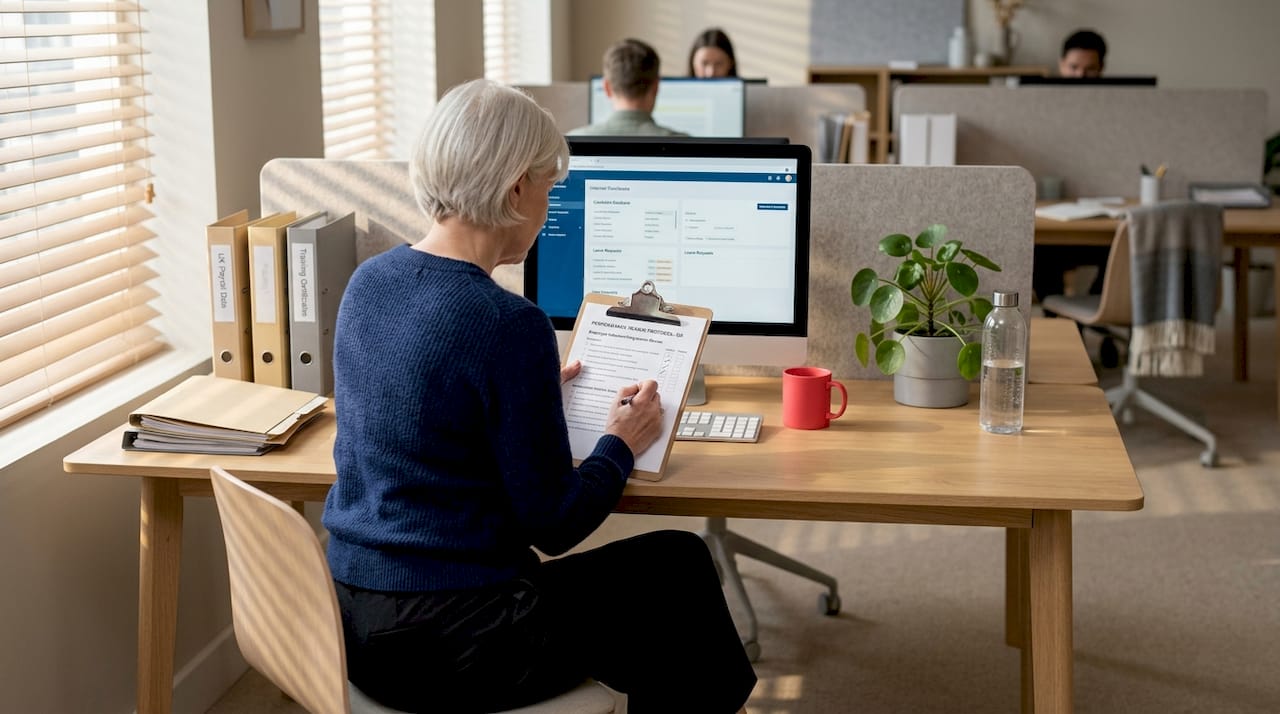
A practical tool for this stage is a simple requirements table, which forces clarity and prevents assumptions:
| Requirement category | Specific need | Priority level |
|---|---|---|
| Spațiu de lucru | Private desk, natural light | Esențiale |
| Connectivity | 25 Mbps minimum, wired option | Esențiale |
| Facilități | In-unit laundry, full kitchen | Înaltă |
| Locație | Within 2 km of client site | Esențiale |
| Durată | 10 nights, possible extension | Înaltă |
| Parcare | One covered space | Mediu |
Using itinerary checklists for smooth trips alongside this requirements table creates a structured foundation that carries through the entire scheduling process.
Pro Tip: Start with the meeting schedule, not the accommodation search. Once you know when and where the executive must be, the property requirements become far more specific and the selection process moves much faster.
Step-by-step scheduling workflow
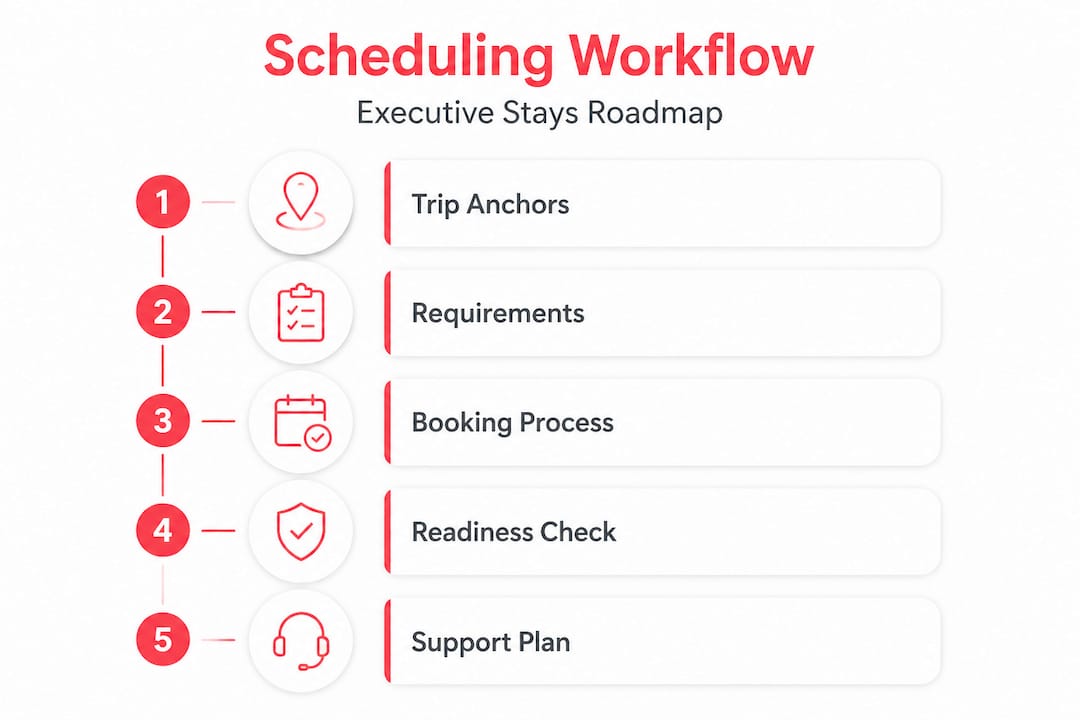
With objectives clarified and requirements documented, the scheduling workflow itself can proceed in a structured, repeatable sequence. The goal is to remove ambiguity at each stage so that no step depends on informal assumptions or verbal agreements.
-
Define meeting anchors and arrival windows. Establish the earliest acceptable arrival time and the latest acceptable departure, factoring in time zone adjustments and travel fatigue. A transatlantic arrival followed by a morning board meeting the next day is a common planning failure that proper buffering prevents.
-
Compile the requirements pack. Document workspace specifications, Wi-Fi minimums, laundry access, parking, and any dietary or accessibility considerations. This pack becomes the basis for property comparison and supplier communication.
-
Run a standardised property checklist and scoring matrix. Rather than relying on gut instinct or supplier recommendations alone, assess each candidate property against weighted criteria. This is particularly valuable when coordinating stays for multiple executives simultaneously, as it makes decisions auditable and defensible.
-
Negotiate contract flexibility upfront. Secure clear terms for extensions, early terminations, and modification windows before signing. This step is frequently skipped in favour of speed, and it almost always creates friction later when project timelines shift.
-
Confirm operational readiness before move-in. Verify that support contacts are responsive, that maintenance response protocols are clearly defined, and that the property has been inspected within a reasonable window before arrival.
For teams managing multiple bookings simultaneously, having a documented booking workflow for project teams reduces cognitive load and prevents critical steps from being skipped under deadline pressure.
When selecting between properties, a comparison table helps clarify trade-offs objectively:
| Caracteristică | Serviced apartment | Standard hotel room | Corporate villa |
|---|---|---|---|
| Dedicated workspace | Da | limitată | Da |
| Spălătorie în unitate | Da | Nu | Da |
| Kitchen access | Bucătărie completă | Kitchenette only | Bucătărie completă |
| Contract flexibility | Înaltă | Mediu | Înaltă |
| Space for focus | Înaltă | Scăzut | Very high |
| Cost per night (extended) | Moderat | Înaltă | Moderate to high |
Pairing this comparison with a reliable executive apartment setup process ensures properties are configured correctly before the executive arrives. The right travel planning tools can also automate elements of this workflow, reducing manual effort without sacrificing precision.
Pro Tip: Build a simple scoring matrix with weighted criteria (connectivity 30%, location 25%, workspace 25%, flexibility 20%) and score each property out of 10. The process takes under 20 minutes per property and eliminates subjective debates later.
Enforcing corporate travel policy and compliance
Even the most thorough scheduling workflow will produce inconsistent results without a governing travel policy. Policy is the invisible infrastructure that keeps individual booking decisions aligned with organisational priorities, budget guardrails, and compliance obligations.
For high-performing corporate lodging, including executive stays, the recommendation from Brex and Emburse is clear: set and enforce a corporate travel policy covering booking procedures, approvals, and spending limits before anyone begins searching or reserving.
An effective travel policy for executive accommodation should address:
- Approved booking channels: Define which platforms or operators may be used, and prohibit ad hoc arrangements that bypass procurement controls
- Approval hierarchies: Specify who authorises stays above certain cost thresholds and how quickly approvals must be granted
- Spend limits by category: Set clear per-night maximums for different stay durations and geographies
- Non-reimbursable expenses: List what the organisation will not cover, removing ambiguity and preventing disputes after travel
- Duty of care obligations: Address how the organisation monitors traveller safety and provides emergency support
The compliance dimension of this work is often underestimated. When policies are vague or inconsistently applied, booking errors multiply, approval processes stall, and budget overruns become routine. The organisations that manage corporate accommodations most effectively are those that treat policy not as bureaucracy but as a practical decision-making tool that accelerates the booking process rather than slowing it down.
“A travel policy is only as effective as its adoption rate. If bookers regularly seek exceptions, the policy either lacks clarity or lacks executive support. Both are solvable problems, but neither solves itself.”
This point matters because exception rates are a meaningful performance indicator. When bookers feel that the policy does not reflect operational reality, workarounds proliferate and compliance data becomes unreliable. Review your policy at least annually, and involve regular bookers in that review to identify friction points before they become habits.
Troubleshooting common scheduling issues
Even well-prepared teams encounter scheduling problems. Recognising the most common failure modes early allows you to resolve them quickly, before they affect the executive’s experience.
The most frequent issues in executive accommodation scheduling include:
- Late bookings: Properties with the right specifications are often unavailable when bookings are made within a week of arrival. Build a minimum lead time into your policy, typically 10 to 14 business days for stays exceeding one week.
- Incomplete requirements: Bookings made without a fully documented requirements pack frequently result in properties that meet most but not all needs. The missing element, often something as specific as a second monitor or blackout curtains, then requires urgent resolution after arrival.
- Unclear approval processes: When approval chains are ambiguous, bookings stall mid-process. Executives arrive to find no confirmed accommodation because a second approver was not aware they were in the chain.
- Missing flexibility clauses: Projects overrun, meetings are rescheduled, and executives sometimes need to leave early. Without negotiated modification terms, these changes incur penalties that could have been avoided.
- Poor communication handovers: When the person who booked the stay is unavailable during the stay itself, the executive has no clear point of contact for operational issues.
Emburse emphasises clear reimbursement and non-reimbursable rules alongside limiting approval steps to avoid backlogs. Reducing the number of required approvals for standard stays, while maintaining oversight for exceptions, is one of the most immediately impactful changes a travel management team can make.
Practical resolution strategies are often straightforward. Use housing selection tips to build a pre-approved shortlist of properties that meet your standard requirements pack, so that searches can begin from a qualified starting point rather than from scratch. Prioritise maximising guest comfort through standardised setup protocols that apply across all bookings. Drawing on smart activity planning tips can also help anticipate logistical needs that fall outside the accommodation itself.
Pro Tip: Create a master booking template that includes the requirements pack, approval chain, policy reference, and a pre-populated checklist. A well-built template reduces booking time by roughly 40% and virtually eliminates incomplete submissions.
Verifying accommodation readiness and ongoing support
Scheduling and booking are not complete until the property has been verified as ready for executive occupancy. This final stage is the one most often skipped under time pressure, and it is frequently the source of avoidable first-impression failures.
A practical readiness checklist should cover:
- Workspace configuration: Desk, chair, and lighting inspected and adjusted to specification
- Connectivity: Wi-Fi tested at the desk location, not just at the router
- Appliances: Laundry, kitchen, and climate control all functioning and clearly labelled
- Consumables: Sufficient supplies stocked for the first 48 hours without requiring a shopping trip
- Access: Key or code access tested, backup access method confirmed
- Support contact: A named individual with a direct line, confirmed as reachable on arrival day
Confirm operational readiness and maintenance response approach before move-in. This is not simply a courtesy check. For an executive whose schedule begins the morning after arrival, a non-functional workspace or slow maintenance response can set a negative tone for an entire project.
“The quality of the first 30 minutes in a property determines how an executive frames the entire stay. When everything works and the space is clearly prepared, they stop thinking about logistics and start focusing on work.”
For a detailed view of what must-haves executive housing should provide, the list consistently returns to the same foundations: connectivity, workspace, and responsive human support. Reviewing guidance on booking travel experiences can also help you anticipate service expectations that executives carry from high-quality travel contexts.
Pro Tip: Test the Wi-Fi speed at the exact desk location using a speed test app at least 24 hours before arrival. Signal strength at the router does not always translate to usable connectivity at the workspace.
What most guides miss about executive stay scheduling
Most scheduling guides focus on cost control. That is understandable, but it creates a blind spot that experienced travel managers learn to recognise: the cheapest compliant property is rarely the most efficient investment when executive performance is the measure.
The uncomfortable reality is that negotiated flexibility matters more than nightly rate for stays of more than two weeks. A property priced 15% higher but offering no-penalty extensions and a 48-hour modification window will almost always deliver better total value than a lower-cost option with rigid terms. Projects extend. Timelines shift. The organisation that locks its executive into an inflexible booking to save 200 kronor per night often pays far more in rebooking costs, disruption, and lost productivity.
The other dimension most guides overlook is the management of last-minute changes once a stay is underway. Pre-arrival planning receives most of the attention, but the moments that most frequently derail executive stays occur during the stay itself. A delayed project, a cancelled meeting, or a changed itinerary requires the booker to act quickly. If the support infrastructure is not already in place, including a responsive operator and pre-negotiated terms, these moments become crises.
A well-designed corporate travel lodging guide for team stays builds in contingency from the outset. The most successful HR leads and project managers approach executive scheduling not as a booking task but as an ongoing management responsibility, with clear protocols for change and a support network that responds without prompting.
Explore executive accommodation solutions
If you are coordinating executive stays across the Nordics and want accommodation that performs as reliably as your planning process, Guestly Homes offers fully managed, high-standard properties built specifically for professionals and project teams.
Every Guestly property is operated to consistent 5-star standards, with responsive support, flexible contract terms, and workspaces configured for professional use from day one. Our executive stay code of conduct sets out exactly what guests and bookers can expect, so there are no surprises. Whether you need a 3BR corporate comfort property for a senior team or a homely house for workers on longer-term placement, Guestly Homes can match the right property to your requirements and manage every operational detail on your behalf.
Întrebări frecvente
What is the best starting point for scheduling executive stays?
Begin with a clear trip anchor: define meetings, purpose, and constraints before planning flights or accommodation. Executive stay planning built around fixed anchors produces far more accurate timelines and property requirements.
How do you ensure compliance with company travel policy?
Set strict booking procedures, approval steps, and spending limits before searching or reserving accommodation. For high-performing corporate lodging, policy must be documented, communicated, and consistently enforced to prevent exceptions becoming the norm.
What are common mistakes when booking executive accommodations?
Frequent errors include late bookings, missing key requirements, and unclear approval processes. Emburse emphasises reducing approval steps and defining non-reimbursable rules clearly to prevent backlogs and post-travel disputes.
How can I verify that an executive property is ready?
Check operational readiness, support contacts, and maintenance responsiveness before move-in. Confirming readiness at least 24 hours before arrival allows time to resolve any gaps without affecting the executive’s schedule.
Which accommodation features matter most for executive comfort?
Workspace, reliable Wi-Fi, laundry, and flexible contract terms are consistently the most critical features. A well-compiled requirements pack covering workspace and connectivity should form the basis of every property search and comparison.
Recomandate
- How to Prepare Homes for Executives: A Step-by-Step Guide – Guestly Homes
- Executive Apartment Setup Process for Seamless Stays – Guestly Homes
- 8 must-haves for executive housing: productivity and comfort – Guestly Homes
- Master extended stay booking workflow for project teams – Guestly Homes
- How punctuality reminders free up mental space