

TL;DR:
- Managing accommodation costs for extended corporate stays requires strategic planning beyond simply comparing nightly rates to ensure quality and savings. Booking early and choosing serviced apartments or managed homes can significantly reduce expenses and improve team comfort during long-term projects. Implementing structured booking programs and consolidating teams in fewer locations helps control costs while maintaining productivity and morale.
Managing accommodation costs for extended corporate team stays is one of the most underestimated challenges in HR and project management. The pressure to control budgets is real, yet choosing the cheapest option rarely delivers the savings it promises. Smart cost-saving tips for corporate stays go well beyond comparing nightly rates: they involve timing, accommodation type, team logistics, and the hidden costs that never appear on a hotel invoice. This guide gives you a clear, practical framework to reduce accommodation spend without compromising the quality your teams need to perform.
Table of Contents
- Optimise booking timing to capture better rates
- Choose mid-term serviced apartments and managed homes over hotels
- Keep teams in fewer locations and use group accommodation options
- Value predictable pricing with included utilities, cleaning and Wi-Fi
- Leverage managed booking programmes and tools to control costs and improve compliance
- Why focusing solely on lowest price can cost more in the long run
- Discover Guestly’s tailored corporate housing solutions in Sweden
- Frequently asked questions
Key Takeaways
| Point | Details |
|---|---|
| Advance booking saves costs | Booking corporate accommodation several weeks to months ahead secures better rates and reduces last-minute surcharges. |
| Opt for serviced apartments | Mid-term serviced apartments and managed homes offer significant savings and more space than hotels for extended stays. |
| Centralise team location | Keeping corporate teams in fewer locations cuts transport, coordination costs and operational inefficiencies. |
| Choose all-inclusive pricing | Properties including utilities, Wi-Fi, and cleaning in the price prevent hidden fees and simplify budgeting. |
| Use managed booking tools | Managed travel programmes reduce booking errors and missed savings through expert rate negotiation and policy compliance. |
Optimise booking timing to capture better rates
The single most reliable way to reduce accommodation costs is also the most overlooked: book earlier. Dynamic pricing, the practice where suppliers adjust rates based on demand and availability, means that the same apartment or hotel room can cost significantly more when booked two weeks out than when reserved two months in advance. For HR professionals managing project teams, this is not a minor detail. It is a structural opportunity.
Flight pricing experts recommend advance booking windows of at least a few weeks for short-haul and at least three months for long-haul trips. The same logic applies directly to corporate accommodation planning. Booking discipline is not just good practice; it is a measurable cost-control mechanism.
The challenge is that most teams book accommodation reactively, once a project start date is confirmed. By then, the best rates are often gone. Embedding booking timelines into your corporate booking process from the outset changes this pattern. When accommodation planning is tied to project milestones rather than left as an afterthought, you consistently capture better rates.
Key benefits of advance booking for corporate teams:
- Lower nightly rates secured before demand peaks
- Wider choice of properties suited to team size and location
- Reduced risk of non-compliant, last-minute bookings that bypass travel policy
- More time to negotiate extended-stay discounts with providers
- Fewer emergency rebookings, which carry premium costs
Pro Tip: Set an internal booking deadline of no later than six weeks before the project start date for stays under three months, and twelve weeks for longer assignments. Align this deadline with your project kick-off planning cycle so accommodation is never left until the final week.
Pairing advance booking with smart travel planning tools that automate reminders and track booking windows can further reduce the administrative burden on your team.
Choose mid-term serviced apartments and managed homes over hotels
For stays beyond two weeks, hotels are rarely the most cost-effective option. The nightly rate may look comparable at first glance, but the total cost of a hotel stay grows quickly once you account for daily meals, laundry charges, parking, and the absence of a proper workspace. Serviced apartments and managed homes address all of these gaps directly.
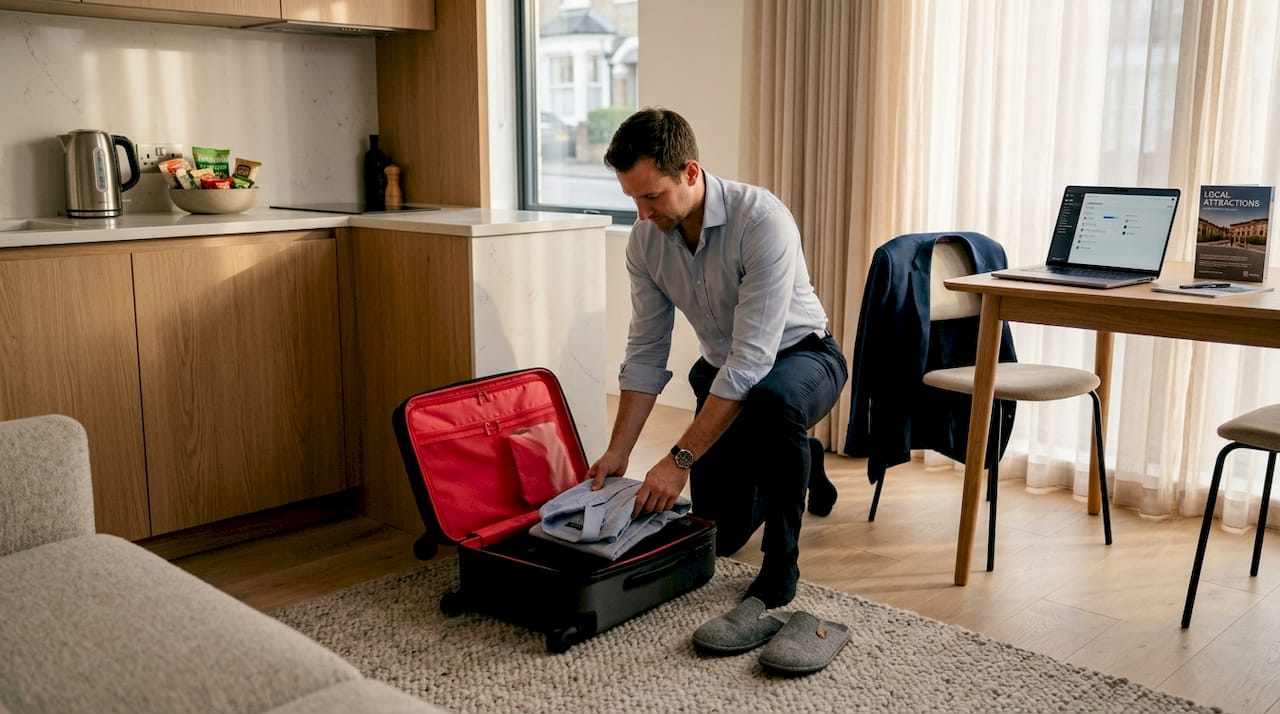
Serviced apartments can save companies up to 30% compared to hotels for stays beyond two weeks, thanks to lower nightly rates and included services such as Wi-Fi and laundry. For a team of four staying for six weeks, that difference is substantial. A full kitchen alone can reduce daily food expenditure by a significant margin when employees can prepare their own meals rather than relying on restaurants or room service.
Managed homes in Sweden take this further. Managed homes deliver savings of 15 to 25% compared to hotels for extended stays, while providing higher executive satisfaction and simplified operations. A single point of contact for maintenance, cleaning, and logistics removes the coordination overhead that HR teams typically absorb.
| Feature | Standard hotel | Serviced apartment | Managed home |
|---|---|---|---|
| Kitchen facilities | None or limited | Full kitchen | Full kitchen |
| Laundry on-site | Paid service | Included | Included |
| Wi-Fi | Often charged | Included | Included |
| Workspace | Desk in room | Dedicated area | Dedicated area |
| Weekly cleaning | Daily (at cost) | Included | Included |
| Contract flexibility | Nightly | Weekly/monthly | Project-aligned |
| Cost per night (extended) | High | Moderate | Moderate to low |
| Single management contact | No | Sometimes | Yes |
Key advantages of serviced apartments and managed homes for extended corporate stays:
- Full kitchens reduce daily meal costs per person
- Laundry facilities eliminate dry-cleaning and laundry service charges
- Dedicated workspaces support productivity without extra cost
- Monthly or project-aligned contracts avoid nightly rate penalties
- Consistent, hotel-grade standards without hotel-level pricing
Pro Tip: When selecting a provider, confirm that contract terms can be extended or shortened in alignment with your project timeline. Providers who penalise early departure or charge for extensions can quickly erode the savings you negotiated upfront. Review executive accommodation options that offer flexible terms before committing.
Understanding corporate travel management as a discipline, rather than a series of ad hoc bookings, is what separates teams that consistently save from those that overspend.
Keep teams in fewer locations and use group accommodation options
Spreading a project team across three different hotels in different parts of a city might seem like a neutral logistical choice. In practice, it creates a cascade of hidden costs: transport expenses, coordination delays, fragmented communication, and reduced team cohesion. Consolidating accommodation is one of the most effective business trip budget tips that rarely appears in formal travel policies.
Keeping teams in fewer locations reduces transport expenses and coordination complexity, which lowers hidden costs such as delays, complaints, and lost productivity. A villa or a cluster of neighbouring apartments can house an entire team while reducing the cost per person compared to individual hotel bookings.
The benefits of extended stays for Swedish teams in consolidated accommodation extend beyond the financial:
- Simpler logistics: One address, one check-in process, one maintenance contact
- Lower transport costs: Reduced need for taxis, rental cars, or public transport between dispersed locations
- Stronger team cohesion: Shared living spaces encourage informal collaboration and reduce isolation
- Clearer communication: Teams in the same location spend less time coordinating and more time delivering
- Reduced complaints: Consistent accommodation quality across the team prevents morale issues driven by perceived inequity
For larger teams, a villa with multiple bedrooms often costs less per person per night than the equivalent number of individual hotel rooms, while offering significantly more space and shared amenities.
Value predictable pricing with included utilities, cleaning and Wi-Fi
One of the most reliable ways to control a corporate accommodation budget is to know exactly what you are paying before the stay begins. Hidden charges are not a minor inconvenience; they are a budgeting failure that HR and finance teams absorb after the fact. Accommodation options with all-inclusive pricing remove this uncertainty entirely.
Corporate accommodation that includes utilities, Wi-Fi, linen, and cleaning in the base price prevents unexpected costs and supports stable budgeting across long projects. When every line item is confirmed upfront, financial planning becomes straightforward and approval processes are faster.
Services and utilities to confirm as included before signing any corporate accommodation contract:
- Wi-Fi: High-speed internet is non-negotiable for working professionals; confirm speed and reliability
- Electricity and heating: Particularly relevant for longer Swedish winters where utility costs can be significant
- Weekly cleaning: Confirm frequency and what is covered to avoid supplementary charges
- Fresh linen and towels: Replacements should be included without additional fees
- Maintenance and repairs: Responsive, included maintenance prevents disruption to working schedules
- Parking: Where relevant, confirm whether on-site parking is included or charged separately
Predictable pricing also reduces the administrative burden on HR teams. When accommodation costs are fixed and transparent, expense reporting is faster, reimbursement disputes are fewer, and the overall management of corporate housing selection becomes a routine process rather than a monthly reconciliation exercise.
Leverage managed booking programmes and tools to control costs and improve compliance
Even the best accommodation strategy delivers inconsistent results if bookings are made informally, outside a structured process. Managed booking programmes centralise the entire accommodation procurement function, applying negotiated rates, enforcing travel policy, and providing visibility across all active stays.
Managed hotel booking programmes reduce costs, booking errors, and improve duty-of-care visibility immediately upon implementation. For HR professionals responsible for teams on extended projects, duty of care, the legal and ethical obligation to ensure employee wellbeing during travel, is as important as cost control. A managed programme addresses both simultaneously.
The financial case is compelling. Clients saved $21.3 million in 2025 through negotiated rates and expert booking strategies, reclaiming over 37,000 work hours and achieving an average ROI of $1.51 per $1 spent on management fees. The return on investment from structured management is not marginal; it is transformational for organisations that travel frequently.
Steps to implement a managed booking programme effectively:
- Audit current booking behaviour: Identify where bookings are made, by whom, and what percentage fall outside policy
- Define your travel policy clearly: Set maximum nightly rates, approved accommodation types, and required booking lead times
- Select a managed booking partner or platform: Choose one with negotiated rates in your key project locations, including Sweden
- Integrate with expense management: Connect booking data directly to your finance systems to eliminate manual reconciliation
- Train internal bookers: Ensure HR leads and project managers understand the process and the policy
- Review quarterly: Analyse spend data, compliance rates, and savings to refine the programme over time
“The organisations that consistently achieve savings on business accommodations are not those with the strictest policies, but those with the clearest processes. When booking is easy and compliant, people follow the system. When it is complicated, they work around it.” — Corporate travel management best practice
Understanding the role of a business travel agent within a managed programme can also clarify where specialist expertise adds value beyond what an internal team can achieve alone.
Why focusing solely on lowest price can cost more in the long run
There is a persistent assumption in corporate travel management that the primary goal is to reduce the nightly rate. It is understandable. Nightly rates are visible, comparable, and easy to report. But they represent only a fraction of the true cost of a corporate stay.
Cheap corporate travel creates hidden costs from delays, stress, and lost productivity, and 86% of business travellers lose time due to poor planning and low-quality stays. When an engineer or consultant is staying in substandard accommodation, the impact does not stay at the front door. It follows them into every meeting, every deliverable, and every interaction with the client.
The real calculation is not nightly rate versus nightly rate. It is total cost of stay, including transport, meals, productivity loss, HR complaints, and the cost of replacing a team member who leaves partly because of poor working conditions. Viewed through this lens, why cheaper stays cost more becomes not a counterintuitive argument but an obvious one.
“Prioritising the lowest accommodation price without accounting for operational risk is not cost management. It is cost displacement. The savings appear on one line of the budget and reappear, larger, on several others.”
Stable, well-managed mid-term accommodation protects productivity, reduces HR overhead, and keeps project timelines intact. For organisations running multi-week projects in Sweden, the difference between a team that is comfortable and a team that is struggling is often the difference between a project delivered on time and one that is not.
Discover Guestly’s tailored corporate housing solutions in Sweden
Guestly Homes offers fully managed properties across Sweden, designed specifically for the needs of project teams, executives, and professionals on extended assignments. Every property includes high-speed Wi-Fi, fully equipped kitchens, dedicated workspaces, and professional maintenance support, with all utilities and cleaning included in a single, predictable price.
Whether your team needs a homely, well-equipped house for workers, a modern luxury villa with lake views for executive teams, or a luxurious apartment for the modern executive, Guestly provides one point of contact, flexible contract terms, and hotel-grade consistency throughout. There are no hidden charges, no coordination delays, and no compromises on quality. Contact Guestly early in your project planning cycle to align housing arrangements with your timeline and secure the best available properties.
Frequently asked questions
How far in advance should I book corporate accommodation to save costs?
Booking at least several weeks in advance for short-haul stays, and up to three months ahead for longer trips, helps secure better rates and reduces costly last-minute errors. Flight pricing experts recommend these same lead times for corporate accommodation planning.
Why are serviced apartments often more cost-effective than hotels for long stays?
They offer lower nightly rates, full kitchens that reduce meal costs, and include utilities and services such as Wi-Fi and laundry in the base price, preventing hidden charges. Serviced apartments can save companies up to 30% compared to hotels for stays beyond two weeks.
How do managed travel programmes help control corporate accommodation costs?
They centralise bookings with negotiated rates, enforce travel policies, reduce booking errors, and improve visibility of travel spend and duty of care. Managed hotel booking programmes deliver these benefits immediately upon implementation.
What hidden costs might arise from choosing the cheapest accommodation options?
Hidden costs include lost productivity from delays, stress from logistics complications, and increased employee complaints, which can outweigh initial savings. 86% of business travellers lose time due to poor planning and low-quality stays.
Recommended
- Why cheaper stays cost more for business travel in Sweden – Guestly Homes
- 7 Corporate Housing Selection Tips for Effortless Business Travel – Guestly Homes
- The essential checklist for a quality corporate stay in Sweden – Guestly Homes
- Corporate Travel Lodging Guide for Seamless Team Stays – Guestly Homes