


|
Pregătirea playerului Trinity Audio...
|
Pe scurt:
- Managing multiple rental properties in Sweden requires strict legal compliance and a solid operational foundation.
- Outsourcing to professional managers and using digital tools help scale portfolios efficiently while maintaining oversight.
- Regular performance reviews and clear expectations are essential to ensure profitability and mitigate risks in a hands-off rental business.
Managing one premium rental property in Sweden is demanding enough. Managing three, five, or eight without a structured system quickly becomes a second job, one that erodes the very financial freedom you set out to create. Swedish property owners with growing portfolios face a specific set of pressures: strict tenancy laws, high tenant expectations, and a market that rewards consistency and professionalism. This guide walks you through the foundational steps, practical scaling strategies, and risk management frameworks that allow you to grow a profitable, largely hands-off rental business in Sweden, without sacrificing returns or your personal time.
Tabla de conținut
- What you need before you start: laying the right foundation
- Step-by-step: how to scale from a single property to a managed portfolio
- Income optimisation and risk management for Swedish portfolios
- Common pitfalls and troubleshooting when hands-off
- Why ‘hands-off’ success in Sweden means trust, not total passivity
- Ready to scale your Swedish rental portfolio?
- Întrebări frecvente
Principalele concluzii
| Punct | Detalii |
|---|---|
| Legal compliance first | Establish documentation and regulation checks before building a passive portfolio in Sweden. |
| Scale with management | Switch from self-managing to professional management around five properties to avoid burnout and maintain quality. |
| Maximise income smartly | Corporate tenants and dynamic pricing help your portfolio earn more consistently and with less risk. |
| Avoid common pitfalls | Regular audits and clear contracts with managers prevent costly mistakes in a hands-off approach. |
What you need before you start: laying the right foundation
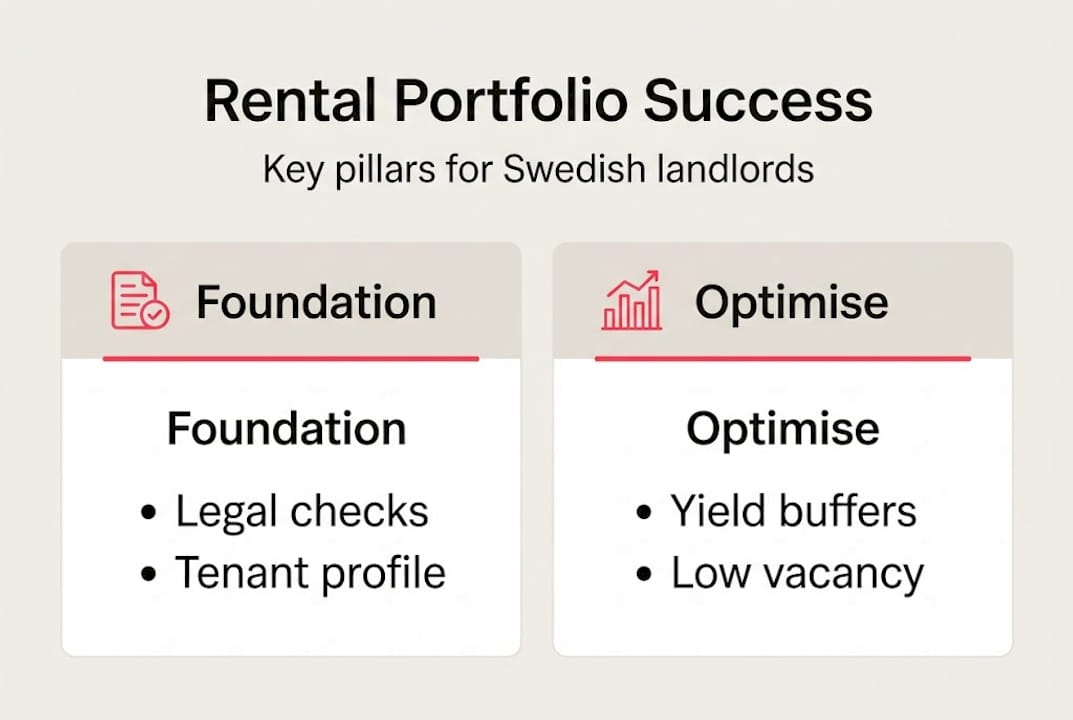
Before you consider outsourcing a single task or adding another property to your portfolio, the groundwork must be solid. Strict Swedish rental regulations require compliance at every stage, and the cost of getting this wrong scales directly with the number of properties you hold. Contracts, permits, and tenant rights are not optional considerations; they are the operating framework within which every decision sits.
Start with a compliance audit across your existing properties. This means reviewing lease agreements against current Swedish tenancy law, confirming that any short-term letting activity aligns with local municipality rules, and ensuring your tax reporting is accurate. Sweden taxes rental income, and the rules differ depending on whether you rent through a company or as a private individual. Consulting a Swedish property tax specialist before scaling is a practical step that pays for itself quickly.
Next, assess each property objectively. Not every asset is suited to a hands-off model. Consider the following criteria:
- Location quality: Is the property in a market with consistent corporate or professional demand?
- Condition and standard: Does it meet the expectations of medium to long-term professional tenants?
- Furnishing status: Furnished properties command higher rents and attract corporate clients, but require higher initial investment and ongoing maintenance.
- Lease type suitability: Is the property better suited to short-term lets, mid-term corporate stays, or long-term tenancies?
For a thorough overview of legal obligations before letting, the essential Swedish rental guide covers the key steps in detail. Understanding management cost insights early also helps you model realistic net returns before committing to a management structure.
Your ideal tenant profile matters enormously at this stage. Corporate tenants and project-based professionals typically offer longer stays, lower vacancy rates, and more predictable income than short-term leisure guests. Platforms such as Bofrid and specialist operators can assist with tenant matching for this segment. Reviewing the complete guide to Swedish apartments will help you understand which property types attract which tenant profiles.
Pro Tip: Use a digital property management checklist to automate compliance reminders, lease renewal dates, and inspection schedules. This single habit prevents the most common and costly regulatory oversights as your portfolio grows.
| Compliance area | Action required | Frequency |
|---|---|---|
| Lease agreement review | Align with current Swedish tenancy law | Annually |
| Tax reporting | Declare rental income correctly | Per tax year |
| Short-term let permits | Confirm municipality rules | Before each let |
| Property condition report | Document and update | At each tenancy change |
Step-by-step: how to scale from a single property to a managed portfolio
Once your compliance foundation is in place, the next challenge is building a scalable operational structure. Key methodologies include BRRRR (Buy, Rehab, Rent, Refinance, Repeat) for scaling rental portfolios efficiently, and this approach translates well to the Swedish premium market. The principle is straightforward: acquire a property, improve it to a lettable standard, generate rental income, refinance against the increased value, and reinvest the released capital into the next acquisition.
Here is a practical sequence for Swedish property owners moving from one property to a managed portfolio:
- Evaluate your first property’s performance. Before expanding, confirm that your existing property is generating consistent net returns and that operations are running smoothly. Reviewing preparing your rental property ensures each asset is optimised before you add complexity.
- Identify and outsource your most time-consuming tasks. Cleaning, maintenance coordination, and guest communication are the first areas to delegate. Use specialist service providers rather than managing individual contractors yourself.
- Introduce digital tools for operations. Property management software handles booking calendars, payment tracking, maintenance requests, and tenant communication across multiple units from a single interface.
- Add your second and third properties with systems already in place. Scaling is significantly easier when processes are documented and repeatable before you grow, not after.
- Engage a professional property manager when you reach five to seven units. Hiring property managers costs 8 to 12% of rent, but the time saved and the reduction in operational risk justify the fee at this portfolio size.
- Review performance quarterly. Use occupancy rates, net yield, and maintenance cost data to guide decisions about further acquisitions or portfolio restructuring.
For additional scaling tips specific to multi-property landlords, external resources can complement your local knowledge. Avoiding first-time landlord mistakes becomes especially important as complexity increases.
Pro Tip: Group properties with similar specifications, size, furnishing level, and target tenant type, when onboarding a property manager. Managers work more efficiently with homogeneous portfolios, and you will find it easier to benchmark performance across units.
| Approach | Time per month | Costuri | Scalabilitate |
|---|---|---|---|
| Self-management | 15 to 25 hours per property | Low direct cost | Very limited beyond 3 units |
| Professional manager | 1 to 3 hours per property | 8 to 12% of rent | High, suitable for 5 or more units |
| Specialist operator | Minimal owner involvement | Revenue share or fixed lease | Optimal for premium portfolios |
Income optimisation and risk management for Swedish portfolios
With operations structured and scaling underway, the focus shifts to maximising what each property earns and protecting those earnings from common risks. Corporate leasing yields stable income with low turnover, and dynamic pricing boosts short-term yields significantly compared to fixed-rate letting. In Stockholm, for example, well-positioned corporate apartments regularly achieve 20 to 40% higher monthly revenue than equivalent long-term lets, particularly when dynamic pricing is applied during peak demand periods.

To compare corporate housing and Airbnb returns across different letting models, it is worth understanding that corporate tenants prioritise quality, reliability, and location over price. This means premium-standard properties in business districts or well-connected suburbs consistently outperform the broader market.
Key income optimisation strategies include:
- Dynamic pricing: Adjust nightly or monthly rates based on local demand, seasonality, and competitor availability. Specialist operators typically handle this automatically.
- Corporate client pipelines: Build relationships with HR departments, relocation agencies, and project management firms that require regular accommodation for teams.
- Minimising vacancy periods: Stagger lease end dates across your portfolio to avoid multiple simultaneous vacancies.
- Furnished premium positioning: Fully furnished, hotel-grade properties command significantly higher rents and attract the most reliable tenant profiles.
“A professional manager saves 10 to 20 hours per month per property but costs 8 to 12% of rental income. For portfolios above five units, this trade-off is almost always favourable.”
Always factor Swedish regulations and build vacancy and maintenance buffers into your financial model. A reserve equivalent to one to two months’ gross rent per property provides a realistic cushion against unexpected costs. Understanding how to avoid costly rental pitfalls will help you protect net yields as your portfolio grows.
| Income model | Yield stability | Vacancy risk | Management complexity |
|---|---|---|---|
| Short-term lets | Variable, high upside | Moderate to high | Înaltă |
| Mid-term corporate stays | Stable, strong returns | Scăzut | Moderat |
| Long-term tenancies | Stable, lower upside | Very low | Scăzut |
Common pitfalls and troubleshooting when hands-off
Handing over operational control is the goal, but it introduces a different category of risk: the risk of not knowing what is happening inside your own portfolio. Vacancy risks and maintenance surprises are significant, and corporate tenants reduce vacancy risks but demand high standards that must be consistently maintained. When a manager is underperforming, the symptoms often appear gradually: yields drift downward, maintenance costs creep up, or tenant quality declines.
“Self-management beyond 5 to 7 properties becomes a full-time job, yet fully passive ownership without oversight creates its own serious risks.”
Common warning signs that your management arrangement needs attention:
- Occupancy rates falling below 80% for premium properties in strong locations
- Maintenance costs rising without clear explanation or prior approval
- Delayed or incomplete monthly reporting from your manager
- Tenant complaints reaching you directly rather than being resolved at management level
- Unexplained gaps between gross income and net distributions
If you notice these signals, follow a structured response:
- Request a full performance report covering occupancy, income, maintenance spend, and tenant feedback for the past three months.
- Compare results against agreed benchmarks set in your management contract. If no benchmarks were set, this is the moment to establish them.
- Schedule a formal review meeting with your manager. Frame it around data, not frustration, and give clear timelines for improvement.
- Audit one property directly if reporting is inconsistent. A single site visit or independent inspection provides clarity quickly.
- Consider switching providers if performance does not improve within an agreed period. The passive investment guide outlines the criteria for evaluating management quality objectively.
Avoiding landlord mistakes in Sweden and understanding the risks of unmanaged rentals are both essential reading before you step back from day-to-day involvement.
Why ‘hands-off’ success in Sweden means trust, not total passivity
There is a persistent myth in property investment circles that the ideal portfolio runs itself entirely. In Sweden, that idea is particularly misleading. The regulatory environment, the expectations of premium tenants, and the complexity of managing multiple assets across different locations all require a level of strategic oversight that cannot be fully delegated.
The most successful Swedish property owners we observe are not passive. They are strategically light-touch. They set clear performance expectations, review quarterly reports, and hold their managers accountable through structured contracts. They do not manage day-to-day operations, but they do manage outcomes. This distinction matters enormously.
The best management relationships are built on visibility, not invisibility. A good operator should proactively share occupancy data, maintenance summaries, and tenant feedback without being asked. If your manager is difficult to reach or reluctant to report, that is a structural problem, not a temporary inconvenience. Knowing how to mitigate costly pitfalls is part of the ongoing role of a portfolio owner, even when operations are outsourced.
International models that rely on pooled investment funds achieve closer to true passivity, but they sacrifice control and often yield. For Swedish owners who want both performance and peace of mind, the answer lies in choosing the right operator and maintaining a structured oversight rhythm.
Pro Tip: Set quarterly review cycles for each property manager in your portfolio. Review occupancy rates, net yield, maintenance costs, and tenant satisfaction scores. Forty-five minutes per quarter per manager is a small investment that protects a significant asset.
Ready to scale your Swedish rental portfolio?
If you have read this far, you already understand that scaling a premium rental portfolio in Sweden is not about working harder. It is about building the right structure, choosing the right partners, and letting a specialist operator handle what they do best.
Guestly Homes works with property owners across Sweden to activate premium properties as fully managed, high-performance assets. Whether you are considering a business villa opportunity or exploring Nordic studio listings for corporate guests, we offer both revenue share and fixed-lease models designed around your goals. Explore fully managed rental solutions or get in touch for a property assessment tailored to your portfolio.
Întrebări frecvente
What is the main advantage of using property managers for Swedish rental portfolios?
Professional managers save 10 to 20 hours of landlord time each month per property and reduce regulatory risks, though their fee is typically 8 to 12% of rental income.
How do I avoid vacancies in premium Swedish rentals?
Focusing on corporate tenants offers the most reliable protection, as corporate tenants reduce vacancy risks considerably, though they require consistently high property standards and responsive management.
Is it possible to make rental income fully passive in Sweden?
Total passivity is rare in the Swedish market. Outsourcing to a specialist operator minimises direct effort significantly, but regular oversight, clear contracts, and quarterly performance reviews remain essential for protecting returns.
What legal steps do I need to manage before outsourcing my Swedish properties?
You must comply with strict Swedish rental laws, file required tax documentation, and ensure that any management contract clearly defines responsibilities, reporting obligations, and exit terms before scaling.
Recomandate
- Sweden Rental Apartments: The Complete Guide for 2025 – Guestly Homes
- Evitați capcanele costisitoare atunci când închiriați o proprietate în Suedia în 2026 – Guestly Homes
- The Ultimate Guide to Rentals in Stockholm Sweden (2025) – Guestly Homes
- Ghidul final pentru închirierea de apartamente Stockholm (2025) - Guestly Homes
- Rental pricing optimization guide to maximize profits in 2026 | Nomora