


TL;DR:
- Companies are moving from hotels to corporate housing because it offers significant cost savings and operational efficiencies. Corporate housing provides better employee wellbeing by offering residential-grade accommodation that reduces health risks associated with extended hotel stays. Procurement and finance departments now lead this shift, favoring long-term contracts, fixed monthly billing, and flexible lease options for assignments longer than 30 days.
Corporate housing is defined as a fully furnished residential apartment or home rented for extended business stays, typically 30 days or more. It costs 30–50% less than equivalent hotel stays for assignments of that length. The shift away from hotels is not a preference trend. It is a financial and operational decision driven by measurable savings, employee wellbeing, and procurement efficiency. HR professionals and corporate decision-makers are choosing serviced apartments over hotel rooms because the numbers, and the evidence on employee health, make the case clearly.
Why more companies are moving from hotels to corporate housing
The core reason is cost. A 30-day hotel stay in a mid-range city centre can cost between £5,900 and £9,500 per person. A fully furnished corporate apartment in the same city typically costs £3,400 to £4,400 per month, all-inclusive. That gap widens significantly on 90-day assignments, where companies save £3,900 to £6,300 per employee.

The second reason is administrative. Hotels bill daily, with variable incidental charges for parking, laundry, and room service. Corporate housing consolidates rent, utilities, and internet into one monthly invoice. Finance teams reconcile one line item instead of dozens. That reduction in administrative work has real value at scale.
The third reason is regulatory framing. The GSA Long Term Lodging programme defines stays over 30 nights as requiring fully furnished residential units, not hotels. That policy position reflects a practical reality: hotels are not designed for residential living, and the longer the stay, the more that mismatch costs the organisation.
What are the real cost advantages of corporate housing?
The financial case for corporate housing is specific and well-documented. For a 90-day assignment, companies save £3,900 to £6,300 per employee compared to hotel accommodation. Across a team of five on a project assignment, that is a saving of up to £31,500 on a single deployment.
The savings come from three sources. First, all-inclusive pricing removes the unpredictability of hotel billing. Corporate apartments bundle rent, utilities, broadband, and often parking into one flat monthly rate. Second, employees cook their own meals rather than relying on hotel restaurants or room service, which reduces subsistence costs. Third, laundry facilities within the property eliminate dry-cleaning and hotel laundry charges.
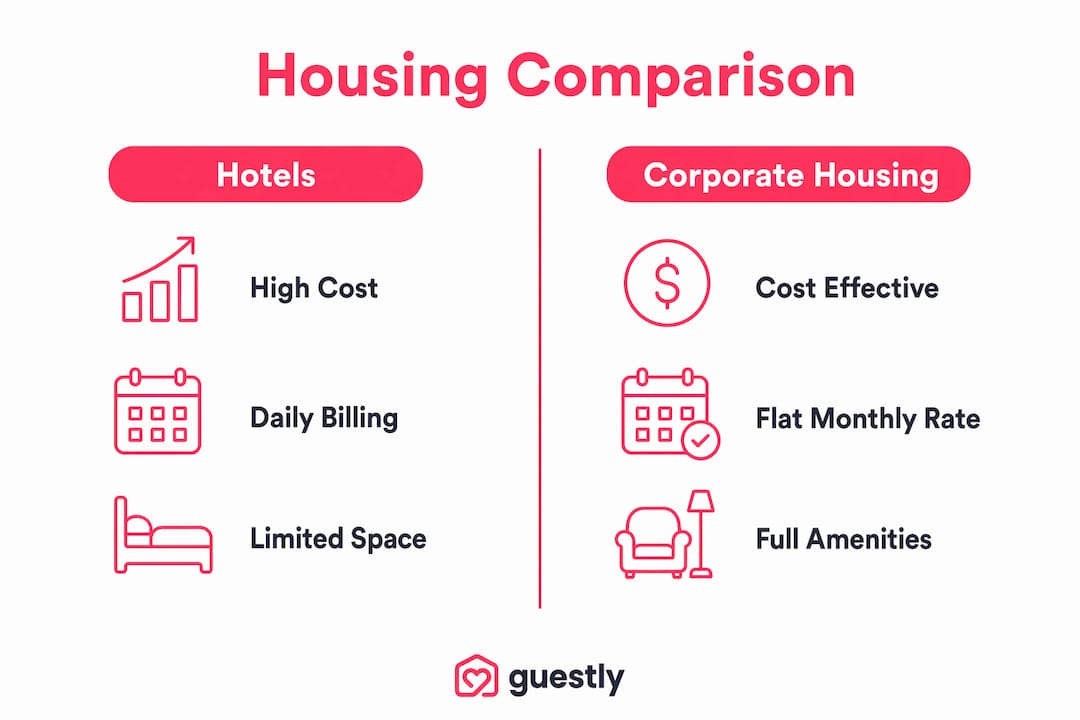
| Cost category | Hotel (30 days) | Corporate apartment (30 days) |
|---|---|---|
| Overnatting | £5,900–£9,500 | £3,400–£4,400 |
| Utilities and internet | Included but variable | Included, fixed |
| Klesvask | Charged per item | On-site, no charge |
| Parkering | Daily charge | Ofte inkludert |
| Billing structure | Daily, itemised | Monthly, single invoice |
The corporate housing market is growing at 15% annually as of 2026. That growth reflects procurement departments recognising the financial case, not just HR departments responding to employee preference.
Pro Tip: Negotiate a master service agreement with a corporate housing provider before a project begins. Fixed monthly rates and guaranteed availability reduce both cost and last-minute booking risk.
How does corporate housing improve employee wellbeing?
Hotels are built for short stays. They are not designed to support the routines that employees need to stay productive and healthy over weeks or months. The evidence on what extended hotel stays do to people is direct.
A Georgia State University study published in 2026 found that extended-stay hotel residents reported mould in 33% of cases, pest problems in 49% of cases, excessive noise in 25% of cases, and safety concerns in 22% of cases. These are not minor inconveniences. They are conditions that disrupt sleep, raise stress levels, and reduce the capacity to work effectively.
Corporate housing removes these risks by providing residential-grade accommodation. The practical differences matter:
- Kitchen access. Employees can cook, which supports diet, reduces costs, and provides a sense of routine.
- Separate living space. A living room distinct from the bedroom allows mental separation between work and rest.
- On-site laundry. Removes a logistical burden that accumulates quickly on long assignments.
- Quiet residential settings. Apartment buildings and villas are not subject to the noise levels of hotel corridors and lobbies.
- Privacy. No daily housekeeping interruptions, no shared lifts with strangers at all hours, no hotel bar noise.
“Feeling at home during a long assignment is not a luxury. It is a condition for sustained performance.”
For employees on assignments of 60 days or more, the ability to maintain a normal routine is directly linked to mental health and output quality. HR professionals who have managed extended assignments know that the first sign of a struggling employee is often a complaint about accommodation, not workload.
Pro Tip: When briefing employees before a long assignment, confirm accommodation details early. Uncertainty about where they will live adds stress before the work has even started.
How are procurement and finance driving the shift?
The decision to move from hotels to corporate housing is increasingly made by procurement and finance teams, not travel managers. Procurement now leads extended-stay lodging decisions, focusing on cost control, compliance, and measurable return on spend. That shift changes the criteria used to evaluate accommodation.
Procurement teams apply vendor consolidation logic to housing. A single corporate housing provider with a managed portfolio is easier to contract, audit, and renew than a rotating list of hotel bookings made through a travel management company. The CHPA has documented the convergence of procurement, travel, and global mobility functions as a defining trend in 2026.
The operational advantages of corporate housing for procurement are specific:
- Single vendor relationship. One contract, one point of contact, one renewal cycle.
- Fixed monthly billing. No variance in invoices, no disputed incidental charges.
- Compliance documentation. Residential leases provide clear records for expense reporting and tax purposes.
- Scalability. Furnished residential models adapt to changing assignment lengths without penalty charges or rebooking fees.
- Duty of care. Residential-grade properties meet health and safety standards that extended-stay hotels often fail to maintain.
Project-based workforce mobility in sectors including infrastructure, technology, and manufacturing is the primary driver of new demand. Traditional relocations account for 33% of corporate housing users. The remaining demand comes from project assignments, which require flexible, short-to-medium-term furnished accommodation rather than permanent relocation support.
What should HR teams look for when choosing corporate housing?
The 30-day threshold is the clearest decision point. For assignments under 30 days, a hotel is often the practical choice. For assignments of 30 days or more, corporate housing delivers better value on every measurable dimension. The GSA’s long-term lodging policy formalises this threshold for government contractors, and the same logic applies to private sector assignments.
When evaluating corporate housing options, HR teams should assess the following:
- All-inclusive pricing. Confirm that utilities, broadband, and parking are bundled. Variable pricing erodes the cost advantage.
- Residential quality standards. Screen for properties with documented maintenance records. The Georgia State University findings show that poor maintenance in extended-stay properties is common, not exceptional.
- Location relative to worksite. Proximity reduces commute time and fatigue, which directly affects productivity.
- Space for the assignment type. A single consultant needs a one-bedroom apartment. A project team of five needs a villa with shared working space and multiple bedrooms.
- Flexible lease terms. Project timelines change. The housing contract should accommodate extensions or early exits without significant penalty.
- Guest support. A managed property with a responsive operator removes the burden from the HR team when issues arise.
For detailed guidance on evaluating options, Guestlyhomes has published a practical guide on selecting corporate housing for business travel that covers these criteria in depth.
Pro Tip: Request a sample invoice before signing any corporate housing agreement. The billing structure tells you more about the provider’s transparency than any marketing material.
Key takeaways
Corporate housing is the financially and operationally superior choice for extended business assignments over 30 days, delivering measurable savings, reduced administrative burden, and better employee health outcomes than hotel accommodation.
| Punkt | Detaljer |
|---|---|
| Cost savings are substantial | Corporate housing costs 30–50% less than hotels for stays of 30 days or more. |
| Billing structure matters | Single monthly invoices replace itemised daily hotel bills, reducing finance team workload. |
| Employee health is at risk in hotels | Georgia State University found mould, pests, and safety issues in nearly half of extended-stay hotels studied. |
| Procurement now leads the decision | Finance and procurement teams drive accommodation choices based on cost control and vendor consolidation. |
| The 30-day threshold is the trigger | Assignments over 30 days warrant corporate housing; the GSA formalises this as policy for government contractors. |
The accommodation decision is a performance decision
I have spoken with HR leads who still default to hotels for 60-day assignments because it feels simpler to book. The booking is simpler. The outcome is not.
What I have seen consistently is that employees on long hotel stays start to disengage around week three. The room feels smaller. The noise accumulates. The inability to cook a proper meal or do laundry without paying for it wears on people in ways that are hard to quantify but easy to observe. By week six, you are managing a performance problem that started as an accommodation problem.
The financial case for corporate housing is clear enough on its own. The wellbeing case makes it definitive. What I think decision-makers underestimate is the retention signal. Employees notice when a company books them into a well-managed apartment rather than a budget hotel corridor. It communicates that the organisation takes their time seriously.
The emerging shift I watch closely is the move toward flexible leasing aligned with project timelines. Hybrid work and project-based mobility mean that assignment lengths are less predictable than they were five years ago. The best corporate housing providers now offer terms that flex with project duration. That flexibility is worth more than a slightly lower nightly rate from a hotel chain.
My recommendation is direct: if your organisation runs assignments longer than 30 days with any regularity, a master service agreement with a managed corporate housing provider is not optional. It is the standard for well-run extended assignment programmes. The companies that have made this shift are not going back.
— Joakim
Guestlyhomes: corporate accommodation that performs
Guestlyhomes operates a portfolio of fully managed villas and apartments across Sweden, built for professionals, project teams, and executives on extended assignments.
Every property is all-inclusive, fully furnished, and managed to a consistent standard. Billing is straightforward. Support is responsive. The properties are designed for people who need their accommodation to work without supervision. For teams requiring space and privacy, the modern lake view villa is a strong example of what residential-grade corporate accommodation looks like in practice. HR teams and project managers can also review how to secure long-term accommodation for business stays to plan assignments with confidence.
FAQ
Hva er bedriftsboliger?
Corporate housing is a fully furnished residential apartment or home rented for extended business stays, typically 30 days or more. It includes utilities, broadband, and household amenities in a single monthly rate.
How much cheaper is corporate housing than a hotel?
Corporate housing costs 30–50% less than equivalent hotel stays for assignments over 30 days, saving companies £3,900 to £6,300 per employee on a 90-day assignment.
When should a company choose corporate housing over a hotel?
The 30-day threshold is the standard trigger. The GSA Long Term Lodging programme defines stays over 30 nights as requiring residential units rather than hotels, and the same logic applies in the private sector.
What are the health risks of extended hotel stays?
A 2026 Georgia State University study found that 49% of extended-stay hotel residents reported pest problems, 33% reported mould, and 25% reported excessive noise. Corporate housing in managed residential properties avoids these conditions.
How does corporate housing simplify procurement?
Corporate housing consolidates rent, utilities, and internet into one monthly invoice, replacing the itemised daily billing of hotels. That structure reduces finance reconciliation work and supports vendor consolidation for procurement teams.
Anbefales
- Corporate Housing vs Hotels 2026 – Guestly Homes
- Corporate Housing vs Airbnb: What’s the Real Difference for Your Stay? – Top 7 Solutions 2026 – Guestly Homes
- Corporate housing vs airbnb: a 2026 overview – Guestly Homes
- Den ultimate guiden til møblerte leiligheter for bedriftsboliger 2025 - Guestly Homes