


TL;DR:
- Executive relocation services encompass comprehensive support for senior leaders, including tax planning, family integration, and legal compliance, beyond mere moving logistics. Proper planning involves three phases—evaluation, preparation, and execution—to avoid costly mistakes and ensure a smooth transition. High-end relocation packages include full-service moving, family support, legal protections, secure transport, and temporary housing matching executive standards.
Executive relocation services are defined as bespoke, advisory-led support packages that manage the full complexity of moving a senior leader from one location to another. They go well beyond hiring a removal van. Explaining relocation services for executives means covering tax planning, family integration, housing, legal compliance, and security, all coordinated before the first box is packed. Executive-tier packages in the US typically range from $55,000 to over $100,000. That figure reflects the true scope of what is required at this level, and it sets the standard for what you should expect and negotiate.
What does explaining relocation services for executives actually cover?
The industry term for this discipline is corporate relocation management, and it operates at two distinct levels: standard employee moves and executive-tier moves. The difference is not just budget. It is the depth of advisory input, the number of stakeholders involved, and the consequences of getting it wrong.
At the executive level, the real challenge is not logistics. The core difficulty lies in managing high-stakes strategic matters such as residency tax implications and spousal career transitions, which require months of careful evaluation. A removal company can move your furniture in a day. Resolving your tax residency status, securing your family’s schooling, and protecting your employment contract takes considerably longer.
Understanding executive moving services means recognising that the process is as much about risk management as it is about physical relocation. Every decision made in the early weeks has financial and legal consequences that can follow you for years.
What phases constitute an effective executive relocation process?
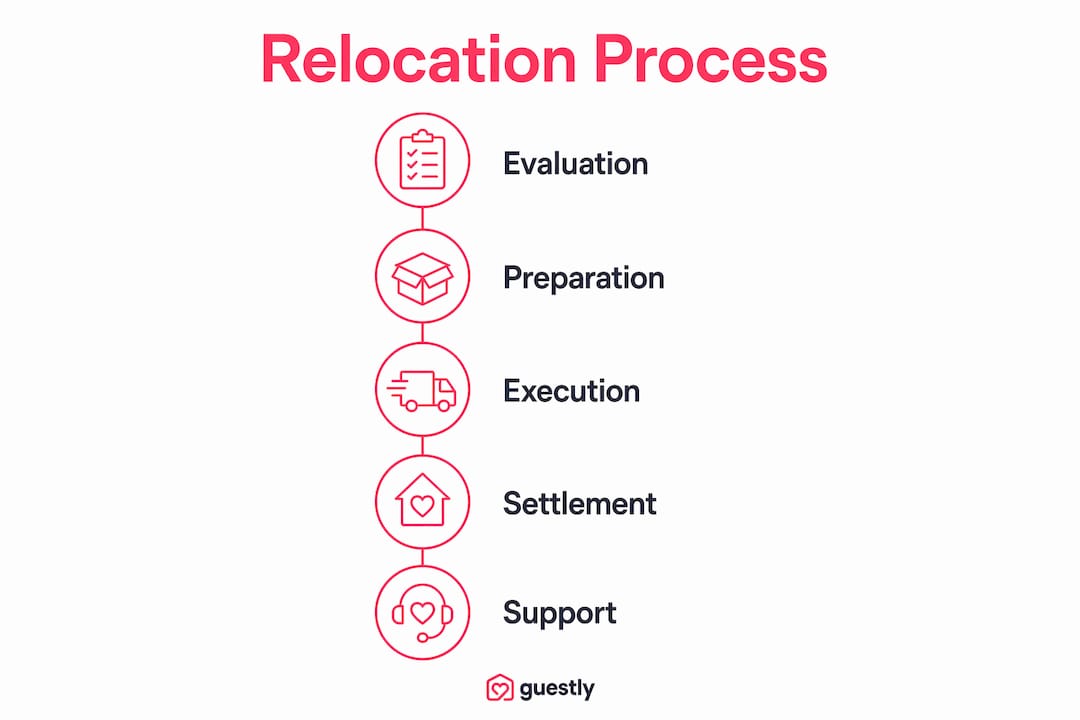
A well-run executive relocation follows a structured three-phase framework: Evaluation, Preparation, and Execution. Each phase has a distinct purpose, and compressing or skipping any one of them is the most common source of expensive regrets among senior leaders post-relocation.
-
Evaluation (3–6 months before the move). This phase assesses career fit, family readiness, and financial implications. You examine whether the role justifies the disruption, whether your partner’s career can survive the move, and whether the destination country’s tax regime works in your favour. This is the phase most executives underestimate.
-
Preparation (1–3 months before the move). This phase covers the legal and financial groundwork. Tax residency documentation, immigration filings, school enrolment, and property decisions all belong here. Negotiating tax protections before residency is established is critical, because tax consequences solidify quickly once you cross a border.
-
Execution (move day and the weeks following). This phase manages the physical move, temporary housing, and settling-in services. It is the most visible phase but the least strategically complex. A good relocation provider handles it without requiring your attention.
Pro Tip: Book your temporary housing before your permanent address is confirmed. Gaps between the two are the single most disruptive event in any executive move, and they are entirely avoidable with early planning.
Failing to dedicate sufficient time to the Evaluation and Preparation phases is the primary reason senior leaders report dissatisfaction after relocating. The Execution phase cannot compensate for decisions that were not made earlier.

Which core services should executives expect from premium relocation offerings?
Corporate relocation assistance for leaders at the executive level is a concierge-level service. It anticipates needs before you articulate them and removes friction before you encounter it. The following are the components that define a premium offering.
- Full-service moving. Custom crating for art, wine, and high-value items. Secure, insured transport. White-glove unpacking and installation at the destination.
- Family support. Spousal career counselling, CV preparation, and introductions to professional networks in the new location. School search assistance and extended temporary housing for 3–6 months to allow families to settle without pressure.
- Housing solutions. Temporary furnished accommodation that meets executive standards from day one. Home-sale support, including valuation, staging, and agent coordination for your departing property.
- Financial and legal protections. Tax gross-up coverage, which ensures that any relocation benefit paid to you is not eroded by income tax. Return-trip allowances for family visits during the transition period.
- Security and privacy. Concierge-level executive relocation includes secure transport, estate management, and private orientation services. These are not luxuries. They are practical responses to the visibility that comes with seniority.
Pro Tip: Ask your provider for a written service-level agreement that specifies response times. A premium relocation service should be reachable within two hours for any urgent matter during the move window.
The benefits of relocation for executives are only realised when the full package is in place. A partial service, one that covers logistics but not family support or tax protection, creates gaps that cost more to fix than they would have cost to prevent.
How to negotiate executive relocation packages effectively
Executive relocation packages are highly negotiable components of employment contracts. Most executives accept the first offer. That is a significant error, because the gap between a standard offer and a fully negotiated package can represent tens of thousands of pounds in real financial protection.
- Include relocation terms in the employment agreement itself. A verbal commitment from HR is not enforceable. Every benefit, from gross-up coverage to return-trip allowances, must appear in writing before you sign.
- Negotiate tax gross-up clauses explicitly. Without this clause, a $20,000 relocation benefit can become a $13,000 benefit after tax. The gross-up clause ensures the company covers the tax liability, not you.
- Secure spousal and family support in writing. Career counselling for a partner and school search assistance are standard at the executive tier, but they are often omitted from initial offers. Request them directly.
- Submit itemised professional quotes to HR. Detailed, itemised relocation estimates submitted to HR accelerate approvals and enable direct billing arrangements. This removes the burden of paying upfront and claiming back.
- Insist on hardship and return-home clauses. Executives should include contract clauses covering hardship and return-home options to manage unforeseen role changes within 12–18 months. Restructuring, leadership changes, and project cancellations are real risks.
Pro Tip: Engage an executive employment solicitor before signing any relocation agreement. The cost of a two-hour consultation is negligible compared to the financial exposure of an unprotected contract.
Executive relocation packages are not fixed. Firm contract language is the difference between a protected transition and a costly one.
What practical steps ensure a smooth transition during and after the move?
The Execution phase is where planning meets reality. Even with a well-negotiated package and a thorough Preparation phase, the days around the physical move require active management. The following steps reduce disruption and protect your performance.
- Plan discreet transport from the outset. Security and visibility concerns during moves require early planning for discreet arrivals, secure transport, and private home tours. Standard corporate policies frequently overlook this. Specify your requirements to your relocation provider before move day.
- Confirm temporary housing standards in advance. Your temporary accommodation should match the standard of your permanent home. Review the property in person or via a private tour before committing. For a practical framework on what to look for, the executive housing must-haves guide covers the key criteria clearly.
- Coordinate local orientation for your family. Arrange a structured introduction to the new area: schools, medical facilities, transport, and social infrastructure. This is not a sightseeing exercise. It is a practical step that accelerates family integration and reduces the domestic pressure that affects professional performance.
- Protect your working routine during the transition. Block your diary for the two weeks around the move. Delegate where possible. Relocation stress is real, and its effects on decision-making are measurable. A calm, managed transition protects both your wellbeing and your professional output.
- Maintain a single point of contact with your relocation provider. Multiple contacts create confusion. One coordinator who knows your full situation handles issues faster and with less friction.
For a step-by-step approach to the logistics of the move itself, the relocation housing guide provides a clear, practical sequence that works at the executive level.
Key takeaways
Executive relocation management succeeds when advisory planning, tax protection, family support, and quality temporary housing are treated as equally important components of a single coordinated process.
| Punkt | Detaljer |
|---|---|
| Define the full scope early | Executive relocation covers tax, legal, family, and housing, not just physical logistics. |
| Follow the three-phase framework | Evaluation, Preparation, and Execution each require dedicated time and cannot be compressed. |
| Negotiate every term in writing | Tax gross-up clauses, family support, and hardship provisions must appear in the signed contract. |
| Submit itemised quotes to HR | Detailed estimates enable direct billing and remove the financial burden from the executive. |
| Match temporary housing to your standard | Accommodation during the transition period should meet the same criteria as your permanent home. |
Why I treat executive relocation as an advisory project, not a logistics exercise
The most consistent mistake I see executives make is treating relocation as a moving problem. They focus on the date, the removal company, and the new address. They leave the hard questions, tax residency, spousal career continuity, contract protections, until the last possible moment, when the options have narrowed and the costs have risen.
The executives who transition well treat the process as a strategic project from the first conversation. They engage advisors early, they negotiate firmly, and they give the Evaluation phase the time it deserves. They also accept that family stability is not a soft concern. It is a direct input to professional performance. A partner who is professionally adrift or children who are struggling in a new school create a level of domestic pressure that no amount of professional success can offset.
The Nordic approach to these transitions, which values thoroughness, calm planning, and long-term thinking over speed, is genuinely instructive here. There is no prize for moving fast. There is a significant cost for moving unprepared.
If you are considering a senior relocation, the single most valuable thing you can do is slow down the Evaluation phase. Ask harder questions about fit, family, and financial protection before you agree to anything. The Execution phase will take care of itself if the groundwork is solid.
— Joakim
Premium housing for executives in transition with Guestlyhomes
Guestlyhomes operates fully managed, high-standard properties across Sweden and the Nordics, designed specifically for professionals and executives on extended assignments. Every property is furnished, maintained, and supported to a consistent five-star standard, with flexible terms that suit the unpredictable timelines of senior relocations.

Whether you need a one-bedroom executive suite for a solo assignment or a luxury villa with lake views for a family transition, Guestlyhomes provides accommodation that performs quietly in the background so you can focus on what matters. Stays range from 10 nights to 12 months. One point of contact. No friction.
FAQ
What is included in an executive relocation package?
Executive relocation packages typically include home-sale support, spousal career counselling, school search assistance, tax gross-up coverage, temporary housing, and secure transport. Package values at the executive tier range from $55,000 to over $100,000.
How long does an executive relocation take to plan properly?
The Evaluation phase alone requires 3–6 months. Compressing this timeline is the most common cause of post-relocation regret among senior leaders.
What is a tax gross-up clause and why does it matter?
A tax gross-up clause requires the employer to cover the income tax liability on any relocation benefit paid to the executive. Without it, a significant portion of your relocation allowance is lost to tax.
Should I negotiate my relocation package before signing my contract?
Yes. Executive relocation terms are negotiable and must be secured in writing before signing. Verbal commitments from HR carry no legal weight.
What temporary housing standard should executives expect during a move?
Temporary housing should match the standard of the executive’s permanent accommodation, with furnished interiors, reliable workspace, and flexible lease terms covering the full transition period of 3–6 months.
Anbefales
- The Ultimate Guide to Executive Apartments for Professionals 2025 – Guestly Homes
- Top Employee Relocation Housing Services – Expert Comparison 2025 – Guestly Homes
- Den ultimate guiden til bedriftsboliger for profesjonelle 2025 - Guestly Homes
- How to Prepare Homes for Executives: A Step-by-Step Guide – Guestly Homes