


TL;DR:
- Demand for corporate housing in Mälardalen is driven by industrial expansion, energy projects, and workforce mobility requiring flexible accommodation. Property owners who adapt to this growth benefit from stable income, higher yields, and longer-term tenants rather than traditional short-term rentals. Emerging trends like smart technology, hybrid work, and longer project durations will further increase demand and influence property upgrade priorities.
Demand for corporate housing in Mälardalen is defined by a structural shift in how businesses accommodate mobile workforces during extended assignments. The region, which includes Västerås, Eskilstuna, and Örebro, is experiencing sustained industrial expansion across the energy, infrastructure, and consulting sectors. This growth is creating a consistent and growing need for flexible, fully furnished accommodation that hotels simply cannot match at scale. 83% of business travellers prefer corporate housing over hotels for long stays, citing productivity and well-being as the primary reasons. For property owners and investors in the region, understanding why demand for corporate housing is growing across Mälardalen is no longer optional. It is a prerequisite for making sound asset decisions.
Why demand for corporate housing is growing across mälardalen
Mälardalen’s economic identity is built on heavy industry, advanced manufacturing, and energy infrastructure. Västerås, home to ABB and a long-standing hub for power technology, has seen a marked increase in project-based workforce activity as Sweden accelerates its transition to renewable energy. Infrastructure upgrades, grid modernisation contracts, and large-scale consulting assignments are bringing specialised workers into the region for months at a time, not days.

Industrial and infrastructure projects of this scale require workers on extended assignments, and that sustained presence creates a direct need for quality corporate housing. A project team rotating through Västerås over six months cannot be accommodated efficiently in a hotel. The costs escalate, the environment becomes unsustainable, and productivity suffers.
The key industrial drivers currently shaping corporate housing demand in Mälardalen include:
- Energy sector contracts. Sweden’s push toward net-zero has accelerated investment in wind, solar, and grid infrastructure across the Mälardalen corridor. Engineering firms and specialist contractors are deploying teams for multi-month assignments.
- Advanced manufacturing expansion. Companies in precision engineering and automotive supply chains are scaling operations in Eskilstuna and Köping, requiring skilled workers from across Sweden and Europe.
- Consulting and IT project rotations. Large public sector and corporate IT transformation projects are bringing consultants into the region on rolling contracts, often three to twelve months in duration.
- Infrastructure development. Rail upgrades and logistics hub construction in the region are creating sustained demand for project accommodation from construction and civil engineering firms.
Pro Tip: Track public procurement notices from Swedish Transport Administration (Trafikverket) and regional energy authorities. Contract award announcements signal incoming workforce deployments and, by extension, corporate housing demand spikes in specific postcodes.
Property owners who monitor these project timelines gain a clear advantage. When a major contract is awarded in Västerås, the accommodation demand follows within weeks.
How does corporate housing compare to hotels for extended stays?
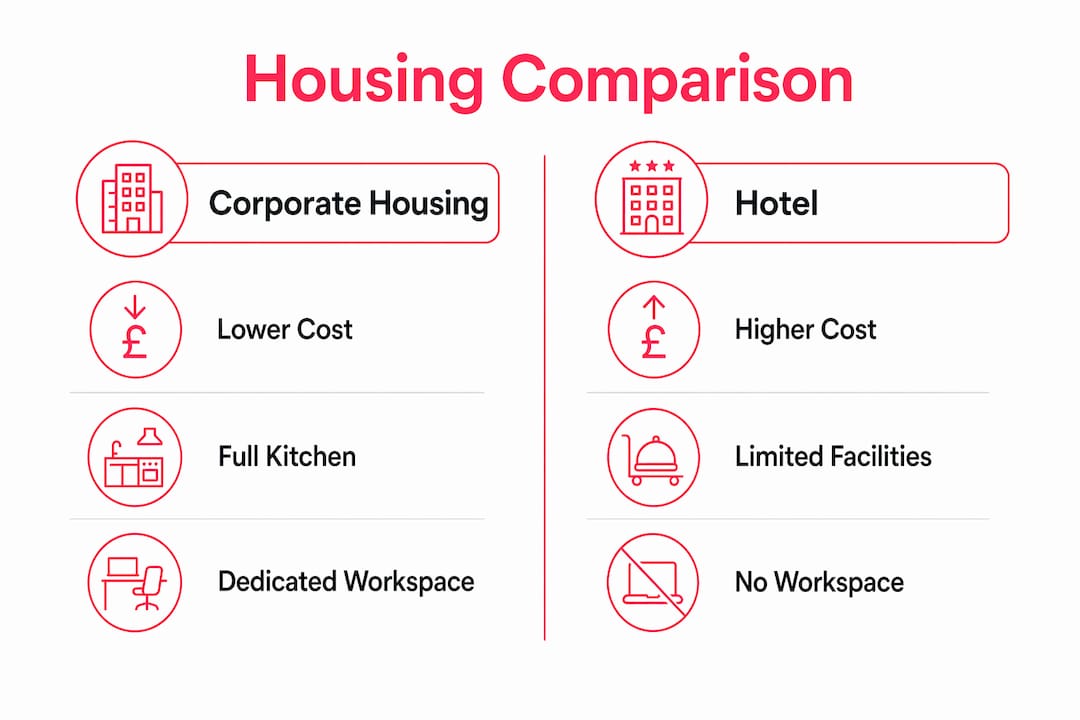
Corporate housing is defined as fully furnished, self-contained accommodation provided on flexible lease terms for business travellers and project teams. The industry term distinguishes it from both traditional long-term rentals and short-term hotel stays. For stays exceeding 30 days, the financial and operational case for corporate housing over hotels is clear.
Corporate housing saves companies around 40% or more on accommodation costs for extended stays. The average monthly cost of corporate housing ranges from approximately $2,500 to $4,500 including utilities and internet, compared to hotel rates that compound rapidly over the same period. That cost differential, across a team of four engineers on a six-month project, represents a material budget saving.
The productivity argument is equally compelling. Teams in corporate housing reported 27% faster project completion compared to those in hotel environments. The reason is straightforward. A private kitchen, a dedicated workspace, and a stable living routine allow professionals to maintain the same discipline they have at home. Hotels interrupt that rhythm with noise, shared spaces, and the absence of domestic normalcy.
| Funksjon | Bedriftsboliger | Hotell |
|---|---|---|
| Monthly cost (per person) | Lower, bundled utilities | Higher, costs compound daily |
| Kitchen facilities | Full kitchen included | Absent or limited |
| Dedicated workspace | Standard in quality units | Inconsistent, often shared |
| Fleksibilitet i leieavtalen | Month-to-month, project-aligned | Nightly, limited long-stay terms |
| Privacy and space | Private apartment or villa | Single room, shared corridors |
| Employee well-being | Stable routine, home-like setting | Disrupted routine, transient feel |
| Early departure options | Available in most agreements | Penalties common |
Long-term hotel stays lack full kitchen and laundry facilities, which adds hidden costs through daily meal expenses and external laundry services. Corporate housing bundles these utilities, making the total cost of occupancy predictable and lower.
Pro Tip: If you own a property in Mälardalen and are considering the corporate market, prioritise a dedicated desk, fast broadband, and a fully equipped kitchen above all other upgrades. These three features are the primary decision criteria for corporate bookers.
What opportunities does this create for property owners in mälardalen?
The corporate housing demand rising in Mälardalen translates directly into tangible advantages for property owners who position their assets correctly. The most significant benefit is income stability. Corporate tenants typically sign medium to long-term leases, which reduces turnover and the associated costs of re-letting, cleaning, and marketing.
Property owners benefit from stable income and reduced vacant periods when they adapt their rentals to corporate housing demand with flexible lease terms and all-inclusive offerings. A property that might sit empty between short-term lets in a quieter tourist season becomes a consistently occupied asset when positioned for project teams and consultants.
The operational profile of corporate tenants also protects asset value. Professionals on work assignments treat accommodation with care. They are not weekend visitors. They are residents with a professional reputation to maintain, and their employers often hold them to conduct standards that protect the property.
For investors considering the Mälardalen market, the following factors strengthen the investment case:
- Predictable demand cycles. Industrial project timelines are publicly available and often span years. This gives investors visibility into future occupancy that consumer short-term rental markets cannot offer.
- Lower management intensity. Longer tenancies mean fewer changeovers, less wear, and more predictable maintenance schedules.
- Premium pricing justification. Fully furnished, business-ready properties command higher monthly rates than unfurnished equivalents. The all-inclusive model is standard in corporate housing and supports stronger yield.
- Reduced vacancy risk. The benefits of corporate housing for companies are well established, meaning demand is driven by business necessity rather than discretionary spending. That makes it more resilient to consumer sentiment shifts.
Investors entering the Mälardalen market now are positioning ahead of a demand curve that is still building. The industrial projects currently underway will generate workforce accommodation needs for years, not months.
What future trends will shape corporate housing in mälardalen?
The structural drivers behind corporate housing demand in Mälardalen are long-term. However, several emerging trends will shape how that demand expresses itself over the next three to five years. Property owners who understand these shifts will be better placed to adapt their offerings and protect their returns.
-
Hybrid and remote work integration. Remote work trends are increasing the need for functional home-office setups within corporate accommodation. Professionals on project assignments increasingly expect a workspace that supports video calls, document management, and focused work without leaving the property. This raises the specification bar for corporate housing providers.
-
Smart home technology adoption. IoT and centralised booking systems are enhancing the attractiveness and economic viability of corporate housing properties. Smart locks, automated check-in, and energy monitoring reduce operational costs and improve the guest experience. Properties without these features will face growing pressure from those that have them.
-
Longer average assignment durations. As companies invest in complex infrastructure and transformation projects, the average length of workforce deployments is extending. This favours corporate housing over hotels even more decisively and supports the case for medium-term lease structures.
-
Policy and infrastructure investment. Sweden’s national infrastructure plan and the EU’s green transition funding are directing capital into the Mälardalen region. Each new project announcement is a forward indicator of accommodation demand. Property owners who track regional planning decisions gain early visibility into where demand will concentrate.
-
Increased competition from purpose-built operators. As the corporate housing market matures, professionally managed operators are entering the Mälardalen market. Individual property owners who do not professionalise their offering risk losing corporate clients to operators who provide consistent, hotel-grade standards across their portfolio.
The overarching direction is clear. Corporate housing in Mälardalen is moving from a niche accommodation category to a mainstream business service. Property owners who treat it as such, and invest accordingly, will capture the strongest returns.
Key takeaways
Corporate housing demand in Mälardalen is driven by industrial expansion, energy investment, and workforce mobility, creating a durable and growing opportunity for property owners who position their assets correctly.
| Punkt | Detaljer |
|---|---|
| Industrial growth is the primary driver | Energy, manufacturing, and consulting projects in Västerås and Eskilstuna are generating sustained corporate housing demand. |
| Cost savings are significant | Corporate housing costs companies 40% or more less than hotels for stays exceeding 30 days. |
| Productivity gains reinforce demand | Teams in corporate housing complete projects 27% faster, making it a business performance decision, not just a cost one. |
| Property owners gain income stability | Corporate tenants sign longer leases, reducing turnover and protecting asset value over time. |
| Future trends favour early movers | Smart technology, hybrid work requirements, and longer project durations will raise the specification bar for corporate properties. |
Mälardalen’s corporate housing market: my honest assessment
I have watched the Mälardalen market closely for several years, and what strikes me most is how underserved it remains relative to the scale of industrial activity taking place. Västerås alone hosts some of Sweden’s most significant energy and engineering operations, yet the quality of available corporate accommodation has not kept pace with the volume of project teams arriving in the region.
The opportunity for property owners here is genuine, but it requires a shift in mindset. Many owners still think in terms of short-term tourist lets or traditional long-term tenancies. Corporate housing sits between those two models and, when managed well, outperforms both on yield and stability. The key is understanding what corporate clients actually need: reliable broadband, a proper workspace, a functional kitchen, and a lease that aligns with their project timeline. These are not luxury requirements. They are baseline expectations.
What I find most compelling about Mälardalen specifically is the long-term nature of the industrial investment underway. This is not a short cycle. Sweden’s energy transition and infrastructure modernisation programmes are decade-long commitments. That means the demand for quality temporary housing solutions in the region is not going to recede. If anything, it will intensify as more contracts are awarded and more specialist teams are deployed.
My advice to property owners is straightforward. Do not wait for the market to mature before you act. Position your property now, invest in the right amenities, and consider working with a professional operator who understands corporate clients. The window to enter ahead of the competition is still open, but it will not stay open indefinitely.
— Joakim
How Guestlyhomes supports corporate housing in mälardalen
Guestlyhomes operates fully managed, high-standard properties across Sweden, with a growing portfolio in Mälardalen designed specifically for professionals, project teams, and executives on extended assignments.
Every Guestlyhomes property is furnished to a consistent standard, with fast broadband, dedicated workspaces, and fully equipped kitchens included as standard. Flexible lease terms align with project timelines, removing the administrative friction that corporate bookers and HR teams face with traditional rentals. For property owners in the region, Guestlyhomes offers both revenue share and fixed-lease models, providing either performance-driven returns or predictable monthly income. Explore the Nordic Comfort apartment as a starting point, or browse the full portfolio at Guestlyhomes to find the right fit for your property or your team.
FAQ
What is corporate housing and how does it differ from a hotel?
Corporate housing is defined as fully furnished, self-contained accommodation provided on flexible lease terms for business travellers and project teams. Unlike hotels, it includes full kitchen facilities, dedicated workspaces, and private living areas, making it suited to stays of 30 days or more.
Why is corporate housing demand growing specifically in mälardalen?
Mälardalen’s growth in energy investment, advanced manufacturing, and infrastructure development is bringing specialist workers into cities like Västerås and Eskilstuna on multi-month assignments. This sustained workforce mobility is the primary driver of rising corporate housing demand in the region.
How much can companies save by choosing corporate housing over hotels?
Companies save around 40% or more on accommodation costs for stays exceeding 30 days when using corporate housing instead of hotels. The average monthly cost of corporate housing, including utilities and internet, is significantly lower than equivalent hotel rates over the same period.
What should property owners do to attract corporate tenants in mälardalen?
Property owners should prioritise fast broadband, a dedicated workspace, and a fully equipped kitchen as the baseline specification. Flexible, project-aligned lease terms and an all-inclusive pricing model are also standard expectations among corporate clients and their HR bookers.
How does working with a managed operator benefit property owners?
A managed operator such as Guestlyhomes handles guest relations, maintenance coordination, and lease administration, reducing the time and effort required from the owner. This model also provides access to an established corporate client base, improving occupancy rates and income predictability.