

|
Preparare il lettore Trinity Audio...
|
In breve:
- Serviced apartments provide a streamlined, fully furnished alternative to hotels, reducing administrative complexity for corporate travel. They offer private, well-equipped spaces with consistent standards, located near major Swedish business hubs to enhance employee performance and wellbeing. Their single-contract, consolidated billing simplifies management and increases operational efficiency across project cycles.
Hotels have long been the default choice for corporate travel, but that assumption is being quietly dismantled by project managers and HR teams across Sweden. The reality is that booking a block of hotel rooms for a multi-week assignment often creates more administrative complexity than it solves. Fragmented invoicing, limited space, and the absence of a proper workspace quickly erode the perceived convenience. This guide explains why an increasing number of corporate bookers are turning to serviced apartments, and how that shift translates into better performance, lower costs, and far fewer complaints from the teams on the ground.
Indice dei contenuti
- Serviced apartments: What they offer for corporate assignments
- Why operational simplicity matters to bookers
- Employee experience: Boosting performance with better accommodations
- Location and reliability: The edge for Swedish corporate projects
- The hidden impact: Why simplicity is the new productivity
- Explore your serviced apartment options in Sweden
- Domande frequenti
Punti di forza
| Punto | Dettagli |
|---|---|
| Streamlined booking and billing | Serviced apartments minimise HR workload with single-contract management and unified invoicing. |
| Better employee performance | Employees perform better with the comfort, privacy, and space provided by serviced apartments. |
| Prime business locations | Most serviced apartments are located near Swedish business hubs, offering maximum convenience. |
| Flexibility for teams | Options for multi-bedroom and team stays make scaling project assignments simple. |
Serviced apartments: What they offer for corporate assignments
Before weighing up the options, it helps to be clear about what a serviced apartment actually is. A serviced apartment is a fully furnished property, managed to a consistent standard, that provides the amenities of a home alongside the reliability of a hospitality operator. It is not a private rental found through a listings platform, nor is it a standard hotel room with a kitchenette bolted on. It is a purpose-designed environment for professional stays.
For Swedish business travel in particular, serviced apartments have become a compelling alternative. They are typically located close to commercial districts and shared spaces near business hubs like Stockholm and Gothenburg, meaning teams are never far from their project sites, clients, or transport connections.
The standard amenities available in a well-managed serviced apartment include:
- Full kitchen with hob, oven, fridge, and dishwasher, allowing employees to self-cater and maintain their routines
- Dedicated workspace with a desk, ergonomic seating, and reliable high-speed internet
- Separate bedrooms providing genuine privacy, rather than a single room where sleeping and working share the same square metres
- Laundry facilities, either in-unit or on-site, removing the need to find a laundrette during a long stay
- Weekly housekeeping maintaining cleanliness to a professional standard throughout the assignment
- Communal or social spaces in larger properties, supporting team cohesion during shared projects
A persistent myth is that serviced apartments are only suitable for leisure travel or very long placements. That is simply not accurate. Many operators offer stays from as short as ten nights, making them viable for a wide range of assignment types. You can see a broad range of examples of serviced apartments for business stays to understand just how versatile this format has become.
“A serviced apartment is not a compromise between a hotel and a rental. It is a distinct product, designed specifically for people who need to live and work effectively in a place that is not their permanent home.”
Pro Tip: When evaluating options, always confirm whether the property is managed by a professional operator or simply listed by a private landlord. The management model determines the consistency of the experience your team receives.
Why operational simplicity matters to bookers
Once you understand what serviced apartments provide, it becomes easier to see how they make a booker’s job genuinely simpler. The administrative burden of corporate accommodation is often underestimated. Booking multiple hotel rooms across a long project means multiple booking references, multiple invoices, and often multiple points of contact when something needs to change.
Serviced apartments consolidate all of that. A single contract covers the entire team. One invoice arrives at the end of the billing period. Adjustments, extensions, and additional placements are handled through one interface. This is why corporate bookers prefer serviced apartments for operational simplicity via single contracts and billing, reducing HR admin compared to fragmented options or hotels.
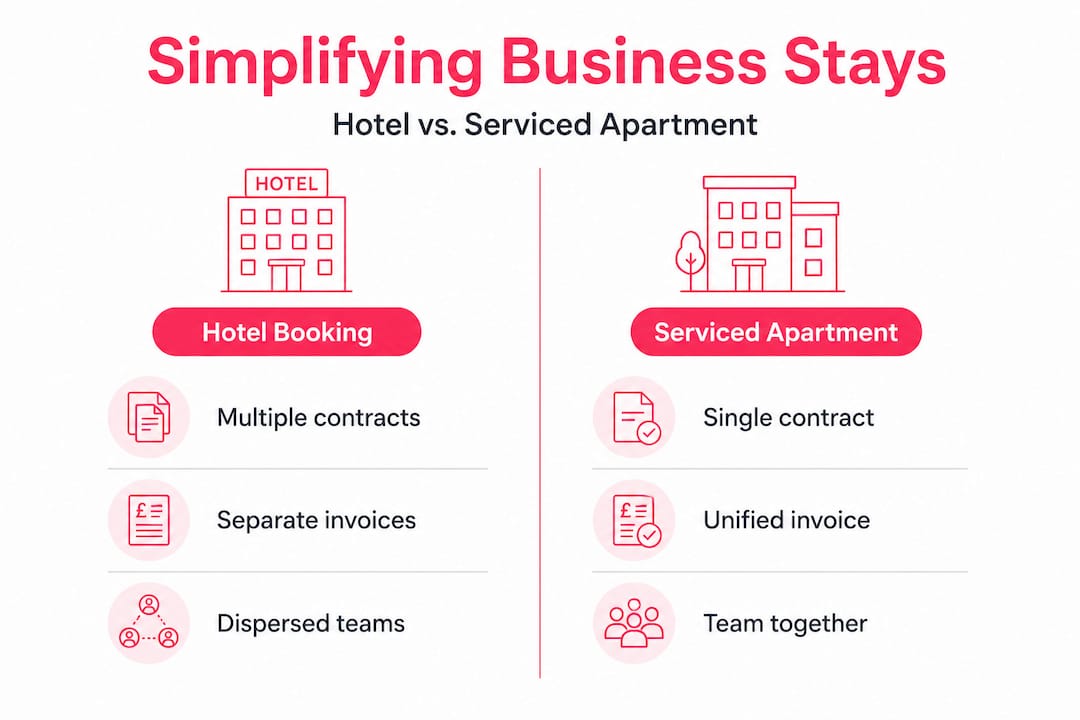
The practical impact on a project manager’s workload is significant. Consider the difference in these two scenarios:
| Task | Hotel booking process | Serviced apartment process |
|---|---|---|
| Initial booking | Multiple rooms, multiple references | Single contract, one confirmation |
| Invoicing | Separate folios per room or per employee | Single consolidated invoice |
| Changes or extensions | Each room re-negotiated individually | One amendment to existing agreement |
| Support queries | Front desk handles issues per guest | Dedicated operator manages all issues |
| Cost approval | Line-by-line review of multiple charges | Single approval per billing period |
| Onboarding new team members | Separate booking required | Add to existing arrangement |
The reduction in approval bottlenecks alone saves meaningful time across a project. When HR managers are not chasing down expense receipts or reconciling multiple hotel folios, they can focus on work that actually moves the project forward. For a broader look at how this stacks up, reviewing a corporate housing options comparison provides useful context.
Pro Tip: Request a sample invoice from any serviced apartment operator before committing. A well-structured single invoice is a sign that the operator has genuinely built their service around corporate clients, not just adapted a leisure product for business use.
It is also worth noting that streamlined corporate services in related sectors follow the same logic: consolidation reduces errors and improves accountability. The same principle holds true for accommodation. You can explore the direct business impacts of corporate housing to see how these operational gains compound over a full project cycle.
Employee experience: Boosting performance with better accommodations
Having seen the organisational benefits for bookers, it is equally important to understand what serviced apartments mean for the individuals actually staying in them. The accommodation choice a company makes for its project teams is not just a procurement decision. It is a direct input into employee performance and wellbeing.
The link is straightforward. When an engineer or consultant finishes a demanding day on site and returns to a cramped hotel room where the only seating is the bed, their ability to decompress, prepare for the next day, and maintain their routines is compromised. Over weeks, that accumulates into fatigue, lower morale, and reduced output.
Serviced apartments address this in several concrete ways:
- Private sleeping environment: Separate bedrooms mean employees are not working and sleeping in the same space. This separation improves sleep quality and reduces the mental blurring between work and rest time.
- Self-catering capability: Access to a full kitchen allows people to eat according to their own schedule and dietary preferences, rather than being dependent on hotel restaurant hours or expensive takeaways every evening.
- Space to move and decompress: A living area, a proper sofa, and space to spread out physically make a significant difference after ten or twelve hours on a project site.
- Consistent routine: The ability to maintain habits, whether that is a morning coffee at a particular time or a regular evening meal, stabilises mental health during long assignments away from home.
The reasons professionals choose serviced apartments for work stays repeatedly return to these quality-of-life factors, and essential serviced apartment amenities for business stays consistently rank space, kitchen access, and laundry as the most valued features.
Here is a direct comparison of the employee experience across the two formats:
| Fattore | Hotel room | Serviced apartment |
|---|---|---|
| Sleep quality | Often disrupted by corridor noise | Quiet, private bedrooms |
| Meal flexibility | Dependent on restaurant or room service | Full self-catering available at any time |
| La privacy | Minimal, shared corridors and facilities | Private entrance and living spaces |
| Work and rest separation | Same room for both | Distinct spaces for working and relaxing |
| Lavanderia | Expensive hotel laundry or offsite | In-unit or on-site laundry included |
| Team interaction | Isolated in individual rooms | Shared communal areas support team cohesion |
Teams staying in serviced apartments consistently report fewer complaints about accommodation during business assignments, which in turn reduces the number of support issues a project manager has to address. Fewer complaints means less firefighting, and less firefighting means more productive management time.
Location and reliability: The edge for Swedish corporate projects
Beyond the apartment itself, the right location and a dependable standard of service are what separate a well-managed serviced apartment from a poorly selected private rental. For Swedish corporate projects specifically, both of these factors carry significant weight.
Most professional serviced apartment operators in Sweden position their properties close to major commercial districts, transport links, and infrastructure. Properties near business hubs in Stockholm and Gothenburg are a deliberate feature of the serviced apartment market, reflecting the needs of project teams who cannot afford long commutes eating into their working day.
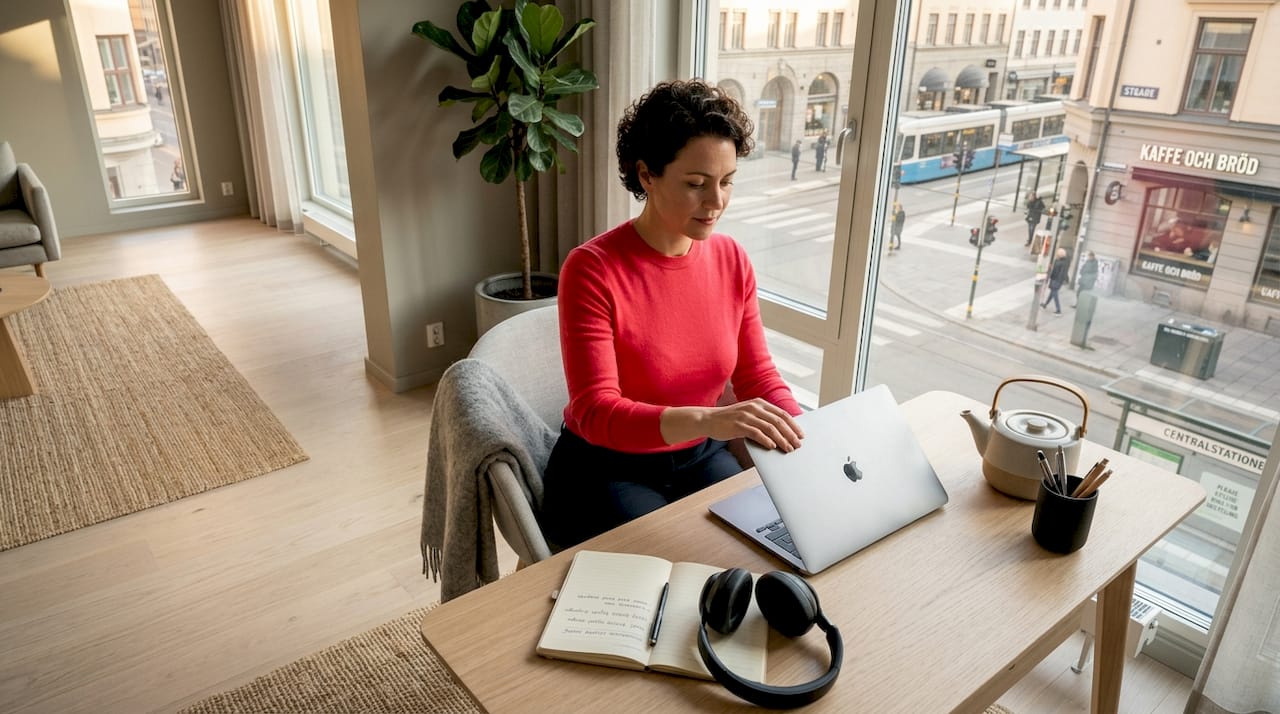
For teams operating in western Sweden, for instance, proximity to industrial facilities, port operations, or engineering sites is a practical necessity. Options such as corporate apartments in Västerås demonstrate how the market has developed to serve projects outside the major metropolitan centres as well, ensuring that teams working in mid-sized Swedish cities are not forced to choose between a distant hotel and an unmanaged private rental.
Key location and reliability factors to consider include:
- Proximity to project sites and major transport nodes, reducing commute times and logistical friction
- Consistent standards across multiple stays, so employees know what to expect whether they are staying for two weeks or three months
- Security and building management that operates to a professional standard, with clear protocols for access and guest support
- Scalability, meaning an operator can accommodate a growing team within the same location or network as a project expands
“Reliability is not a luxury in corporate accommodation. It is a baseline requirement. When a team arrives after a long journey, they should find exactly what was promised, ready to support their work from day one.”
For corporate support in Stockholm and broader project management contexts, the same principle applies: predictability reduces risk. For a structured overview of how accommodation reliability fits into overall project planning, the ultimate guide to corporate housing in Sweden provides an excellent framework.
The hidden impact: Why simplicity is the new productivity
Most corporate accommodation decisions are still evaluated primarily on per-night price or the perceived prestige of a well-known hotel brand. This approach misses a substantial part of the actual cost picture, and it is worth being direct about that.
The real cost of corporate accommodation is not the nightly rate on the invoice. It is the total time and energy consumed by managing that accommodation across the life of a project. When a booker spends three hours reconciling hotel folios at the end of a month, that time has a cost. When a project manager fields six separate complaints from team members about noise, poor facilities, or billing errors, that has a cost too. When an employee underperforms because they have not slept properly for two weeks, the cost is measured in project outcomes.
Serviced apartments do not eliminate all of these pressures, but they dramatically reduce them. A single contract, a reliable operator, and a properly equipped property remove the most common sources of accommodation-related friction. The indirect time savings across a project cycle often represent a far greater return on investment than a slightly lower hotel rate per night.
The insight for any booker considering seamless corporate stays in Sweden is this: simplicity is a performance strategy. Every decision that reduces the number of things your team has to think about, navigate, or tolerate allows more of their cognitive and physical energy to go towards the actual work. That is the hidden productivity multiplier that per-night price comparisons never capture.
Pro Tip: Build a simple tracker for accommodation-related support queries during your next project. The volume is almost always higher than managers expect, and quantifying it makes a compelling case for investing in a better accommodation model.
Explore your serviced apartment options in Sweden
If your team’s next assignment in Sweden deserves accommodation that works as hard as they do, Guestly Homes offers a range of fully managed properties designed specifically for professional stays.
Whether you are placing a single executive in a 1BR executive premium suite or coordinating an entire project team in a 5-bedroom business villa, every Guestly property is managed to a consistent, high standard. Single contracts, consolidated billing, and a dedicated support interface mean less administration for you and a better experience for your team. Contact Guestly Homes to discuss tailored options for your next project, and discover why more corporate bookers across Sweden are choosing this approach.
Domande frequenti
What makes serviced apartments better for business teams than hotels?
Serviced apartments offer more space, genuine privacy, and single-invoice simplicity, which reduces administrative burden for HR teams and project managers handling multi-week assignments.
Are serviced apartments in Sweden flexible for both short and long stays?
Yes, many serviced apartments accommodate both short business trips and extended project placements, with most professional operators offering stays from ten nights upwards.
How do serviced apartments simplify billing for companies?
They typically provide single-contract billing that consolidates all accommodation costs into one invoice, eliminating the fragmented folios and approval complexity associated with hotel bookings.
Are serviced apartments usually near Swedish business hubs?
Yes, most professionally managed serviced apartments are positioned close to central business areas in cities like Stockholm and Gothenburg, as well as near industrial and infrastructure sites in mid-sized Swedish cities.
Can serviced apartments support large project teams?
Many operators offer multi-bedroom properties with shared communal areas, making them well-suited to project teams that benefit from both private space and shared living environments during a placement.
Consigliato
- Why professionals choose serviced apartments for work stays – Guestly Homes
- Come prenotare appartamenti serviti per il vostro soggiorno in Svezia - Guestly Homes
- Why serviced accommodation makes business travel seamless – Guestly Homes
- Why corporate bookers choose serviced homes in Sweden – Guestly Homes