

In breve:
- Long-term corporate guests stay four weeks or longer, requiring reliable, home-like accommodations. They prioritize operational support, direct billing, and consistent maintenance, unlike holiday tourists. Property owners benefit from lower costs, higher stability, and repeat business from organizations.
Long-term corporate guests are defined as professionals staying in furnished accommodation for work assignments, typically for four weeks or longer, and their needs differ fundamentally from those of holiday tourists. With global business travel spending forecast to reach approximately $1.57 trillion in 2026, the corporate accommodation sector represents a substantial and sustained market. Understanding why long-term corporate guests are different from holiday tourists is not an academic exercise. For corporate travel managers and HR professionals, it directly affects which properties you book, how you manage supplier relationships, and how well your teams perform on assignment.
How do stay length and daily routines differ between corporate and leisure guests?
Corporate guests typically stay 4–12 weeks or longer, and that duration shapes every aspect of how they use a property. A holiday tourist arrives for a few nights, treats the space as a base for sightseeing, and tolerates minor inconveniences because the stay is short. A corporate guest lives in the property. They cook, work, do laundry, and maintain a daily routine that mirrors home life.
Corporate housing is fully furnished with dedicated workspaces, kitchens, and laundry facilities, whereas holiday rentals typically prioritise leisure amenities such as hot tubs or game rooms. This distinction matters operationally. A corporate guest arriving after a long flight needs a functioning desk, reliable broadband, and a stocked kitchen. A leisure tourist arriving at the same property might not notice if the desk chair is uncomfortable.
Monthly rates for long-term stays drop by 30–50% after 90 days, reflecting the mutual benefit of extended occupancy. That cost reduction also signals a shift in the guest relationship. Corporate guests are not transient visitors. They are temporary residents with consistent habits, predictable schedules, and a genuine need for the property to function reliably every day.
- Corporate guests use kitchens daily, requiring well-stocked, functional appliances.
- Dedicated workspaces are non-negotiable for professionals on assignment.
- Laundry facilities reduce reliance on external services and support routine stability.
- Leisure amenities matter less than operational reliability for business travellers.
Pro Tip: When arranging accommodation for a corporate assignment, confirm workspace specifications before booking. A desk in a bedroom corner is not equivalent to a dedicated home office with adequate lighting and power access.
What communication and operational needs set corporate guests apart?
Corporate guests require direct communication channels, invoice billing, and immediate problem resolution. Holiday tourists generally accept a slower response to minor issues because the inconvenience is temporary. A corporate guest cannot afford a broken boiler, failed Wi-Fi, or a billing dispute that drags into a working week.
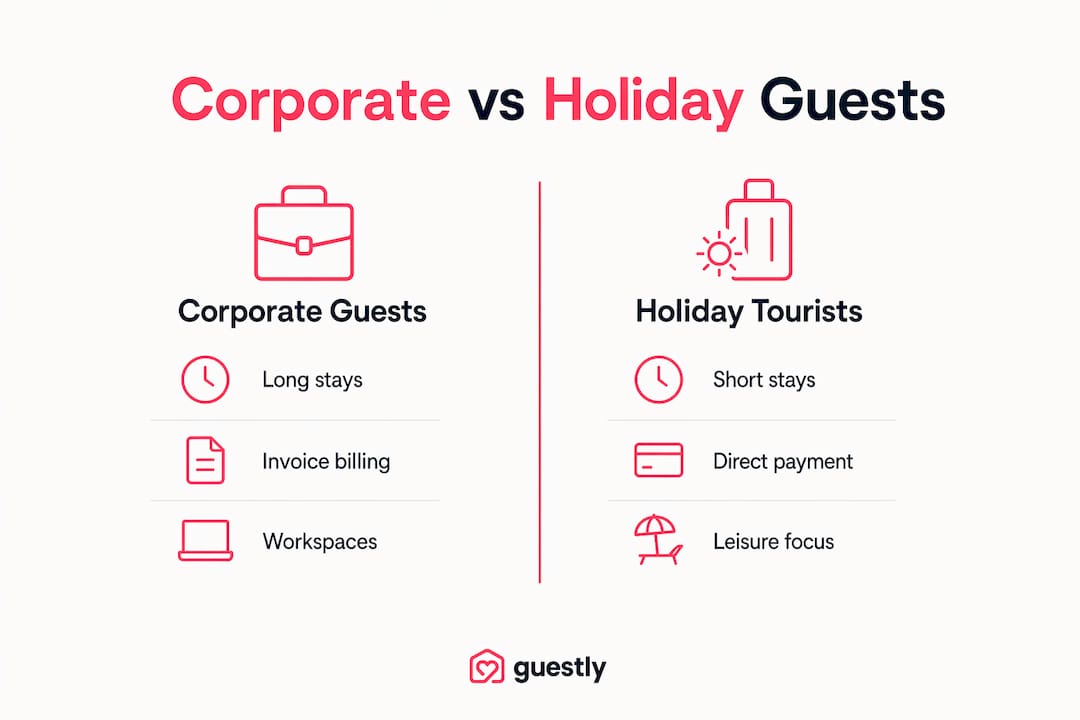
Reliability and operational support are paramount for corporate guests, as disruptions directly affect their work assignments. This is the clearest behavioural divide between the two guest types. A leisure traveller might post a complaint online after checkout. A corporate guest needs the problem resolved before their 9 AM call.
Invoice management is another critical difference. Corporate bookings require formal invoicing for company expense systems, VAT documentation, and sometimes purchase order references. Online travel agencies are poorly suited to this. They are built for card transactions and consumer-facing confirmations, not B2B billing workflows. Direct booking systems, by contrast, allow accommodation providers to issue invoices, manage extensions, and communicate with HR or finance teams directly.
- Direct billing to company accounts removes friction for HR and finance teams.
- Immediate response protocols protect the guest’s professional performance.
- Extension management requires flexibility that OTA platforms cannot provide.
- A single point of contact for the booking reduces administrative burden significantly.
Pro Tip: When evaluating accommodation providers for corporate assignments, ask directly whether they support invoice billing and have a dedicated contact for booking changes. If the answer is unclear, the operational support will likely be too.
In what ways do cleanliness and maintenance expectations differ?
Corporate guests report lower per-night wear and tear than leisure tourists, but their cleanliness expectations are considerably higher. The distinction is important. Less damage does not mean less scrutiny. A business traveller living in a property for eight weeks notices every maintenance issue, every inconsistency in cleaning standards, and every item that stops working.
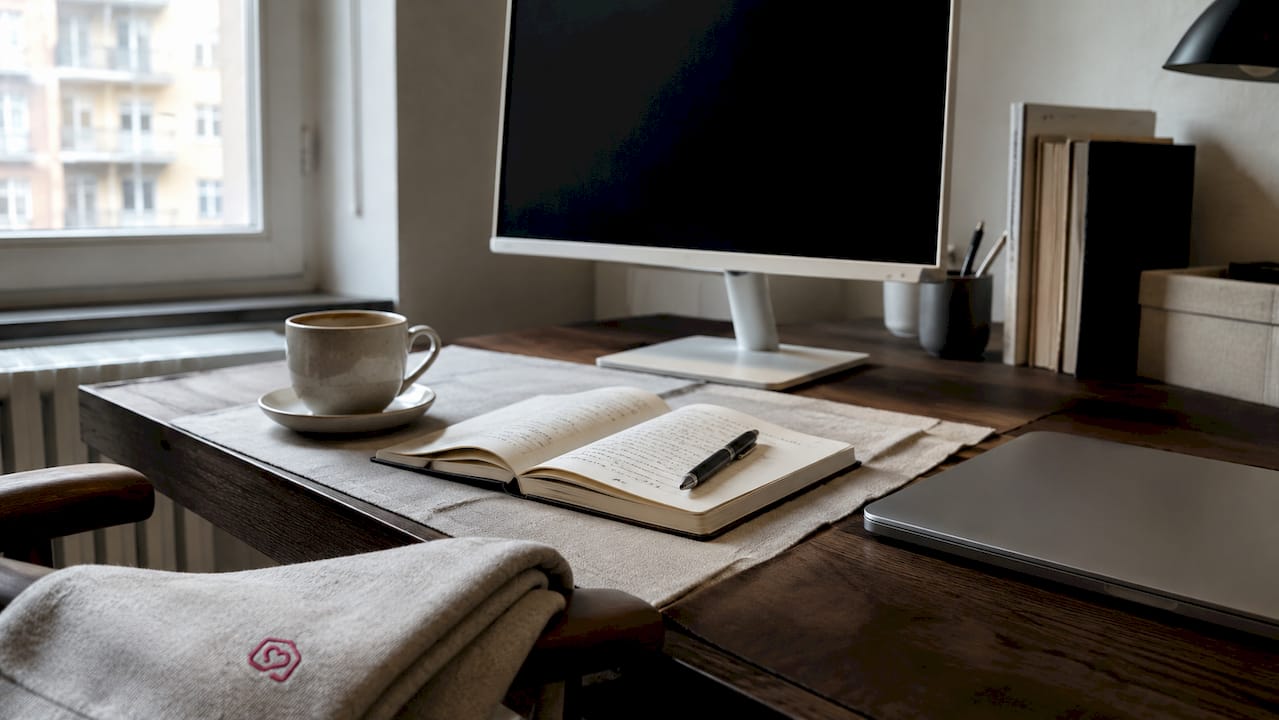
Operators consistently report that corporate stays generate less property wear per night compared to holiday guests. This makes sense. Corporate guests are not hosting parties, moving furniture for group dinners, or using the property for events. They follow a quiet, consistent routine that is inherently gentler on the fabric of a home.
Maintenance scheduling adapts accordingly for longer stays. Rather than a full turnover clean between guests, long-term corporate stays require periodic deep cleans, routine appliance checks, and a clear process for reporting and resolving issues mid-stay. The following points outline the key maintenance differences:
- Periodic deep cleans replace the full turnover model used for short holiday lets.
- Appliance checks should be scheduled at regular intervals, not only at checkout.
- Mid-stay issue reporting requires a clear, responsive process that the guest trusts.
- Consistent linen and consumable replenishment supports the guest’s daily routine without interruption.
- Property condition at checkout is typically better than after a comparable holiday let period.
Long-term corporate guests also contribute to stable property care in a less obvious way. Because they treat the space as a temporary home, they are more likely to report a dripping tap or a faulty light fitting promptly. Holiday tourists often leave without mentioning minor issues, which accumulate between stays.
Why do property owners often prefer long-term corporate stays?
Predictable occupancy and stable revenue are the primary reasons property owners favour long-term corporate bookings over high-turnover holiday lets. A property occupied by a corporate guest for three months generates consistent income without the administrative overhead of weekly turnovers, repeated check-in coordination, and frequent cleaning cycles.
Corporate bookings above 28 nights attract a reduced VAT rate, dropping to approximately 4% from night 29. This makes long-term bookings financially advantageous compared to short-term OTA bookings, which carry both standard VAT and platform commission costs. The financial case for corporate occupancy is clear.
Mixing B2B and B2C revenue strategies without separation causes price erosion. The most effective approach treats corporate demand as the stable revenue engine and leisure bookings as supplementary. Experienced operators also protect revenue by maintaining a “right to extend” window near a corporate guest’s nominal departure date, blocking short-term availability to preserve the option of a higher-value monthly extension.
| Fattore | Corporate stays | Holiday lets |
|---|---|---|
| Typical duration | 4–12 weeks or longer | 2–7 nights |
| Turnover frequency | Basso | Alto |
| Billing method | Invoice, direct | Card, OTA |
| VAT from night 29 | Approximately 4% | Standard rate |
| Wear and tear per night | Più basso | Più alto |
Guestly Homes operates on this principle across Sweden, managing properties under both revenue share and fixed-lease models. The corporate guest profile is central to how properties are prepared, priced, and maintained.
How do repeat bookings and loyalty differ between the two guest types?
Corporate guests generate repeat and consecutive bookings at a far higher rate than leisure tourists. A holiday traveller may return to a favourite destination, but rarely to the same property in the same year. A corporate guest on a rolling project assignment may extend their stay multiple times, or return for a new assignment within months.
This repeat pattern has direct implications for corporate accommodation planning. When a guest returns, the property team already knows their preferences, their working hours, and their communication style. That accumulated knowledge reduces friction on both sides and raises the quality of the stay without additional cost.
- Corporate guests on multi-phase projects often return to the same property.
- Consecutive assignments from the same employer create predictable forward bookings.
- Relationship-based service improves with each stay, reducing the need for onboarding.
- Holiday tourists rarely generate the same forward booking visibility.
Loyalty in the corporate context is also institutional, not just personal. When an HR team or travel manager has a positive experience with an accommodation provider, they direct future bookings to that provider across multiple employees. A single satisfied corporate guest can represent a pipeline of future stays from the same organisation. That dynamic simply does not exist with leisure tourism.
Key takeaways
Long-term corporate guests require a fundamentally different accommodation model from holiday tourists, one built on reliability, direct communication, and operational consistency rather than leisure amenities or high turnover.
| Punto | Dettagli |
|---|---|
| Stay length shapes everything | Corporate guests stay 4–12 weeks or longer, requiring home-like functionality over leisure features. |
| Communication must be direct | Invoice billing and immediate issue resolution are non-negotiable for business travellers. |
| Maintenance differs by pattern | Lower wear per night but higher consistency expectations require scheduled mid-stay servicing. |
| Owners benefit financially | Reduced VAT from night 29 and lower turnover costs make corporate stays more profitable. |
| Loyalty is institutional | Satisfied corporate guests generate repeat bookings from their entire organisation, not just themselves. |
What I have learned from managing corporate and leisure stays side by side
The most common mistake I see travel managers and HR professionals make is treating accommodation as a commodity. They compare nightly rates, tick a box for Wi-Fi, and move on. That approach works for a two-night conference trip. It fails completely for a twelve-week project assignment.
Corporate guests do not need a beautiful property. They need a property that works. The desk must be at the right height. The broadband must not drop during video calls. The kitchen must have a proper hob, not a single induction plate. These are not luxury requirements. They are the baseline conditions for professional performance, and they are entirely different from what a holiday tourist needs from the same space.
The financial logic also surprises people when they first see it clearly. A property generating steady corporate occupancy at a negotiated monthly rate, with low turnover costs and predictable maintenance, often outperforms a property chasing peak-season leisure rates with heavy OTA commission and high wear between guests. Stability is undervalued in accommodation planning, on both sides of the booking.
My advice to HR professionals arranging long-term business accommodation is to qualify the operator, not just the property. Ask how they handle extensions. Ask how quickly they resolve maintenance issues. Ask whether they can issue a VAT invoice to your finance team. The answers tell you everything about whether the stay will support your team or create work for you.
— Joakim Thörn
Guestly Homes for corporate travel managers and HR teams
Corporate travel managers who need reliable, well-managed accommodation for extended assignments will find that Guestly Homes is built precisely for this purpose.
Guestly Homes operates fully managed properties across Sweden, with a 1BR Executive Premium Suite designed specifically for professionals on assignment. Every property includes a dedicated workspace, full kitchen, and hotel-grade consistency across the entire stay. Booking is handled directly, with invoice billing available for company accounts and a single point of contact for extensions or changes. There are no OTA intermediaries, no commission layers, and no ambiguity about who to call when something needs attention. For HR teams placing employees on multi-week assignments, that clarity is the difference between a stay that supports performance and one that creates problems.
FAQ
What is the typical length of a long-term corporate stay?
Corporate stays typically range from 4 to 12 weeks, though project-based assignments can extend to six months or longer. This duration distinguishes corporate guests from leisure tourists, who generally stay for a few nights.
Why do corporate guests need direct booking channels?
Corporate guests require invoice billing, VAT documentation, and flexible extension management that OTA platforms cannot support. Direct booking channels allow accommodation providers to handle B2B billing and communicate with HR or finance teams efficiently.
Do long-term corporate stays cause more property damage than holiday lets?
Operators report that corporate stays generate less wear per night than holiday lets. Corporate guests follow consistent routines and are more likely to report maintenance issues promptly, which supports better property condition over time.
What financial advantages do long-term corporate bookings offer property owners?
Corporate bookings above 28 nights attract a reduced VAT rate of approximately 4% from night 29, and they eliminate OTA commission costs through direct billing. Combined with lower turnover frequency, this makes long-term corporate occupancy more profitable than comparable short-term leisure lets.
How does corporate guest loyalty differ from holiday tourist loyalty?
Corporate guest loyalty is institutional. A satisfied guest on a work assignment often generates repeat bookings from their entire organisation, as HR teams and travel managers direct future stays to trusted providers. Holiday tourists rarely produce the same volume of forward bookings from a single relationship.