


In breve:
- Self-managing a rental often incurs hidden costs that surpass management fees, including time, vacancies, maintenance, and compliance risks. These operational frictions can lead to significant financial losses and legal issues if not properly systematized. Outsourcing critical tasks to professionals like Guestlyhomes can mitigate these costs, ensuring more predictable income and less stress for property owners.
Self-managing a rental property is defined by one persistent misconception: that avoiding a management fee is the same as saving money. The hidden costs of managing rentals yourself span time, vacancies, maintenance, compliance, and guest communication, and they routinely exceed the fees you set out to avoid. In property management, the industry term for these overlooked expenses is operational friction, and it compounds quietly until it becomes a serious financial drain. This article breaks down each cost category with evidence, practical examples, and comparisons to professional management, so you can make a clear-eyed decision about where your time and capital are best spent.
What are the real time commitments of self-managing a rental?
Self-managing a rental property is not a passive activity. It is an ongoing operational role that demands consistent attention across guest communication, rent collection, cleaning coordination, maintenance scheduling, check-ins, and platform management. The workload is uneven, spiking sharply during turnovers and emergencies, and it rarely fits neatly into a landlord’s existing schedule.

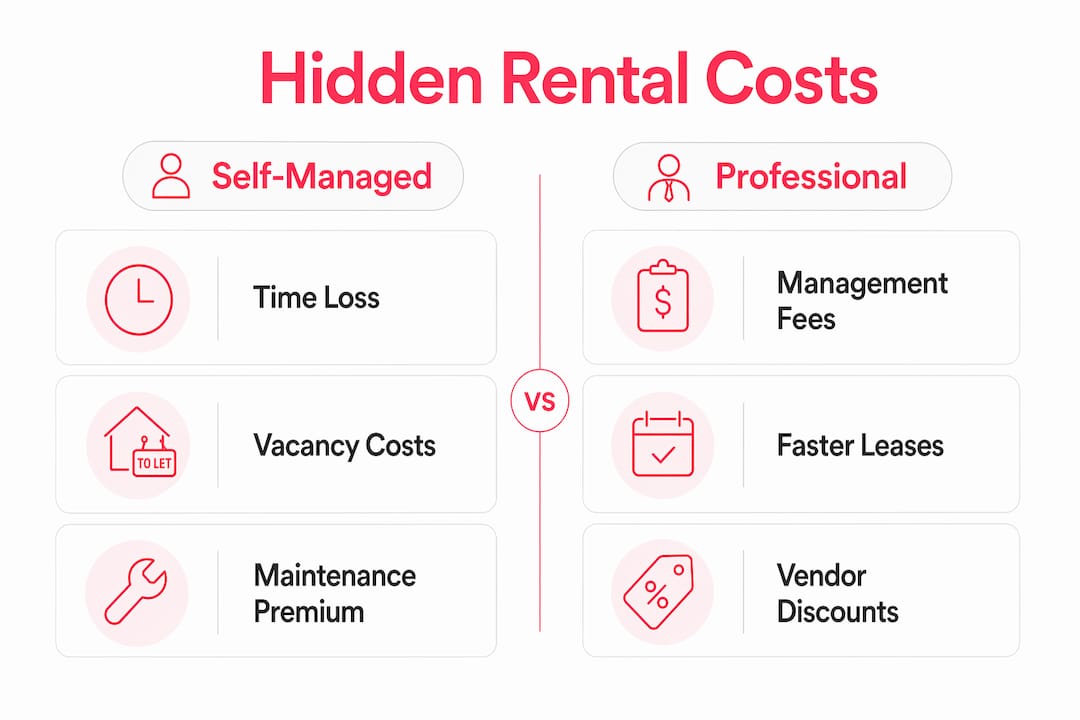
Time investment runs from 4 to 20 hours monthly, translating into a £160 to £800 opportunity cost at a conservative £40 per hour rate. That figure alone rivals or exceeds the monthly fee charged by many professional operators. The implication is direct: the cost of your time is a real financial cost, even when no invoice arrives.
The operational tasks involved include:
- Guest and tenant communication: Responding to enquiries, handling complaints, and managing check-in instructions, often across multiple platforms simultaneously.
- Rent collection and financial tracking: Chasing late payments, issuing receipts, and maintaining records for tax purposes.
- Cleaning and maintenance coordination: Sourcing cleaners, confirming schedules, and following up on quality between stays.
- Emergency response: Handling boiler failures, plumbing issues, or lockouts at short notice, including outside business hours.
- Platform management: Updating listings, adjusting pricing, monitoring reviews, and responding publicly to guest feedback.
Managing ratings on platforms such as Airbnb or Booking.com adds a further layer of pressure. Guests expect responses within one to two hours. A delayed reply or unresolved complaint can lower your response score and push your listing down in search results, directly reducing bookings.
Pro Tip: Use a property management tool such as Lodgify, Hostaway, or a shared inbox system to centralise guest messages and automate check-in instructions. This reduces daily time demands without removing you from the process entirely.
How do vacancy and turnover costs create hidden financial losses?
Vacancy is the most quantifiable hidden expense in DIY rental management, yet most self-managing landlords underestimate its full scope. Lost rent is only the beginning. A 45-day vacancy on a property renting at £2,200 per month generates losses exceeding £8,000 when carrying costs, cleaning, and re-marketing expenses are included. That is a significant sum to absorb, particularly when faster leasing by a professional operator could have reduced the vacancy to two weeks.
The financial breakdown of a single vacancy period typically looks like this:
- Lost rent: The most visible cost, calculated directly from daily rate multiplied by vacant days.
- Carrying costs: Mortgage interest, service charges, utilities, and insurance continue regardless of occupancy.
- Turnover preparation: Professional cleaning, minor repairs, and restocking consumables between tenancies.
- Re-marketing expenses: Photography updates, listing fees, and time spent conducting viewings or responding to enquiries.
- Opportunity cost of delayed decisions: Each day spent deliberating over pricing or applicant quality extends the vacancy further.
The chain reaction effect is particularly damaging for self-managers. Vacancies trigger slower showings, weaker applicant pools, and deferred maintenance, each of which raises costs beyond the initial vacant days. A landlord who lowers the asking rent to fill a property quickly may secure a less suitable tenant, leading to higher turnover frequency and compounding the problem over time.
| Vacancy scenario | Estimated cost |
|---|---|
| 30-day vacancy at £2,200/month | £2,200 lost rent + £900 carrying costs |
| 45-day vacancy at £2,200/month | £3,300 lost rent + £1,350 carrying costs + £500 turnover |
| 60-day vacancy at £2,200/month | £4,400 lost rent + £1,800 carrying costs + £800 turnover |
Professional operators maintain established applicant pipelines and leasing processes that reduce vacancy periods measurably. For self-managing landlords, the absence of these systems is a structural disadvantage that shows up directly in annual income.
What maintenance challenges increase costs for self-managing landlords?
Maintenance is where the costs of DIY property management become most unpredictable. Without an established vendor network, self-managing landlords pay retail rates for tradespeople, often at short notice and without the negotiating leverage that comes from volume relationships. Maintenance bills run 30 to 40% higher for self-managers compared with professionally managed properties. Over a full year, that premium is substantial.
The specific challenges include:
- Emergency repair premiums: A plumber called at 10pm on a Sunday charges significantly more than one booked through a scheduled maintenance programme.
- Delayed responses: A minor leak left unaddressed for a week becomes a ceiling replacement. Deferred maintenance consistently costs more than prompt action.
- Vendor quality risk: Without trusted relationships, landlords may hire cheaper contractors whose work requires correction, doubling the cost.
- Documentation gaps: Lacking maintenance records exposes landlords to legal penalties and weakens their position in deposit disputes. UK regulations in particular place significant weight on documented maintenance response.
The legal dimension of maintenance documentation is underappreciated by most self-managers. Courts and deposit adjudication services rely on written records of reported issues, responses, and completed work. A landlord who cannot produce these records faces a weaker position in any dispute, regardless of the actual facts.
Pro Tip: Build a shortlist of three trusted tradespeople for plumbing, electrical, and general repairs before you need them. Use a simple maintenance log, whether in a spreadsheet or a tool such as Arthur Online or Fixflo, to record every reported issue and its resolution date.
How do rent-setting, compliance, and guest communication affect hidden costs?
Pricing a rental property correctly is not a one-time decision. Rents need to be reviewed against market conditions, regulatory caps, and seasonal demand. Self-managing landlords frequently miss these windows, and the compounded income loss is significant. Missing rent increase windows tied to CPI adjustments can cost a landlord thousands over a three-year period. In regulated markets, the calculation requires tracking CPI data, applying the correct formula, and serving notice within prescribed timeframes. Missing one cycle means the increase cannot be backdated.
Tenant and guest screening carries equal financial weight. Poor screening leads to evictions and property damage costing between £4,000 and £12,000 per tenancy. Self-managing landlords often lack access to professional referencing services or the experience to interpret credit and employment data accurately, increasing the risk of selecting unsuitable occupants.
The table below compares DIY and professionally managed approaches across the key risk areas:
| Fattore | DIY self-management | Gestione professionale |
|---|---|---|
| Rent reviews | Ad hoc, often missed | Scheduled, CPI-tracked |
| Tenant screening | Basic checks, variable quality | Full referencing, consistent criteria |
| Guest communication | Owner-dependent, variable response times | Dedicated team, fast response |
| Conformità normativa | Owner’s responsibility, risk of gaps | Managed by specialists |
| Pricing adjustments | Infrequent, reactive | Dynamic, market-led |
Guest communication delays increase tenant frustration and accelerate turnover. For short-stay rentals in particular, a slow response to a booking enquiry or an unresolved maintenance complaint translates directly into a negative review. Negative reviews reduce future occupancy, creating a cycle that is difficult to reverse without significant effort.
What situations become expensive without proper systems in place?
The most revealing test of a self-management approach is not the routine month. It is the difficult one. A boiler failure on a Friday evening, a guest who locks themselves out at midnight, a tenant who stops paying rent and does not respond to messages. These situations expose the absence of systems, and the costs accumulate quickly.
Operational friction and inconsistent task execution are the biggest hidden costs in self-management, not the individual tasks themselves. A landlord who handles each situation differently, without a documented process, spends more time, makes more errors, and faces greater legal exposure than one who follows a consistent workflow.
Consider the following scenarios:
- Missed rent payment: Without an automated tracking system, a payment may go unnoticed for two weeks. By the time formal notice is served, the landlord has lost income and the legal timeline has been delayed.
- Unresolved guest complaint: A complaint about a broken appliance that is not logged and resolved within 24 hours can escalate to a platform dispute, a refund request, and a public negative review.
- Emergency repair without a vendor list: A landlord who calls around for quotes during an emergency pays a premium and loses time. The guest or tenant experience suffers in the meantime.
“The difference between a manageable rental and a costly one is rarely the property itself. It is the presence or absence of a system for every foreseeable situation.”
Maintaining high ratings on short-stay platforms requires response times measured in minutes, not hours. Platforms such as Airbnb factor response rate and speed into search ranking algorithms. A landlord managing multiple responsibilities simultaneously will struggle to meet these standards consistently, particularly during busy periods or personal commitments.
Key takeaways
The hidden costs of managing rentals yourself consistently exceed the management fees they are intended to replace, making professional support a financially sound choice for most property owners.
| Punto | Dettagli |
|---|---|
| Time has a real cost | Self-management demands 4 to 20 hours monthly, with an opportunity cost that rivals professional fees. |
| Vacancies compound quickly | A 45-day vacancy can generate losses exceeding £8,000 when all associated costs are included. |
| Maintenance costs run higher | Self-managers pay 30 to 40% more on maintenance without vendor networks or scheduled programmes. |
| Compliance gaps are expensive | Missed rent reviews and poor documentation create legal exposure and compounded income loss. |
| Systems determine outcomes | Operational consistency, not individual effort, separates profitable rentals from costly ones. |
The cost you cannot put on a spreadsheet
I have spoken with many property owners who arrived at self-management with genuine enthusiasm and left it with a clearer understanding of what they had underestimated. The financial costs are real and calculable. The less visible cost is the sustained cognitive load of being permanently on call for a property that does not pause when you do.
The most underestimated hidden expense is not a single large bill. It is the accumulation of small decisions made under pressure, without systems, without vendor relationships, and without the experience that comes from managing properties at scale. A missed rent review here, a delayed maintenance response there, a guest complaint that escalates because no one was available to handle it promptly. Each one is manageable in isolation. Together, they erode both income and wellbeing.
Where I have seen self-management work well is in a hybrid model. Landlords who handle day-to-day communication but outsource tenant screening, leasing, and legal compliance to specialists capture meaningful savings while reducing their exposure to the highest-risk tasks. This approach requires honest self-assessment about which tasks you can execute consistently and which ones benefit from professional depth.
The property owners who protect their income most effectively are not necessarily those who manage everything themselves or those who delegate everything. They are the ones who know precisely where their involvement adds value and where it introduces risk. That clarity is worth more than any fee calculation.
— Joakim
How Guestlyhomes removes the hidden cost burden
Guestlyhomes was built for property owners who want their asset to perform without the operational weight of self-management. As a fully managed operator across Sweden and the Nordics, Guestlyhomes handles guest communication, dynamic pricing, professional cleaning, maintenance coordination, and legal compliance as a single integrated service. You retain ownership and income upside. Guestlyhomes carries the operational responsibility.

Whether your property is a city apartment or a premium villa, Guestlyhomes structures the arrangement around your goals, through a revenue share or fixed-rent model. Owners working with Guestlyhomes consistently report fewer surprises, more predictable income, and a measurable reduction in the time and stress that define self-management. Explore what a professionally managed property looks like in practice by viewing a luxury managed villa or a Nordic apartment in the Guestlyhomes portfolio. For a full breakdown of what professional management costs and delivers, the property management cost guide is a practical starting point.
FAQ
What are the main hidden costs of self-managing a rental?
The primary hidden costs are time opportunity cost, vacancy losses, higher maintenance bills, missed rent reviews, and legal compliance gaps. Together, these frequently exceed the management fees that self-managing landlords set out to avoid.
How much time does self-managing a rental actually take?
Self-managing a rental typically requires 4 to 20 hours monthly, depending on property type, occupancy frequency, and the number of maintenance issues. During turnover periods, the workload increases significantly.
Is self-managing rentals worth it financially?
For most landlords, the financial case for self-management weakens once vacancy costs, maintenance premiums, and compliance risks are included in the calculation. A hybrid approach, outsourcing high-risk tasks while retaining routine oversight, often delivers the best balance of cost and control.
How do maintenance costs differ for self-managing landlords?
Self-managing landlords typically pay 30 to 40% more on maintenance due to the absence of established vendor networks and the premium charged for emergency call-outs. Documented maintenance workflows also reduce legal exposure, which self-managers frequently lack.
What is the cost of a vacancy for a self-managing landlord?
A 45-day vacancy on a property at £2,200 per month can generate total losses exceeding £8,000 when lost rent, carrying costs, and turnover expenses are combined. Professional operators reduce vacancy periods through faster leasing processes and established applicant pipelines.