


|
Preparare il lettore Trinity Audio...
|
In breve:
- Corporate leasing offers higher income stability and less vacancy risk compared to traditional renting.
- Managing corporate lets demands higher operational effort, including maintenance, cleaning, and guest support.
- Partnering with professional operators helps mitigate legal, compliance, and operational risks for owners.
Many Swedish premium property owners treat traditional renting as the default, safest option. Yet the market is shifting, and those assumptions deserve scrutiny. Corporate leasing is growing rapidly across Sweden’s major cities, driven by demand from multinational companies, project teams, and executives requiring high-quality, extended-stay accommodation. Understanding how these two models truly compare, on income security, operational demands, and legal compliance, is no longer optional if you want to maximise your property’s performance in 2026 and beyond.
Indice dei contenuti
- Defining corporate leasing and traditional renting in Sweden
- Income stability and financial returns: What the numbers reveal
- Operational demands and day-to-day management
- Legal, compliance, and reputational considerations
- Our perspective: Making the right choice for Swedish premium homes
- Next steps: Expert help with Swedish corporate letting
- Domande frequenti
Punti di forza
| Punto | Dettagli |
|---|---|
| Know both models | Corporate leasing and traditional rent offer very different financial and management profiles for Swedish premium homes. |
| Corporate means more work | Expect higher property standards and more active management with corporate leasing, but potentially better returns. |
| Partnerships mitigate risk | Teaming up with specialist operators often leads to greater income stability and less owner workload. |
| Check compliance early | Clarify legal and association approvals in advance, especially with bostadsrätts or company lets. |
| Choose for your goals | Pick the option matching your time, expertise, and appetite for hands-on management versus passive income. |
Defining corporate leasing and traditional renting in Sweden
Before assessing which option could best fit your premium property, let’s make sure the major models are crystal clear.
Corporate leasing involves letting your property directly to a company or via a professional operator, who then houses employees, executives, or project teams. These corporate lease apartments are typically furnished to a high standard and are occupied for periods ranging from a few weeks to 12 months. The tenant of record is the business entity, not an individual, which fundamentally changes your contractual relationship and risk profile.
Traditional renting, by contrast, means letting your property to an individual or household under a standard tenancy agreement. In Sweden, this falls under hyreslagen (the Tenancy Act), which affords tenants significant protections and, in practice, restricts what you can charge in regulated areas.
The Swedish property market adds important nuance to both models. Consider these key distinctions:
- Bostadsrätt (leasehold apartment) owners must obtain approval from their housing association (bostadsrättsförening) before letting to a company. Block rentals of multiple units are common in the corporate segment, but association rules vary widely.
- Villa and äganderätt (freehold) owners generally have more flexibility, though local planning restrictions may still apply.
- Standard for corporate lets is typically higher, with fully furnished, professionally maintained homes expected as standard.
| Caratteristica | Corporate leasing | Traditional renting |
|---|---|---|
| Tenant type | Company or operator | Individual or household |
| Furnishing required | Yes, to high standard | Usually no |
| Lease duration | 1 month to 3+ years | Typically 1 year or longer |
| Association approval needed | Often (bostadsrätt) | A volte |
| Rent regulation applies | Less strictly | Yes, in most cases |
Understanding what a corporate lease actually entails at a contractual level is essential before you commit to either path. Each model demands a different set of owner skills, resources, and risk tolerance.
Income stability and financial returns: What the numbers reveal
With the basics established, let’s see how your bottom line could be impacted by each approach.
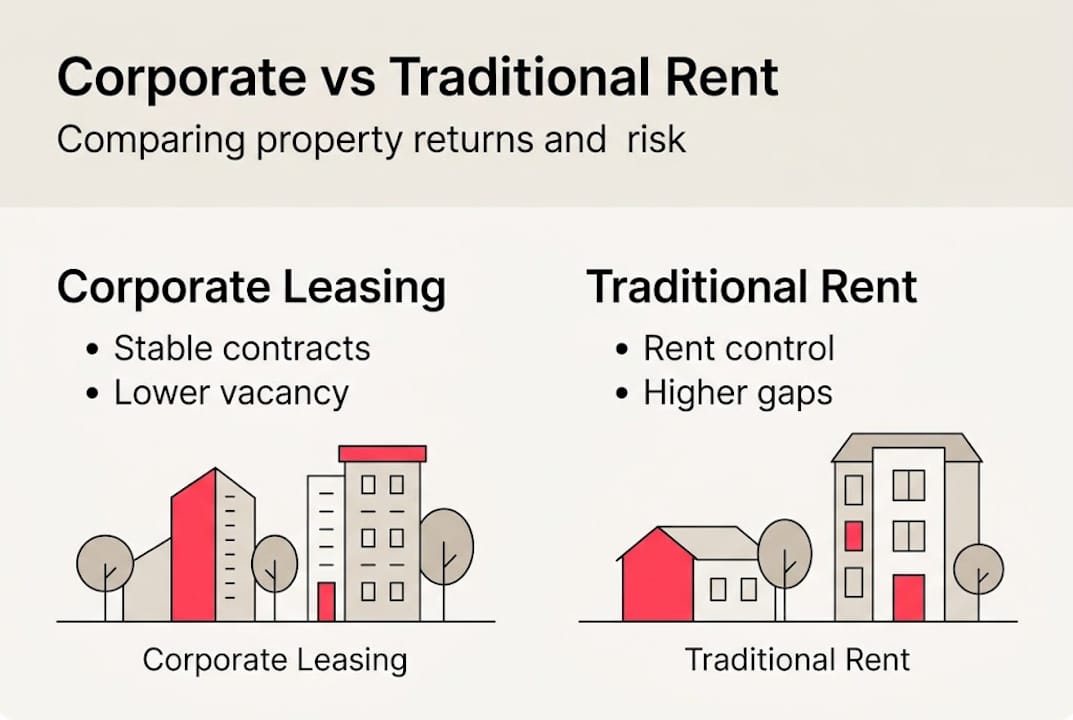
One of the most significant concerns for any property owner is vacancy risk. With traditional tenancies, a gap between tenants can mean weeks or even months without income, and in a softer market, finding a reliable individual tenant for a premium property is not always straightforward. Corporate lets, by contrast, are typically backed by the financial strength of the hiring company, offering a degree of payment security that private tenants simply cannot match.
Financially, traditional rent is subject to regulated rents limiting potential yields, particularly in Stockholm, Gothenburg, and Malmö where rent controls are most pronounced. This means even a premium property may not command a market-rate return under a traditional tenancy.
Corporate leasing sidesteps many of these restrictions, allowing negotiated rates that better reflect the property’s true quality, location, and amenities. However, corporate leasing usually demands furnishing and management investment but may attract higher, more stable corporate contracts that reward that upfront commitment over time.
| Income factor | Corporate leasing | Traditional renting |
|---|---|---|
| Vacancy risk | Low (company-backed) | Moderate to high |
| Rent regulation | Largely unaffected | Strongly regulated |
| Typical yield premium | 20–40% above regulated rent | Limited by rent controls |
| Up-front investment | Higher (furnishing, fitout) | Più basso |
| Payment security | Company invoice, more reliable | Individual, variable |
Statistic to note: Premium corporate lets in Swedish cities can achieve yields 20 to 40 per cent above equivalent regulated residential rents, making the up-front investment case compelling for well-located properties.
Pro Tip: If your property is in a high-demand Swedish city and can be furnished to an executive standard, the income gap between corporate and traditional letting will widen considerably over a three-year horizon. Consult our corporate rental guide to model likely returns before making a decision.
Operational demands and day-to-day management
Financials aside, your personal time commitment and operational preference can make or break success, so let’s examine what each option involves day-to-day.
Traditional tenants tend to occupy a property for extended periods, handle minor maintenance themselves, and require relatively infrequent owner interaction. Your main touchpoints are the start and end of tenancy, plus occasional repairs. For many owners, this simplicity is genuinely appealing.

Corporate lets introduce a more demanding operational rhythm. Furnished properties require regular inspection, professional cleaning between stays, and swift resolution of any maintenance issues. Standards expected by companies housing their staff are high, and reputational consequences for falling short are real.
Here is what day-to-day corporate management typically involves:
- Professional cleaning and laundry between every occupier change
- Inventory checks and appliance maintenance on an ongoing basis
- 24/7 guest support availability, or a designated contact for urgent issues
- Quarterly property inspections to maintain standards
- Coordination with company HR or facilities managers on arrival and departure logistics
Higher property standards and professional management are typically required for corporate leasing, and owners who underestimate this often find themselves stretched. In fact, self-management of corporate lets can demand 20 to 30 hours per week and carry high liability risks.
“The difference between a corporate let that thrives and one that struggles almost always comes down to operational consistency, not the property itself.”
This is precisely why many owners explore the difference between self-managing rentals vs operators before committing. Professional operators absorb the operational burden in exchange for a revenue share or a fixed lease arrangement, which is often the more rational choice for time-conscious owners.
Pro Tip: Before deciding to self-manage a corporate let, track your available weekly hours honestly. If you cannot reliably commit to at least 15 to 20 hours per week for coordination, using a property manager will almost certainly protect both your income and your sanity.
Legal, compliance, and reputational considerations
Now that we’ve uncovered the practical and financial divides, let’s clarify how to stay on the right side of the law and keep a strong reputation.
Sweden’s property legal framework treats corporate and traditional lets quite differently, and the consequences of non-compliance are not trivial. There are four core legal and reputational areas every premium property owner should address before choosing a model:
- Association approval. Bostadsrätts need association approval for corporate lets. Proceeding without it risks fines, loss of membership rights, and forced termination of the arrangement.
- Tenancy law compliance. Traditional tenancies are heavily regulated under hyreslagen, offering strong tenant protections around notice periods, rent increases, and grounds for eviction. Breaching these rules, even inadvertently, exposes you to formal dispute processes.
- Tax and invoicing obligations. Corporate lets typically involve VAT-registered business invoicing, with different tax treatment to private tenancy income. Swedish Skatteverket guidance should be followed closely, and many owners engage a specialist accountant.
- Reputational management with neighbours. Frequent changeovers associated with corporate lets can create friction in residential buildings. Establishing clear house rules and communicating with neighbours proactively can prevent complaints and protect your standing in the building.
When comparing corporate housing vs Airbnb or traditional letting from a compliance perspective, corporate leasing via a professional operator offers the clearest risk management framework. Self-management increases liability versus partnering with professionals who understand the regulatory landscape.
“Compliance is not a one-time checkbox. It is an ongoing responsibility that grows in complexity as your property portfolio does.”
Choosing property management partners who are fluent in Swedish tenancy law and bostadsrätt regulations is one of the most valuable risk-mitigation steps you can take as a premium property owner.
Our perspective: Making the right choice for Swedish premium homes
With all factors considered, what is our recommendation for Swedish premium property owners weighing up these models?
Conventional wisdom fixates almost entirely on rent yields. What it consistently underestimates is the operational complexity and compliance burden, particularly with corporate letting. Many owners enter corporate leasing attracted by the income premium, only to discover that self-managing versus professional operation is not simply a cost comparison. It is a question of capability, time, and risk appetite.
The owners who consistently achieve the best outcomes are those who partner with operators for risk mitigation, reducing exposure to vacancy, compliance failures, and property damage, while enjoying genuinely passive income. This model requires trust in your operator, which is why due diligence on any partnership matters enormously.
Traditional letting still makes sense for owners who are highly experienced with Swedish tenancy law, prefer minimal operational involvement, and are comfortable with regulated returns. It is not a poor choice. It is simply a different risk-return trade-off. The mistake is assuming it is safer without accounting for rent control constraints and the cumulative cost of long-term under-yield.
Next steps: Expert help with Swedish corporate letting
If you’re ready to apply these insights and optimise your property strategy, here’s where to find the right partnership and listings.
Guestly Homes specialises in fully managed corporate leasing for premium Swedish properties, handling everything from furnishing strategy and compliance to guest management and maintenance. Whether you prefer a revenue share model or a fixed-income arbitrage arrangement, the right structure exists to match your goals.
Explore how Swedish corporate leasing experts can take your property from underperforming asset to a reliably high-yielding, hands-off investment. Browse available modern luxury villa options and business-ready properties to understand the standard we maintain, then get in touch to discuss how your home could work harder for you.
Domande frequenti
Is corporate leasing more profitable than traditional renting for luxury Swedish homes?
Corporate leasing demands more investment but typically attracts stable longer contracts, making it more profitable over a three to five year horizon for well-positioned premium properties.
What are the main legal challenges with corporate letting in Sweden?
Association approval is required for corporate lets in bostadsrätt buildings, and owners must also navigate stricter operational standards and ensure compliance with tenant protection legislation.
How much time does it actually take to self-manage a corporate lease property?
Self-management typically requires significant weekly time from the owner, often 20 to 30 hours, particularly when managing frequent occupier changeovers and maintaining corporate-grade standards.
Which option provides the most passive income for high-value homes?
Operator partnerships reduce vacancy and risk, resulting in more passive income. Partnering with a professional operator for corporate leasing generally delivers the most stable and genuinely hands-off returns for premium Swedish homes.
Consigliato
- Preparing Property for Corporate Rental: Owner Versus Partner – Guestly Homes
- The Ultimate Guide to Corporate Leases for Businesses 2025 – Guestly Homes
- Come massimizzare il reddito da locazione della tua proprietà – Guestly Homes
- Corp Rental Guide: Everything You Need to Know in 2025 – Guestly Homes
- Lease Extension with a Freeholder Residing in Your Building