


Arranging corporate housing in Sweden is rarely straightforward. HR leads and project managers face a web of legal requirements, regional market pressures, and hidden costs that can quietly derail even the most carefully planned assignment. Get it wrong, and you risk disputes, unexpected invoices, and unhappy professionals who cannot perform at their best. Get it right, and you create a productive, frictionless experience that reflects well on your organisation. This guide walks you through the essential dos and don’ts, from setting smart criteria to avoiding the pitfalls that serviced apartments save 20-30% compared to hotels for extended stays.
Table des matières
- Set clear criteria before searching for corporate housing
- Key dos: What makes corporate housing stress-free
- Common don’ts: Pitfalls that disrupt successful stays
- Comparing corporate housing options: Hotels, serviced apartments, and more
- Special scenarios: Project extensions, seasonal shifts, and regional variations
- The overlooked truth about corporate housing in Sweden
- Discover premium, hassle-free corporate housing with Guestly Homes
- Frequently asked questions
Principaux enseignements
| Point | Détails |
|---|---|
| Set criteria first | Define legal, budget, and amenity requirements before searching to avoid costly oversights. |
| Prioritise legal compliance | Use proper contracts, deposit limits, and checklists to reduce dispute risks in Sweden. |
| Choose serviced, all-inclusive housing | Opting for serviced apartments can cut accommodation costs by 20-30% for extended stays. |
| Plan for special scenarios | Proactively manage likely project extensions and pay attention to regional demand and seasonal needs. |
Set clear criteria before searching for corporate housing
Having established the stakes, let’s begin with how to set yourself up for success before even searching. The most common mistake HR leads make is jumping straight into property searches without a defined framework. Without clear criteria, you waste time evaluating options that simply do not fit, and you risk making costly compromises under deadline pressure.
Start by assessing the guest profile in detail. Consider the length of stay, the number of professionals involved, and any specific seasonal needs. A single consultant staying for three weeks in Gothenburg has very different requirements from a project team of six spending four months in Luleå during winter. These distinctions shape everything from space requirements to amenity checklists.
Next, define your compliance essentials before shortlisting a single property. Swedish tenancy standards require written contracts, documented deposit arrangements, clear notice periods, and no cash payments. Skipping this step exposes your company to legal risk and financial liability. Understanding the business impacts of choosing corporate housing correctly from the outset can save significant time and money.

Setting a realistic target budget is equally critical. A practical benchmark is to budget 2-4% of employee salary for housing costs. Serviced apartments consistently deliver better value for extended stays, with all-inclusive pricing eliminating the hidden fees that inflate hotel bills. These corporate housing selection tips can help you build a sharper shortlist from the start.
Finally, compile a must-have amenities list before you begin outreach. Key items to include are:
- Reliable high-speed Wi-Fi suitable for video calls and remote work
- A fully equipped kitchen to reduce daily food costs
- Dedicated parking, particularly important in northern regions
- Engine heaters for vehicles during Swedish winters
- Laundry facilities for stays exceeding two weeks
- Proximity to the worksite or reliable public transport links
Pro Tip: Build a one-page criteria brief and share it with every provider you contact. It cuts response time significantly and filters out unsuitable options before they consume your attention.
Key dos: What makes corporate housing stress-free
Once your criteria are set, focus on the proven ‘dos’ that consistently deliver stress-free stays. These are not abstract best practices. They are specific actions that protect your company legally, control costs, and keep travelling professionals comfortable and productive.
-
Secure a written, legally compliant contract. Every arrangement must be documented in writing. Swedish tenancy law is precise: clear contracts on rent, deposits capped at one to two months, 30-day notice periods, and no cash payments are non-negotiable. Verbal agreements carry no legal weight and create significant exposure.
-
Choose all-inclusive, serviced accommodation. Providers who bundle utilities, internet, cleaning, and maintenance into a single monthly fee make budget management far simpler. Hidden costs such as separate utility bills or cleaning charges can add 10-15% to your total spend if not addressed upfront.
-
Communicate specific needs before arrival. If a guest requires accessible facilities, has dietary considerations that affect kitchen equipment, or needs winter-specific amenities, raise these during the booking process. Surprises on arrival are expensive and damaging to morale.
-
Conduct a thorough move-in inventory check. A detailed, signed inventory protects both parties. It documents the property’s condition at the start of the stay and prevents deposit disputes at the end. Providers who offer this as standard are demonstrating professionalism. Reviewing rental agreement essentials will help you understand what a compliant inventory should contain.
-
Audit the provider’s reputation. Check verified reviews, ask for references from corporate clients, and confirm the provider’s track record with extended stays. A provider experienced in maximising guest comfort for professionals will anticipate needs you have not yet considered.
“The difference between a smooth corporate stay and a disruptive one often comes down to the quality of the initial agreement and the professionalism of the operator, not the size of the budget.”
Following these dos consistently reduces the risk of disputes, unexpected charges, and accommodation-related disruptions that pull focus away from the actual project.
Common don’ts: Pitfalls that disrupt successful stays
Knowing what to do is powerful, but avoiding key traps can save you far more trouble. Here’s what to watch out for when arranging corporate housing in Sweden.
-
Do not rely on verbal agreements or pay in cash. This is the single most damaging shortcut in corporate housing. Disputes from non-compliance affect 40% of cases, and informal arrangements are the primary cause. Every payment must be traceable, and every agreement must be in writing.
-
Do not skip the move-in inventory. Without a documented record of the property’s condition at the start of the stay, you have no protection when the deposit is reviewed. This is a straightforward process that many bookers overlook under time pressure.
-
Do not leave lease extensions too late. In high-demand areas such as Luleå and Boden, availability tightens quickly. Waiting until the final week of a stay to request an extension often means losing the property entirely and scrambling for alternatives. Review the comparison of options available in your target region well before the original end date.
-
Do not ignore seasonal and regional amenity requirements. Sweden’s northern winters are severe. Properties without engine heaters, snow-cleared parking, or adequate insulation create real operational problems for professionals who need to commute reliably. Consult the corporate housing guide for region-specific checklists.
-
Do not assume all providers understand corporate needs. Many short-term rental operators cater primarily to leisure travellers. Corporate stays require different standards around invoicing, contract structure, and communication speed.
Pro Tip: Create a simple internal checklist that every booker must complete before confirming any arrangement. It takes ten minutes to build and prevents the majority of avoidable mistakes.
Comparing corporate housing options: Hotels, serviced apartments, and more
With mistakes to avoid in mind, let’s compare your accommodation options directly to make the most strategic decision. Each type carries distinct advantages, cost profiles, and compliance implications.
| Accommodation type | Best suited for | Key advantages | Key drawbacks | Relative cost |
|---|---|---|---|---|
| Hôtel | Short stays under 7 nights | Flexible, no contract needed | Expensive long-term, no kitchen, limited space | Le plus élevé |
| Serviced apartment | 2 weeks to 12 months | All-inclusive, home-like, compliant | Requires advance booking | Mid-range |
| Unfurnished flat | Long-term, settled teams | Lowest monthly cost | Setup time, furniture costs, compliance complexity | Lowest base cost |
| Villa or premium home | Executive or team stays | Space, privacy, full amenities | Prix de la nuitée plus élevé | Premium |
Serviced apartments consistently outperform hotels for extended stays. The savings of 20-30% vs hotels are well documented, and poorly managed arrangements can add hidden costs of 10-15% through separate billing for utilities and services. For regional context, average costs in Norrbotten differ meaningfully from Stockholm, making local market knowledge essential.
Corporate housing rates typically run 20-40% above unfurnished rentals, but the all-inclusive structure and compliance ease make them cost-effective for most professional assignments. For teams working across seasons, choosing housing by season is a practical framework worth adopting. You can also explore serviced office comparisons if your team needs workspace alongside accommodation.
Special scenarios: Project extensions, seasonal shifts, and regional variations
Choosing the right type is vital, but you will also face special scenarios that demand tailored decisions. These edge cases are where even experienced HR leads can be caught off guard.
Managing project extensions requires early action. The guidance is clear: assess extensions 4-6 weeks ahead of the original end date and work only with providers who offer genuine flexibility. Operators who require long notice periods or charge punitive extension fees are not suited to dynamic project environments.
| Scénario | Recommended action | Timing |
|---|---|---|
| Project extended by 2-4 weeks | Notify provider, confirm availability | 4-6 weeks before end date |
| Winter stay in northern Sweden | Confirm engine heater, snow parking | At booking stage |
| Team size increases mid-project | Request adjacent or larger property | As soon as confirmed |
| Seasonal transition (autumn to winter) | Review heating, parking, insulation | 6 weeks before season change |
Seasonal requirements in Sweden are not optional considerations. Engine heaters, snow-ready parking, and robust insulation are operational necessities in the north, not luxury additions. Ignoring them creates avoidable disruptions.
Regional demand is also a material factor. Northern Sweden, including Luleå and Boden, is experiencing rising demand driven by major infrastructure and energy projects. Properties in these areas book out faster than in southern cities, and last-minute availability is increasingly rare. The HR strategic value of planning ahead in these regions cannot be overstated.
Key actions for special scenarios:
- Build extension clauses directly into the original contract
- Maintain a list of pre-approved flexible providers by region
- Assign one point of contact at your chosen provider for rapid communication
- Review seasonal amenity requirements at the point of booking, not on arrival
The overlooked truth about corporate housing in Sweden
Checklists are useful. But they have a ceiling. The professionals who manage corporate housing most effectively are not those with the longest checklists. They are the ones who have built direct relationships with premium, locally knowledgeable operators and who treat accommodation as a strategic function, not an administrative task.
Generic best practices do not account for the nuances of regional regulation or sudden market surges. When a major infrastructure contract lands in Luleå in January, standard booking timelines collapse. Providers who know you, understand your standards, and can move quickly become genuinely invaluable. The full corporate housing guide covers much of the technical ground, but the real competitive advantage lies in proactivity and relationships.
Build a rapid escalation playbook before you need it. Know which providers can confirm availability within 24 hours. Know which contracts include extension clauses by default. That preparation is what separates smooth operations from costly scrambles.
Discover premium, hassle-free corporate housing with Guestly Homes
Implementing these dos and don’ts is far simpler when you work with a provider built specifically for professional, extended stays. Guestly Homes operates fully managed, all-inclusive properties across Sweden, with contracts designed to meet Swedish tenancy standards from day one.
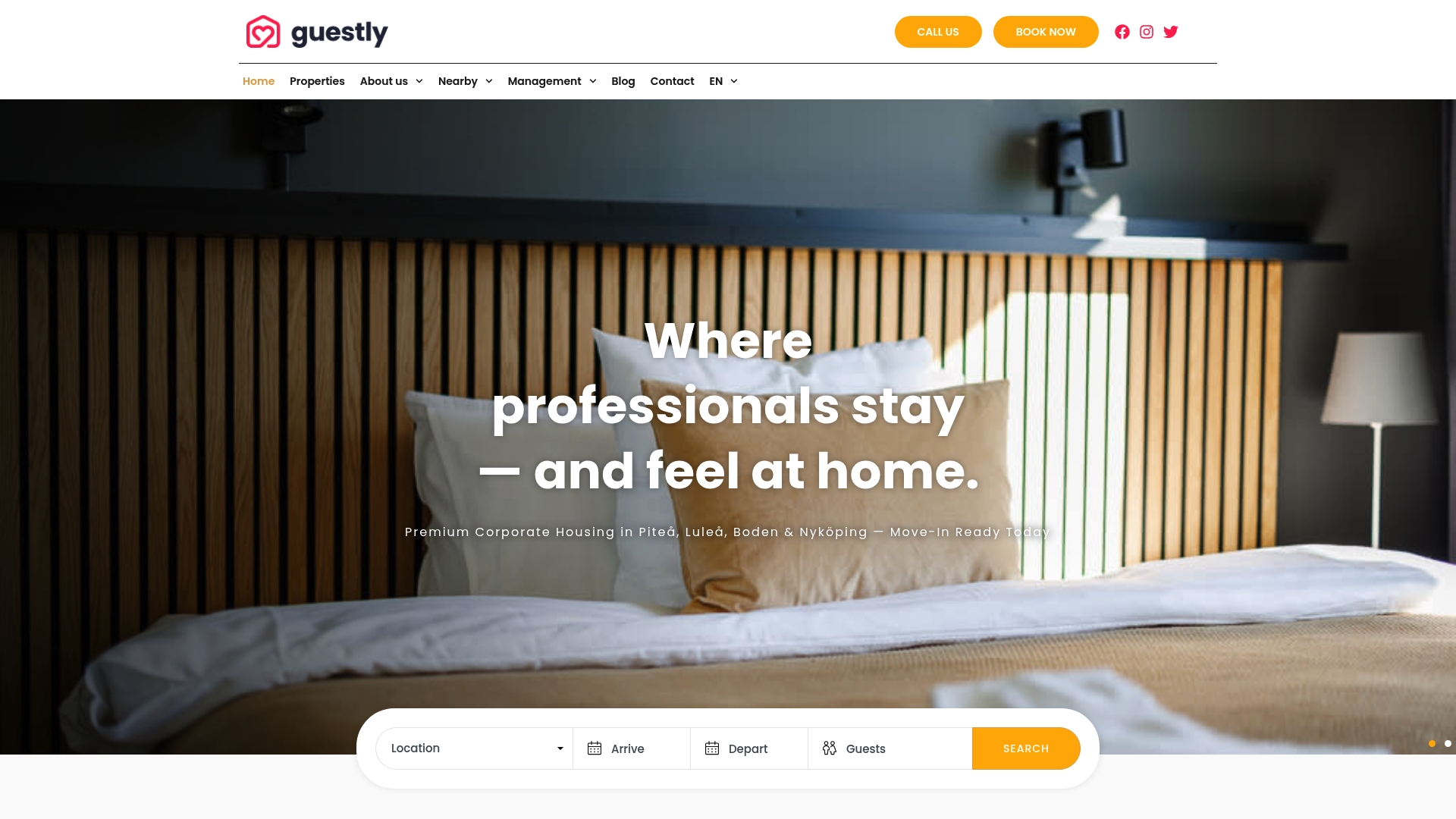
Whether you need a modern luxury villa for an executive team or a serviced apartment for a solo consultant, Guestly Homes removes the administrative burden entirely. One point of contact, transparent pricing, and properties ready for professionals. Submit your requirements directly through the housing request form and receive a tailored response without delay.
Frequently asked questions
What is the biggest mistake HRs make when booking corporate housing in Sweden?
The most common mistake is not securing a written, legally compliant contract, which creates dispute risks and unexpected costs. Swedish tenancy law requires clear terms on rent, deposits, notice periods, and payment methods.
How much can companies save by choosing serviced apartments over hotels?
Companies typically save 20-30% with serviced apartments for extended stays compared to traditional hotels, with all-inclusive pricing preventing additional hidden charges.
What should be included in a compliant Swedish corporate housing agreement?
A compliant agreement must specify rent, deposit capped at one to two months, a 30-day notice period, and a detailed inventory, with all payments fully documented and no cash accepted.
How far in advance should I plan for possible project extensions in Sweden?
Ideally, assess extensions 4-6 weeks before the original end date and confirm availability with providers who offer genuine contractual flexibility.
Are there regional differences when booking in northern Sweden?
Yes, demand in Luleå and Boden is rising sharply, requiring earlier booking and specific attention to winter amenities such as engine heaters and snow-cleared parking.