


Every Swedish property owner managing a premium rental in Piteå or Luleå knows that every percentage point matters when it comes to long-term returns. As regional markets shift and expenses accumulate, understanding the difference between gross and net rental yield becomes key to true profitability. By focusing on strategies that target operational costs, effective property management, and local tenant demand, you can make decisions that directly strengthen your investment performance.
Sisällysluettelo
- Rental Yield Defined For Swedish Property Owners
- Gross Versus Net Rental Yield Explained
- How Location And Property Type Influence Yield
- Taxation And Costs Affecting Rental Profitability
- Maximising Your Rental Yield With Professional Management
Keskeiset asiat
| Kohta | Yksityiskohdat |
|---|---|
| Understanding Rental Yield | Rental yield is crucial for assessing the financial performance of property investments in Sweden, with an average gross yield of approximately 5.46%. |
| Gross Versus Net Yield | Gross yield provides a basic income estimate, while net yield, typically 1.5% to 2% lower, reflects realistic profit after expenses. |
| Influence of Location | Rental yields vary significantly across Sweden, with university towns often outperforming major cities in rental returns. |
| Taxation and Deductions | Familiarity with Sweden’s tax regulations and available deductions is essential to maximise rental income and profitability. |
Rental Yield Defined for Swedish Property Owners
Rental yield represents the annual income generated from a property relative to its total investment cost, serving as a critical financial metric for Swedish property owners. Understanding this concept helps landlords assess the profitability and performance of their real estate investments across different Swedish markets.
In the Swedish property landscape, rental yield is calculated by dividing annual rental income by the property’s total purchase price, then expressing the result as a percentage. Specific yield calculations demonstrate that gross rental yields in Sweden averaged approximately 5.46% in recent quarterly assessments, with significant variations depending on location and property characteristics.
Net rental yields provide an even more precise assessment of potential returns, accounting for operational expenses, maintenance costs, and property management fees. While gross yields offer an initial snapshot, experienced Swedish property owners recognise that net yields typically range 1.5% to 2% lower than gross calculations. Central urban locations like Stockholm often present lower yields compared to suburban areas, reflecting the nuanced nature of property investment strategies across different Swedish regions.
Pro tip: Calculate your potential rental yield by comparing projected annual rental income against your total property investment, remembering to factor in both direct and indirect ownership expenses for a comprehensive assessment.
Gross Versus Net Rental Yield Explained
Rental yields are fundamental metrics for Swedish property investors, providing crucial insights into potential investment returns. Understanding the distinction between gross and net rental yields helps landlords make informed decisions about property investments and expected financial performance.
Gross rental yield represents the total potential income before accounting for any expenses. Calculation methods reveal it as a straightforward percentage determined by dividing annual rental income by the property’s purchase price. For Swedish landlords, this provides an initial snapshot of potential returns, typically ranging around 5-6% across different property markets.
Net rental yield offers a more nuanced and realistic perspective by subtracting all associated property ownership expenses. These expenses include property management fees, maintenance costs, insurance, taxes, and potential vacancy periods. While gross yield presents an optimistic view, net yield provides a more accurate representation of actual income. In the Swedish property market, net yields are typically 1.5% to 2% lower than gross yields, reflecting the substantial operational costs inherent in property management.
Here is a concise comparison of gross and net rental yield methodologies for Swedish property owners:
| Aspect | Gross Rental Yield | Net Rental Yield |
|---|---|---|
| Expense Inclusion | Ignores operating expenses | Deducts all relevant costs |
| Typical Swedish Rate | Around 5–6% | 1.5–2% lower than gross, often 3–4.5% |
| Calculation Simplicity | Quick and straightforward | Requires detailed cost breakdown |
| Investment Insight | Initial estimate, basic reference | More accurate for real profit |
Pro tip: Always calculate both gross and net rental yields to gain a comprehensive understanding of your property’s true income potential, ensuring you factor in all potential expenses for a realistic investment assessment.
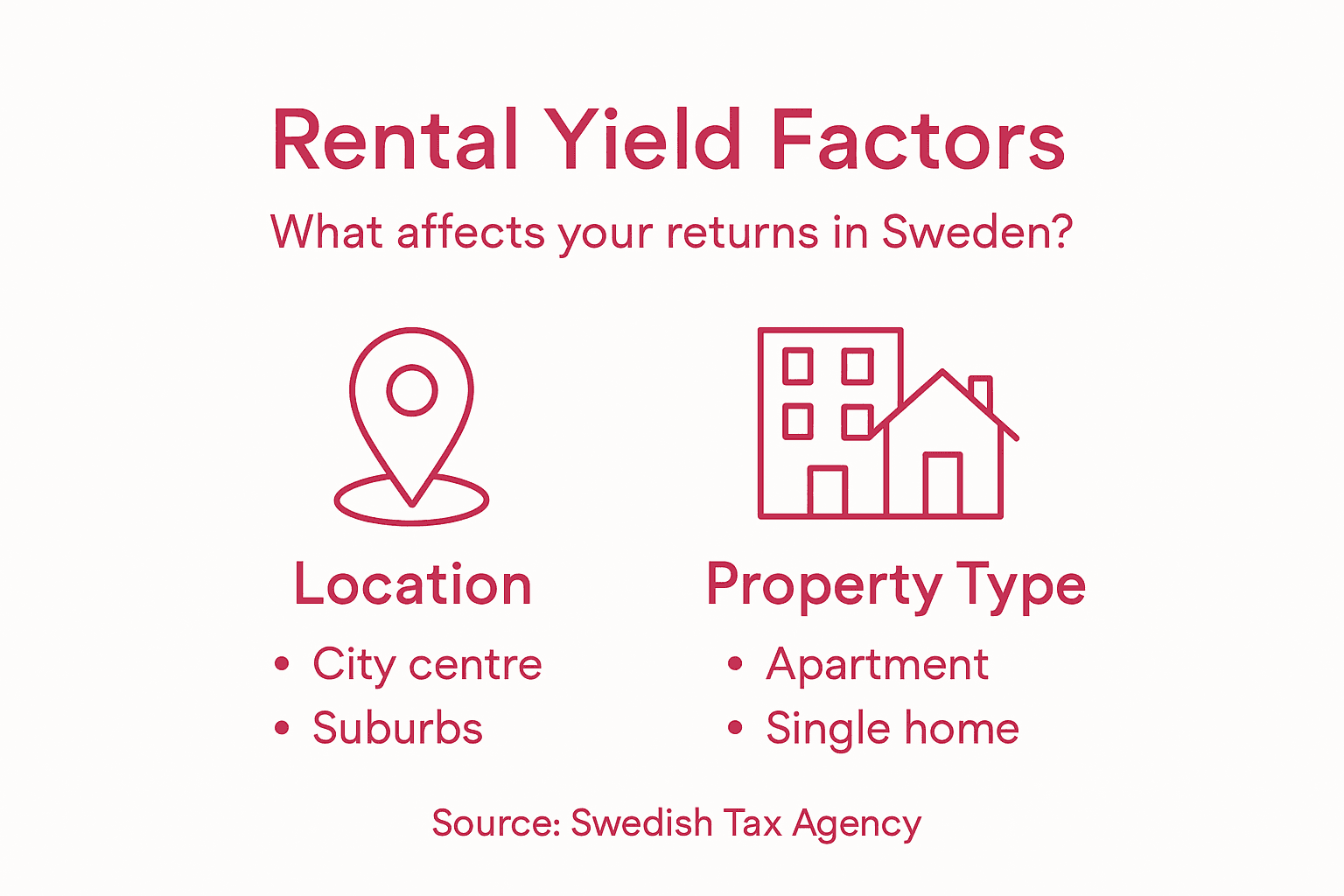
How Location and Property Type Influence Yield
Rental yield variations across Sweden demonstrate the profound impact of geographical positioning and property characteristics on investment returns. Understanding these nuanced factors enables Swedish property investors to make strategic decisions that maximise potential income and minimise financial risks.
Rental market dynamics reveal significant yield disparities between different Swedish cities and property types. University towns like Uppsala consistently outperform major metropolitan areas, with rental yields reaching approximately 7% compared to Stockholm’s more modest 4.2%. Smaller residential units, particularly studios and one-bedroom apartments, demonstrate notably higher yields due to their efficient rent-to-space ratios and consistent tenant demand.

Property type plays a crucial role in determining rental performance. Compact apartments designed for students and young professionals typically generate superior returns, especially when located in central urban areas with high institutional and employment density. Investors should consider factors such as proximity to universities, public transportation, and employment centres when evaluating potential investment properties. Smaller municipalities and university towns often present more attractive investment opportunities compared to saturated metropolitan markets.
To illustrate the impact of city and property type on Swedish rental yields, see the following summary:
| Location/Type | Example Yield (%) | Key Factors Influencing Yield |
|---|---|---|
| Stockholm (Central) | 4.2 | High prices, strong demand |
| Uppsala (University) | 7.0 | Student population, steady tenancies |
| Studio/1-bed Flat | Higher (5–7) | Efficient use, constant rental demand |
| Larger Apartment/House | Lower (3–5) | Higher costs, slower turnover |
Pro tip: Conduct thorough localised market research, focusing on specific neighbourhood demographics and tenant profiles to identify property types and locations with the most promising rental yield potential.
Taxation and Costs Affecting Rental Profitability
Navigating the complex landscape of taxation is crucial for Swedish property investors seeking to maximise their rental income. Understanding the intricacies of tax regulations and allowable deductions can significantly impact the overall financial performance of rental properties.
Rental income taxation in Sweden operates under a structured system where rental earnings are classified as capital income and taxed at a flat rate of 30%. Landlords benefit from a standard deduction of SEK 40,000 annually, with additional opportunities to reduce taxable income through various expense claims. For residential properties, owners can typically deduct 20% of rental income for operating costs, creating meaningful tax efficiency strategies.
Property owners must carefully account for multiple cost factors that influence net rental profitability. Beyond direct taxation, expenses such as property insurance, maintenance, utilities, and property management fees all contribute to the overall financial calculation. The Swedish tax system allows strategic deductions for these expenses, enabling landlords to optimise their rental income by carefully documenting and claiming legitimate operational costs.
Pro tip: Maintain meticulous financial records and consult with a tax professional specialising in Swedish property regulations to identify all available deductions and maximise your rental property’s net income.
Maximising Your Rental Yield with Professional Management
Professional property management represents a strategic approach for Swedish landlords seeking to optimise their rental income and minimise operational complexities. By leveraging expert services, property owners can transform their real estate investments into more efficient and profitable assets.
Property maintenance strategies play a crucial role in sustaining financial value for rental housing. Institutional investors increasingly recognise that professional management extends beyond basic maintenance, encompassing sophisticated approaches to property valuation, tenant relations, and strategic asset development. These services help landlords navigate regulatory requirements, implement timely renovations, and create opportunities for sustainable rent increases.
Effective professional management typically involves comprehensive services such as tenant screening, rent collection, property maintenance, legal compliance, and financial reporting. By outsourcing these complex tasks to experienced professionals, landlords can reduce vacancy rates, minimise maintenance costs, and ensure their properties remain competitive in the Swedish rental market. The right management partner can provide detailed market insights, helping property owners make informed decisions about pricing, upgrades, and long-term investment strategies.
Pro tip: Select a property management company with demonstrable local expertise, transparent fee structures, and a proven track record of maximising rental yields in your specific Swedish region.
Unlock Higher Rental Yields with Expert Property Management from Guestly Homes
Understanding and maximising rental yield is essential for Swedish landlords looking to boost their property investment returns with confidence. Whether you are grappling with managing operational costs, tenant turnover, or navigating complex taxation, fully managed services that deliver consistent, hassle-free income are key to realising long-term profitability. Guestly Homes specialises in premium, fully managed homes across Sweden designed to elevate your rental income through expert property activation and strategic market insights.
**Partner with Guestly to experience:
- Professionally managed properties that reduce vacancy and maintenance costs
- Transparent revenue share or fixed rent models tailored to your financial goals
- Trusted hands-off ownership with hotel-grade consistency for your asset
Find out how our approach to smarter property management transforms rental yield challenges into steady, maximised returns at Guestly Homes. Start your seamless journey toward optimised rental performance today.

Ready to increase your rental yield without the day-to-day hassle Learn more about our premium management solutions at Guestly Homes and take the next step towards stress-free, high-margin property ownership.
Usein kysytyt kysymykset
What is rental yield?
Rental yield is the annual income generated from a property relative to its total investment cost, expressed as a percentage. It helps landlords assess the profitability of their real estate investments.
How do I calculate my rental yield?
To calculate your rental yield, divide your annual rental income by the property’s total purchase price and multiply by 100 to get the percentage. Make sure to consider both gross and net yields for a comprehensive assessment.
What factors influence rental yield?
Rental yield is influenced by various factors including the property’s location, type, and market demand. Urban areas, student populations, and smaller units generally exhibit different yield performances.
What expenses should I consider for net rental yield?
Net rental yield accounts for all associated costs such as property management fees, maintenance costs, insurance, taxes, and potential vacancy periods. It’s vital to factor these expenses for accurate profitability assessment.