

TL;DR:
- The true cost of cheap accommodation includes productivity loss, tax liabilities, and operational inefficiencies that often outweigh savings. Investing in professionally managed lodgings improves sleep quality, reduces HR workload, and ensures tax compliance, leading to lower total expenses. Therefore, evaluating total cost of occupancy provides a more accurate basis for selecting accommodation than focusing on nightly rates alone.
The hidden cost of cheap accommodation is defined as the gap between the advertised nightly rate and the true total expenditure once productivity loss, tax exposure, logistical friction, and employee dissatisfaction are factored in. For corporate travellers and HR professionals managing stays in Sweden, this gap is rarely small. A budget hotel or shared hostel may save 400 SEK per night on paper, yet cost multiples of that figure in lost working hours, compliance penalties, and staff morale. The industry term for this broader calculation is total cost of occupancy, and it is the only metric that gives an accurate picture of what accommodation actually costs a business.
How cheap accommodation affects sleep and employee productivity
Sleep disruption is the most direct and measurable consequence of poor lodging quality. A 2026 study of call centre employees found a significant positive correlation between REM sleep duration and next-day task performance metrics including call volume and talk time. That finding is not abstract: it means a consultant who sleeps poorly in a noisy budget hotel on Monday night will demonstrably underperform on Tuesday morning.
The scale of this effect across a workforce is substantial. Research drawing on 79,048 workers identified a U-shaped relationship between sleep duration and productivity, with disrupted sleep patterns increasing presenteeism. Presenteeism, where employees are physically present but cognitively absent, is one of the least visible and most expensive forms of productivity loss a company faces.
Cheap lodging creates the conditions for exactly this outcome. Shared dormitories, thin walls, street-facing rooms without blackout curtains, and inconsistent heating are standard features of budget accommodation. Each one fragments sleep architecture, reducing the restorative deep and REM stages that drive next-day performance. For a project team deployed in Gothenburg or Stockholm for three weeks, the cumulative effect on deliverable quality is significant.
The affordable lodging drawbacks extend beyond noise. Poor mattresses, inadequate ventilation, and shared bathroom schedules all contribute to what sleep researchers call social jetlag: a misalignment between the body’s natural rhythm and the environment it is placed in. Workers experiencing social jetlag show measurably higher rates of absenteeism and error.
- Noise from shared spaces or street traffic interrupts sleep continuity and reduces REM duration.
- Inadequate temperature control forces the body to work harder to regulate core temperature, reducing sleep depth.
- Shared facilities create unpredictable morning routines, adding stress before the working day begins.
- Lack of private workspace within the accommodation means employees cannot decompress or prepare effectively.
- Inconsistent Wi-Fi or no dedicated work area forces employees to start the day already behind.
Pro Tip: When evaluating accommodation for a project team, request the room specification in writing. Confirm blackout curtains, private bathroom access, and noise insulation before booking. These details are not luxuries. They are performance infrastructure.
What are the operational and managerial challenges of low-cost lodging?
Poor accommodation does not only affect the employee staying in it. It creates a secondary workload for the HR professionals and travel managers responsible for the booking. Quality team accommodation directly reduces the volume of complaints, escalations, and rebooking requests that land on a manager’s desk.
The operational challenges follow a predictable pattern:
- Complaint handling. Employees in substandard accommodation report issues with noise, cleanliness, and broken facilities. Each complaint requires HR time to investigate, respond, and potentially rebook.
- Productivity disruption. When an employee spends 45 minutes on a Monday morning reporting a heating fault or a broken shower, that time is lost. Multiply this across a team of eight over a three-week project and the figure becomes material.
- Morale and retention risk. Accommodation quality signals how much a company values its people. Repeated poor stays contribute to disengagement and, over time, to attrition. Replacing a mid-level consultant costs between 50% and 200% of their annual salary.
- Logistical complexity. Budget accommodation is rarely located close to project sites in Swedish cities. The transport costs and commute time required to bridge that gap are rarely captured in the original booking decision.
- Rebooking and cancellation costs. When accommodation fails to meet basic standards, emergency rebooking at short notice is expensive. Last-minute corporate rates in Stockholm or Malmö can be two to three times the planned rate.
The contrast with professionally managed corporate accommodation is direct. A serviced apartment or villa operated to consistent standards removes the complaint cycle entirely. Facilities are verified before arrival. Issues are resolved by the operator, not escalated to HR. The corporate travel lodging guide from Guestlyhomes outlines how this operational clarity translates into measurable time savings for internal bookers.
Tax, reimbursement and compliance pitfalls with budget accommodation in Sweden
Sweden’s tax framework for business travel accommodation is precise, and the consequences of non-compliance are financial. The Swedish per-diem rules require that accommodation be located more than 50 kilometres from both the employee’s workplace and home address, and that the stay includes an overnight component, for any reimbursement to qualify as tax-free.
This creates a specific risk with budget accommodation. When employees book their own lodging informally, or when HR uses consumer platforms without documented receipts, the reimbursement may not meet the evidentiary standard required by Skatteverket. The result is that what appeared to be a cost-saving becomes taxable income for the employee and an employer social contribution liability.
| Compliance factor | Krav | Risk if unmet |
|---|---|---|
| Distance from home/workplace | More than 50 km | Reimbursement becomes taxable income |
| Overnight stay | Must be documented | Allowance disallowed entirely |
| Meal provisions included | Reduces allowable per-diem | Overclaimed allowance triggers tax liability |
| VAT classification | Depends on services and duration | Unexpected VAT charge on invoice |
| Receipt documentation | Required for all claims | Claim rejected; employee bears cost |
The VAT dimension adds further complexity. The Swedish Supreme Administrative Court has clarified that accommodation with hotel-like services such as linen changes, reception services, and cleaning, may trigger VAT liability even for stays extending beyond the typical short-term threshold of four to six months. Budget accommodation providers do not always issue VAT-compliant invoices, leaving the corporate buyer exposed.
A further detail that HR professionals frequently overlook: when employer-provided meals are included in the accommodation package, the maximum tax-free daily allowance is reduced. Failing to account for this in allowance calculations creates inadvertent taxable income, which neither the employer nor the employee anticipated.
Pro Tip: Align every accommodation booking with Sweden’s per-diem documentation requirements before travel, not after. A VAT-compliant invoice from a professional operator is worth more than a receipt from a budget platform that cannot confirm its tax registration status.
Budget versus managed accommodation: what does the total cost actually look like?
The true cost of budget hotels and low-cost lodging only becomes visible when all cost categories are placed side by side. The nightly rate is the smallest part of the picture.

| Cost category | Budget accommodation | Professionally managed accommodation |
|---|---|---|
| Nightly rate | Low (advertised) | Higher (transparent) |
| Hidden fees | Wifi, towels, lockers, early check-in | Included in rate |
| Transport to project site | High (poor location) | Low (central or site-adjacent) |
| Productivity loss (per employee per week) | High (sleep disruption, complaints) | Minimal |
| HR management time | High (complaints, rebooking) | Minimal |
| Tax compliance risk | High (informal receipts, VAT gaps) | Low (compliant invoicing) |
| Employee morale impact | Negative | Neutral to positive |
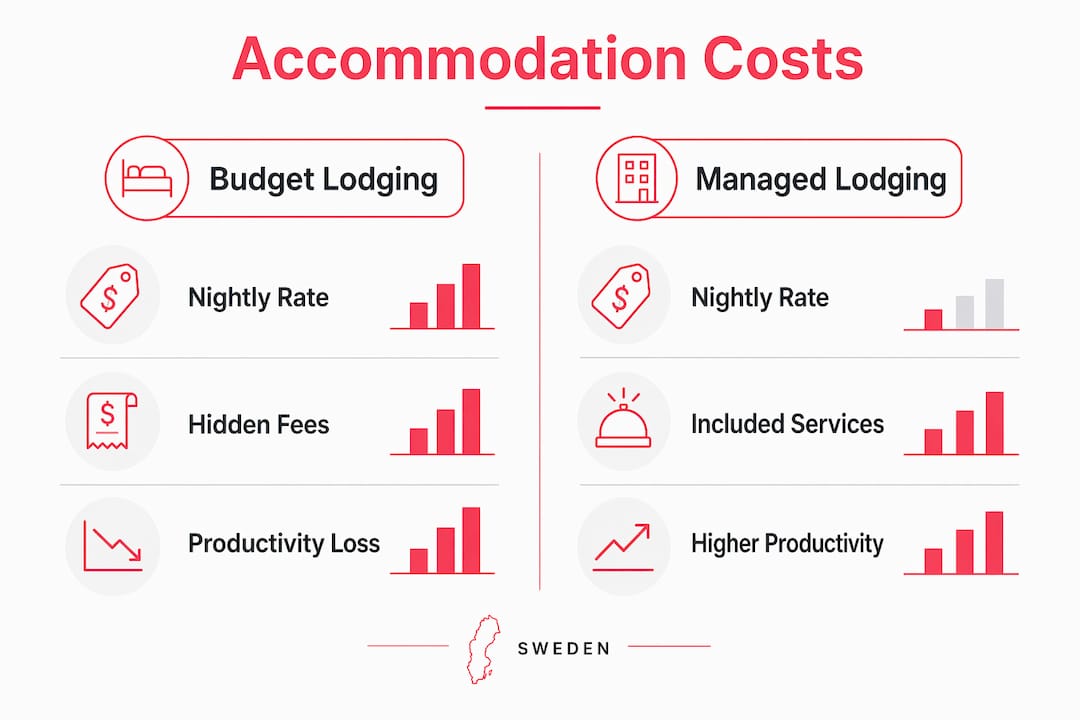
Hidden fees in hostels and budget hotels are well documented. Locker rental, towel hire, paid Wi-Fi, and early check-in charges can double the effective nightly cost compared to the advertised rate. For a team of six staying ten nights, these additions can represent thousands of additional SEK that were never in the travel budget.
The productivity loss column is where the largest numbers sit. If a single employee loses two productive hours per day due to poor sleep and a long commute, and their fully loaded daily cost to the company is 3,000 SEK, the weekly productivity loss per person is 30,000 SEK. No budget accommodation saving approaches that figure. This is why corporate serviced accommodation is correctly understood as a productivity investment rather than a cost line.
How to assess accommodation value beyond the nightly rate
HR professionals and travel managers who want to reduce the unseen expenses of cheap lodging need a structured evaluation framework. Price is one input, not the decision criterion.
- Location relative to the project site. Calculate the daily commute cost and time for each team member. A property 15 minutes from the site beats a cheaper property 45 minutes away when transport and lost time are included.
- Sleep environment quality. Confirm private rooms, noise insulation, blackout facilities, and temperature control. These directly affect the productivity metrics discussed above.
- Included amenities. A fully equipped kitchen reduces subsistence costs. Reliable high-speed Wi-Fi removes the need for mobile data top-ups. Laundry facilities reduce the need for dry-cleaning expenses.
- VAT-compliant invoicing. Confirm that the provider issues invoices that meet Skatteverket’s requirements before booking, not on checkout.
- Alignment with per-diem rules. Verify distance from home and workplace, and confirm that any included meals are accounted for in the allowance calculation.
- Operator accountability. A professionally managed property has a single point of contact for issues. A consumer rental platform does not. The difference in HR workload over a three-week project stay is considerable.
The why cheaper stays cost more analysis from Guestlyhomes provides a Sweden-specific breakdown of how these factors compound across extended project deployments.
Key takeaways
The hidden cost of cheap accommodation is always higher than the nightly rate suggests, because productivity loss, tax exposure, and operational friction are costs that never appear on the original invoice.
| Punkt | Detaljer |
|---|---|
| Sleep quality drives output | REM sleep disruption from poor lodging directly reduces measurable next-day work performance. |
| Hidden fees compound quickly | Budget accommodation extras such as Wi-Fi and towel hire can double the effective nightly cost. |
| Tax compliance is non-negotiable | Swedish per-diem rules require documented overnight stays over 50 km from home to qualify as tax-free. |
| VAT liability requires diligence | Hotel-like services in longer stays may trigger VAT charges that budget providers cannot invoice correctly. |
| Total cost of occupancy is the right metric | Nightly rate plus transport, productivity loss, and HR time gives the accurate cost comparison. |
Why I stopped looking at nightly rates first
I have reviewed enough corporate travel budgets to know that the nightly rate is almost always the wrong starting point. The conversations that produce the best outcomes begin with a different question: what does this stay need to deliver?
When a project team is deployed in Malmö for four weeks, the accommodation is not a peripheral expense. It is the environment in which those people will recover, prepare, and perform. The research on sleep and productivity is unambiguous on this point. A team that sleeps well, commutes briefly, and works in a calm, well-equipped space will outperform a team that does not. The cost difference between those two outcomes dwarfs any saving on the nightly rate.
The compliance dimension is equally underestimated. I have seen companies absorb unexpected tax liabilities because a well-intentioned HR coordinator booked through a consumer platform that could not produce a VAT-compliant invoice. The saving on the booking was real. The tax exposure that followed was larger.
My advice to HR professionals and travel managers is straightforward: build your accommodation evaluation around total cost of occupancy, not advertised price. Factor in transport, productivity, compliance, and operator reliability. When you do, professionally managed accommodation almost always wins the comparison. The nightly rate is higher. Everything else is lower.
— Joakim
Corporate stays in Sweden without the hidden costs
Guestlyhomes operates fully managed villas and serviced properties across Sweden, designed specifically for project teams, executives, and extended corporate stays. Every property includes VAT-compliant invoicing, verified amenities, and a single point of contact for the duration of the stay. There are no hidden fees, no complaint cycles, and no compliance surprises.
For teams requiring space, privacy, and performance-grade living conditions, the 5BR business villa and the 4BR grand villa offer the kind of environment where people can actually do their best work. One booking. Full accountability. No follow-up required.
FAQ
What is the hidden cost of cheap accommodation for business travel?
The hidden cost of cheap accommodation refers to expenses beyond the nightly rate, including productivity loss from poor sleep, transport costs, hidden fees, and tax compliance risks. For corporate stays in Sweden, these costs routinely exceed the initial saving.
How does poor accommodation affect employee productivity?
Poor sleep from noisy or low-quality lodging directly reduces next-day work performance. A 2026 study found a significant positive correlation between REM sleep duration and measurable task output, meaning accommodation quality has a direct effect on deliverable quality.
What are Sweden’s tax rules for accommodation reimbursement?
Swedish per-diem rules require the accommodation to be more than 50 km from the employee’s home and workplace, with a documented overnight stay, for the reimbursement to qualify as tax-free. Employer-provided meals reduce the allowable daily allowance amount.
Can budget accommodation trigger VAT liability in Sweden?
Yes. The Swedish Supreme Administrative Court has clarified that accommodation with hotel-like ancillary services may trigger VAT liability regardless of stay duration. Budget providers often cannot issue VAT-compliant invoices, leaving the corporate buyer exposed.
How should HR professionals compare accommodation costs accurately?
Use total cost of occupancy as the evaluation metric. Add the nightly rate to transport costs, productivity impact, HR management time, and compliance risk. Professionally managed accommodation consistently produces a lower total figure than budget alternatives, even when the nightly rate is higher.