


Every property owner in Sweden faces the challenge of measuring what truly counts as a good return. Understanding gross yield versus net yield helps you cut through the confusion and focus on what you actually keep, not just what looks promising on paper. This guide shows why stability, real costs, and your specific market in Piteå, Luleå, Boden, or Nyköping matter far more than any headline figure when securing reliable income for the long term.
Innholdsfortegnelse
- Defining Good Rental Property Returns
- Gross Yield Versus Net Yield Explained
- Breaking Down The Real Costs
- The Real Income You Keep
- Factors Influencing Long-Term Rental Income
- Direct Income Drivers
- External Market Factors
- Stability, Vacancy, And Cost Control
- Practical Cost Control Strategies
- Evaluating Returns Using Real Data
- Creating Your Return Evaluation Framework
- Scenario Planning
De viktigste erfaringene
| Punkt | Detaljer |
|---|---|
| Understand Gross vs. Net Yield | Focus on net yield, which accounts for all operating costs, as it reflects true profitability. Gross yield can be misleading and does not give a complete picture of financial success. |
| Control Costs Effectively | Regularly track and manage all property-related expenses to prevent profit erosion. Implementing preventative maintenance and utilising professional management can significantly enhance profitability. |
| Evaluate Stability Over Volatility | A property that generates consistent income with lower vacancy rates provides greater long-term security than one with fluctuating returns but high potential returns. Stability should be prioritised in rental strategies. |
| Use Local Data for Assessments | Gather and analyse specific historical performance data of your property to evaluate its true potential. Comparing against generic benchmarks often leads to misaligned expectations and investment risks. |
Defining Good Rental Property Returns
The term “good return” means different things depending on where your property sits, how you operate it, and what you’re comparing it against. A property in Luleå won’t perform the same way as one in Nyköping, and a villa managed hands-off operates under completely different economics than a flat requiring active oversight. Rather than chasing a generic percentage, understanding good returns means recognising the specific factors that drive income and stability in your actual market.
When property professionals assess rental performance, they typically examine two distinct measurements. Gross yield represents your total rental income divided by property value, expressed as a percentage. Net yield accounts for all operating costs: maintenance, insurance, vacancy periods, management fees, property tax, and wear and tear. This distinction matters profoundly. A property showing 8% gross yield might deliver only 3-4% net yield once real expenses surface. European property market analysis demonstrates that net rental yields vary considerably across regions, influenced by inflation, interest rates, and operational costs, which is why net return stability should concern you far more than gross figures.
What separates sustainable returns from temporary spikes is consistency. A property generating predictable income across months, seasons, and market cycles outperforms one with volatile occupancy or unpredictable guest behaviour. Consider these factors that genuinely move the needle:
- Vacancy rates: Even 5% vacancy difference dramatically alters annual income. A property sitting empty for 3 weeks per year versus 6 weeks costs you thousands in lost revenue.
- Guest quality and stay length: Longer bookings mean lower turnover costs, reduced cleaning cycles, and less wear on furnishings. A single 30-night booking is far more profitable than three 10-night bookings.
- Controllable costs: Properties with efficient utility usage, durable finishes, and reduced maintenance demands preserve more of your income. Premium properties attract guests willing to treat spaces carefully, lowering damage frequency.
- Management overhead: A fully managed property eliminates your time investment but carries management costs. A fixed-rent arbitrage model removes income volatility entirely but caps your upside.
For property owners in Swedish markets like Luleå, Piteå, Boden, and Nyköping, the real measure of good returns is whether your net income covers your mortgage (if applicable), property costs, unexpected repairs, and provides genuine profit margin. That margin matters because it buffers you against market shifts, rising rates, or guest cancellations. A property netting 25,000 SEK monthly with 5,000 SEK in actual profit is fragile. One netting 18,000 SEK monthly with 12,000 SEK profit is sustainable.
Pro tip: Stop comparing your returns to generic industry percentages. Instead, calculate your actual net income by subtracting every real cost from your rental revenue, then ask: does this monthly figure meet my financial goals and cover my risk? If not, it’s not a good return, regardless of what benchmark tables suggest.
Gross Yield Versus Net Yield Explained
You’ll encounter these two terms constantly in property discussions, and they tell completely different stories. Gross yield is the simpler figure: your annual rental income divided by the property’s purchase price or current market value. It sounds straightforward until you realise it ignores reality. A property costing 2 million SEK that generates 200,000 SEK in annual rent shows a 10% gross yield. Sounds excellent. But that figure tells you nothing about what you actually keep.
Net yield is where truth lives. It subtracts every cost you’ll face: property management fees, maintenance and repairs, insurance, local property taxes, utilities you cover, vacancy allowances, and the slow erosion of your asset through wear and tear. Net yield calculation methodologies across European markets reveal how dramatically this figure shrinks once real expenses are factored in. That same property showing 10% gross yield might deliver only 3-4% net yield once you subtract actual operating costs. The difference between these two figures isn’t academic—it’s the difference between a property that looks good on paper and one that actually funds your life.
To better understand the difference, compare the business impacts of gross yield and net yield:
| Measurement | What It Shows | Business Impact | Common Pitfalls |
|---|---|---|---|
| Brutto avkastning | Top-line revenue performance | Useful for initial screening | Ignores all real expenses |
| Netto avkastning | Actual retained profit after costs | The true measure of investment success | Can be underestimated without full data |
Breaking Down the Real Costs
Here’s what actually eats into your rental income:
- Management and administrative costs: Whether you hire a professional manager like Guestly Homes or handle bookings yourself, this carries a real price. Professional management typically runs 15-25% of gross income.
- Maintenance and repairs: Paint fades. Appliances fail. Flooring wears. Budget 1-2% of property value annually for predictable maintenance, plus reserves for unexpected issues.
- Insurance and taxes: Property insurance, liability coverage, and local taxes are non-negotiable. In Swedish markets, these typically consume 3-5% of gross income.
- Vacancy periods: No property rents 365 days per year. Even well-positioned properties in Luleå or Nyköping experience 10-15% vacancy. This cost compounds across the year.
- Utilities and services: If you cover heating, water, or internet during guest stays, these add up quickly in Nordic climates.
The Real Income You Keep
Let’s use concrete numbers for a Swedish property owner. Suppose you own a villa in Piteå generating 30,000 SEK monthly in gross rental income (360,000 SEK annually):
- Subtract 20% for vacancy and turnover (72,000 SEK)
- Subtract 18% for professional management (64,800 SEK)
- Subtract 5% for maintenance reserves (18,000 SEK)
- Subtract 4% for insurance and taxes (14,400 SEK)
- Net annual income: 190,800 SEK (about 15,900 SEK monthly)
Your gross yield at purchase might have looked like 8%. Your actual net yield is roughly 3.2%. This isn’t failure—it’s reality. And understanding this distinction prevents you from overestimating returns or making poor investment decisions based on gross figures alone.
Pro tip: When evaluating a rental property, ignore any discussion of gross yield entirely. Build a detailed spreadsheet of every cost you’ll actually incur, subtract that from your gross rental income, then calculate your true net return. This figure alone should determine whether the investment makes sense for your financial goals.
Factors Influencing Long-Term Rental Income
Your rental income doesn’t exist in isolation. It’s shaped by forces both within your control and entirely outside it. Understanding these factors helps you recognise why one property in Luleå generates solid returns whilst another struggles, and why your income might shift across seasons or years. Some factors you can influence directly. Others you must anticipate and plan around.
Market dynamics form the foundation. Housing supply constraints in your region affect demand and pricing power. If Nyköping is experiencing new apartment construction, competition may pressure your rates downward. Conversely, limited inventory in Boden creates scarcity that supports higher rents. Rent inflation trends across European markets reveal that demographic shifts, urban migration patterns, and regulatory interventions substantially impact long-term rental income stability. Wage growth in your area matters too. If local salaries stagnate whilst property costs rise, demand for extended-stay rentals weakens because fewer professionals can afford premium accommodation.
Your property’s characteristics directly influence income potential. Location quality shapes guest willingness to pay. A villa 2 kilometres from central Piteå commands different rates than one on the periphery. Property condition and amenities matter profoundly. Premium finishes, reliable heating systems, strong internet connectivity, and thoughtful design attract corporate guests and project teams who value stability. These guests stay longer, treat properties respectfully, and accept higher rates because they’re prioritising performance over budget. Operational efficiency determines how much income converts to actual profit. Properties with lower turnover costs, reduced maintenance demands, and predictable booking patterns generate better net yields. This is where long-term rental models outperform short-term alternatives—extended stays reduce cleaning cycles, guest turnover friction, and wear on furnishings.
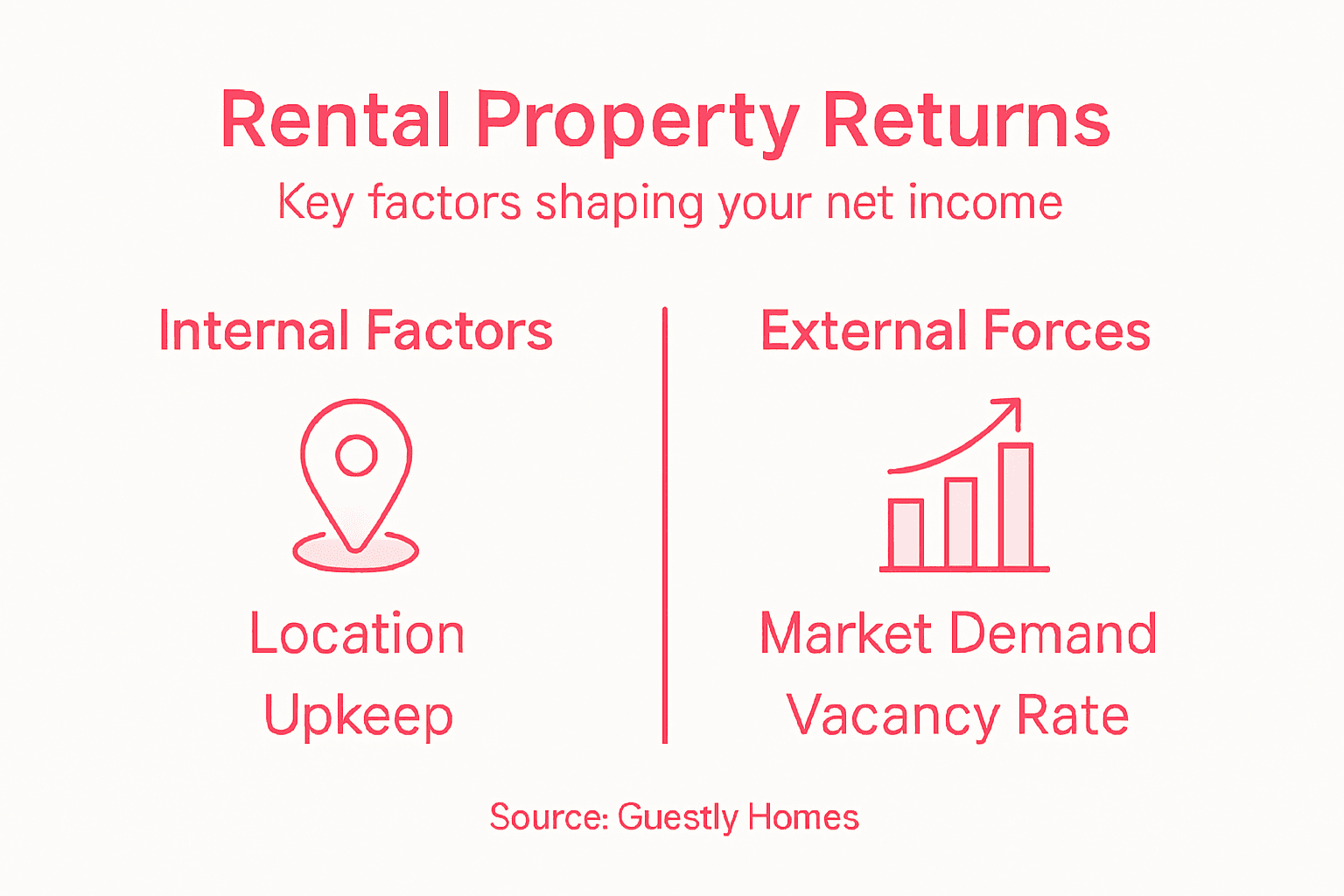
Direct Income Drivers
These factors are within your influence:
- Guest selection and booking quality: Longer stays from vetted professionals beat shorter bookings from transient guests. A single 90-night booking eliminates 9 separate turnover processes.
- Pricing strategy: Understanding your market allows you to optimise rates without losing occupancy. Too aggressive pricing attracts few bookings; too conservative leaves money on the table.
- Property presentation: Professional photography, clear descriptions, and honest communication reduce cancellations and guest dissatisfaction.
- Management model choice: An arbitrage agreement with Guestly Homes removes income volatility. A revenue-share model allows upside but introduces occupancy risk.
External Market Factors
These require monitoring and adaptation:
- Economic conditions: Interest rate changes, wage inflation, and employment trends shape demand for premium extended-stay accommodation.
- Regulatory environment: Swedish rental regulations, tax policies, and tenant protections evolve. Stay informed about changes affecting your market.
- Seasonal variation: Nordic properties experience pronounced seasonal patterns. Winter vacancy differs sharply from summer demand.
- Competition: New properties entering your market shift pricing power. Monitor competitor offerings and adjust accordingly.
Pro tip: Track your rental income monthly alongside local employment data, competitor pricing, and seasonal patterns in your region. Over 12-24 months, you’ll see the genuine drivers of your returns and can predict income more accurately than relying on industry averages.
Stability, Vacancy, and Cost Control
These three elements form the bedrock of sustainable rental returns. A property showing impressive gross yields but experiencing 30% vacancy, volatile guest quality, and mounting unexpected repairs will drain you far faster than a stable property with modest income. Good returns aren’t about peak performance in one month. They’re about predictable, consistent income across months and years. This is where most property owners misjudge what matters.

Stability means your rental income behaves predictably. No surprises. No sudden drops. Properties with professional management, longer guest stays, and vetted booking processes deliver this. When you partner with an operator like Guestly Homes using an arbitrage model, you receive fixed monthly rent regardless of occupancy. That’s maximum stability, though it caps your upside. Conversely, a revenue-share model ties your income directly to guest bookings, creating income volatility but allowing you to benefit from strong seasons. Your choice depends on whether you prioritise certainty or opportunity.
Vacancy is your silent profit killer. Even 2 weeks of unbooked property per year compounds to 4% lost income. A month of vacancy costs you 8.3% annually. Properties in Luleå or Piteå with strong corporate demand might experience only 5-10% vacancy. Properties in less competitive markets can drift toward 20-30%, especially seasonally. Rent control policies and regulatory frameworks across European markets influence vacancy duration and landlord incentives for cost management, affecting overall income stability. You control vacancy through strategic pricing, professional marketing, guest screening, and operational quality. A property that consistently attracts bookings and sees guests complete their stays without cancellation becomes a cash-generating asset. One plagued by turnover and cancellations becomes an expense.
Cost control determines what you actually keep. Two properties generating identical gross income can produce vastly different net returns depending on operational efficiency. A property requiring frequent repairs, attracting guests who damage furnishings, suffering from utility waste, or demanding intensive management consumes profits rapidly. Conversely, a well-maintained property with durable finishes, efficient systems, and professional oversight preserves income.
Here is a summary of best practices for sustainable property returns:
| Strategy Area | Viktige tiltak | Hvorfor det er viktig |
|---|---|---|
| Stabil inntekt | Focus on consistent bookings | Reduces financial stress and risk |
| Vacancy Management | Minimise empty periods with robust marketing | Preserves revenue, maximises profit |
| Cost Control | Track and analyse all expenses regularly | Prevents hidden profit erosion |
Practical Cost Control Strategies
Focus on these levers:
- Preventative maintenance: Small repairs now prevent expensive problems later. Regular inspections, prompt fixes, and quality materials save money over years.
- Guest quality: Premium guests with longer stays and professional backgrounds treat properties carefully. They reduce damage claims, extend asset life, and lower turnover costs.
- Operational efficiency: Professional management handles bookings, cleaning, and guest communication consistently. This reduces chaos and unexpected expenses.
- Smart pricing: Finding the right rate balances occupancy and income. Too low leaves money on the table; too high creates vacancy.
The properties delivering the strongest net returns combine moderate income with exceptional stability and tight cost control. A villa in Nyköping generating 20,000 SEK monthly with 95% occupancy, zero damage claims, and predictable 2,000 SEK monthly maintenance costs outperforms one generating 28,000 SEK monthly but experiencing 70% occupancy, frequent repairs, and guest turnover chaos. The first delivers reliable profit. The second delivers headaches.
Pro tip: Build a 12-month cost history for your property. Track every expense: maintenance, repairs, utilities, management fees, vacancy periods, and guest cancellations. This data reveals whether your returns are genuinely sustainable or whether hidden costs are eroding your profit. Compare this cost structure against potential rental income in your market, and you’ll know immediately whether the investment makes sense.
Evaluating Returns Using Real Data
Generic benchmarks are useless for your specific situation. A “good” 5% net yield means nothing if your property can realistically achieve 7%. Equally, chasing a 6% target when your market supports only 3% sets you up for disappointment. The only meaningful evaluation uses data from your actual property, in your actual market, accounting for your actual costs. This requires discipline. It requires honesty. It works.
Start by gathering historical data. If your property has been rented before, collect 12-24 months of rental income records, vacancy periods, guest turnover, maintenance costs, and utility expenses. If it’s new to rental, research comparable properties in your area and interview owners who manage similar properties. You’re building a realistic picture of what your property can actually generate. Yield trends and rental income growth across European markets show considerable variation based on regional factors, inflation impacts, and interest rate environments, which is precisely why local data matters far more than continental averages. A property in Luleå operates under different economic conditions than one in Stockholm. Your research must be local.
Build a spreadsheet capturing monthly figures across a full year. Include gross rental income, vacancy days, cleaning and turnover costs, maintenance and repairs, insurance, property tax, utilities if you cover them, and management fees. Calculate your total annual costs. Subtract from gross income. The remainder is your net income. Divide by your property value or purchase price to determine your actual net yield. This number, derived from your own data, is what matters.
Creating Your Return Evaluation Framework
Structure your analysis around three key questions:
-
Does this net income meet my financial goals? Be specific. If you need 15,000 SEK monthly to cover your mortgage and living costs, a property netting 12,000 SEK won’t work, regardless of its percentage yield. If you’re reinvesting returns into additional properties, even 8,000 SEK monthly might be excellent.
-
Is this income stable enough for my risk tolerance? Some owners sleep soundly with volatile revenue-share income during strong seasons. Others need the certainty of fixed arbitrage payments. Your psychological comfort matters more than theoretical optimisation.
-
How does this compare to alternative uses of capital? If you could invest the same money in bonds earning 4% with zero effort, is a 3.2% rental yield worth the property management burden? Or does your local market’s rental growth trajectory justify the difference?
Scenario Planning
Avoid single-point forecasts. Instead, model three scenarios:
- Conservative: Assume 15% vacancy, 10% higher maintenance costs than historical average, and no rental growth. What is your net income in this scenario?
- Realistic: Use your actual historical data as the baseline. This is your most likely outcome.
- Optimistic: Assume 5% vacancy, predictable maintenance, and 3% annual rental growth. What is your potential upside?
Good returns aren’t about hitting the optimistic case. They’re about the conservative case still meeting your needs. If your property requires perfect occupancy and zero unexpected repairs to cover your mortgage, it’s a risky investment. If even the conservative scenario generates comfortable profit, you’ve found genuine value.
Pro tip: Use Guestly Homes’ revenue estimation tool at app.guestlyhomes.se to see what your specific property could realistically generate in your market. Compare this estimated income against your actual costs, then you’ll have a data-driven baseline for evaluating whether the investment makes sense for your situation.
Unlock Real Rental Income With Guestly Homes
Understanding the true difference between gross yield and net yield is crucial for property owners striving to achieve sustainable, predictable rental returns. This article highlights how controlling vacancy, managing costs, and focusing on stable income streams can transform your rental property from a risky investment into a steady source of profit. If you are tired of unpredictable income swings or confusing benchmarks that do not reflect your actual performance, it is time to consider a hands-off, expert approach.

Discover how Guestly Homes specialises in fully managed premium homes tailored for extended stays. Our bespoke Revenue Share or Arbitrage Models ensure you receive clear, dependable income while we take care of guest quality, maintenance, and operational efficiency. Visit Guestly Homes to learn how we help property owners across Sweden achieve real, net positive returns with minimum involvement. Explore our approach to property management and start turning your property into a consistent, high-margin asset today.
Ofte stilte spørsmål
What is the difference between gross yield and net yield in rental property income?
Gross yield is the total rental income divided by the property’s value, expressed as a percentage, while net yield accounts for all operating expenses such as maintenance, management fees, and taxes, providing a more accurate representation of actual income retained.
How do I calculate the net return on my rental property?
To calculate the net return, subtract all real costs from your total rental revenue and divide the remaining amount by the property’s value. This will give you a percentage that reflects your actual income after expenses.
What factors influence the return on rental property income?
Factors include vacancy rates, guest quality and stay length, controllable costs, management overhead, and the property’s location and condition. These elements significantly affect stability and profitability.
How can I improve my rental property’s net yield?
You can improve net yield by reducing vacancy rates through effective marketing, ensuring high-quality guest experiences to encourage longer stays, managing operational costs efficiently, and maintaining your property to prevent extensive repairs.
Anbefales
- 7 typer inntektsmodeller som eiendomseiere bør kjenne til - Guestly Homes
- What is Property Yield? Understanding Its Importance – Guestly Homes
- What is Revenue Share Model? Understanding Its Importance – Guestly Homes
- Rental Yield: Maximising Returns for Swedish Landlords – Guestly Homes
- Investors Are Turning to the Build-to-Rent Model for Investing 2026