

TL;DR:
- Corporate and mid-term guests offer stable income and better property care in northern Sweden.
- Tourist rentals generate high nightly rates but involve high operational demands and income volatility.
- Choosing the right guest type depends on location, property, risk appetite, and management capability.
Choosing the right guest type for your Swedish rental property is one of the most consequential decisions you will make as an owner. Many landlords assume that local tenants are the safest bet, yet national vacancy rates sit as low as 1.3% for long-term lets while seasonal gaps for tourist rentals can exceed 30%. That gap tells a story. In cities like Piteå, Luleå, Boden, and Nyköping, the rental landscape is shifting fast, driven by infrastructure projects, growing corporate travel, and evolving tourism patterns. This guide compares tourists, local tenants, and corporate guests across income stability, day-to-day management, and long-term property care so you can make a genuinely informed choice.
Indice dei contenuti
- Understanding your guest options: Tourists, locals, and corporate guests
- Pros and cons of renting to tourists
- Renting to locals: Stability, predictability, and legal nuances
- Corporate/mid-term guests: The rising star in Piteå, Luleå, Boden and Nyköping
- Making the right choice for your property and location
- Our take: Why most owners misunderstand the rental guest equation
- Power your rental strategy with Guestly Homes
- Frequently asked questions
Punti di forza
| Punto | Dettagli |
|---|---|
| Local tenants offer stability | Vacancy rates are exceptionally low but returns and flexibility are limited under Swedish law. |
| Corporate lets excel in the north | The project-driven demand in cities like Luleå and Boden drives reliable, higher rental income. |
| Tourist lets are volatile | Income is seasonal and management-heavy, risking long periods of low occupancy between peaks. |
| Blending strategies works | Many owners maximise returns by flexibly switching between corporate and tourist guests based on season and demand. |
Understanding your guest options: Tourists, locals, and corporate guests
With an overview established, it is vital to understand exactly what each guest category involves before weighing up the numbers.
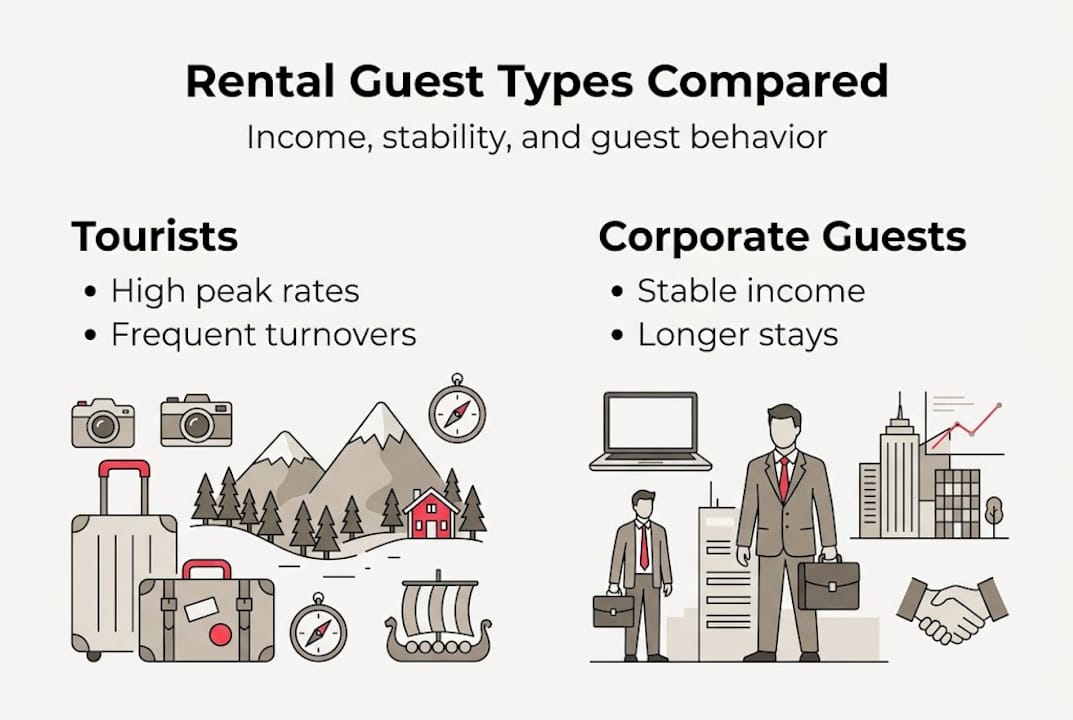
Short-term tourist lets typically run from one night to a few weeks. Guests book through platforms like Airbnb or Booking.com, and the arrangement is transactional by nature. Income per night can be high, but the volume of turnovers is significant, and the unpredictability of demand is real.
Long-term local tenants sign formal lease agreements, usually for 12 months or more. They are governed by Hyreslagen, Sweden’s tenancy law, which provides strong protections for renters. National gross yields for this model sit between 3.3% and 5.46%, with net yields closer to 2–4%. Stability is the headline benefit, but flexibility is not.
Corporate and mid-term guests occupy a compelling middle ground. These are professionals, project teams, or executives staying for one to twelve months, often arranged through company contracts. You can read more about this model in our medium-term rental guide. The city context matters enormously here.
| Guest type | Typical stay length | Income reliability | Management intensity | Best suited to |
|---|---|---|---|---|
| Tourist | 1–14 nights | Variabile | Alto | Seasonal hotspots |
| Local tenant | 12+ months | Stabile | Basso | Passive investors |
| Corporate/mid-term | 1-12 mesi | Very reliable | Medio | Project cities |
Key differences at a glance:
- Luleå and Boden see strong corporate demand linked to energy and infrastructure projects
- Piteå attracts a blend of seasonal tourists and project-based workers
- Nyköping has moderate activity across all three segments, with growing corporate interest
Pros and cons of renting to tourists
Now, let us examine the case for tourist rentals and where they shine and where they struggle.
Tourist lets can generate impressive nightly rates during peak periods, and that headline figure often attracts owners initially. The reality is more nuanced. Seasonality gaps exceeding 30% occupancy loss are common, meaning that a strong July can be offset by a very quiet November. For owners in northern Sweden, this volatility is particularly pronounced.
Take Boden as an example. Boden Airbnb annual income averages $17,642, with an occupancy rate of 35% and an average daily rate of $191, with the strongest demand concentrated in winter. That 35% occupancy figure is telling. Your property sits empty nearly two thirds of the year.
Beyond the numbers, tourist lets carry operational weight that many owners underestimate:
- Frequent cleaning and linen changes between every stay
- Check-in and check-out coordination, often at inconvenient hours
- Higher exposure to property misuse, noise complaints, smoking, and accidental damage
- Constant guest communication and review management
- Greater wear and tear on furnishings and fittings
Pro Tip: If you pursue tourist lets, build a robust damage deposit process and photograph the property thoroughly before every stay. This protects you legally and sets clear expectations with guests from the outset.
For owners considering the full picture of short-term rental risks, the management burden is often the deciding factor. Tourist lets reward active, hands-on landlords. For those seeking a quieter income stream, the model can quickly become exhausting.
Renting to locals: Stability, predictability, and legal nuances
Contrasting the bustle of tourist lets, renting to locals offers a much steadier approach.
The appeal is straightforward. A long-term local tenant pays every month, rarely moves, and requires minimal day-to-day involvement from you. National vacancy sits at 1.3%, and net returns range from 1.7% to 4.5%, governed by the robust protections of Hyreslagen. For a genuinely passive investor, this model has real merit.
“The local tenant model is not about maximising returns. It is about minimising friction. For the right owner, that trade-off is entirely rational.”
However, the legal environment demands careful attention. Here are the key considerations in order of importance:
- Eviction is difficult. Swedish tenancy law strongly favours the tenant. Removing a non-paying or problematic tenant can take months and requires formal legal proceedings.
- Rent increases are capped. You cannot simply raise the rent to market rate. Increases are tied to index-linked negotiations, often through the tenant’s union.
- Lease terms are regulated. Fixed-term contracts have strict conditions, and converting a property back to owner use is not straightforward.
- Maintenance obligations are yours. Landlords carry significant responsibility for property upkeep under Swedish law.
Pro Tip: Before signing a long-term lease, consult a Swedish property lawyer or engage a professional property management service in Sweden to ensure your contract reflects current regulations and protects your interests.
For owners in Nyköping or Piteå who prioritise simplicity and low involvement, local tenants remain a sound choice. The key is entering the arrangement with clear expectations about the legal framework.
Corporate/mid-term guests: The rising star in Piteå, Luleå, Boden and Nyköping
For those seeking a blend of stability and solid income, the corporate and mid-term segment is shifting the market, particularly in the north.
The economics are compelling. Corporate guests in Norrbotten pay between SEK 8,000 and 12,000 per month for a one-bedroom property, and demand is rising directly in line with major regional projects in energy, mining, and infrastructure. Companies booking accommodation for their teams also benefit from 25–35% savings compared to hotel alternatives, which makes the arrangement attractive on both sides.
| Città | Corporate demand driver | Typical monthly rate (1-bed) | Occupancy outlook |
|---|---|---|---|
| Luleå | Energy and tech projects | SEK 9,000–12,000 | High year-round |
| Boden | Defence and infrastructure | SEK 8,000–10,000 | Strong and growing |
| Piteå | Industrial and project work | SEK 8,000–9,500 | Moderate to high |
| Nyköping | Logistics and mixed industry | SEK 8,500–11,000 | Moderato |
Corporate guests bring a different behavioural profile compared to tourists. They are work-focused, routine-driven, and far less likely to cause disturbances. Property care tends to be better over time, and payment reliability is high because it is typically the employer, not the individual, settling the invoice.
The serviced apartment demand for this segment is growing, and owners who invest in quality furnishings, fast broadband, and professional presentation consistently attract longer bookings. Explore the full range of corporate housing options to understand what the market expects. The setup cost is higher than a bare local let, but the return justifies it in most northern cities.
Making the right choice for your property and location
The final step is bringing all the evidence together to guide your next move.
No single guest type is universally superior. The right model depends on your property, your city, and your appetite for involvement. Here is a practical framework to help you decide:
- Assess your location. Is your city driven by project work (Luleå, Boden) or mixed demand (Nyköping, Piteå)? Corporate demand is strongest where large employers are active.
- Evaluate your property. A furnished, well-equipped apartment suits corporate and tourist lets. An unfurnished property is better positioned for local tenants.
- Define your risk tolerance. Tourist lets carry income volatility. Local lets carry legal inflexibility. Corporate lets balance both reasonably well.
- Consider your time. Tourist lets demand active management. Corporate and local lets are more hands-off once established.
- Think seasonally. You can blend strategies. Many owners use corporate bookings as the backbone and open to tourists during peak seasons.
| Città | Best primary guest type | Best secondary option |
|---|---|---|
| Luleå | Corporate/mid-term | Local tenant |
| Boden | Corporate/mid-term | Tourist (winter) |
| Piteå | Corporate/mid-term | Tourist (summer) |
| Nyköping | Corporate/mid-term | Local tenant |
For all four cities, prioritising corporate and mid-term lets for stability and income, with tourist lets as a seasonal supplement, represents the strongest overall strategy. If you are also considering how moving business tenants interact with your property planning, it is worth understanding the logistical side of corporate relocations. Explore the ultimate guide to corporate housing in Sweden for a deeper look at what this segment requires.
Our take: Why most owners misunderstand the rental guest equation
Stepping back from the details, here is the insight few guides offer.
Most owners default to local tenants because stability feels safe. And it is, up to a point. But the net yield reality, often 1.7–4.5%, combined with the legal constraints of Hyreslagen, means that passive comfort can come at a significant financial cost over time. The model rewards patience but punishes ambition.
Corporate guests demand more preparation up front. You need a well-furnished property, reliable services, and a professional presentation. But once that foundation is in place, the economics shift decisively in your favour. Fewer turnovers, better property care, reliable payments, and higher monthly rates create a compounding advantage that the local tenant model simply cannot match in cities like Luleå and Boden.
The owners who consistently outperform are not the ones who pick one model and defend it. They are the ones who treat guest strategy as a living decision, adapting to city demand cycles, regulatory shifts, and their own capacity. Explore corporate lodging alternatives to understand the full range of options available before committing to a single path. Regulation, in this context, is not a barrier. It is a filter that rewards prepared, professional landlords.
Power your rental strategy with Guestly Homes
If you are ready to act on these insights, consider how Guestly Homes can streamline your next steps.
Guestly Homes operates as a fully managed, 5-star operator across Sweden, supporting property owners in Piteå, Luleå, Boden, Nyköping, and beyond. Whether your property is suited to reliable serviced apartments for corporate guests or a premium business villa for corporate lets, we handle every detail from guest sourcing to property care. Our revenue share and arbitrage models give you flexibility without the operational burden. If you are ready to explore what your property could earn with the right guest strategy in place, submit your rental requirements and our team will be in touch.
Frequently asked questions
What type of rental guest offers the highest income in northern Sweden?
Corporate guests in Norrbotten pay SEK 8,000–12,000 per month and demand is rising, making them the highest-yield stable option in cities like Luleå and Boden where project-driven demand is strongest.
Are there restrictions on short-term lets for tourists in these Swedish cities?
In Piteå, Luleå, Boden, and Nyköping, short-term rental regulation is relatively light, but northern city rules around seasonal and building-specific restrictions should always be verified before listing.
What is the main risk with long-term local tenants?
Swedish tenancy law creates a situation where vacancy is low at 1.3% but eviction is legally complex and rent increases are capped, limiting your ability to respond quickly if problems arise.
Can I switch between guest types seasonally?
Yes, and many owners do. Blending corporate and tourist lets across the year, using corporate bookings as the income backbone and opening to tourists during peak seasons, is a proven strategy for maximising annual returns.
Consigliato
- Corporate Housing vs Airbnb: Which Model Fits Your Property? – 4 Options 2026 – Guestly Homes
- Mantenete i dipendenti felici con un'ottima sistemazione aziendale | Guestly
- Compare short-term vs long-term rentals for stable income – Guestly Homes
- La guida definitiva all'affitto di case per affari (2025) - Guestly Homes